10 minutes free every day
Continue audio lessons in the app
Word explanations appear automatically in sync with the audio.
No login required · synced translations · playback with the screen locked
Choose your learning language and open this lesson in the app.

About This Lesson
Use Opening a stuck door to practice German conversation, pronunciation, vocabulary, grammar, and quizzes.
Dialogue
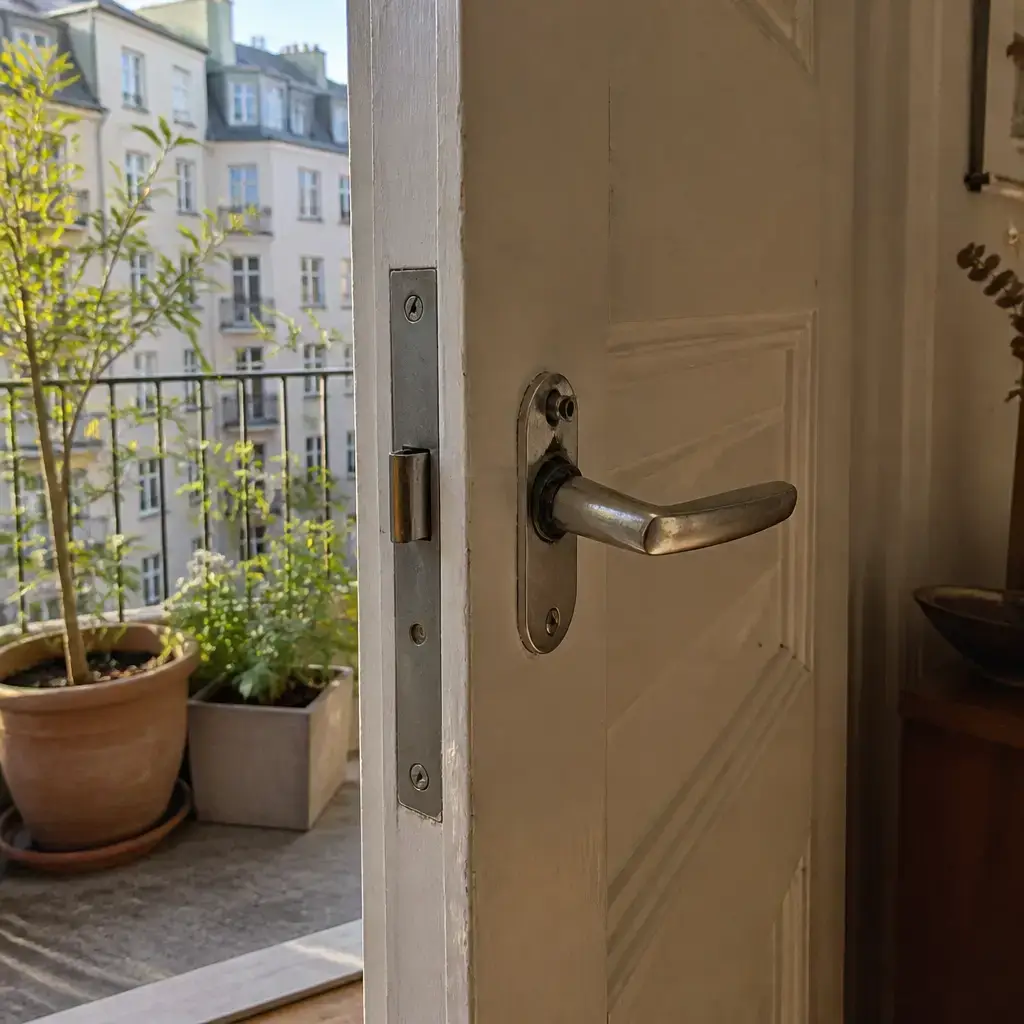
Die Tür klemmt.
dee TEWR KLEMPT. The door is stuck.Versuch, am Griff zu ziehen.
fer-ZOOKH, ahm GRIFF tsoo TSEE-en. Try pulling the handle.Ich habe daran gezogen, aber sie bleibt zu.
ikh HAH-buh dah-RAHN guh-TSOH-gen, AH-ber zee blypt TSOO. I pulled it, but it stays closed.Drück langsam am Rand.
DRUEK LAHNG-zahm ahm RAHNT. Push near the edge slowly.Sie ist ein wenig aufgegangen.
zee ist ine VAY-nikh OWF-guh-GAHNG-en. It opened a little.Der Griff fühlt sich locker an.
dair GRIFF fewlt zikh LOCK-er ahn. The handle feels loose.Sollen wir diese Tür nicht mehr benutzen?
ZOLL-en veer DEE-zuh TEWR nikht mair buh-NOOT-sen? Should we stop using this door?Wir können den Griff reparieren, bevor wieder jemand stecken bleibt.
veer KEURN-en dayn GRIFF reh-pah-REE-ren, beh-FOHR VEE-der YAY-mahnt SHTEK-en blypt. We can fix the handle before anyone gets stuck again.Sentence explanations
Die Tür klemmt.
The door is stuck.
- Tür
- door
- klemmt
- is stuck
More detail
Tür means “door” here. It is a feminine noun: die Tür in the singular and die Türen in the plural. The form die marks the feminine singular nominative here because Tür is the subject. Example: Die Türen sind offen. — “The doors are open.” klemmt comes from klemmen and is the present-tense form for a singular third-person subject. Here it describes a door that does not move freely because it is jammed or stuck. The same verb can describe another object that is jammed: Die Schublade klemmt. — “The drawer is stuck.” Together, Die Tür identifies the door as the subject, and klemmt says that it is stuck. Thus the complete utterance means “The door is stuck.”
Versuch, am Griff zu ziehen.
Try pulling the handle.
- Versuch
- try
- Griff
- handle
- ziehen
- pull
More detail
Versuch is the imperative of versuchen (“to try”) addressed to one person informally. The subject du is understood but not stated. Compare the forms versuchen (base form), du versuchst (present tense), and Versuch! (imperative). Here, the comma is followed by an infinitive phrase that says what to try. Griff means “handle” here. Its plural is Griffe. In am Griff, am is the contracted form of an dem; the phrase means “on the handle” or “at the handle.” The preposition is part of the reusable pattern an etwas ziehen (“pull on something”), with the object after an in the dative: an dem Griff becomes am Griff. ziehen means “pull” here. The infinitive is used after zu: zu ziehen means “to pull.” In the present tense, the useful forms include ich ziehe, du ziehst, and er/sie zieht; the vowel change is in the verb stem. Example: Zieh an der Tür. — “Pull on the door.” Together, Versuch, ... zu ziehen is a reusable way to say “Try to pull ...”. am Griff zu ziehen specifies pulling on the handle, so the whole utterance means “Try pulling the handle.”
Ich habe daran gezogen, aber sie bleibt zu.
I pulled it, but it stays closed.
- Ich habe
- I have
- daran
- at/on it
- gezogen
- pulled
- aber
- but
- sie
- it
- bleibt
- stays
- zu
- closed
More detail
Ich habe begins a German perfect-tense construction: habe is the first-person singular present form of haben, used here as the auxiliary, while the completed action is expressed by gezogen at the end. Compare Ich ziehe (“I pull”) with Ich habe gezogen (“I pulled” / “I have pulled”). daran is a pronominal adverb meaning “at/on it” in this context. It is formed with da- plus an and is useful when the thing being acted on is already understood. The reusable pattern is an etwas ziehen (“to pull on something”) or daran ziehen (“to pull on it”). Example: Ich ziehe daran. — “I am pulling on it.” gezogen is the past participle of ziehen: ziehen – zog – gezogen. Together with habe, it gives the completed-action meaning “pulled.” The participle itself does not identify the subject; Ich habe supplies the first-person singular subject here. Example: Ich habe an der Tür gezogen. — “I pulled on the door.” aber is a coordinating conjunction meaning “but.” It connects the pulling action with a contrasting result or state: the speaker pulled, but the object remains closed. sie is a third-person singular feminine nominative personal pronoun and is the subject of bleibt. The fixed translation renders it as “it”; the specific noun it refers to is not named in the supplied sentence. German pronoun form follows grammatical gender: a feminine antecedent uses sie, while masculine and neuter antecedents use er and es respectively. This grammatical gender does not by itself indicate biological sex. bleibt is the third-person singular present form of bleiben (“to remain” or “stay”): ich bleibe, du bleibst, sie bleibt. Here bleiben describes a state that does not change: Die Tür bleibt offen. — “The door remains open.” zu here describes the closed state, contrasting with offen (“open”). In sie bleibt zu, it functions as the state word after bleibt: “it stays closed.” This is different from zu before an infinitive, as in zu gehen (“to go”). Together, Ich habe daran gezogen means “I pulled on it,” and aber sie bleibt zu adds the contrast “but it stays closed.” The complete utterance therefore means: “I pulled it, but it stays closed.”
Drück langsam am Rand.
Push near the edge slowly.
- Drück
- push
- langsam
- slowly
- am Rand
- near the edge
- Rand
- edge
More detail
Drück is the singular informal imperative of drücken (“to push”): it tells one person to push. The subject du is normally omitted in this command. Compare drücken (to push), drück! (push!), and drückt! (push! to several people in the informal plural). The formal command is drücken Sie!. Example: Drück den Knopf. — “Press the button.” langsam describes how the action should be carried out: slowly. The same form can also be an adjective, as in ein langsamer Zug (“a slow train”), but here it modifies the verb and functions adverbially. Example: Bitte fahr langsam. — “Please drive slowly.” am Rand is the contraction of an dem Rand. In this sentence, an with the dative indicates location near or at the edge, rather than movement toward it. Example: Bleib am Rand. — “Stay near the edge.” Rand means “edge” or “rim” here. Its base form is the masculine noun der Rand; in the dative singular after an, it appears as dem Rand. The article is not part of Rand itself: der Rand is the basic form, while dem Rand is the dative form. Example: Das Glas steht am Rand. — “The glass is at the edge.” Together, Drück gives the command, langsam specifies its manner, and am Rand specifies the place. The complete meaning is: “Push near the edge slowly.”
Sie ist ein wenig aufgegangen.
It opened a little.
- Sie
- it
- ein wenig
- a little
- aufgegangen
- opened
More detail
Sie means “it” here according to the fixed translation. At the beginning of a German sentence, capitalization does not by itself distinguish sie from a sentence-initial capital letter. The supplied translation and the verb form establish the intended singular third-person reading here; ist is the third-person singular form of sein. The sentence does not identify the specific referent. ein wenig expresses a small degree: “a little.” It can limit the degree of a description, as in Das Fenster ist ein wenig offen. — “The window is a little open.” Here it limits the extent of the opening. aufgegangen is the past participle of the separable verb aufgehen (“to open,” in the relevant sense). A useful form chain is aufgehen → ging auf → ist aufgegangen. This verb forms the perfect with sein, so ist aufgegangen describes a completed change into an open state. In this sentence, the fixed translation supports the meaning “opened”; aufgehen can have other meanings in other contexts. Together, Sie ist aufgegangen says “It opened,” and ein wenig limits the extent: “It opened a little.”
Der Griff fühlt sich locker an.
The handle feels loose.
- Griff
- handle
- fühlt … sich … an
- feels
- locker
- loose
More detail
Griff means “handle” here. Its base form is der Griff, a masculine noun; the article and noun form belong together when you identify it: Der Griff = “the handle.” The plural is die Griffe. Example: Der Griff ist fest. — “The handle is firm.” fühlt sich an comes from the separable verb sich anfühlen, “to feel.” In this sentence, fühlt is the third-person singular present form, agreeing with Der Griff. The reflexive pronoun sich refers back to the subject, while the separable part an appears at the end of the clause. The pattern is etwas fühlt sich ... an — “something feels ...”. Example: Der Stoff fühlt sich weich an. — “The fabric feels soft.” locker means “loose” here. It is an adjective describing the handle's condition; after fühlt sich ... an, it appears in its basic, uninflected form. The useful opposite in this context is fest, “firm” or “tight.” Example: Die Schraube fühlt sich locker an. — “The screw feels loose.” Together, Der Griff identifies the thing being assessed, and fühlt sich locker an says that it gives a loose physical impression when handled. The whole utterance therefore means: “The handle feels loose.”
Sollen wir diese Tür nicht mehr benutzen?
Should we stop using this door?
- Sollen wir
- should we
- diese
- this
- Tür
- door
- nicht mehr
- no longer
- benutzen
- use
More detail
Sollen wir is a reusable way to ask for a suggestion or agreement: “Should we …?” sollen is the modal verb in the present tense, and wir is its first-person plural subject. The following lexical verb stays in the infinitive and goes to the end of the clause. Compare Sollen wir warten? — “Should we wait?” diese means “this” here and refers to the door identified in the fixed translation. It is the demonstrative determiner agreeing with Tür. Because Tür is feminine singular and functions as the accusative object, the form is diese; demonstratives change with gender, number, and case in other combinations, for example diesen Tisch — “this table.” Tür means “door.” Its plural is Türen — “doors.” The noun is the object of benutzen, the thing being used. nicht mehr is the reusable combination “no longer” or “not anymore.” With a verb, it marks that an action should cease: Ich benutze das nicht mehr. — “I no longer use that.” Here, nicht mehr applies to the action of using the door; it does not mean simply “not use” without the idea of stopping an existing or expected practice. benutzen is the infinitive “to use.” Its present-tense forms include ich benutze, du benutzt, and wir benutzen. In this question it remains an infinitive because it follows the modal verb sollen, while sollen carries the subject and tense marking. Together, Sollen wir asks for a proposed course of action, diese Tür identifies the object, and nicht mehr benutzen expresses stopping its use. The whole utterance therefore means: “Should we stop using this door?”
Wir können den Griff reparieren, bevor wieder jemand stecken bleibt.
We can fix the handle before anyone gets stuck again.
- Wir können
- we can
- Griff
- handle
- reparieren
- repair
- bevor
- before
- wieder
- again
- jemand
- anyone
- stecken bleibt
- gets stuck
More detail
Wir können means “we can” here. können is the modal verb “can/be able to”; with a second verb, that verb stays in the infinitive and können is finite. In a main-clause statement, the finite verb is in the second position: Wir können .... Example: Wir können warten. — “We can wait.” den Griff means “the handle.” Griff is a masculine noun, and den marks the masculine accusative form here because the handle is the thing being repaired. The citation form is der Griff; compare ein Griff (“a handle”) and den Griff (“the handle” as the direct object). Example: Ich sehe den Griff. — “I see the handle.” reparieren means “to repair” and is the infinitive selected by können. The reusable pattern is können + infinitive: Wir können die Tür reparieren. — “We can repair the door.” bevor introduces a subordinate clause meaning “before.” German places the finite verb at the end of this clause. Thus bevor ... jemand stecken bleibt means “before ... anyone gets stuck,” rather than using the main-clause word order. wieder means “again.” It marks the getting-stuck event as happening another time; it does not itself mean “before.” Example: Sie bleibt wieder stehen. — “She stops again.” jemand is an indefinite pronoun meaning “someone” or, in this intended context, “anyone.” Its specific referent is not identified. It is not a form that names a particular person. Example: Jemand wartet draußen. — “Someone is waiting outside.” stecken bleibt expresses “gets stuck.” The construction is stecken bleiben, whose meaning here is to remain stuck. bleibt is the finite form of bleiben for a third-person singular subject, while stecken remains unchanged. In the subordinate clause introduced by bevor, the finite form comes last: bevor jemand stecken bleibt. Example: Das Auto bleibt im Schnee stecken. — “The car gets stuck in the snow.” Together, Wir können den Griff reparieren says “We can repair the handle.” The subordinate clause bevor wieder jemand stecken bleibt adds the time condition “before anyone gets stuck again.” The complete utterance is therefore: “We can fix the handle before anyone gets stuck again.”
Grammar Points
bevor + subordinate clause: verb at the end
Bevor jemand die Tür repariert, bleibt sie zu.
beh-FOHR YAY-mahnt dee TEWR reh-pah-REE-ert, blypt zee TSOO.Before someone repairs the door, it stays closed.
After bevor, German places the conjugated verb at the end of the clause: jemand ... repariert.
German Vocabulary
Sie ist ein wenig aufgegangen.
Sie bleibt zu.
Ich habe daran gezogen.
Drück langsam am Rand.
Versuch, am Griff zu ziehen.
Die Tür klemmt.
Drück langsam am Rand.
Drück langsam am Rand.
Die Tür klemmt.
Versuch, am Griff zu ziehen.
Ich habe daran gezogen.
Sie bleibt zu.
Quiz
Word Order
Arrange the words in the correct order.
The door is stuck.
Show Answer
Die Tür klemmt.Try pulling the handle.
Show Answer
Versuch, am Griff zu ziehen.Push near the edge slowly.
Show Answer
Drück langsam am Rand.Spelling
Tap the letters to spell the word.
to be stuck; to jam
Show Answer
klemmthandle
Show Answer
Griffto push
Show Answer
Drückat it; on it