10 minutes free every day
Continue audio lessons in the app
Word explanations appear automatically in sync with the audio.
No login required · synced translations · playback with the screen locked
Choose your learning language and open this lesson in the app.

About This Lesson
Use Finding a Missing Screw to practice German conversation, pronunciation, vocabulary, grammar, and quizzes.
Dialogue
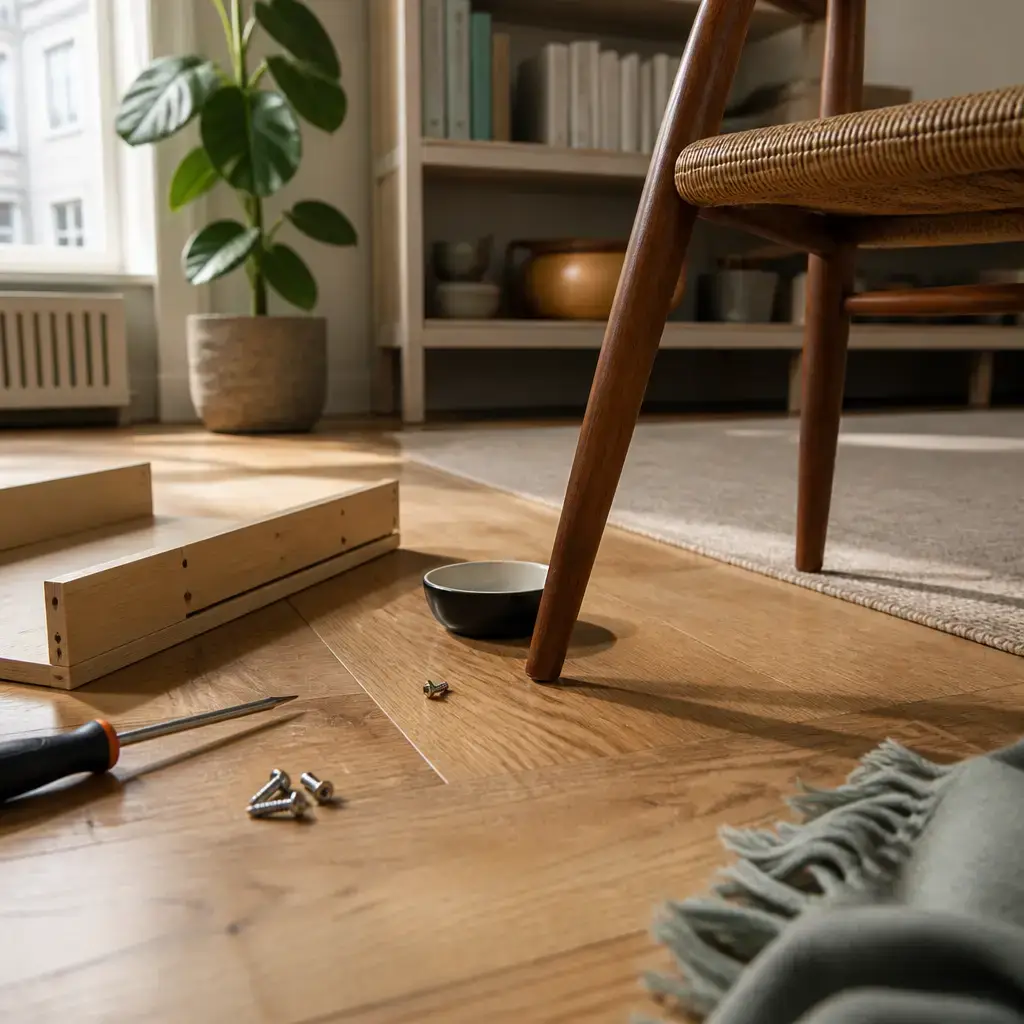
Ich habe eine kleine Schraube verloren.
ikh HAH-buh EYE-nuh KLY-nuh SHROW-buh fehr-LOH-ren. I lost a small screw.Schau unter dem Stuhl nach.
SHOW OON-ter daym SHTOOL nahkh. Check under the chair.Sie lag am Stuhlbein.
zee lahk ahm SHTOOL-byn. It was by the chair leg.Heb sie vorsichtig auf.
hayp zee FOR-zikh-tikh owf. Pick it up carefully.Sie ist winzig.
zee ist VIN-tsikh. It is tiny.Halte sie in deiner Handfläche, damit sie nicht wieder wegrollt.
HAHL-tuh zee in DYE-ner HAHNT-fleh-khuh, dah-MIT zee nikht VEE-der vek-ROHLT. Hold it in your palm so it does not roll away again.Wir brauchen sie, um das Regal zu reparieren.
veer BROW-khen zee, oom dahs ray-GAHL tsoo reh-pah-REE-ren. We need it to fix the shelf.Dann können wir es fertig reparieren.
dahn KURN-en veer es FEHR-tikh reh-pah-REE-ren. Then we can finish fixing it.Sentence explanations
Ich habe eine kleine Schraube verloren.
I lost a small screw.
- Ich habe
- I have
- kleine
- small
- Schraube
- screw
- verloren
- lost
More detail
Ich habe means “I have” here and begins the German perfect construction. The subject is ich (“I”), and habe is the first-person singular present form of haben. With a past participle at the end, haben works as the auxiliary: Ich habe ... verloren = “I lost ...” / literally “I have ... lost.” Example: Ich habe den Schlüssel gefunden. — “I found the key.” kleine describes the screw as small. Its base form is the adjective klein. Here it is the feminine singular accusative form, because Schraube is a feminine noun and is the direct object: eine kleine Schraube. The ending changes with the noun phrase’s grammatical conditions; compare ein kleiner Hund — “a small dog,” where the adjective form is different because Hund is masculine in this phrase. Schraube means “screw.” Its base form is also Schraube; the definite article is die Schraube, showing that it is feminine. Its plural is Schrauben: Ich sehe zwei Schrauben. — “I see two screws.” In this sentence, Schraube is part of the direct object eine kleine Schraube. verloren means “lost” here and is the past participle of verlieren (“to lose”). The perfect pattern is haben + verloren; the participle appears at the end of this main clause. Example: Sie hat ihr Handy verloren. — “She lost her phone.” Together, Ich habe identifies the speaker and supplies the auxiliary, eine kleine Schraube is the thing affected by the action, and verloren states the completed action. The whole utterance means: “I lost a small screw.”
Schau unter dem Stuhl nach.
Check under the chair.
- Schau … nach
- check / look to see
- unter
- under
- Stuhl
- chair
More detail
Schau ... nach is the separable verb nachschauen in the informal singular imperative. It means “check” or “look to see.” In a main-clause imperative, the verb’s parts separate: Schau nach! means “Check!” or “Have a look!” With a place, the location can be inserted between them: Schau unter dem Stuhl nach. unter means “under” here. For a stationary location, it takes the dative in this construction. Compare the reusable pattern unter + dative for “under [a place/object]” when something is located there. Movement toward a position can use the accusative instead, as in Ich stelle die Tasche unter den Stuhl. — “I put the bag under the chair.” Stuhl is the noun “chair.” Its base form is masculine singular nominative: der Stuhl; after dative unter, it appears as dem Stuhl. The noun itself does not change here; the article marks the case. A useful plural form is die Stühle — “the chairs.” The whole utterance combines the imperative Schau ... nach with the location phrase unter dem Stuhl: “Check under the chair.” It is a direct, informal instruction to inspect that location.
Sie lag am Stuhlbein.
It was by the chair leg.
- Sie
- it
- lag
- lay; was lying
- am
- by the; at the
- Stuhlbein
- chair leg
More detail
Sie means “it” here and is the subject of lag. In this sentence, the singular verb shows that sie is singular; the form is compatible with a feminine singular referent, but the supplied sentence does not identify exactly what object it refers to. At the beginning of a sentence it is capitalized. Do not confuse this with formal Sie (“you”), which takes plural verb forms. lag is the simple past form of liegen (“to lie; to be lying”) for third-person singular: liegen → lag. It describes a stationary position, not an action of placing something. Example: Das Buch lag auf dem Tisch. — “The book was lying on the table.” am is the contraction of an dem: an + the dative article dem. With a location, an can mean “at/by” or “against,” depending on the setting. Here am Stuhlbein gives the location “by the chair leg.” Stuhlbein is a compound noun: Stuhl (“chair”) + Bein (“leg”), meaning “chair leg.” Its grammatical gender is neuter: das Stuhlbein; the plural is die Stuhlbeine. In am Stuhlbein, dem is the dative form required by the contracted phrase an dem. Together, Sie lag am Stuhlbein means “It was lying by the chair leg.” The structure is subject + past-tense form of liegen + location: [subject] lag [at/by + dative location]. The preceding and following context supports a single object being located there and then picked up, without identifying that object more specifically.
Heb sie vorsichtig auf.
Pick it up carefully.
- Heb … auf
- pick up
- sie
- it
- vorsichtig
- carefully
More detail
Heb ... auf is the informal singular imperative of the separable verb aufheben, “to pick up.” Its base form is aufheben; in a main-clause imperative, the finite part heb comes first and the prefix auf moves to the end: Heb das auf. = “Pick that up.” The form heb addresses one person informally; a plural or formal command uses a different form. Here, sie is the accusative pronoun meaning “it,” referring to the object identified by the fixed translation and context. The pronoun form is sie; its exact referent is not named in the supplied utterance. In German, object pronouns mark grammatical case: compare Sie sieht es. (“She sees it.”) with Heb sie auf. (“Pick it up.”). The capitalization distinguishes the pronoun sie here from the formal address pronoun Sie. vorsichtig describes how the picking-up should be done: carefully or gently. The same form can function as an adjective before a noun or as an adverb describing an action: eine vorsichtige Bewegung = “a careful movement,” but Heb es vorsichtig auf. = “Pick it up carefully.” Together, Heb gives the informal command, sie names the object of the action, vorsichtig specifies the manner, and the separated prefix auf completes aufheben. The complete meaning is “Pick it up carefully.”
Sie ist winzig.
It is tiny.
- Sie ist
- it is
- winzig
- tiny
More detail
Sie ist means “it is” here, as established by the fixed translation. Sie is the sentence-initial form of German sie; in this use it is a singular feminine pronoun in the subject role. The exact noun it refers to is not identified in the supplied text, so the pronoun’s grammatical form can be explained without naming that noun. Depending on context, sie can also mean “she” or “they,” while capitalized Sie elsewhere can mean formal “you”; the translation fixes the intended reading here. ist is the present-tense third-person singular form of sein (“to be”): sein → ist. For example, Sie ist hier. means “It is here” when the context gives sie that referent. winzig means “tiny” here. It is an adjective used after ist, so it describes the subject without an adjective ending: X ist winzig = “X is tiny.” Its useful comparison forms are winziger (“tinier” or “smaller”) and am winzigsten (“the tiniest”). For example, Der Käfer ist winzig. means “The beetle is tiny.” Together, Sie ist winzig. states that the referent of sie is tiny: “It is tiny.”
Halte sie in deiner Handfläche, damit sie nicht wieder wegrollt.
Hold it in your palm so it does not roll away again.
- Halte
- hold
- sie
- it
- Handfläche
- palm
- damit
- so that
- nicht
- not
- wieder
- again
- wegrollt
- rolls away
More detail
Halte is the singular informal imperative of halten (“to hold”). The form addresses one person with du; compare Halt! as a short imperative and Halten Sie ... as the formal command. Here it tells the listener to keep the object in a particular place. sie is the accusative singular feminine pronoun. In this utterance, the fixed translation identifies its meaning as “it,” referring to the object being held; German uses this form because the object is grammatically feminine, even though English “it” does not show that distinction. The same form can also mean “her” in another context, but that is not the intended reading here. Handfläche is the feminine noun for “palm” (the inside surface of the hand). Its plural is Handflächen. In in deiner Handfläche, deiner marks the feminine singular dative after in because the object is being held in a stationary location, not moved into it. The phrase means “in your palm.” damit introduces a clause expressing the intended purpose or prevented result: “so that.” It is useful for linking an action to the outcome it is meant to bring about. A subordinate clause introduced by damit places its finite verb at the end. nicht is the standard negation word here. It negates the rolling-away event, so the clause says that the object does not roll away rather than that the holding action is absent. wieder means “again,” indicating a repeated event. It modifies the rolling-away event: the object is not to roll away another time. wegrollt comes from the separable verb wegrollen, “to roll away.” It is third-person singular present: sie rollt weg in a main clause. After damit, the finite form appears at the end and the prefix is attached: damit sie nicht wieder wegrollt. Together, Halte sie in deiner Handfläche gives the command “Hold it in your palm.” damit sie nicht wieder wegrollt gives the purpose: “so it does not roll away again.” The complete utterance is therefore “Hold it in your palm so it does not roll away again.”
Wir brauchen sie, um das Regal zu reparieren.
We need it to fix the shelf.
- brauchen
- need
- sie
- it
- um
- in order to
- Regal
- shelf
- zu reparieren
- to fix
More detail
brauchen means “to need” here. Its base form is brauchen; with wir, it is the present-tense first-person plural form: wir brauchen. Example: Ich brauche Hilfe. — “I need help.” sie is the object pronoun meaning “it” in this sentence, as supported by the fixed translation and context. Here it is the accusative object of brauchen. German sie has other uses in other contexts, but those are not intended here. Example: Wir sehen sie. — “We see it.” um introduces a purpose. In this sentence it combines with zu reparieren to form the pattern um ... zu + infinitive, meaning “in order to ...”. The material between the two parts can include the object of the infinitive. Regal means “shelf.” It is a neuter noun: das Regal is “the shelf,” and its plural is die Regale. In das Regal, the article has the same form in nominative and accusative; here the noun phrase is accusative because it is the object of reparieren. Example: Das Regal ist neu. — “The shelf is new.” zu reparieren means “to fix.” The base form is reparieren; zu marks the infinitive used in the purpose construction. Example: Sie versucht, das Fahrrad zu reparieren. — “She tries to fix the bicycle.” Together, Wir brauchen sie means “We need it.” The purpose construction um das Regal zu reparieren means “in order to fix the shelf.” The complete utterance therefore means: “We need it to fix the shelf.”
Dann können wir es fertig reparieren.
Then we can finish fixing it.
- Dann
- then
- können wir
- we can
- es
- it
- fertig
- finished; complete
- reparieren
- repair
More detail
Dann means “then” here: it places the action after an earlier point or event. It is an adverb and does not change form. Example: Dann gehen wir nach Hause. — “Then we go home.” können wir combines können (“can, be able to”) with the subject pronoun wir (“we”). können is the present-tense form for wir of können; the base form is also können. With a modal verb such as können, the other verb normally appears as an infinitive at the end of the clause: Wir können warten. — “We can wait.” The form wir identifies a first-person plural subject, but the sentence itself does not specify who is included in “we.” es is the accusative singular pronoun “it” in this sentence. Its form is es for a neuter singular pronoun in both nominative and accusative, so its object role here comes from the sentence structure rather than from a visible change in the pronoun. The fixed translation identifies it as the thing being repaired, without naming that thing. Example: Wir reparieren es. — “We repair it.” fertig means “finished” or “complete.” Before the infinitive reparieren, it contributes the idea of completing the repair: etwas fertig reparieren means “to finish repairing something” or “to repair something completely.” Here fertig is used adverbially, so it does not receive an adjective ending. Do not confuse it with fertig sein, “to be finished,” where it describes a state. Example: Sie macht die Arbeit fertig. — “She finishes the work.” reparieren is the infinitive “to repair.” It is a regular verb whose infinitive ends in -en; with the modal können, this infinitive remains at the end of the clause. A useful present-tense contrast is ich repariere — “I repair” and wir reparieren — “we repair.” Example: Wir können den Tisch reparieren. — “We can repair the table.” Together, Dann sets the time or sequence, können wir says that “we” are able or permitted to act, es is the object, and fertig reparieren expresses completing its repair. The whole utterance therefore means: “Then we can finish fixing it.”`
Grammar Points
Trennbare Verben: nachschauen → Schau ... nach
Schau nach.
SHOW nahkh.Check.
In a German command, the separable prefix moves to the end: nachschauen becomes Schau ... nach.
Adjektivendung: kleine Schraube
kleine Schraube
KLY-nuh SHROW-buhsmall screw
The adjective klein changes to kleine before the feminine noun Schraube.
German Vocabulary
Heb sie vorsichtig auf.
Halte sie in deiner Handfläche.
eine kleine Schraube
Sie lag am Stuhlbein.
Schau unter dem Stuhl nach.
eine kleine Schraube
unter dem Stuhl
am Stuhlbein
unter dem Stuhl
Ich habe eine kleine Schraube verloren.
Heb sie vorsichtig auf.
Sie ist winzig.
Quiz
Word Order
Arrange the words in the correct order.
I lost a small screw.
Show Answer
Ich habe eine kleine Schraube verloren.Check under the chair.
Show Answer
Schau unter dem Stuhl nach.It was by the chair leg.
Show Answer
Sie lag am Stuhlbein.Spelling
Tap the letters to spell the word.
to lose
Show Answer
verlorenscrew
Show Answer
Schraubechair leg
Show Answer
Stuhlbeinunder