10 minutes free every day
Continue audio lessons in the app
Word explanations appear automatically in sync with the audio.
No login required · synced translations · playback with the screen locked
Choose your learning language and open this lesson in the app.

About This Lesson
Use Cleaning a Small Stain to practice German conversation, pronunciation, vocabulary, grammar, and quizzes.
Dialogue
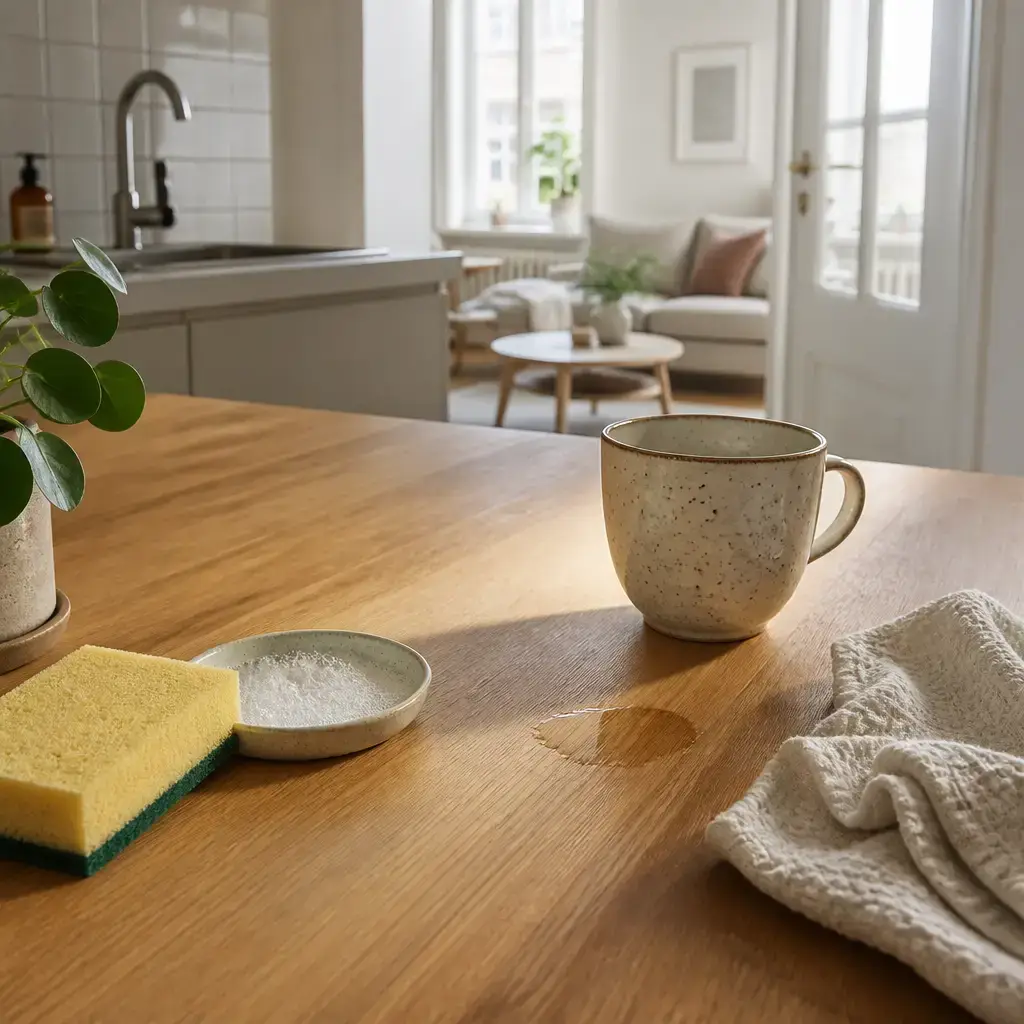
Auf dem Tisch ist ein Fleck.
owf dehm TISH ist eye-n FLEHK There is a stain on the table.Ich sehe ihn bei der Tasse.
ikh ZAY-uh een bye dair TAH-suh I can see it near the cup.Haben wir einen sauberen Schwamm?
HAH-bən veer EYE-nən ZOW-buh-rən SHVAHM Do we have a clean sponge?Der Schwamm ist am Waschbecken.
dair SHVAHM ist ahm VAHSH-behk-ən The sponge is by the sink.Soll ich etwas Seife nehmen?
zohl ikh ET-vahs ZY-fuh NAY-mən Should I use some soap?Tu ein bisschen Seife auf den Schwamm.
too eye-n BISS-khen ZY-fuh owf dayn SHVAHM Put a little soap on the sponge.Der Fleck ist fast weg.
dair FLEHK ist fahst vehk The stain is almost gone.Der Tisch sieht sauber aus.
dair TISH zeet ZOW-buh owss The table looks clean.Sentence explanations
Auf dem Tisch ist ein Fleck.
There is a stain on the table.
- Auf dem
- on the
- Tisch
- table
- ist
- is
- Fleck
- stain
More detail
Auf dem introduces a fixed location: “on the …”. With the two-way preposition auf, a stationary location takes the dative case. Here dem is the masculine/neuter singular dative form of the definite article; it does not itself indicate a quantity. Tisch means “table”. Its base form is der Tisch; in this phrase, the article changes to dem Tisch because the phrase describes where something is, not movement toward the table. Example: Das Buch liegt auf dem Tisch. — “The book is lying on the table.” ist is the third-person singular present form of sein (“to be”): sein → ist. Here it links the located item with its location and contributes to a “there is …” meaning. German can place the location first, followed by the verb and then the subject: Auf dem Tisch ist .... Fleck means “stain” or “spot” here. The full noun phrase is ein Fleck, with Fleck in the nominative because it is the thing being located. Its dictionary form is der Fleck; the indefinite article is ein in the masculine nominative singular. Example: Ein Fleck ist auf dem Hemd. — “There is a stain on the shirt.” Together, Auf dem Tisch gives the location, ist gives the present-tense “is/there is” structure, and ein Fleck identifies the located thing. The whole utterance therefore means: “There is a stain on the table.”
Ich sehe ihn bei der Tasse.
I can see it near the cup.
- Ich
- I
- sehe
- see
- ihn
- it
- bei
- near
- Tasse
- cup
More detail
Ich is the first-person singular pronoun in the subject form (nominative): “I.” It is the speaker who performs the action. Example: Ich sehe den Fleck. — “I see the stain.” sehe is the first-person singular present form of sehen (“to see”): ich sehe, du siehst. German present tense can describe what is happening now. In this sentence, the English translation uses “can see,” but German has no separate modal verb here; sehe itself supplies the seeing meaning. ihn is the masculine singular accusative form of er (“he/it” for a masculine noun). It is the direct object of sehe. In the supplied context, it refers to der Fleck (“the stain”), so the intended English pronoun is “it.” The same form can refer to a masculine person or object in other sentences. Contrast: Ich sehe ihn. — “I see him/it.” bei means “near” here and is a preposition that takes the dative in this use. With the feminine noun Tasse, the definite article is der: bei der Tasse — “near the cup.” The article form der here is dative singular feminine, not masculine nominative. Tasse means “cup.” Its base form is the feminine noun die Tasse; its plural is die Tassen. After bei, the singular phrase is bei der Tasse. Example: Der Schwamm ist bei der Tasse. — “The sponge is near the cup.” Together, Ich sehe ihn means “I see it,” with Ich as the subject and ihn as the direct object. bei der Tasse gives the location of the object: “near the cup.” The whole utterance therefore means “I can see it near the cup.”
Haben wir einen sauberen Schwamm?
Do we have a clean sponge?
- Haben wir
- do we have
- sauberen
- clean
- Schwamm
- sponge
More detail
Haben wir is the reusable German yes/no question pattern “do we have …?”. haben is the present-tense form of haben for wir (“we”): ich habe, du hast, er/sie/es hat, wir haben, ihr habt, sie/Sie haben. In a yes/no question, the conjugated verb comes before the subject: Haben wir ...? Compare the statement Wir haben ... (“We have ...”). sauberen means “clean” here. Its base form is the adjective sauber. The ending -en appears because the adjective describes the masculine accusative noun Schwamm in the phrase einen sauberen Schwamm: einen is the masculine accusative form of the indefinite article, and -en is the corresponding adjective ending here. The adjective, not the noun, carries this ending. For example, Ich brauche einen sauberen Tisch. means “I need a clean table.” Schwamm means “sponge.” Its basic singular form is der Schwamm; its plural is die Schwämme (“sponges”). In this sentence, Schwamm is singular and is the direct object of haben, so it appears in the accusative phrase einen sauberen Schwamm. Together, Haben wir + einen sauberen Schwamm forms Haben wir einen sauberen Schwamm? The verb-first order marks the utterance as a yes/no question, and the object phrase asks whether the group has a clean sponge.
Der Schwamm ist am Waschbecken.
The sponge is by the sink.
- Schwamm
- sponge
- ist
- is
- am
- by the
- Waschbecken
- sink
More detail
Schwamm means “sponge” here. Its base form is the masculine noun der Schwamm; the plural is die Schwämme. In the previous question, einen sauberen Schwamm is the same noun in the accusative after haben, while here Der Schwamm is the subject in the nominative. The adjective sauberen is not part of this sentence. ist is the third-person singular present form of sein, “to be”: ich bin, du bist, er/sie/es ist. Here it links the sponge to its location. For a plural subject, German uses sind, as in the example Die Schwämme sind am Waschbecken. — “The sponges are by the sink.” am is the contracted form of an dem. In this sentence, an describes a fixed location, so the following noun phrase is in the dative. The contraction is used when an is followed by the masculine or neuter definite article dem. Here am Waschbecken means “by/at the sink”; it does not itself express movement toward the sink. Waschbecken means “sink” in this context. It is a neuter noun: das Waschbecken; after an for this fixed location, dem Waschbecken appears, contracted in the sentence as am Waschbecken. The noun’s form itself does not change between nominative and dative singular; the article shows the case. Together, Der Schwamm identifies the sponge as the subject, ist states its current location, and am Waschbecken gives that location. The whole utterance means: “The sponge is by the sink.” A reusable pattern is Der/Die ... ist ... for locating one item. Example: Der Eimer ist am Waschbecken. — “The bucket is by the sink.”
Soll ich etwas Seife nehmen?
Should I use some soap?
- Soll ich
- Should I …?
- etwas
- some
- Seife
- soap
- nehmen
- use
More detail
Soll ich combines soll, the first-person singular present form of sollen, with ich, “I.” In this question, sollen asks whether the speaker ought to do something or whether it is the recommended action. The reusable pattern is Soll ich ...? = “Should I ...?” German places the conjugated verb first in a yes/no question: Soll ich warten? = “Should I wait?” etwas means “some” here: it indicates an unspecified amount of something, without stating an exact quantity. It is useful with substances or other non-counted material. For example, Ich brauche etwas Wasser. means “I need some water.” Seife is the noun “soap.” It is written with a capital letter because German nouns are capitalized. Its grammatical gender is feminine: die Seife; an example is Die Seife ist hier. = “The soap is here.” nehmen is the infinitive “to take.” In this utterance, the fixed translation and context support the meaning “to use,” namely to take soap for the washing action. After soll, the lexical verb remains in the infinitive at the end. The important forms are nehmen (infinitive), nimmt (third-person singular present), and nahm (simple past). For example, Soll ich den Schwamm nehmen? means “Should I use the sponge?” Together, Soll ich etwas Seife nehmen? asks whether the speaker should use an unspecified amount of soap. The structure is Soll ich + [amount or object] + infinitive?, which can be reused with other verbs: Soll ich etwas Wasser holen? = “Should I get some water?”
Tu ein bisschen Seife auf den Schwamm.
Put a little soap on the sponge.
- Tu
- put
- ein bisschen
- a little
- Seife
- soap
- auf
- onto
- Schwamm
- sponge
More detail
Tu is the informal singular imperative of tun (“to do”); in this sentence, tun is used in the practical sense “to put/apply.” The person addressed is understood as singular du, although du is not written. The imperative is useful for direct instructions. Example: Tu das Buch auf den Tisch. — “Put the book on the table.” ein bisschen means “a little” or “a small amount.” It expresses a limited amount here; it does not specify an exact measurement. The noun after it can remain without an additional quantity-marking article, as in ein bisschen Wasser — “a little water.” Seife means “soap.” It is a feminine noun: die Seife. In this utterance, it is the thing being put onto the sponge. Example: Die Seife ist nass. — “The soap is wet.” auf means “onto” here. With a two-way preposition such as auf, German uses the accusative when the sentence presents movement or placement toward a location, and the dative for a stationary location. Compare Ich lege das Tuch auf den Tisch. — “I put the cloth onto the table” with Das Tuch liegt auf dem Tisch. — “The cloth is lying on the table.” Schwamm means “sponge.” It is a masculine noun: der Schwamm. In the phrase auf den Schwamm, the article is den, the masculine singular accusative form of der, because the sponge is the destination of the placement. The noun itself is not what carries that case marking here; the article does. Together, Tu gives the direct instruction, ein bisschen Seife identifies a small amount of soap, and auf den Schwamm identifies the destination. The whole utterance therefore means: “Put a little soap on the sponge.”
Der Fleck ist fast weg.
The stain is almost gone.
- Fleck
- stain
- ist
- is
- fast
- almost
- weg
- gone
More detail
Fleck means “stain” here. Its base form is der Fleck; the masculine article der is part of the noun phrase. The plural is die Flecken, with an added -en: ein Fleck / zwei Flecken. Example: Der Fleck ist klein. — “The stain is small.” ist is the third-person singular present form of sein, “to be”: ich bin, du bist, er/sie/es ist. Here it links the stain with its current state. Example: Der Fleck ist trocken. — “The stain is dry.” fast means “almost” or “nearly.” It indicates that the following state is close to being true, but not completely true. Example: Der Fleck ist fast unsichtbar. — “The stain is almost invisible.” weg means “gone” or “away.” With sein, it describes something as no longer present in its place; as a predicative adjective, it does not take an ending here. Example: Die Seife ist weg. — “The soap is gone.” Together, Der Fleck ist fast weg. means “The stain is almost gone.” The pattern etwas ist fast weg is reusable for saying that something is nearly no longer present. The sentence describes the stain’s current state and does not say that it has completely disappeared.
Der Tisch sieht sauber aus.
The table looks clean.
- Tisch
- table
- sieht … aus
- looks / appears
- sauber
- clean
More detail
Tisch means “table” here. Its base form is der Tisch, and its plural is die Tische. In this sentence, Der Tisch is the subject; der is the masculine nominative form of the definite article used with this noun. sieht ... aus is the separated present-tense form of aussehen, meaning “to look” or “to appear.” sieht is the third-person singular form of aussehen used with der Tisch, while the separable particle aus moves to the end of the clause. A useful pattern is etwas sieht + adjective + aus: “something looks + adjective.” Example: Das Zimmer sieht groß aus. — “The room looks large.” sauber means “clean.” Here it is a predicative adjective after aussehen, so it has no adjective ending. By contrast, when it directly describes a noun, it can take an ending: ein sauberer Tisch — “a clean table.” Together, Der Tisch identifies what is being described, sieht ... aus expresses its appearance, and sauber describes that appearance. The whole utterance means: “The table looks clean.”
Grammar Points
aussehen: sieht ... aus
Der Tisch sieht sauber aus.
dair TISH zeet ZOW-buh owssThe table looks clean.
aussehen is a separable verb: the prefix aus moves to the end of the sentence.
bei + Dativ
bei dem Tisch
bye dehm TISHby the table
bei is a preposition that requires the dative case: der Tisch becomes dem Tisch.
German Vocabulary
Ich sehe ihn bei der Tasse.
Der Schwamm ist am Waschbecken.
Auf dem Tisch ist ein Fleck.
Haben wir einen sauberen Schwamm?
Auf dem Tisch ist ein Fleck.
Ich sehe ihn bei der Tasse.
Soll ich etwas Seife nehmen?
Haben wir einen sauberen Schwamm?
Ich sehe ihn bei der Tasse.
Haben wir einen sauberen Schwamm?
Ich sehe ihn bei der Tasse.
Soll ich etwas Seife nehmen?
Quiz
Word Order
Arrange the words in the correct order.
There is a stain on the table.
Show Answer
Auf dem Tisch ist ein Fleck.I can see it near the cup.
Show Answer
Ich sehe ihn bei der Tasse.Do we have a clean sponge?
Show Answer
Haben wir einen sauberen Schwamm?Spelling
Tap the letters to spell the word.
clean
Show Answer
sauberento have
Show Answer
Habento see
Show Answer
sehesoap