10 minutes free every day
Continue audio lessons in the app
Word explanations appear automatically in sync with the audio.
No login required · synced translations · playback with the screen locked
Choose your learning language and open this lesson in the app.

About This Lesson
Use Talking about taking photos to practice German conversation, pronunciation, vocabulary, grammar, and quizzes.
Dialogue
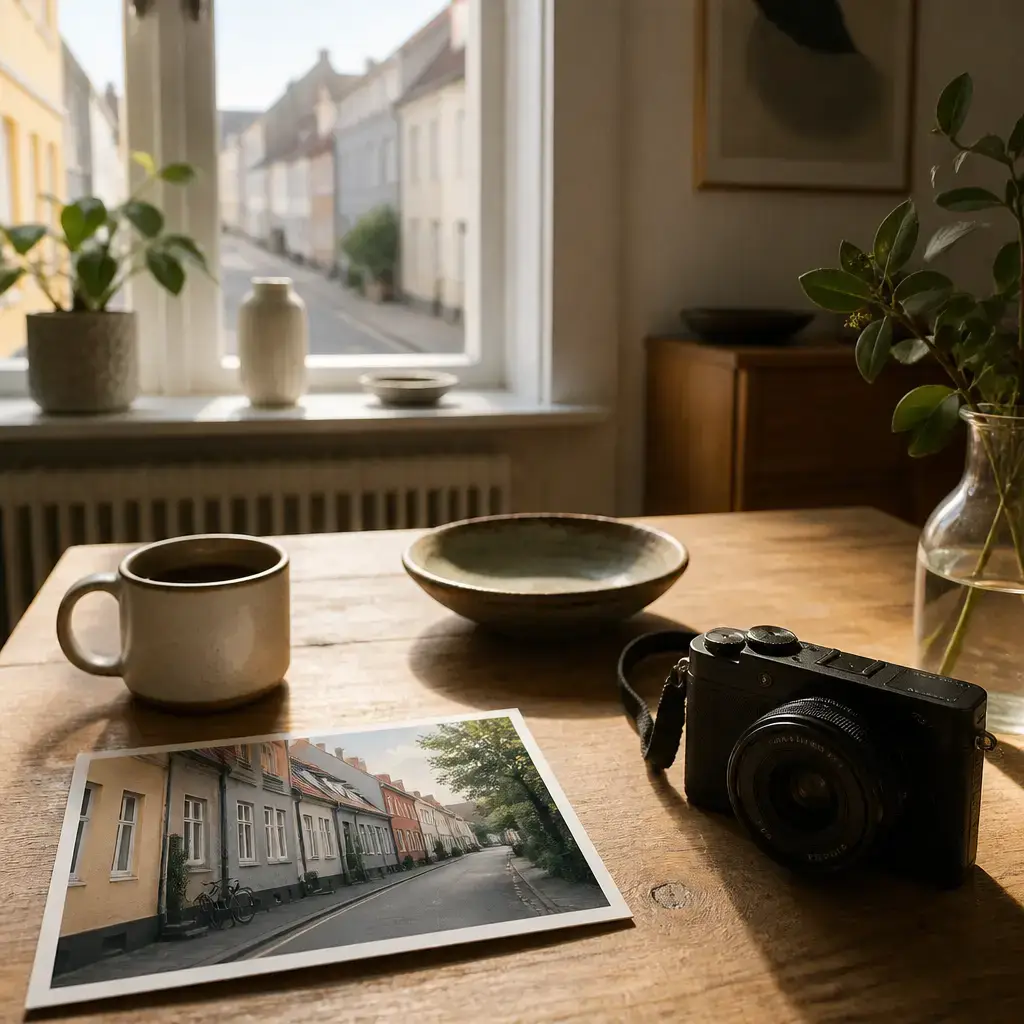
Machst du Fotos?
MAKHST doo FOH-tohs? Do you take photos?Ich benutze an den meisten Tagen meine kleine Kamera.
ikh beh-NOOT-suh ahn dayn MY-stən TAH-gən MY-nuh kah-MEH-rah. I use my small camera most days.Was fotografierst du gern?
vahs foh-toh-grah-FEERST doo gairn? What do you like to photograph?Ruhige Straßen mag ich am liebsten.
ROO-ih-guh SHTRAH-sən mahk ikh ahm LEEP-stən. Quiet streets are my favorite.Kann ich eins sehen?
kahn ikh ayns ZAY-ən? Can I see one?Hier ist eins. Ich habe es in der Nähe meines Zuhauses aufgenommen.
heer ist ayns. ikh HAH-buh ess in dair NAY-uh MY-nəs TSOO-hah-zəs OWF-guh-NOH-mən. Here is one I took near my home.Es sieht einfach und klar aus.
ess zeet AYN-fakh oont klahr owss. It looks simple and clear.Ich übe immer, wenn ich Zeit habe.
ikh EW-buh IM-uh, venn ikh TSYTE HAH-buh. I practice whenever I have time.Sentence explanations
Machst du Fotos?
Do you take photos?
- Machst
- take
- du
- you
- Fotos
- photos
More detail
Machst is the present-tense second-person singular form of machen (“to do” or “to make”). With Fotos, the combination Fotos machen means “to take photos.” In a yes/no question, the conjugated verb comes first: Machst du ...? This is different from the ordinary statement order Du machst ... (“You ...”). du is the informal singular word for “you.” It addresses one person; the formal word for “you” is Sie, and the plural informal form is ihr. Here du is the subject, the person doing the action. Fotos is the plural of Foto (“photo”). The plural form is used because the question concerns photos in general or more than one photo; the sentence does not specify an exact number. Foto is a neuter noun, and in this sentence the plural form is unchanged between nominative and accusative. Together, Machst du Fotos? uses the reusable pattern Verb + subject + object? for a yes/no question: Machst + du + Fotos. It means “Do you take photos?”
Ich benutze an den meisten Tagen meine kleine Kamera.
I use my small camera most days.
- Ich
- I
- benutze
- use
- an den meisten Tagen
- most days
- meine
- my
- kleine
- small
- Kamera
- camera
More detail
Ich means “I” here: the first-person singular pronoun for the speaker. Its form is independent of the speaker’s gender. Compare du (“you,” singular informal) in a question such as Machst du Fotos? — “Do you take photos?” benutze is the first-person singular present form of benutzen, “to use.” The ending -e marks the present-tense form with ich: ich benutze, while du benutzt means “you use.” Example: Ich benutze mein Handy. — “I use my phone.” an den meisten Tagen is a time expression meaning “most days.” meisten is the superlative form used here in the phrase die meisten (“the most / most”), and Tagen is the dative plural of Tag (“day”). The preposition an takes dative in this temporal expression. Example: An den meisten Tagen arbeite ich. — “I work most days.” meine means “my” and belongs to the speaker. Here it is the possessive determiner agreeing with the feminine singular accusative noun Kamera: meine Kamera. The form changes with the noun’s grammatical gender, number, and case; for example, mein Buch is “my book,” with a neuter singular noun. kleine means “small” here. It is the adjective klein with the ending -e, agreeing with the feminine singular accusative noun phrase after meine: meine kleine Kamera. The base form is klein; its comparative is kleiner (“smaller”). Example: Ich habe eine kleine Tasche. — “I have a small bag.” Kamera means “camera.” It is a feminine noun: die Kamera; its plural is die Kameras. In this sentence it is the direct object of benutze, so the feminine singular accusative form remains Kamera, while the determiner and adjective show the relevant agreement: meine kleine Kamera. Together, Ich benutze gives “I use,” meine kleine Kamera gives “my small camera,” and an den meisten Tagen gives the time pattern “most days.” In the natural German order used here, the complete meaning is: “I use my small camera most days.”
Was fotografierst du gern?
What do you like to photograph?
- Was
- what
- fotografierst
- photograph
- du
- you
- gern
- gladly; like to
More detail
Was asks for the thing being photographed. Here it is the German question word used for “what” as the object of fotografieren. Its visible form is was; German does not show a separate accusative form for this word. Compare Wer fotografiert ...? (“Who photographs ...?”), which asks for the person doing the action. fotografierst means “photograph” here. Its base form is fotografieren; fotografierst is the present-tense form for du (“you”). The verb is a regular weak verb: ich fotografiere, du fotografierst, sie fotografiert. Example: Du fotografierst die Straße. — “You photograph the street.” du is the informal singular subject pronoun “you.” It identifies the person doing the photographing. Its plural informal counterpart is ihr (“you” addressed to several people), while the formal pronoun is Sie. gern says that the action is liked or willingly done. With a verb, the reusable pattern is etwas gern tun, commonly translated as “to like doing something.” Example: Ich lese gern. — “I like reading.” The comparison forms are lieber (“rather; prefer”) and am liebsten (“most preferably; like best”). The next sentence uses am liebsten to express the strongest preference for quiet streets. Together, Was fotografierst du gern? places the question word first, followed by the verb and then the subject, as is typical in a German question. gern describes the speaker’s preference for the photographing action. The whole utterance therefore means “What do you like to photograph?” This is a natural, informal way to ask about someone’s preferred subjects for photography.
Ruhige Straßen mag ich am liebsten.
Quiet streets are my favorite.
- Ruhige
- quiet
- Straßen
- streets
- mag
- like
- am liebsten
- most of all
More detail
Ruhige means “quiet” here and describes Straßen. It is the inflected form of ruhig; with a plural noun and no preceding article, the adjective takes the -e ending in this phrase. The adjective itself does not show whether the plural is nominative or accusative, so the ending alone does not determine the phrase’s role. Straßen means “streets.” It is the plural of Straße. In this sentence, Ruhige Straßen is the plural accusative object of mag, and it has been placed at the beginning for emphasis. The normal subject–verb–object order would be Ich mag ruhige Straßen am liebsten. mag is the first-person singular present form of mögen, “to like.” The subject ich appears after the verb because the object phrase occupies the first position; German main clauses keep the finite verb in the second position. Compare Ich mag ... (“I like ...”) with Sie mag ... (“She likes ...”): the verb form changes with the subject. am liebsten means “best” or “most.” It is the superlative adverbial form related to gern (“gladly; with pleasure”): gern → lieber (“rather; preferably”) → am liebsten (“most preferably”). Here it says that quiet streets are the thing the speaker likes best, not that the streets themselves are performing an action. Together, Ruhige Straßen mag ich am liebsten literally has the order “Quiet streets like I best.” In natural English, the fronted object is usually expressed as “I like quiet streets best,” matching the supplied translation “Quiet streets are my favorite.”
Kann ich eins sehen?
Can I see one?
- Kann ich
- can I
- eins
- one
- sehen
- see
More detail
Kann ich combines the verb können (“can, be able to”) with ich (“I”). In this question, kann is the first-person singular present form of können; the infinitive is können, but the modal verb is conjugated here. German yes/no questions commonly put the conjugated verb first, so Kann ich ...? is a reusable pattern for asking whether the speaker may or is able to do something. For example: Kann ich kommen? — “Can I come?” eins means “one” here and stands alone instead of naming the item again. It is the neuter form of the indefinite pronoun used independently; it is not the article ein before a noun. The exact item is not named in this sentence, while the surrounding context supports understanding it as one item of the relevant kind. Example: Ich nehme eins. — “I’ll take one.” sehen is the infinitive “to see.” After a modal verb such as können, German keeps the other verb in the infinitive, usually at the end of the clause: Kann ich eins sehen? The form sehen itself does not show the subject here; kann carries the first-person singular agreement with ich. Example: Kann ich das sehen? — “Can I see that?” Together, Kann ich asks about the speaker’s permission or ability, eins identifies the unspecific item as “one,” and sehen supplies the requested action. The complete utterance therefore means “Can I see one?”
Hier ist eins. Ich habe es in der Nähe meines Zuhauses aufgenommen.
Here is one I took near my home.
- Hier ist
- Here is
- eins
- one
- Ich habe
- I have
- es
- it
- Nähe
- vicinity
- Zuhauses
- home
- aufgenommen
- took
More detail
Hier ist presents something at the current point: “Here is …”. The following eins supplies what is being presented. German hier means “here”, while ist is the third-person singular present form of sein (“to be”). eins is the standalone form of the numeral “one” here, referring to the item requested in the preceding question. Before a noun, the corresponding forms are normally ein, eine, or ein, selected according to the noun’s grammatical properties and case; eins is used independently, not as the article directly before a noun. Example: Ich sehe eins. — “I see one.” Ich habe begins a German perfect-tense construction. habe is the first-person singular present form of haben, and with a past participle it expresses a completed event: Ich habe … aufgenommen — “I took/recorded …”. This is a construction, so habe does not by itself mean that the taking happened. es is the object pronoun “it” here, referring to the item presented by eins. German es is the accusative form used for a singular neuter referent; the form also has other grammatical uses in other sentences, so its form alone does not identify every possible referent. Nähe means “vicinity” or “nearness”. In the fixed expression in der Nähe (“nearby”, “in the vicinity”), in takes the dative for a stationary location, giving der Nähe. The expression in der Nähe meines Zuhauses means “near my home”. Example: Der Laden ist in der Nähe. — “The shop is nearby.” Zuhauses is the genitive singular form of the neuter noun Zuhause (“home”). In meines Zuhauses, meines marks genitive singular neuter, because the home is the reference point for the vicinity: literally, “in the vicinity of my home”. The noun Zuhause can also occur in the expression zu Hause (“at home”); that separate expression is not the form used here. aufgenommen is the past participle of aufnehmen. In this sentence, aufnehmen has the relevant sense “to take” or “to record”, and aufgenommen combines with habe to form the perfect. The participle is placed at the end of this main clause. Example: Ich habe ein Bild aufgenommen. — “I took a picture.” Together, Hier ist eins means “Here is one”. Ich habe es in der Nähe meines Zuhauses aufgenommen means “I took it near my home”: es is the thing taken, in der Nähe meines Zuhauses gives the location, and habe … aufgenommen presents the completed taking as a German perfect-tense construction. The whole utterance is therefore: “Here is one I took near my home.”
Es sieht einfach und klar aus.
It looks simple and clear.
- Es sieht … aus
- looks
- einfach
- simple
- klar
- clear
More detail
Es sieht ... aus is the separated form of aussehen, “to look” or “to appear.” In the sentence, sieht is the present-tense third-person singular form, and aus is placed at the end because aussehen is a separable verb. The es is the subject, referring here to the thing being described. Example: Das sieht gut aus. — “That looks good.” einfach means “simple” here. It is an adjective describing how the subject looks. The same form can also mean “easy” in a different context, so the intended meaning comes from what is being described and from the translation. Example: Die Aufgabe ist einfach. — “The task is easy.” klar means “clear.” As an adjective, it can describe something that is easy to understand or visually distinct, depending on context. Example: Die Erklärung ist klar. — “The explanation is clear.” Together, Es sieht einfach und klar aus means “It looks simple and clear.” The two adjectives, joined by und, describe the subject, while the separated verb sieht ... aus expresses its appearance. The sentence is a straightforward present-tense description.
Ich übe immer, wenn ich Zeit habe.
I practice whenever I have time.
- übe
- practice
- immer
- always
- wenn
- when; whenever
- Zeit
- time
- habe
- have
More detail
übe is the first-person singular present form of üben, “to practice.” The ending -e marks “I” in this form: ich übe = “I practice.” Example: Ich übe Deutsch. — “I practice German.” immer means “always.” Here it modifies the practicing: the speaker practices whenever the stated condition is true. It can also appear in other sentences, for example Sie ist immer pünktlich. — “She is always punctual.” wenn introduces the condition or time situation “when” or “whenever.” In this sentence it begins a subordinate clause. In German, the conjugated verb normally moves to the end of this clause, giving wenn ich Zeit habe rather than the main-clause order ich habe Zeit. Zeit is the noun “time.” The expression Zeit haben means “to have time”; it does not assert a particular amount of time. German nouns are capitalized, so Zeit has a capital letter here. Example: Ich habe heute Zeit. — “I have time today.” habe is the first-person singular present form of haben, “to have.” Its subject in this clause is ich, and the form is placed at the end because the clause begins with wenn. The useful present-tense pair is ich habe — “I have,” du hast — “you have.” Together, Ich übe gives “I practice,” and immer, wenn ich Zeit habe adds the condition “whenever I have time.” The complete meaning is: “I practice whenever I have time.”
Grammar Points
sieht ... aus
Die Straße sieht ruhig aus.
dee SHTRAH-suh zeet ROO-ikh owss.The street looks quiet.
aussehen is separable: the prefix aus moves to the end of the sentence.
am liebsten + Verb
Ich sehe am liebsten ruhige Straßen.
ikh ZAY-uh ahm LEEP-stən ROO-ih-guh SHTRAH-sən.I like looking at quiet streets best.
am liebsten expresses the strongest preference and usually comes before the main verb.
German Vocabulary
Quiz
Word Order
Arrange the words in the correct order.
Do you take photos?
Show Answer
Machst du Fotos?What do you like to photograph?
Show Answer
Was fotografierst du gern?Quiet streets are my favorite.
Show Answer
Ruhige Straßen mag ich am liebsten.Spelling
Tap the letters to spell the word.
camera
Show Answer
Kameraquiet
Show Answer
Ruhigegladly; like to
Show Answer
gernday