10 minutes free every day
Continue audio lessons in the app
Word explanations appear automatically in sync with the audio.
No login required · synced translations · playback with the screen locked
Choose your learning language and open this lesson in the app.

About This Lesson
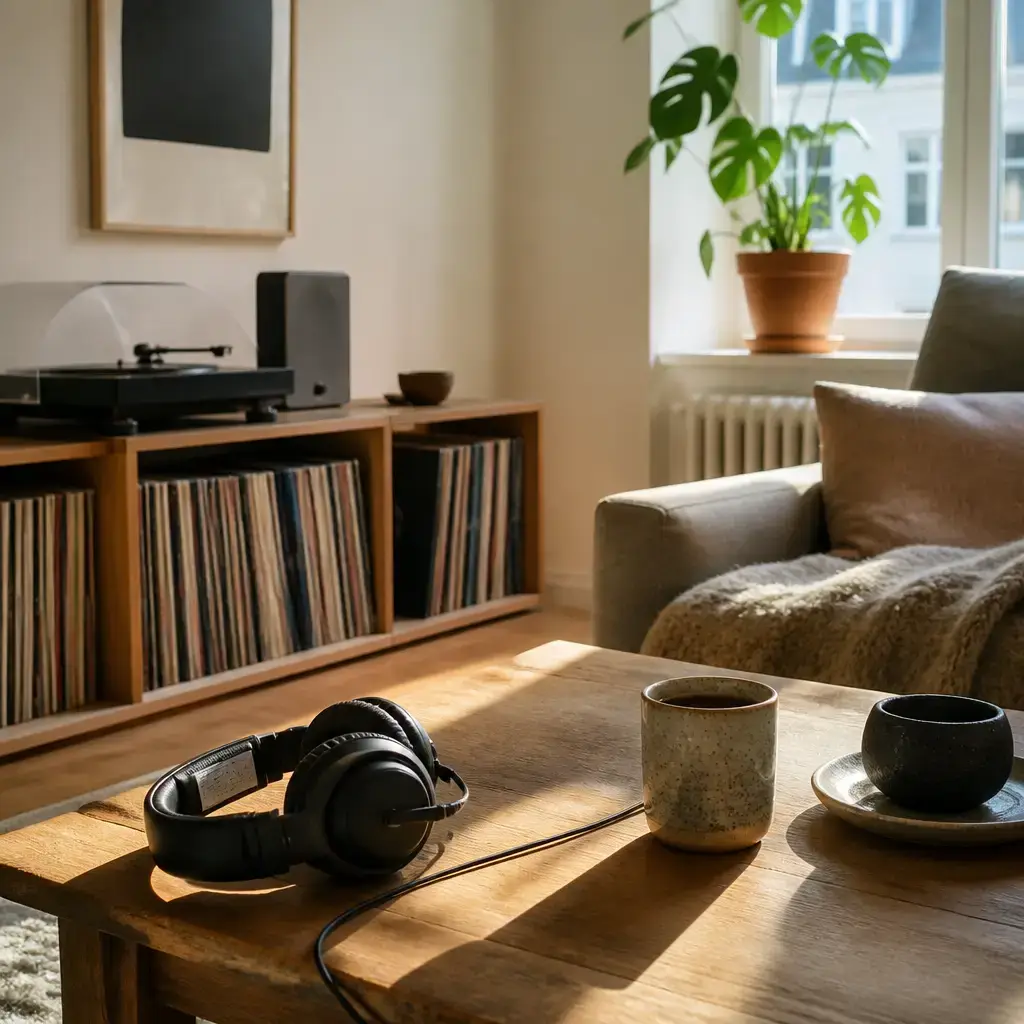
Use Listening to slow music to practice German conversation, pronunciation, vocabulary, grammar, and quizzes.
Dialogue
Hörst du Musik?
HURST doo moo-ZEEK? Do you listen to music?Ich höre in meiner Freizeit Musik.
ikh HUR-uh in MY-nuh FRY-tsite moo-ZEEK. I listen in my free time.Welche Musik magst du?
VEL-khuh moo-ZEEK mahkst doo? What kind of music do you like?Ich mag langsame Lieder.
ikh mahk LANG-zah-muh LEE-duh. I like slow songs.Benutzt du Kopfhörer?
buh-NOOTST doo KOPF-hur-uh? Do you use headphones?Ich benutze sie, wenn ich mich entspannen möchte.
ikh buh-NOOT-suh zee, ven ikh mikh ent-SHPAH-nun MURKH-tuh. I use them when I want to relax.Kann ich etwas hören?
kahn ikh ET-vahs HUR-un? Can I hear something?Ich spiele ein ruhiges Lied ab.
ikh SHPEE-luh ine ROO-ih-gus LEET ahp. I'll play a quiet track.Sentence explanations
Hörst du Musik?
Do you listen to music?
- Hörst
- listen
- du
- you
- Musik
- music
More detail
Hörst is the present-tense form of hören (“to listen” or “to hear”) for du: du hörst. The umlaut is part of this verb form. In this utterance, the following noun makes the intended sense “listen.” For example: Du hörst Musik. — “You listen to music.” du is the informal second-person singular pronoun, meaning one person addressed as “you.” A question can place this pronoun after the verb: Hörst du ...? This verb-first order marks a yes/no question in German. Compare the statement order Du hörst ... with the question order Hörst du ...? Musik is the noun “music.” It is written with a capital letter because German nouns are capitalized. In this sentence it is used without an article to refer to music generally; the noun itself does not assert a particular piece or amount of music. Together, Hörst + du forms the reusable yes/no question pattern Hörst du ...? (“Do you listen to ...?”), and Musik supplies what is listened to. The complete utterance therefore means “Do you listen to music?”
Ich höre in meiner Freizeit Musik.
I listen in my free time.
- Ich
- I
- höre
- listen
- in meiner Freizeit
- in my free time
- Musik
- music
More detail
Ich means “I” and identifies the speaker as the subject. German subject pronouns change with person and number: ich is first-person singular; for example, Ich lerne. means “I am learning.” höre is the first-person singular present form of hören, “to hear” or “to listen.” With an object such as Musik, it has the intended meaning “listen to music” here. The present form is: ich höre — “I listen” du hörst — “you listen” The form changes for the subject, while the verb base is hören. in meiner Freizeit means “in my free time.” Freizeit is a feminine noun: die Freizeit. After the temporal use of in here, the phrase uses the dative form meiner of the possessive word corresponding to “my.” Compare the reusable pattern in meiner Freizeit — “in my free time” with in seiner Freizeit — “in his free time.” The phrase says when the activity happens; it does not itself specify how often. Musik means “music.” It is a feminine noun, die Musik, but German commonly uses it without an article when referring to music generally: Ich höre Musik. means “I listen to music.” With a specific piece or defined music, an article or another determiner can be used, for example Ich höre die Musik. — “I listen to the music.” Together, Ich höre (“I listen”), in meiner Freizeit (“in my free time”), and Musik (“music”) form: “I listen to music in my free time.” The German sentence places the time phrase before the object, while the intended meaning remains the same. This is a reusable pattern: Ich [verb] in meiner Freizeit [object].
Welche Musik magst du?
What kind of music do you like?
- Welche
- which; what kind of
- Musik
- music
- magst
- like
- du
- you
More detail
Welche introduces a question about a choice or type. It is the interrogative determiner corresponding here to “which/what kind of,” and it agrees with Musik in feminine singular. Because Musik is the object of magst, the phrase is in the accusative; feminine singular welche has the same form in the nominative and accusative. Pattern: Welche + noun ...? — “Which/what kind of ...?” Musik means “music.” It is a feminine noun: die Musik. In this sentence it is used as a general, normally uncountable noun rather than as a counted individual item. Example: Ich höre Musik. — “I listen to music.” magst is the second-person singular present form of mögen, “to like.” The form changes with the subject: ich mag, du magst, er/sie mag. The observed form magst therefore matches the informal singular subject du. Example: Du magst langsame Lieder. — “You like slow songs.” du is the informal singular subject pronoun, “you.” It is the nominative form used for the person who has the preference. Its corresponding object form is dich, but that is not the form needed here because du is the subject of magst. Together, Welche Musik asks what type or selection of music is meant, and magst du asks whether you like it. In German questions beginning with a question word, the finite verb comes before the subject: Welche Musik magst du? The complete meaning is “What kind of music do you like?”
Ich mag langsame Lieder.
I like slow songs.
- Ich
- I
- mag
- like
- langsame
- slow
- Lieder
- songs
More detail
Ich is the first-person singular pronoun, meaning “I.” It identifies the speaker as the subject. Its form does not change for grammatical gender. mag is the first-person singular present form of mögen, “to like.” The vowel changes in this form: mögen → ich mag. The first-person singular present form has no ending; the form is recognized here through the stem change and the subject ich. For example, Ich mag Tee. means “I like tea.” langsame means “slow” here and describes Lieder. Its base form is langsam. Because it stands before a plural noun without an article, it takes the plural ending -e: langsame. The accusative object does not change this adjective ending here, because German has the same ending in this pattern for plural nominative and accusative. For example, Ich höre schnelle Lieder. means “I listen to fast songs.” Lieder is the plural of Lied, “song.” The noun is the object of mag: the speaker likes the songs. For example, Die Lieder sind kurz. means “The songs are short.” Together, Ich mag expresses the speaker’s liking, while langsame Lieder specifies what is liked. The complete utterance means “I like slow songs.”
Benutzt du Kopfhörer?
Do you use headphones?
- Benutzt
- use
- du
- you
- Kopfhörer
- headphones
More detail
Benutzt is the present-tense form of benutzen (“to use”) for du (“you”): du benutzt. The stem is benutz-; because it ends in z, the second-person singular form uses -t, giving benutzt, rather than the usual-looking -st ending. The same written form also occurs with third-person singular and second-person plural subjects, but du identifies this instance as second-person singular. Example: Du benutzt ein Handy. — “You use a mobile phone.” du is the informal singular “you” in the subject role. It addresses one person informally; the formal singular form is Sie, which is grammatically different and capitalized. Here, du is the subject of benutzt. Kopfhörer means “headphones” here. The singular and plural forms are both Kopfhörer; the number is shown by the surrounding determiner or context. For example, ein Kopfhörer can mean “a headphone,” while bare Kopfhörer commonly has the plural meaning “headphones” in this sentence. Example: Ich benutze Kopfhörer. — “I use headphones.” In a German yes-or-no question, the finite verb comes first, followed by the subject: Benutzt du + noun? Here, Benutzt du Kopfhörer? asks whether the person addressed uses headphones. The present tense can describe a current or general use, and the fixed translation supports the general-use reading.
Ich benutze sie, wenn ich mich entspannen möchte.
I use them when I want to relax.
- Ich
- I
- benutze
- use
- sie
- them
- wenn
- when
- mich entspannen
- relax
- möchte
- want
More detail
Ich means “I” here. It is the first-person singular personal pronoun and identifies the speaker as the subject. German subject pronouns include ich (“I”), du (“you,” singular informal), and wir (“we”). benutze means “use.” It is the first-person singular present form of benutzen: ich benutze (“I use”). The ending -e marks this present-tense form with ich; the subject is not expressed by the verb alone, so Ich makes the actor clear. sie means “them” here. The fixed translation and context identify it as the plural accusative pronoun referring to the items being used. German distinguishes sie (“them,” accusative plural) from ihr (“them,” dative plural) and sie (“they,” nominative plural); its role in this sentence is the direct object of benutze. wenn introduces a condition or time circumstance meaning “when.” It starts a subordinate clause. In a German subordinate clause introduced by wenn, the conjugated verb goes to the end. mich entspannen means “relax.” entspannen is the infinitive “to relax,” and mich is the reflexive accusative pronoun used with the first-person subject: ich entspanne mich (“I relax”). The infinitive remains entspannen after a modal-type form such as möchte. möchte means “want” in this sentence, specifically “want to” before an infinitive. It is the first-person singular form of möchten, a form used to express a desire politely; ich möchte means “I want” or “I would like.” With an infinitive, the infinitive goes at the end: Ich möchte schlafen (“I want to sleep”). Here, because möchte is inside the wenn clause, it appears at that clause’s end. Together, the main clause says that the speaker uses the plural object, and the wenn clause gives the situation in which this happens: the speaker uses them when the speaker wants to relax. The subject is ich in both clauses: it is written as Ich in the main clause and as ich in the subordinate clause. mich marks the reflexive object of entspannen.
Kann ich etwas hören?
Can I hear something?
- Kann ich
- can I
- etwas
- something
- hören
- hear
More detail
Kann ich comes from the modal verb können (“can, be able to”) with the first-person singular subject ich. The present-tense form is ich kann; in a yes/no question, the conjugated verb comes before the subject: Kann ich ...? This asks whether the speaker is able or permitted to do something, with the intended meaning here being “Can I ...?” Example: Kann ich gehen? — “Can I leave?” etwas is an indefinite pronoun meaning “something” here. It refers to an unspecified thing and does not state a particular quantity. The same form can have other uses in German, such as “somewhat,” but that is not its meaning in this sentence. Example: Ich möchte etwas trinken. — “I would like to drink something.” hören is the infinitive “to hear.” With a modal verb such as können, the modal verb carries the tense and the infinitive remains in its base form. The infinitive is therefore placed at the end of this question: Kann ich ... hören? Example: Ich kann die Musik hören. — “I can hear the music.” Together, Kann ich asks about the speaker’s ability or permission, etwas supplies an unspecified thing, and hören names the action. The complete utterance Kann ich etwas hören? means “Can I hear something?”
Ich spiele ein ruhiges Lied ab.
I'll play a quiet track.
- Ich
- I
- spiele … ab
- play back
- ein
- a
- ruhiges
- quiet
- Lied
- song; track
More detail
Ich means “I” and is the first-person singular subject pronoun. It identifies the speaker as the person performing the action. Example: Ich lerne. — “I am learning.” spiele ... ab comes from the separable verb abspielen, “to play back” or “to play.” In this sentence, spiele is the present-tense first-person singular form of abspielen, and the prefix ab moves to the end of the clause: Ich spiele ... ab. With a different subject, the verb changes: Sie spielt ein Lied ab. — “She plays a song.” The separated parts must be understood together; spiele alone is from spielen, while abspielen gives the playback meaning here. ein is an indefinite article. Here it introduces one unspecified neuter noun, but the article itself is not a separate claim about a numerical count. In ein ruhiges Lied, it has the form used with a neuter singular noun in the accusative, which is also the same form as the neuter nominative. ruhiges means “quiet” here. It is the adjective ruhig, “quiet,” with the ending -es. The ending agrees with the neuter singular noun Lied in this noun phrase and appears after the indefinite article ein. Compare the base form ruhig with the comparative ruhiger, “quieter.” Example: ein ruhiger Ort — “a quiet place.” Lied is a neuter noun meaning “song”; in this translation, “track” conveys the intended audio meaning. Its article is das: das Lied. In the sentence, Lied is the accusative object of abspielen, the thing being played. Example: Ich höre ein Lied. — “I am listening to a song.” Together, Ich spiele ... ab states that the speaker will play something back, ein ruhiges Lied supplies the unspecified quiet song as the object, and the complete utterance means: “I’ll play a quiet track.”
Grammar Points
Wenn ..., ...
Wenn sie sich entspannen, benutzen sie Kopfhörer.
ven zee zikh ent-SHPAH-nun, buh-NOOT-sun zee KOPF-hur-uh.When they relax, they use headphones.
In a wenn-clause, the conjugated verb moves to the end: wenn sie sich entspannen.
abspielen: spiele ... ab
Sie spielen Musik ab.
zee SHPEE-lun moo-ZEEK ahp.They play music back.
abspielen is separable; in a main clause, ab moves to the end.
German Vocabulary
Benutzt du Kopfhörer?
in meiner Freizeit
Hörst du Musik?
Benutzt du Kopfhörer?
Ich mag langsame Lieder.
Ich mag langsame Lieder.
Welche Musik magst du?
Hörst du Musik?
wenn ich mich entspannen möchte
Ich benutze sie
Welche Musik magst du?
wenn ich mich entspannen möchte
Quiz
Word Order
Arrange the words in the correct order.
Do you listen to music?
Show Answer
Hörst du Musik?I listen in my free time.
Show Answer
Ich höre in meiner Freizeit Musik.What kind of music do you like?
Show Answer
Welche Musik magst du?Spelling
Tap the letters to spell the word.
to use
Show Answer
Benutztmusic
Show Answer
Musikto listen; to hear
Show Answer
Hörstfree time