10 minutes free every day
Continue audio lessons in the app
Word explanations appear automatically in sync with the audio.
No login required · synced translations · playback with the screen locked
Choose your learning language and open this lesson in the app.

About This Lesson
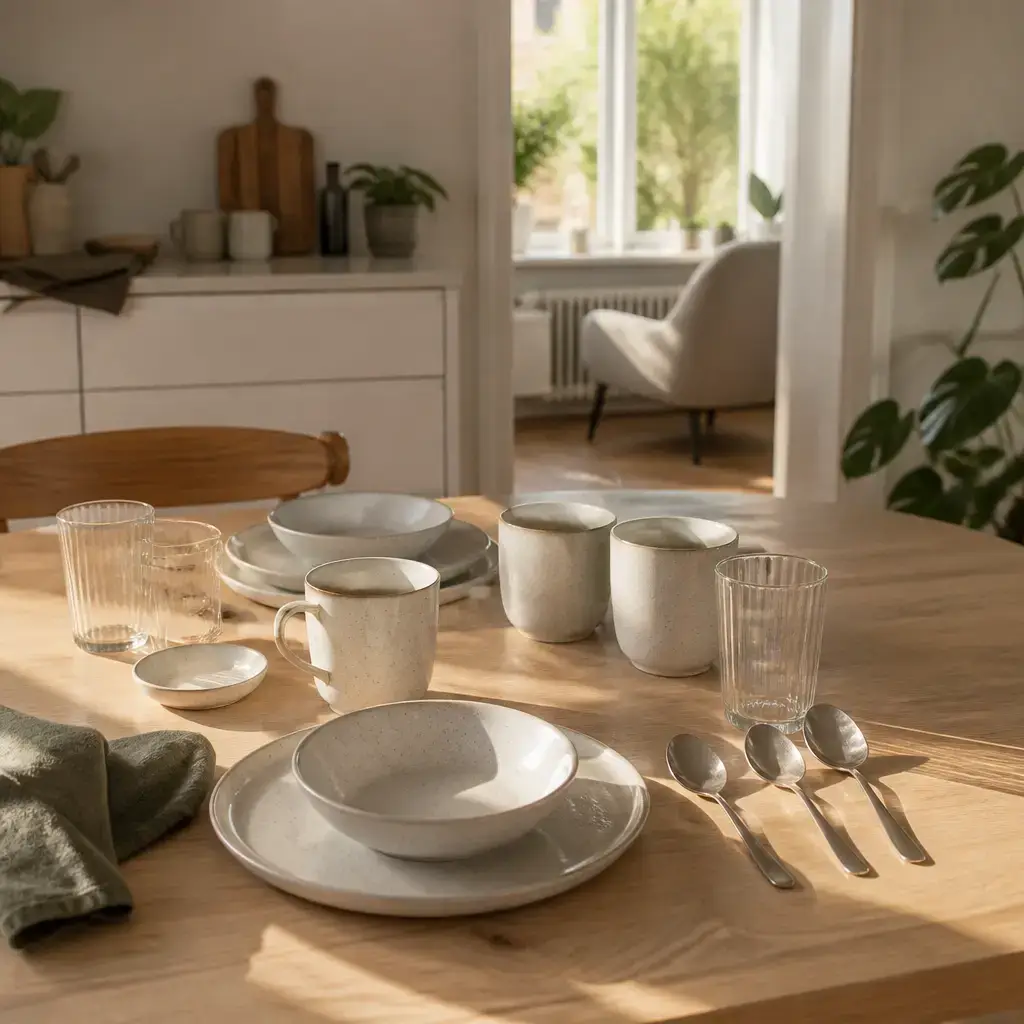
Use Checking the table-setting list to practice German conversation, pronunciation, vocabulary, grammar, and quizzes.
Dialogue
Schauen wir auf die Liste.
SHOW-en veer owf dee LIS-tuh. Let's look at the list.Ich habe sie hier.
ikh HAH-buh zee heer. I have it here.Sind die Tassen bereit?
zint dee TASS-en buh-RITE? Are the cups ready?Ich habe sie alle gewaschen.
ikh HAH-buh zee ALL-uh guh-VASH-en. I washed them all.Fehlt etwas?
faylt ET-vahs? Is anything missing?Wir brauchen noch einen Löffel.
veer BROW-khen nokh EYE-nen LURF-el. We still need one spoon.Ich kann noch einen holen.
ikh kahn nokh EYE-nen HOH-len. I can get another one.Dann ist der Tisch gedeckt.
dahn ist day-uh TISH guh-DEKT. Then the table is set.Sentence explanations
Schauen wir auf die Liste.
Let's look at the list.
- Schauen wir
- Let’s look
- auf
- at
- Liste
- list
More detail
Schauen wir uses schauen (“to look”) with wir (“we”) in a first-person plural suggestion: “let’s look.” The verb comes before the subject in this suggestion form, unlike the ordinary statement order Wir schauen .... The infinitive is schauen. Example: Wir schauen auf die Liste. — “We are looking at the list.” auf links schauen to what is being looked at. In the pattern auf etwas schauen, the object after auf is accusative: auf die Liste — “at the list.” Liste is the noun “list.” Its citation form is die Liste, and its plural is die Listen. Here, die is the singular definite article. Because Liste is feminine and auf takes an accusative object in this pattern, the form is die Liste; the feminine singular definite article is die in both the nominative and accusative. The sentence therefore refers to a specific list, matching “the list.” Together, Schauen wir auf die Liste forms a first-person plural suggestion: “Let’s look at the list.” A reusable suggestion pattern is Verb + wir + object, with any required preposition included by the verb or construction. Example: Lesen wir das Buch. — “Let’s read the book.”
Ich habe sie hier.
I have it here.
- Ich
- I
- habe
- have
- sie
- it
- hier
- here
More detail
Ich is the first-person singular pronoun meaning “I.” Here it is the subject, the person who has something. German contrasts ich (“I”) with du (“you,” singular) and wir (“we”). habe is the present-tense first-person singular form of haben (“to have”): ich habe = “I have.” The verb changes with the subject: ich habe, du hast, er/sie/es hat. Example: Ich habe Zeit. — “I have time.” sie is the object pronoun translated as “it” here. In this use, its form is accusative singular feminine; the English translation does not identify what the referent is, so the specific object remains unspecified. German sie has other uses in other contexts, but this sentence uses it as the object of haben. Example: Ich sehe sie. — “I see it,” when the object is grammatically feminine. hier means “here.” It is an adverb and does not change form. Its opposite is dort (“there”). Example: Das Buch ist hier. — “The book is here.” Together, Ich habe sie hier. means “I have it here.” The structure is subject + present-tense form of “have” + object + place adverb: Ich habe + sie + hier. It states that the speaker has the intended object here.
Sind die Tassen bereit?
Are the cups ready?
- Sind
- are
- Tassen
- cups
- bereit
- ready
More detail
Sind is the present-tense form of sein (“to be”) for sie meaning “they” and for the formal “you”; here, with plural Tassen, it means “are.” In a yes/no question, the finite verb comes first: Sind ...? Compare the statement Die Tassen sind bereit. (“The cups are ready.”) Tassen means “cups” here. Its base form is singular die Tasse; Tassen is the plural form. The word is the subject of sind, so the plural subject determines the verb form. Example: Die Tassen sind sauber. — “The cups are clean.” bereit means “ready” and describes the cups’ state. It is a predicate adjective after sein, so it does not receive an adjective ending here. Example: Die Tassen sind bereit. — “The cups are ready.” Together, the pattern Sind + plural subject + adjective? asks whether plural things have a stated property. Thus Sind die Tassen bereit? means “Are the cups ready?”
Ich habe sie alle gewaschen.
I washed them all.
- Ich
- I
- habe
- have (perfect-tense auxiliary)
- sie
- them
- alle
- all
- gewaschen
- washed
More detail
Ich means “I” here and is the first-person singular subject. It identifies the speaker as the person who did the washing. Example: Ich lerne Deutsch. — “I am learning German.” habe is the first-person singular present form of haben (“to have”). Here it is an auxiliary, so habe combines with the past participle at the end to form the German perfect: ich habe ... gewaschen — “I washed ...” / “I have washed ...”. The present form of the auxiliary does not make this event present in English. sie means “them” here. The fixed translation identifies it as a plural accusative pronoun, referring to the things washed; the supplied sentence does not identify those things by name. This form is distinct from capitalized Sie, the formal “you,” and from sie meaning “she” or “they” in other grammatical contexts. Example: Ich sehe sie. — “I see them.” alle means “all” and emphasizes the complete group: not just some of them. With a plural pronoun, sie alle means “all of them.” Example: Wir nehmen alle. — “We are taking all of them.” gewaschen is the past participle of waschen (“to wash”). It is the form used with haben in the perfect here. A useful chain is waschen (base form) → wusch (simple past) → gewaschen (past participle). Example: Sie hat das Auto gewaschen. — “She washed the car.” Together, Ich is the actor, habe ... gewaschen expresses the completed washing in the German perfect, and sie alle is the complete group affected by it. German places the auxiliary in the finite second position and the participle at the end, producing the meaning “I washed them all.”
Fehlt etwas?
Is anything missing?
- Fehlt
- is missing
- etwas
- anything
More detail
Fehlt is the 3rd-person singular present form of fehlen, meaning “to be missing” here. The base form is fehlen; for example, Der Schlüssel fehlt. means “The key is missing.” In German, the missing item is the subject of fehlen, so it appears in the nominative rather than as an object. etwas is an indefinite pronoun meaning “something” in a statement and “anything” in this question. It is not a numeric word and does not identify a particular item. Example: Fehlt etwas im Schrank? — “Is anything missing from the cupboard?” German yes/no questions commonly place the finite verb first: Fehlt etwas? The verb fehlt comes before the subject-like pronoun etwas. Together, Fehlt + etwas means “Is anything missing?” The utterance asks whether there is an unspecified missing item, without naming what that item is.
Wir brauchen noch einen Löffel.
We still need one spoon.
- Wir
- we
- brauchen
- need
- noch
- still
- einen
- a
- Löffel
- spoon
More detail
Wir means “we”: it is the first-person plural subject pronoun, used when the speaker includes at least one other person. Compare ich (“I”) for a singular speaker. brauchen means “need” here. With wir, the present-tense form is wir brauchen; the infinitive is also brauchen. Example: Wir brauchen Wasser. — “We need water.” noch means “still” in this sentence. It shows that the need continues or remains at this point. In other contexts, noch can also mean “another” or “more,” but “still” is the intended meaning here. einen is the masculine accusative form of the indefinite article. The noun Löffel is masculine: der Löffel in the nominative, but einen Löffel when it is the direct object of brauchen. The article marks the object; it does not by itself state a numeric count. Löffel means “spoon.” Its singular nominative form is der Löffel; its plural is die Löffel. Example: Ich nehme einen Löffel. — “I am taking a spoon.” Together, Wir brauchen noch einen Löffel means “We still need one spoon.” Wir is the subject, brauchen expresses the need, noch adds the continuing sense, and einen Löffel is the masculine direct object. The sentence is a straightforward way to say that one spoon is still needed.
Ich kann noch einen holen.
I can get another one.
- Ich kann
- I can
- noch
- another
- einen
- one
- holen
- get
More detail
Ich kann means “I can” here. kann is the first-person singular present form of können (“to be able to/can”). With a modal verb, the lexical verb stays in the infinitive and appears at the end of this clause: Ich kann ... holen. noch means “another” in combination with einen here: it adds one more item of the relevant kind. In the supplied context, that item is understood as another spoon. The same word can mean “still” in other contexts, but that is not its meaning here. einen means “one” or “one of them” here. It is the masculine accusative form related to the indefinite article ein, used for the object of holen; the omitted noun is understood from the context. The form chain is ein (masculine nominative) → einen (masculine accusative). An indefinite article does not by itself assert a numeric count; here the “one more” reading comes from noch einen. holen means “to get” or “fetch”. It is the infinitive used after kann. Example: Ich kann Wasser holen. — “I can get water.” Together, Ich kann + noch einen + holen means “I can get another one.” The speaker presents getting one additional item as possible or within their ability; the item is supplied by the context.
Dann ist der Tisch gedeckt.
Then the table is set.
- Dann
- then
- ist
- is
- Tisch
- table
- gedeckt
- set
More detail
Dann means “then” here: it places this statement after the situation mentioned before it. It is a time adverb and does not itself express who performs the action. ist is the present-tense third-person singular form of sein (“to be”): sein → ist. The subject is singular, and ist links der Tisch with the description gedeckt. der Tisch: Tisch means “table.” Its base form is the noun Tisch; der marks the masculine nominative singular form needed here because the table is the subject. For example, Der Tisch ist groß. means “The table is large.” gedeckt is the form of decken used as a result-state description: decken → gedeckt. In this sentence it means that the table is set, ready with the relevant tableware. With sein, a participle such as gedeckt can describe the resulting state: Der Tisch ist gedeckt. means “The table is set.” Together, Dann ist der Tisch gedeckt. means “Then the table is set.” The sequence is Dann (“then”) + ist (“is”) + the subject der Tisch (“the table”) + its state gedeckt (“set”).
Grammar Points
haben + Partizip II
habe gewaschen
HAH-buh guh-VASH-enhave washed
German uses a form of haben with the past participle to form the perfect tense.
German Vocabulary
Ich habe sie alle gewaschen.
Schauen wir auf die Liste.
Sind die Tassen bereit?
Wir brauchen noch einen Löffel.
Fehlt etwas?
Fehlt etwas?
Ich habe sie hier.
Ich habe sie hier.
Schauen wir auf die Liste.
Schauen wir auf die Liste.
Sind die Tassen bereit?
Ich habe sie alle gewaschen.
Quiz
Word Order
Arrange the words in the correct order.
Let's look at the list.
Show Answer
Schauen wir auf die Liste.I have it here.
Show Answer
Ich habe sie hier.Are the cups ready?
Show Answer
Sind die Tassen bereit?Spelling
Tap the letters to spell the word.
to look
Show Answer
Schauento wash
Show Answer
gewaschenhere
Show Answer
hierready