10 minutes free every day
Continue audio lessons in the app
Word explanations appear automatically in sync with the audio.
No login required · synced translations · playback with the screen locked
Choose your learning language and open this lesson in the app.

About This Lesson
Use Checking before leaving to practice German conversation, pronunciation, vocabulary, grammar, and quizzes.
Dialogue
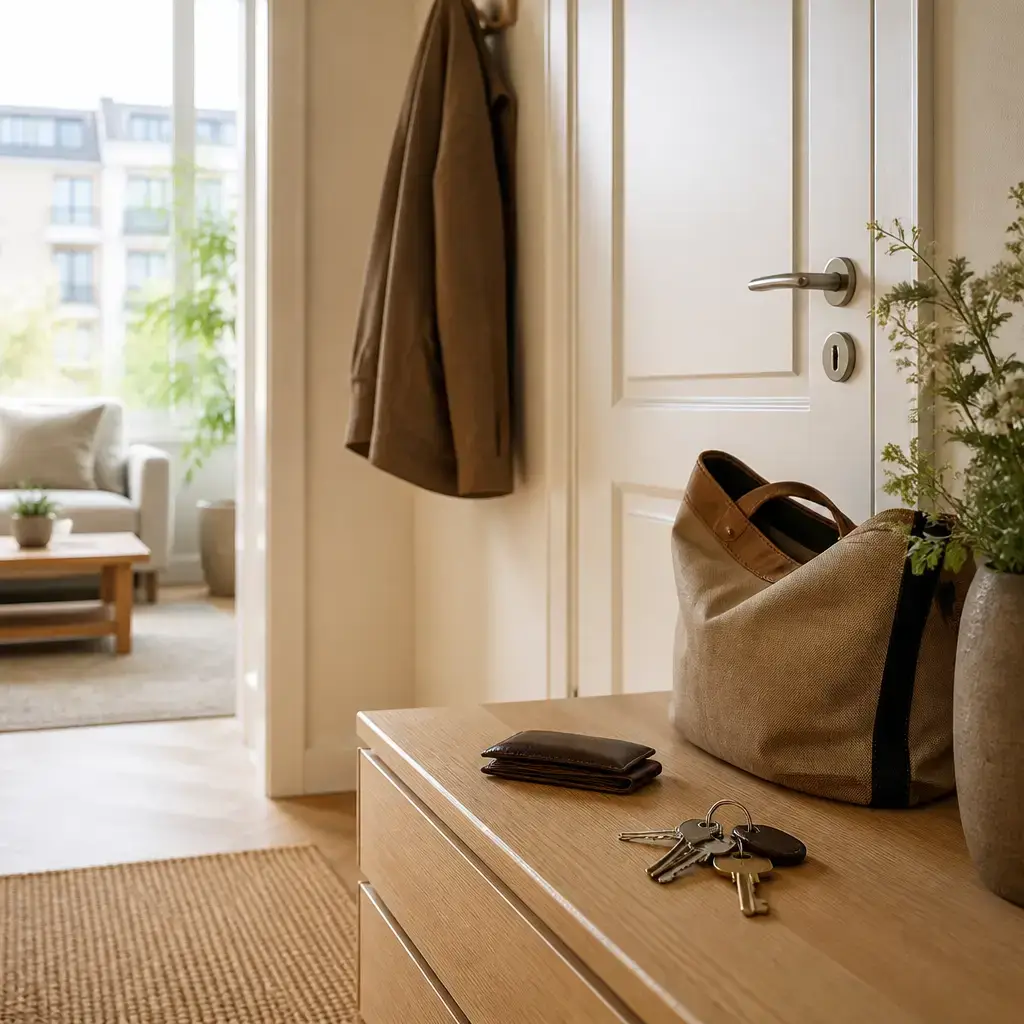
Haben wir alles, bevor wir gehen?
HAH-ben veer AH-les, beh-FOHR veer GAY-en? Do we have everything before we leave?Lass uns jetzt nachsehen.
lahs oons yetst NAHKH-zay-en. Let's check now.Hast du deine Schlüssel?
hahst doo DYE-neh SHLISS-el? Do you have your keys?Sie sind in meiner Tasche.
zee zint in MY-nuh TAH-sheh. They're in my pocket.Ist dein Portemonnaie in deiner Tasche?
ist dine por-teh-moh-NAY in DYE-nuh TAH-sheh? Is your wallet in your bag?Ich habe es dort hineingelegt.
ikh HAH-beh es dort hin-EYN-geh-LAYKT. I put it in there.Ist die Tür abgeschlossen?
ist dee TEWR AHP-guh-SHLOSS-en? Is the door locked?Ich habe gerade nachgesehen.
ikh HAH-beh geh-RAH-deh NAHKH-zay-en. I checked it just now.Sentence explanations
Haben wir alles, bevor wir gehen?
Do we have everything before we leave?
- Haben wir
- do we have
- alles
- everything
- bevor
- before
- gehen
- leave
More detail
Haben wir combines haben (“to have”) with wir (“we”). haben is in the present tense, first-person plural form: wir haben means “we have.” German yes/no questions commonly put the finite verb first: Haben wir ...? means “Do we have ...?” Here it asks whether the group has everything needed. alles means “everything” and is an indefinite pronoun: it refers to the whole relevant set without naming each item. Example: Wir haben alles. — “We have everything.” bevor introduces a clause meaning “before.” It places the event in that clause earlier than the event in the main clause. A clause introduced by bevor normally sends its finite verb to the end: Bevor wir gehen, prüfen wir die Liste. — “Before we leave, we check the list.” gehen is the infinitive of “to go” and, in this sentence, means “to leave.” In wir gehen, the verb is the present-tense first-person plural form; after bevor, the infinitive form appears at the end of the subordinate clause: bevor wir gehen — “before we leave.” Together, Haben wir alles asks whether “we” have the complete relevant set, and bevor wir gehen sets leaving as the later event. The whole utterance therefore means: “Do we have everything before we leave?”
Lass uns jetzt nachsehen.
Let's check now.
- Lass uns
- let’s
- jetzt
- now
- nachsehen
- check
More detail
Lass uns is a reusable German way to suggest doing something together: Lass uns + infinitive means “let’s + verb.” Lass is the informal singular imperative of lassen (“let”); uns means “us” and refers to the speaker together with at least one other person. The more formal version is Lassen Sie uns .... jetzt is the adverb “now.” It places the proposed action in the present moment. For example, Wir machen das jetzt. means “We’re doing that now.” nachsehen is the infinitive “to check” here. It is also a separable verb: in a main clause, its parts can separate, as in Wir sehen das nach. (“We’ll check that.”) After Lass uns, however, the infinitive stays together: Lass uns das nachsehen. Together, Lass uns jetzt nachsehen. means “Let’s check now.” The suggestion is for the speaker and the other person to carry out the checking together, with jetzt specifying when and nachsehen naming the action.
Hast du deine Schlüssel?
Do you have your keys?
- Hast du
- do you have
- deine
- your
- Schlüssel
- keys
More detail
Hast du is the yes/no-question form of haben (“to have”). The base form is haben; hast is its present-tense form for du (“you,” singular informal). In a German main-clause question, the finite verb comes before the subject: Hast du ...? Compare the statement Du hast ... (“You have ...”). deine means “your” here. It is the possessive form related to du and agrees with the thing possessed, not with the owner. With the plural noun Schlüssel, the form is deine; the same form is also used with a feminine singular noun in the relevant cases, so the form alone does not establish which of those noun categories is present. The intended noun here is plural, as shown by the translation “keys.” Schlüssel means “keys” here. Its singular and plural forms are both Schlüssel; the plural meaning is identified by deine and by the fixed translation. A useful pair is ein Schlüssel (“a key”) and zwei Schlüssel (“two keys”). Together, Hast du asks whether the addressee possesses or has something, deine Schlüssel identifies that thing as the addressee’s keys, and the whole utterance means “Do you have your keys?”
Sie sind in meiner Tasche.
They're in my pocket.
- Sie
- they
- sind
- are
- in
- in
- meiner
- my
- Tasche
More detail
Sie means “they” here, as established by the fixed translation. German sie can also mean “she” or “they,” while capitalized Sie can mean formal “you”; at the beginning of a sentence, capitalization alone does not distinguish these uses. Here the intended reading is the plural pronoun “they.” sind is the present-tense form of sein (“to be”) for sie meaning “they”: sie sind = “they are.” Compare ich bin (“I am”) and du bist (“you are”). Example: Die Schlüssel sind hier. — “The keys are here.” in means “in.” For a location, German uses in with the dative: in der Tasche means “in the pocket/bag.” With movement into something, in commonly takes the accusative instead, as in Ich lege es in die Tasche. — “I put it in the pocket/bag.” meiner is the dative feminine singular form of the possessive word mein (“my”). It agrees with the feminine noun it modifies and also shows the dative required by the stationary location after in: in meiner Tasche. The basic forms include mein in forms such as mein Buch, meine Tasche, and meiner Tasche in this dative context. Tasche is a feminine noun: die Tasche. In this fixed sentence, the translation identifies it as “pocket.” German Tasche can also mean “bag” in other contexts, but that is not the intended meaning here. Example: Das Buch ist in der Tasche. — “The book is in the pocket/bag.” Together, Sie sind gives “they are,” and in meiner Tasche gives “in my pocket.” The complete utterance therefore means “They’re in my pocket.”
Ist dein Portemonnaie in deiner Tasche?
Is your wallet in your bag?
- Ist
- is
- dein
- your
- Portemonnaie
- wallet
- in
- in
- deiner
- your
- Tasche
- bag
More detail
Ist is the present-tense form of sein (“to be”) for er/sie/es and for a singular noun such as das Portemonnaie. In this sentence it comes first because German forms a yes/no question by placing the finite verb before the subject. Compare the statement Dein Portemonnaie ist in deiner Tasche. (“Your wallet is in your bag.”). dein means “your” here and agrees with the noun it determines: Portemonnaie is neuter, singular, and nominative because it is the subject. The basic form is dein; the form changes with the noun’s grammatical gender, number, and case, for example deine Tasche for a feminine nominative or accusative noun. Portemonnaie is the noun “wallet.” Its plural is Portemonnaies. Example: Mein Portemonnaie ist hier. — “My wallet is here.” in expresses location here: something is situated inside something else. With a static location, in takes the dative; with movement into a place, it takes the accusative. Compare Das Portemonnaie ist in der Tasche. (“The wallet is in the bag.”) with Ich lege das Portemonnaie in die Tasche. (“I put the wallet into the bag.”). deiner means “your” and is the dative feminine form of the possessive determiner dein, agreeing with Tasche after location in. This form is not an inflection of Tasche; it is the possessive determiner that carries the case marking. Compare deine Tasche in a nominative or accusative context with in deiner Tasche for a fixed location. Tasche means “bag” here. It is feminine: die Tasche; the dative singular form with the definite article is der Tasche. Example: Die Tasche ist auf dem Tisch. — “The bag is on the table.” Together, the structure is Ist + dein Portemonnaie + in deiner Tasche?: the finite verb first marks a yes/no question, the subject is “your wallet,” and the location phrase says “in your bag.” The complete meaning is “Is your wallet in your bag?”
Ich habe es dort hineingelegt.
I put it in there.
- Ich habe
- I have
- es
- it
- dort
- there
- hineingelegt
- put in
More detail
Ich habe uses haben as the first-person singular auxiliary: ich habe = “I have.” In this utterance, it helps form the perfect tense; the completed-action meaning comes from the participle at the end, hineingelegt. Compare ich habe ... gelegt (“I put / have put ...”) with du hast ... gelegt (“you put / have put ...”). es is the neuter singular accusative pronoun meaning “it” here. Its specific referent is not identified by the supplied sentence or translation, so learn the reusable pattern ich lege es ... (“I put it ...”). The form es marks the pronoun’s grammatical class and role; it does not identify what the object is. dort means “there,” referring to a place. It contrasts with hier (“here”). Example: Ich war dort. — “I was there.” hineingelegt is the perfect participle of hineinlegen, “to put/place something into a place.” The base verb is hineinlegen; its participle is hineingelegt, and its simple-past form is legte hinein. The verb legen means “to lay or put” something in a position, while liegen means “to lie/be located” and describes the object’s position rather than the act of placing it. Example: Ich habe das Buch hineingelegt. — “I put the book in there.” Together, Ich habe ... hineingelegt forms a completed-action statement in the perfect: the speaker says that they put it into the place indicated by dort. German places the auxiliary in the second position and the participle at the end: Ich habe es dort hineingelegt. The whole utterance therefore means “I put it in there.”
Ist die Tür abgeschlossen?
Is the door locked?
- Ist
- is
- Tür
- door
- abgeschlossen
- locked
More detail
Ist is the third-person singular present form of sein (“to be”). In a yes/no question, the finite verb comes first: Ist ...? means “Is ...?” Tür means “door.” Its base form is the feminine noun die Tür; the form Tür itself does not show the article or case here. The noun phrase die Tür means “the door,” referring to the door identified in this situation. abgeschlossen means “locked” here. It is the past participle of abschließen (“to lock” or “to close and secure”), used after sein to describe the resulting state. Compare geschlossen (“closed”): a door can be closed without necessarily being locked. In a statement, for example, Die Tür ist abgeschlossen. means “The door is locked.” Together, Ist + die Tür + abgeschlossen forms a yes/no question about the door’s current locked state: “Is the door locked?”
Ich habe gerade nachgesehen.
I checked it just now.
- Ich habe
- I have
- gerade
- just now
- nachgesehen
- checked
More detail
Ich habe combines the first-person singular pronoun Ich (“I”) with habe, the first-person singular present form of haben (“to have”). Here habe is an auxiliary: with the participle at the end, it forms the German perfect tense for a completed past action. Compare ich habe gesehen (“I saw / I have seen”) with du hast gesehen (“you saw / you have seen”); the auxiliary changes for the subject. Example: Ich habe angerufen. — “I called.” gerade means “just now” in this sentence, placing the checking very close to the present moment. It can have other context-dependent uses, but here it is a time adverb, not part of the verb form. Example: Sie ist gerade angekommen. — “She has just arrived.” nachgesehen is the past participle of the separable verb nachsehen, meaning “to check” or “to look something up.” Its parts are not separate words in this form: the participle is written nachgesehen, with the prefix nach- before the participle form of sehen (“to see”). With haben, it expresses a completed checking action. In this utterance, the fixed translation identifies the intended meaning as “checked it”; the object is understood from the context rather than stated in the German sentence. Example: Ich habe im Kalender nachgesehen. — “I checked the calendar.” Together, Ich habe ... nachgesehen is the German perfect pattern “I checked ... / I have checked ...”. In Ich habe gerade nachgesehen., gerade specifies that the completed check happened just now, giving the whole meaning “I checked it just now.”
Grammar Points
bevor + Nebensatz: Verb am Ende
Bevor wir gehen, sehen wir nach.
beh-FOHR veer GAY-en, ZAY-en veer NAHKH.Before we leave, we check.
After „bevor“, the conjugated verb goes to the end of the subordinate clause.
haben + Partizip II im Perfekt
Ich habe das Portemonnaie dort hineingelegt.
ikh HAH-beh dahs por-teh-moh-NAY dort hin-EYN-geh-LAYKT.I put the wallet in there.
German uses „haben“ plus the past participle to form the perfect tense.
German Vocabulary
Haben wir alles?
Quiz
Word Order
Arrange the words in the correct order.
Do we have everything before we leave?
Show Answer
Haben wir alles, bevor wir gehen?Let's check now.
Show Answer
Lass uns jetzt nachsehen.Do you have your keys?
Show Answer
Hast du deine Schlüssel?Spelling
Tap the letters to spell the word.
before
Show Answer
bevorto check; to look
Show Answer
nachsehenpocket; bag
Show Answer
Tascheto go; to leave