10 minutes free every day
Continue audio lessons in the app
Word explanations appear automatically in sync with the audio.
No login required · synced translations · playback with the screen locked
Choose your learning language and open this lesson in the app.

About This Lesson
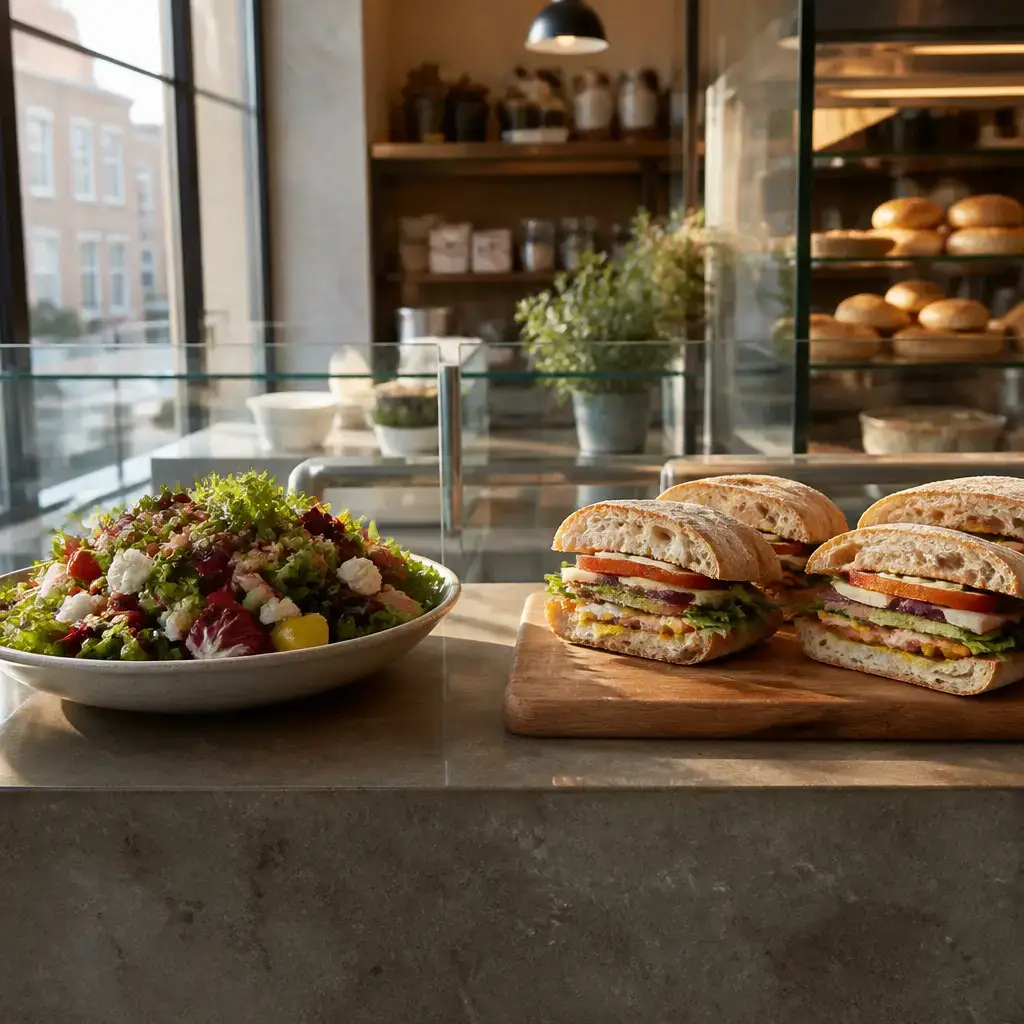
Use Choosing Food to practice German conversation, pronunciation, vocabulary, grammar, and quizzes.
Dialogue
Soll ich ein Sandwich oder einen Salat wählen?
zoll ikh eye-n SENT-vitch OH-der EYE-nen zah-LAHT VAY-len? Should I choose a sandwich or a salad?Der Salat ist eine leichtere Wahl.
dare zah-LAHT ist EYE-nuh LYKHT-uh-ruh VAHL. The salad is a lighter option.Ich habe nicht sehr viel Hunger.
ikh HAH-buh nikht zair feel HOONG-er. I am not very hungry.Dann passt er vielleicht besser zu dir.
dahn passt air fee-LYKHT BESS-er tsoo deer. Then it may suit you better.Was nimmst du?
vahs nimst doo? What are you getting?Ich möchte etwas Größeres.
ikh MURKHT-uh ET-vahs GRUR-suh-rus. I want something bigger.Ich nehme das Sandwich.
ikh NAY-muh dahs SENT-vitch. I will choose the sandwich.Der Salat passt für mich.
dare zah-LAHT passt fyoor mikh. The salad works for me.Lass uns bestellen, wenn die Bedienung zurückkommt.
lahss oons beh-SHTELL-en, venn dee beh-DEE-noong tsoo-RUEK-komt. Let's order when the server comes back.Sentence explanations
Soll ich ein Sandwich oder einen Salat wählen?
Should I choose a sandwich or a salad?
- Soll ich
- Should I …?
- Sandwich
- sandwich
- Salat
- salad
- wählen
- choose
More detail
Soll ich begins a yes/no question. soll is the first-person singular form of sollen; here it asks whether the speaker ought to or should do something. In a main-clause question, the finite verb comes first, followed by the subject: Soll ich ...? = “Should I ...?” This pattern is reusable with another infinitive, for example: Soll ich warten? — “Should I wait?” Sandwich means “sandwich.” In ein Sandwich, the article and noun form the first option. Sandwich is neuter in German, and the neuter indefinite article is ein in both the nominative and accusative here. The choice of ein is therefore not itself a statement that there is exactly one sandwich; it is the normal indefinite noun phrase for this meaning. Salat means “salad.” In einen Salat, the noun is masculine and appears with the masculine accusative article einen, because it is the object of wählen. Compare the two object phrases: ein Sandwich (neuter) and einen Salat (masculine). The article carries the visible case difference; Salat itself does not change form here. wählen means “to choose” or “to select.” It is the infinitive, the base form used after sollen. In this question, wählen comes at the end, while the finite form soll is at the beginning. For example: Soll ich den Salat wählen? — “Should I choose the salad?” The structure is Soll ich [option A] oder [option B] wählen? The conjunction oder joins the two alternatives: ein Sandwich and einen Salat. Together, the sentence asks whether the speaker should choose a sandwich or a salad. The following context describes the salad as eine leichtere Wahl, “a lighter option,” but the question itself presents both foods as alternatives without stating which one will be chosen.
Der Salat ist eine leichtere Wahl.
The salad is a lighter option.
- Salat
- salad
- ist
- is
- leichtere
- lighter
- Wahl
- choice; option
More detail
Salat means “salad” here. It is a masculine German noun: der Salat in the nominative, einen Salat in the accusative. For example: Der Salat ist frisch. — “The salad is fresh.” ist is the third-person singular present form of sein (“to be”), used with a singular subject such as der Salat. The basic pattern is X ist Y — “X is Y.” leichtere means “lighter” here. Its base adjective is leicht (“light”), and its comparative form is leichter (“lighter”). In eine leichtere Wahl, the comparative describes the feminine noun Wahl and carries the ending -e after eine; the observed form is therefore leichtere. Example: Das ist eine leichtere Aufgabe. — “That is an easier task.” Wahl means “choice” or “option” here. It is feminine: die Wahl, and in this phrase it appears as eine Wahl. Example: Das ist eine gute Wahl. — “That is a good choice.” Together, Der Salat ist identifies the salad as the subject and uses the present-tense “is.” eine leichtere Wahl describes it as an option that is lighter than another relevant option. Thus the whole utterance means: “The salad is a lighter option.”
Ich habe nicht sehr viel Hunger.
I am not very hungry.
- Ich habe
- I have
- nicht
- not
- sehr viel
- very much
- Hunger
- hunger
More detail
Ich habe uses the first-person singular form of haben, whose base form is haben. Here, haben is part of the German expression Hunger haben, literally “to have hunger,” which naturally means “to be hungry.” Compare Ich habe Hunger. — “I am hungry.” The form habe agrees with ich; it is not the noun Hunger that carries this verb inflection. nicht places negation on the following description of the amount of hunger. In this sentence, it makes the meaning “not very much,” rather than simply asserting hunger. German nicht can negate different parts of a sentence, so its position helps show what is being denied or limited. sehr viel means “very much” here. sehr intensifies viel; viel describes a large amount and is used with the mass-like noun Hunger. For example, Ich habe sehr viel Hunger. means “I am very hungry.” With negation, Ich habe nicht sehr viel Hunger. means that the amount is not very large, rather than necessarily meaning that there is no hunger at all. Hunger is the masculine noun meaning “hunger.” In the expression Hunger haben, it is used without an article. The same noun can occur with an article when referring to hunger more generally or in a particular context, for example Der Hunger ist groß. — “The hunger is great.” Together, Ich habe + nicht sehr viel Hunger forms a first-person statement about the speaker’s amount of hunger: “I have not very much hunger.” Natural English expresses this as “I am not very hungry.”
Dann passt er vielleicht besser zu dir.
Then it may suit you better.
- Dann
- Then
- passt
- suits; fits
- er
- it
- vielleicht
- perhaps; maybe
- besser
- better
- zu dir
- to you
More detail
Dann means “then” here, linking this statement to a later point or choice. It can also mean “in that case” in other contexts, but this sentence uses the time/sequence meaning. Example: Dann gehen wir. — “Then we’ll go.” passt is the third-person singular present form of passen (“to suit; to fit”): passen → er passt. The subject is er, so the verb has the ending -t. With zu plus a dative expression, passen can describe suitability for someone: Das passt zu mir. — “That suits me.” er is a masculine singular personal pronoun. In this sentence, the fixed translation identifies it as “it,” referring to an already understood item; the supplied texts do not identify that item more specifically. The pronoun’s grammatical form is masculine singular, while its English translation can be “it.” vielleicht means “perhaps” or “maybe.” It makes the statement uncertain rather than definite. Example: Vielleicht kommt er später. — “Maybe he’ll come later.” besser is the comparative form of gut (“good”): gut → besser (“better”) → am besten (“best”). It compares the suitability here with another possibility or an earlier situation. Example: Diese Lösung ist besser. — “This solution is better.” zu dir consists of the preposition zu and dir, the dative form of the informal singular pronoun du (“you”): du → dir. In the pattern zu jemandem passen, the dative expression names the person for whom something suits or fits. Example: Die Farbe passt zu dir. — “The color suits you.” Together, Dann passt er vielleicht besser zu dir. means “Then it may suit you better.” Dann sets the sequence or situation; er is the item being evaluated; passt ... zu dir expresses suitability for you; vielleicht adds uncertainty; and besser makes a comparison with another option or situation.
Was nimmst du?
What are you getting?
- Was
- what
- nimmst
- are getting
- du
- you
More detail
Was asks for an unspecified thing: “what?”. It is the interrogative pronoun used here for the thing being chosen or obtained. Example: “Was möchtest du?” — “What would you like?” nimmst is the second-person singular present form of nehmen (“to take”). In this question, the context and fixed translation give it the meaning “are getting” or “are choosing,” rather than only physical taking. The useful present-tense forms include ich nehme (“I take”), du nimmst (“you take”), and er/sie nimmt (“he/she takes”); the vowel change from e to i occurs in the du and er/sie forms. Example: “Du nimmst den kleineren.” — “You’re choosing the smaller one.” du is the informal singular “you” and is the subject of nimmst. German uses the subject pronoun after the question word and verb here: Was nimmst du? The verb form nimmst also identifies the addressee as singular informal, while du makes that subject explicit. Together, Was asks which thing, and nimmst du asks what the addressee is choosing or getting. The whole utterance therefore means “What are you getting?” The present form can describe a choice being made now; the wording is a short, ordinary question.
Ich möchte etwas Größeres.
I want something bigger.
- Ich möchte
- I want / I would like
- etwas
- something
- Größeres
- something bigger
More detail
Ich möchte means “I want” here, and it is also a common polite way to say “I would like.” möchte is the first-person singular form used with ich; it comes from mögen, but the form möchte is the one used for this present-time desire. For example: Ich möchte einen Tee. — “I would like a tea.” etwas is an indefinite pronoun meaning “something.” It refers to an unspecified thing, without stating a number. A reusable pattern is Ich möchte etwas ... — “I would like something ...”. Größeres expresses “something bigger.” It is the comparative form of groß: groß — “big,” größer — “bigger,” am größten — “biggest.” In this sentence, the comparative adjective is used substantivally, so it is capitalized and takes the ending -es after etwas: etwas Größeres. The adjective describes an unspecified thing rather than naming the thing itself. For example: Wir suchen etwas Größeres. — “We are looking for something bigger.” Together, Ich möchte + etwas Größeres gives “I want something bigger,” or more politely, “I would like something bigger.”
Ich nehme das Sandwich.
I will choose the sandwich.
- Ich
- I
- nehme
- choose
- Sandwich
- sandwich
More detail
Ich means “I” here. It is the first-person singular pronoun, used for the speaker. In German, its related object form is mich: Ich sehe mich. means “I see myself.” nehme is the present-tense form of nehmen (“to take”); with ich, the verb is ich nehme. In this utterance, the fixed translation shows that nehmen means “choose” in the context of selecting an item, rather than only physical taking. Other forms include du nimmst (“you take/choose”) and wir nehmen (“we take/choose”). Example: Ich nehme den Tee. — “I’ll choose the tea.” das Sandwich means “the sandwich.” Sandwich is a noun, and das is the definite article used with this noun here. German nouns are capitalized. The article and noun form a reusable pattern: das + noun, as in das Buch (“the book”). Together, Ich nehme das Sandwich. means “I will choose the sandwich.” German present tense can express a decision or intended action about the near future; here, nehme presents the speaker’s choice. The structure is Ich + nehme + das Sandwich: “I choose/will choose the sandwich.”
Der Salat passt für mich.
The salad works for me.
- Salat
- salad
- passt
- works; suits
- für mich
- for me
More detail
Salat means “salad” here. It is a masculine German noun, so the definite article in Der Salat is der in the nominative singular. German nouns are capitalized. Example: Der Salat ist frisch. — “The salad is fresh.” passt is the present-tense, third-person singular form of passen (“to fit” or “to suit”). With a food or choice as the subject, passen can mean that something works for someone or is suitable for them. The form is passen for the base form and passt with a singular third-person subject such as der Salat. Example: Das passt für mich. — “That works for me.” für mich expresses who the choice suits. für is a preposition that takes the accusative, and mich is the accusative form of the first-person singular pronoun ich (“I”). Compare ich as the subject with mich after für: Das ist für mich. — “That is for me.” Together, Der Salat supplies the subject, passt says that it is suitable, and für mich identifies the person for whom it is suitable. The whole utterance therefore means “The salad works for me.”
Lass uns bestellen, wenn die Bedienung zurückkommt.
Let's order when the server comes back.
- Lass uns
- let’s
- bestellen
- order
- wenn
- when
- die Bedienung
- the server
- zurückkommt
- comes back
More detail
Lass uns is a common way to make a suggestion meaning “let’s …”. Lass is the informal singular imperative of lassen (“to let”); with uns (“us”), the construction invites the speaker and the listener to do the following action. Example: Lass uns gehen. — “Let’s go.” bestellen means “to order,” especially food or drinks in this context. It is an infinitive after the suggestion construction: Lass uns bestellen — “Let’s order.” The same verb can also mean ordering something in another setting, such as a product, but here the restaurant meaning is supported by the context. wenn introduces the condition or time at which something happens. Here it means “when,” not a question word. In a clause introduced by wenn, the finite verb normally comes at the end. Example: Ich rufe an, wenn ich ankomme. — “I’ll call when I arrive.” die Bedienung means “the server” here. Bedienung is a feminine German noun, so it takes the feminine singular article die; this grammatical gender does not by itself state the server’s personal gender. Depending on context, Bedienung can also refer more generally to service or serving staff. zurückkommt means “comes back.” It is the third-person singular present form of the separable verb zurückkommen (“to come back”). In a main clause, the parts separate: Die Bedienung kommt zurück. — “The server comes back.” In the subordinate wenn-clause, the finite verb is at the end and appears together as zurückkommt. Together, wenn die Bedienung zurückkommt means “when the server comes back.” The wenn-clause gives the time for the suggestion: Lass uns bestellen, wenn die Bedienung zurückkommt. — “Let’s order when the server comes back.”
Grammar Points
etwas + substantiviertes Adjektiv
etwas Größeres
ET-vahs GRUR-suh-russomething bigger
After etwas, an adjective can be used like a noun and is capitalized: Größeres.
Lass uns + Infinitiv
Lass uns bestellen
lahss oons beh-SHTELL-enLet's order
Lass uns + the infinitive expresses a suggestion for an activity: “Let's …”.
German Vocabulary
suits you better
I am not very hungry
a lighter option
I want something bigger
What are you getting?
it suits you better
a salad; the salad
a sandwich
perhaps better
a choice
choose
What are you getting?
Quiz
Word Order
Arrange the words in the correct order.
The salad is a lighter option.
Show Answer
Der Salat ist eine leichtere Wahl.I am not very hungry.
Show Answer
Ich habe nicht sehr viel Hunger.What are you getting?
Show Answer
Was nimmst du?Spelling
Tap the letters to spell the word.
lighter
Show Answer
leichterehunger
Show Answer
Hungerto choose
Show Answer
wählensuits; fits