10 minutes free every day
Continue audio lessons in the app
Word explanations appear automatically in sync with the audio.
No login required · synced translations · playback with the screen locked
Choose your learning language and open this lesson in the app.

About This Lesson
Use Choosing a Place to Sit to practice German conversation, pronunciation, vocabulary, grammar, and quizzes.
Dialogue
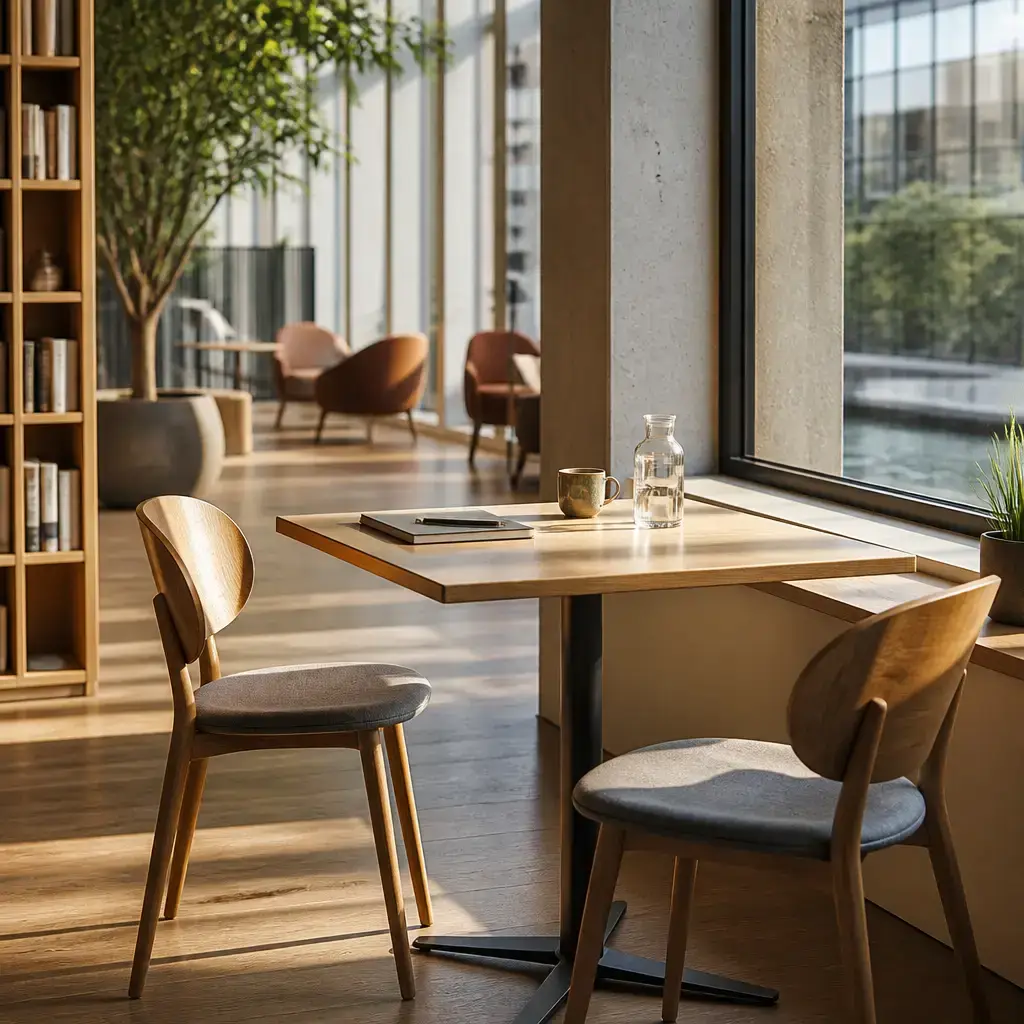
Wo sollen wir sitzen?
voh ZOL-len veer ZIT-tsen? Where should we sit?Der Tisch in der Ecke steht an einem ruhigen Ort.
dayr TISH in dayr ECK-uh shtayt an EYE-nem ROO-ee-gen ORT. The corner table is in a quiet spot.An diesem Tisch ist auch gutes Licht.
an DEE-zem TISH ist owkh GOO-tes LIKHT. This table has nice light too.Dieser Tisch wäre besser zum Lesen.
DEE-zair TISH VAIR-uh BEH-ser tsoom LAY-zən. This table would be better for reading.Sind diese Stühle bequem?
zint DEE-zuh SHTOO-luh beh-KVAYM? Are these chairs comfortable?Für mich sind sie bequem.
fyoor mikh zint zee beh-KVAYM. They feel fine to me.Setzen wir uns an diesen Tisch.
ZET-tsen veer oons an DEE-zən TISH. Let's sit at this table.Ich stelle unsere Taschen unter den Tisch.
ikh SHTEL-luh OON-zuh-ruh TASH-en OON-ter dayn TISH. I'll put our bags under it.Sentence explanations
Wo sollen wir sitzen?
Where should we sit?
- Wo
- where
- sollen wir
- should we
- sitzen
- sit
More detail
Wo means “where” and asks for a place. It is used for a location, not for a person. Example: Wo ist der Tisch? — “Where is the table?” Sollen wir is a useful question pattern meaning “should we …?” Here, sollen is the present-tense form of the modal verb sollen for wir (“we”); wir is the first-person plural pronoun. With a modal verb, the other verb normally stays in the infinitive and comes later in the clause. Example: Sollen wir warten? — “Should we wait?” Sitzen means “to sit” or “be seated.” It is the infinitive form, used here after the modal verb sollen. Its present-tense forms include ich sitze (“I sit”), wir sitzen (“we sit”), and sie sitzen (“they sit”). Example: Wir sitzen am Tisch. — “We are sitting at the table.” Together, Wo asks for the location, sollen wir asks what location is advisable or intended for the speakers, and sitzen supplies the action. The whole utterance means “Where should we sit?”
Der Tisch in der Ecke steht an einem ruhigen Ort.
The corner table is in a quiet spot.
- Tisch
- table
- Ecke
- corner
- steht
- is located
- ruhigen
- quiet
- Ort
- place; spot
More detail
Tisch means “table” here. Its base form is der Tisch; the plural is die Tische. In Der Tisch, the masculine singular noun is the subject, so the definite article is nominative: der Tisch. Example: Der Tisch ist groß. — “The table is large.” Ecke means “corner.” The form der Ecke occurs after in here because in der Ecke describes a fixed location, not movement toward a location. Ecke is feminine: die Ecke in the basic form, and der Ecke in this dative phrase. Example: Der Stuhl steht in der Ecke. — “The chair is in the corner.” steht is the third-person singular present form of stehen, “to stand” or, for an object, “to be located.” The subject is Der Tisch, so the verb is singular. In this sentence, stehen describes the table’s position rather than a person literally standing. Example: Die Lampe steht am Fenster. — “The lamp is by the window.” ruhigen means “quiet” here. Its base form is the adjective ruhig; ruhigen is an inflected form. In an einem ruhigen Ort, the adjective follows the indefinite article einem and takes the ending -en in this dative masculine phrase. The adjective describes Ort, not Tisch. Example: Wir suchen einen ruhigen Platz. — “We are looking for a quiet place.” Ort means “place” or “spot.” Its basic form is der Ort; here it appears as einem ... Ort after an, which marks a fixed location and therefore uses the dative. einem is the dative masculine/neuter form of the indefinite article; it does not by itself assert a numerical count. Example: Das Café ist an einem schönen Ort. — “The café is in a beautiful place.” The sentence begins with Der Tisch in der Ecke: “the table in the corner.” The phrase in der Ecke identifies which table is meant. steht then says where that table is located. Finally, an einem ruhigen Ort gives its location as “in a quiet spot.” Together, the utterance means: “The corner table is in a quiet spot.”
An diesem Tisch ist auch gutes Licht.
This table has nice light too.
- An
- at
- diesem
- this
- Tisch
- table
- ist
- is
- auch
- also; too
- gutes
- good; nice
- Licht
- light
More detail
An is a preposition meaning “at” here. For a stationary location, an takes the dative: an dem Tisch means “at the table.” In this sentence, an and diesem Tisch together form the location phrase. diesem means “this” here and is the dative masculine singular form of the demonstrative pattern dieser. It matches Tisch, a masculine noun, in the phrase an diesem Tisch. The form changes with grammatical case and gender: for example, dieser Tisch is nominative, while diesem Tisch is dative. Example: Ich sitze an diesem Tisch. — “I am sitting at this table.” Tisch means “table.” Its plural is Tische. In the fixed sentence, it is the noun governed by the dative preposition an. ist is the third-person singular present form of sein, “to be.” The pattern An ... ist ... presents something as being available or present at a location. Example: Im Zimmer ist Licht. — “There is light in the room.” auch means “also” or “too.” It adds this location or situation to something already relevant: the table has good light in addition to the other features or places under discussion. Its exact scope comes from the sentence context. gutes is the inflected form of the adjective gut, “good”; here it has the context-appropriate sense “nice.” It describes Licht. Because Licht is neuter singular and there is no article before the adjective, the adjective has the neuter nominative ending -es: gutes Licht. Useful comparison forms are gut — “good,” besser — “better,” and am besten — “best.” Example: Das ist gutes Licht zum Lesen. — “That is good light for reading.” Licht means “light.” It is a neuter noun, so the adjective phrase is gutes Licht in the nominative. Here it is what is present at the table, rather than an object being physically possessed by the table. Putting the parts together: An diesem Tisch gives the location, ist says that something is present there, auch adds it to the relevant situation, and gutes Licht identifies what is present. The full meaning is: “This table has nice light too,” or more literally, “There is also good light at this table.”
Dieser Tisch wäre besser zum Lesen.
This table would be better for reading.
- Dieser
- this
- Tisch
- table
- wäre
- would be
- besser
- better
- zum Lesen
- for reading
More detail
Dieser means “this” here and modifies Tisch. It is the masculine singular nominative form of the demonstrative determiner dies-, because Tisch is the masculine singular subject. Compare dieser Tisch (“this table”) with diese Stühle (“these chairs”); the form reflects the noun’s grammatical features, not a stated distance or number of tables. Tisch is the noun “table.” Its plural is Tische. Example: Der Tisch ist groß. — “The table is large.” wäre is the third-person singular Konjunktiv II form of sein (“to be”). In this sentence it expresses a hypothetical or tentative evaluation: “would be.” The form agrees with the singular subject Dieser Tisch. Compare ist (“is”) for a direct present statement with wäre (“would be”) for a conditional or less direct assessment. Example: Der Tisch wäre praktischer. — “The table would be more practical.” besser is the comparative form of gut (“good”): gut → besser → am besten (“good” → “better” → “best”). It describes the table’s suitability in this comparison, rather than simply saying that it is good. A comparison with a specific alternative can use besser als: Dieser Tisch ist besser als der andere. — “This table is better than the other one.” zum Lesen expresses the activity or purpose “for reading.” zum is the contraction of zu dem, and Lesen is the capitalized nominalized infinitive of lesen (“to read”). German commonly uses zu plus a nominalized activity for a purpose or intended use: ein Platz zum Sitzen — “a place for sitting.” Here, zum Lesen does not name a separate person or object; it identifies the activity for which the table would be more suitable. Together, Dieser Tisch supplies the subject, wäre presents a hypothetical evaluation, besser gives the comparative assessment, and zum Lesen specifies its intended use. The complete meaning is: “This table would be better for reading.”
Sind diese Stühle bequem?
Are these chairs comfortable?
- Sind
- are
- diese
- these
- Stühle
- chairs
- bequem
- comfortable
More detail
Sind is the present-tense form of sein (“to be”) for third-person plural, and it is also used with sie meaning “they” and with Sie meaning formal “you.” Here it is third-person plural because the subject is diese Stühle. In a yes/no question, the finite verb comes first: Sind ...? means “Are ...?” The ordinary statement order would be Diese Stühle sind bequem. diese means “these” and is the plural form used here with Stühle. It identifies multiple items that are being indicated or are salient in the situation. The form agrees with the noun’s grammatical number and case here: plural nominative. In the nominative singular, the related forms are dieser with a masculine noun, diese with a feminine noun, and dieses with a neuter noun. The plural form diese does not show grammatical gender. Stühle means “chairs.” It is the plural of Stuhl (“chair”); the vowel changes from u to ü in this plural, and the plural ending is -e. Example: Der Stuhl ist bequem. — “The chair is comfortable.” bequem means “comfortable” here, describing the chairs. It is a predicative adjective after sein, so it has no ending in this sentence. Its comparative is bequemer (“more comfortable”): Diese Stühle sind bequemer. — “These chairs are more comfortable.” Together, Sind + diese Stühle + bequem forms a yes/no question: “Are these chairs comfortable?” The plural subject is diese Stühle, and bequem describes that subject through the verb sein.
Für mich sind sie bequem.
They feel fine to me.
- Für mich
- to me
- sind
- are
- sie
- they
- bequem
- comfortable
More detail
Für mich means “for me” or “from my point of view.” für takes the accusative case, so the first-person pronoun is mich here; compare ich as the subject form: Ich finde den Stuhl bequem. — “I find the chair comfortable.” sind is a present-tense form of sein (“to be”). In this sentence it agrees with the plural subject sie; the same form also occurs with first-person plural wir: Wir sind bereit. — “We are ready.” sie is the lowercase nominative pronoun meaning “they” here. The fixed translation establishes the plural reading. Its exact real-world referent is not independently specified in the sentence itself. German also uses sie for singular feminine “she,” but that is not the reading in this utterance. bequem means “comfortable” here, especially comfortable to use or sit on. As a predicative adjective after sein, it has no ending: Der Stuhl ist bequem. — “The chair is comfortable.” Useful comparison forms are bequemer (“more comfortable”) and am bequemsten (“most comfortable”). Together, Für mich identifies the speaker’s viewpoint, while sie sind bequem says that the plural entities referred to by sie are comfortable. Thus the whole utterance means “They are comfortable for me,” naturally rendered by the fixed translation as “They feel fine to me.”
Setzen wir uns an diesen Tisch.
Let's sit at this table.
- Setzen wir uns
- let’s sit down
- diesen
- this
- Tisch
- table
More detail
Setzen wir uns uses the first-person plural imperative: the speaker includes the addressee, giving the reusable pattern Verb + wir ... for “let’s ...”. setzen is the base verb “to place” or “to seat”; with the reflexive uns here, sich setzen means “to sit down.” uns is the reflexive form matching wir. This differs from sitzen, which describes already being seated: Wir sitzen. — “We are sitting.” diesen is the masculine accusative form of the demonstrative dieser (“this”). The masculine noun Tisch (“table”) requires this form in the phrase an diesen Tisch. The preposition an takes the accusative here because the sentence presents movement or a change of position toward the table; with a fixed location, German uses the dative: Wir sitzen an diesem Tisch. — “We are sitting at this table.” Tisch means “table.” Its plural is Tische: Die Tische sind groß. — “The tables are big.” Together, Setzen wir uns an diesen Tisch means “Let’s sit down at this table.” The sentence invites the speaker and the addressee to move into a seated position at the specifically indicated table.
Ich stelle unsere Taschen unter den Tisch.
I'll put our bags under it.
- stelle
- put; place
- unsere
- our
- Taschen
- bags
- unter
- under
- Tisch
- table
More detail
stelle is the first-person singular present form of stellen, “to put/place.” The subject is Ich, so the verb has the ending for “I”: ich stelle. German present tense can also describe a planned or immediate future action; here the fixed translation presents it as “I’ll put …”. Compare stellen (place something in a position) with stehen (be standing): Ich stelle die Tasche dort hin means “I put the bag there,” while Die Tasche steht dort means “The bag is there/stands there.” unsere means “our” and agrees with the plural noun Taschen. The possessive determiner is related to unser (“our”); unsere is the form used here with a plural noun. Possessive determiners change form according to the noun phrase’s grammatical features, so do not treat unsere as a plural form of the noun itself. Taschen means “bags” here. Its singular base form is Tasche (“bag”), and Taschen is its plural form. In this sentence it is the object being placed, so the plural accusative has the same visible form as the plural nominative: unsere Taschen. unter means “under/beneath.” It is a German two-way preposition: with a location it can take the dative, while with movement toward a destination it takes the accusative. Because stelle describes moving the bags to a position under the table, the destination phrase uses the accusative: unter den Tisch. For comparison, Die Taschen sind unter dem Tisch means “The bags are under the table,” describing location rather than placement toward it. Tisch means “table.” Its base form is Tisch; with the masculine singular accusative article, it appears in den Tisch. The phrase unter den Tisch therefore means “under the table.” In the fixed translation, “it” refers to the table, as supported by this phrase; the German noun itself is explicitly Tisch. Together, Ich stelle identifies the speaker as the person placing something, unsere Taschen identifies the bags as the object, and unter den Tisch gives the destination. The complete meaning is that the speaker will put their shared bags under the table.
Grammar Points
Setzen wir uns
Setzen wir uns
ZET-tsen veer oonsLet's sit down.
A suggestion with wir places the conjugated verb first; the reflexive pronoun uns means the action applies to ourselves.
Lesen
Lesen
LAY-zənreading
An infinitive used as a noun is capitalized in German.
German Vocabulary
An diesem Tisch ist auch gutes Licht.
An diesem Tisch ist auch gutes Licht.
Dieser Tisch wäre besser zum Lesen.
Der Tisch in der Ecke steht an einem ruhigen Ort.
gutes Licht
An diesem Tisch ist auch gutes Licht.
an einem ruhigen Ort
an einem ruhigen Ort
Wo sollen wir sitzen?
Der Tisch in der Ecke steht an einem ruhigen Ort.
Der Tisch in der Ecke steht an einem ruhigen Ort.
Wo sollen wir sitzen?
Quiz
Word Order
Arrange the words in the correct order.
Where should we sit?
Show Answer
Wo sollen wir sitzen?This table would be better for reading.
Show Answer
Dieser Tisch wäre besser zum Lesen.Are these chairs comfortable?
Show Answer
Sind diese Stühle bequem?Spelling
Tap the letters to spell the word.
corner
Show Answer
Ecketable
Show Answer
Tischto stand; to be located
Show Answer
stehtalso; too