10 minutes free every day
Continue audio lessons in the app
Word explanations appear automatically in sync with the audio.
No login required · synced translations · playback with the screen locked
Choose your learning language and open this lesson in the app.

About This Lesson
Use Choosing a Simple Activity to practice German conversation, pronunciation, vocabulary, grammar, and quizzes.
Dialogue
Welche Aktivität sollen wir machen?
VEL-khuh ak-tee-vee-TAYT ZOL-len veer MAKH-en? What activity should we do?Wir könnten draußen spazieren gehen.
veer KURN-ten DROW-sen shpa-TSEER-en GAY-en. We could walk outside.Draußen kann es kalt sein.
DROW-sen kahn ess KAHLT zine. It may be cold out there.Dann können wir drinnen lesen.
DAHN KURN-en veer DRIN-en LAY-zen. Then we can read inside.Lesen klingt heute besser.
LAY-zen klinkt HOY-tuh BES-er. Reading sounds better today.Lass uns einen ruhigen Raum wählen.
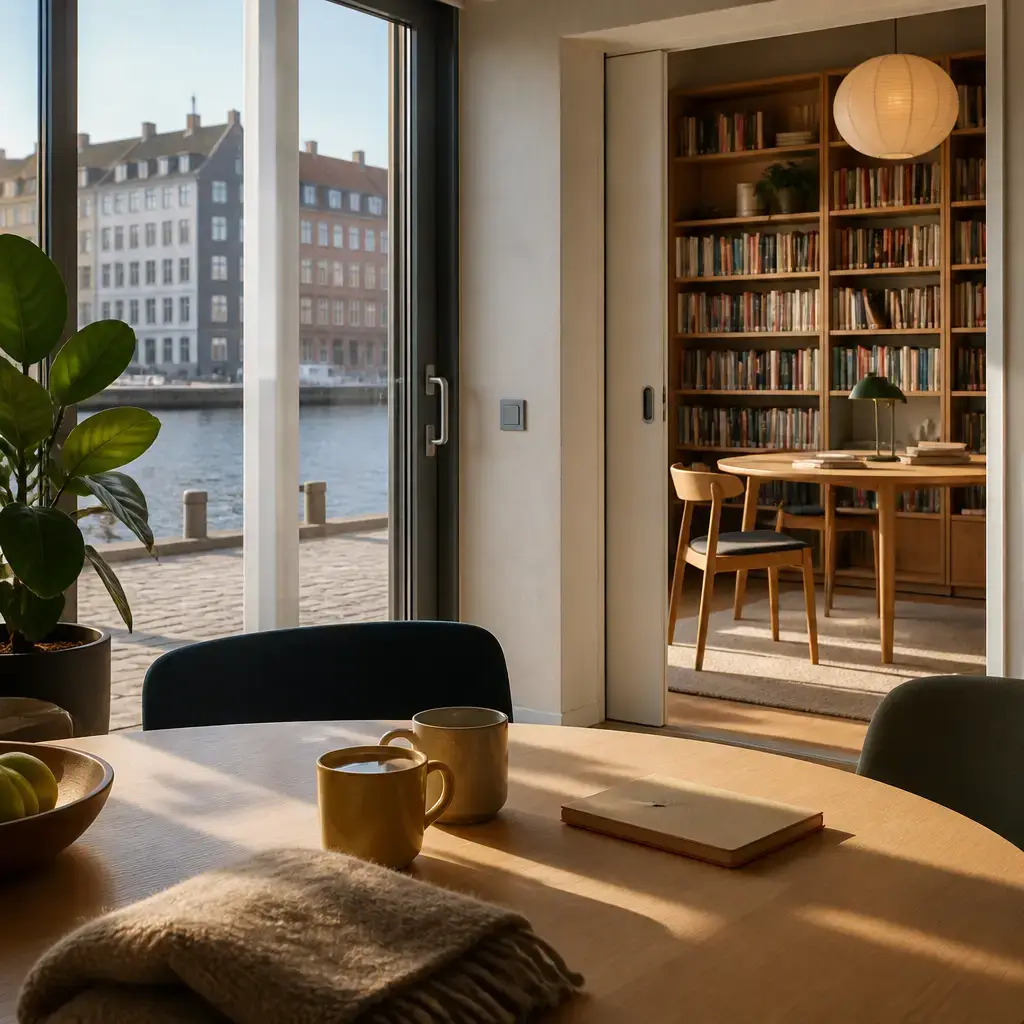
LAHS oons EYE-nen ROO-ih-gen ROWM VAY-len. Let's choose a quiet room.Ich bringe mein Buch mit.
ikh BRING-uh mine BOOKH mit. I'll bring my book.Ich finde einen Platz für uns.
ikh FIN-duh EYE-nen PLAHTS fyoor oons. I'll find a spot for us.Sentence explanations
Welche Aktivität sollen wir machen?
What activity should we do?
- Welche
- which / what
- Aktivität
- activity
- sollen wir
- should we
- machen
- do / make
More detail
Welche means “which/what” here as an interrogative determiner. It appears with the noun Aktivität, so it agrees with that noun in gender and number; Aktivität is feminine singular. In this sentence, the feminine accusative form is also welche. Compare the reusable pattern Welche + noun ...? for asking which option is intended. Aktivität means “activity.” It is a feminine noun, as shown by die Aktivität in the basic form. Its plural is Aktivitäten. In the sentence, it is the object of machen, so the phrase asks about doing an activity rather than naming the activity as the subject. sollen wir combines the modal verb sollen with the subject pronoun wir (“we”). Sollen expresses what is expected, suggested, or considered appropriate; with wir, sollen wir ...? commonly asks for a suggestion or decision about what the speakers should do. The infinitive comes later in this German question. For example, Sollen wir anfangen? means “Should we start?” machen is the infinitive of the verb meaning “to do” or “to make.” Here it means “do,” referring to carrying out the activity. German uses the infinitive machen after the modal verb sollen; the modal carries the finite verb position, while machen stays at the end. The same pattern appears in Wir sollen lernen (“We should study”). Together, Welche Aktivität asks which activity, sollen wir asks what the speakers should do, and final machen supplies the action. The complete meaning is “What activity should we do?”
Wir könnten draußen spazieren gehen.
We could walk outside.
- Wir könnten
- We could
- draußen
- outside
- spazieren gehen
- go for a walk
More detail
Wir könnten means “we could.” Wir is the first-person plural pronoun “we.” Könnten is the Konjunktiv II form of können (“can, be able to”); here it presents a possible activity or suggestion rather than a definite plan. A reusable pattern is Wir könnten + infinitive, as in Wir könnten warten. — “We could wait.” Draußen is the adverb “outside” or “outdoors.” It describes the location of the walking, not a noun that receives an article. Its useful contrast is drinnen (“indoors”): Wir bleiben draußen. — “We are staying outside.” Spazieren gehen is a two-word verb expression meaning “to go for a walk.” Spazieren names the walking activity, while gehen is the infinitive “to go”; together they form the natural expression for taking a walk. In the sentence, the infinitive expression follows könnten: Wir könnten spazieren gehen. — “We could go for a walk.” Together, Wir könnten + draußen + spazieren gehen produces: “We could walk outside” or, naturally, “We could go for a walk outside.” The utterance presents walking outdoors as a possible activity for “we,” without asserting that it will definitely happen.
Draußen kann es kalt sein.
It may be cold out there.
- Draußen
- outside; outdoors
- kann es
- it may
- kalt
- cold
- sein
- be
More detail
Draußen means “outside” or “outdoors” and locates the situation. Its useful opposite is drinnen, “inside.” Example: Draußen ist es warm. — “It is warm outside.” kann es combines kann, the form of können for er/sie/es, with es. Here können expresses possibility, so kann is naturally translated as “may.” In this weather expression, es is a formal or placeholder subject; it does not identify a particular person or thing. Example: Es kann regnen. — “It may rain.” kalt is the adjective “cold.” In kalt sein, it describes the state of the situation. Example: Das Wasser ist kalt. — “The water is cold.” sein is the infinitive meaning “to be.” After the modal verb kann, the lexical verb remains in the infinitive and appears at the end of this clause. The reusable pattern is kann ... sein — “may be ...”. Example: Es kann schwierig sein. — “It may be difficult.” Together, Draußen sets the location, kann marks possibility, es supplies the weather-expression subject, and kalt sein states the possible condition. German therefore forms Draußen kann es kalt sein., meaning “It may be cold out there.”
Dann können wir drinnen lesen.
Then we can read inside.
- Dann
- then
- können wir
- we can
- drinnen
- inside
- lesen
- read
More detail
Dann means “then” here: it connects this sentence to a resulting or subsequent situation. A useful reusable pattern is Dann + clause, as in Dann gehen wir. — “Then we’ll go.” können wir combines können (“can” or “be able to”) with wir (“we”). The form können is the present-tense form used with wir; compare ich kann (“I can”) and sie können (“they can” or formal “you can”). In a statement, the conjugated modal verb is in the second position, while the other verb goes to the end: Wir können lesen. — “We can read.” drinnen means “inside” or “indoors.” It is an adverb describing location, so it does not change for gender or number. It contrasts with draußen (“outside”); Draußen kann es kalt sein. means “It may be cold out there.” lesen means “to read.” This is the infinitive, the base form used after a modal verb such as können: Wir können lesen. — “We can read.” In a simple present-tense statement without a modal, the verb changes with the subject: Wir lesen. — “We read” or “We are reading.” Together, Dann sets the situation as “then,” können wir expresses the ability or possibility “we can,” drinnen gives the location “inside,” and lesen supplies the action. The whole utterance therefore means: “Then we can read inside.”
Lesen klingt heute besser.
Reading sounds better today.
- Lesen
- reading
- klingt
- sounds
- heute
- today
- besser
- better
More detail
Lesen is the capitalized infinitive used as a noun: “reading.” As the subject here, it names the activity rather than a person who reads. The verb form remains the infinitive; capitalization marks this nominal use in German. Compare the ordinary verb in Wir können drinnen lesen (“We can read inside”), where lesen is not a noun and is not capitalized. klingt comes from klingen (“to sound”) and is the present-tense form for a third-person singular subject. Here, Lesen is treated as singular, so Lesen klingt means “reading sounds.” The verb klingen describes how something comes across to the senses or in an impression; it does not mean “to read.” Example: Das klingt gut. — “That sounds good.” heute means “today” and places the statement in the current day. It is an adverb, so it does not change form for number or gender. Its position between the verb and the comparative is natural here, while the exact position of time adverbs can vary in other German sentences. besser is the comparative form of gut (“good”): gut → besser (“better”) → am besten (“best”). It compares the current impression with an understood alternative or earlier possibility; the sentence does not specify what that comparison is. Heute klingt es besser. — “Today it sounds better.” Together, Lesen supplies the activity being evaluated, klingt says how it comes across, heute limits the statement to today, and besser gives the comparison. The whole utterance therefore means: “Reading sounds better today.”
Lass uns einen ruhigen Raum wählen.
Let's choose a quiet room.
- Lass uns
- let’s
- ruhigen
- quiet
- Raum
- room
- wählen
- choose
More detail
Lass uns is the fixed German way to make an informal suggestion to one person: “let’s …”. Lass is the imperative of lassen for du, and uns means “us”. The pattern is Lass uns + infinitive: Lass uns anfangen. = “Let’s start.” With several people addressed informally, German uses Lasst uns; in formal address, Lassen Sie uns is used. ruhigen means “quiet” here. Its base form is ruhig. The ending -en belongs to the adjective, not to Raum: after the accusative masculine article einen, the adjective takes this form: einen ruhigen Raum. For comparison, ruhig means “quiet”, ruhiger means “quieter”, and am ruhigsten means “quietest”. Raum means “room”. It is a masculine noun: der Raum in the basic form, but einen Raum in this sentence because it is the direct object of wählen. The plural is Räume. wählen means “choose” or “select”. It is the infinitive used after Lass uns; German keeps the second verb in the infinitive in this suggestion pattern. Example: Wir wählen einen anderen Weg. = “We choose another path.” Together, Lass uns introduces the suggestion, einen ruhigen Raum is the thing being chosen, and wählen names the action. The complete meaning is “Let’s choose a quiet room.”
Ich bringe mein Buch mit.
I'll bring my book.
- Ich
- I
- bringe … mit
- bring along
- mein
- my
- Buch
- book
More detail
Ich means “I” here, the first-person singular subject. German subject pronouns include ich (“I”), du (“you,” singular informal), and sie (“she” or “they,” depending on context). Example: Ich lerne Deutsch. — “I am learning German.” bringe is the first-person singular present form of bringen, “to bring.” With ich, the verb form is ich bringe; the present tense can describe a current action or a planned action understood from context. Example: Ich bringe das Essen. — “I’ll bring the food.” mit completes the separable verb mitbringen, “to bring along.” In a main clause, the finite part appears in the verb position and the separable prefix moves to the end: Ich bringe ... mit. In an infinitive or with a modal verb, it stays together: Ich will mein Buch mitbringen. — “I want to bring my book along.” mein is the possessive determiner meaning “my.” Its form agrees with the thing possessed, not with the person who possesses it. Before neuter Buch in this sentence, mein has the same form in the nominative and accusative: mein Buch. The related forms include meine before a feminine noun or a plural noun, as in meine Tasche (“my bag”) and meine Bücher (“my books”). Buch means “book.” Its base form is das Buch; the plural is die Bücher, with a vowel change. Here Buch is the object of bringen, so it is in the accusative, but the neuter noun has the same visible form as in the nominative. Example: Ich lese mein Buch. — “I am reading my book.” Together, Ich bringe ... mit expresses that the speaker will bring something along. mein Buch identifies that item as the speaker’s book. Thus the complete utterance means “I’ll bring my book.”
Ich finde einen Platz für uns.
I'll find a spot for us.
- Ich
- I
- finde
- find
- einen Platz
- a spot
- für uns
- for us
More detail
Ich means “I” here. It is the first-person singular pronoun in the nominative case, used for the person carrying out the action. Compare wir (“we”) for first-person plural. finde is the present-tense first-person singular form of finden, “to find.” The pattern is ich finde (“I find”); German present tense can also refer to a future action when the context supports it, as in the fixed translation “I’ll find.” Example: Ich finde den Schlüssel. — “I’ll find the key.” einen Platz means “a spot” or “a place” here. Platz is a masculine noun; in this sentence it is the direct object of finden, so it is in the accusative case. The masculine accusative form of the indefinite article is einen: ein Platz (nominative) → einen Platz (accusative). Example: Ich suche einen Platz. — “I’m looking for a spot.” für uns means “for us.” The preposition für requires the accusative case. uns is the first-person plural accusative form, referring to the speaker together with at least one other person; its nominative counterpart is wir (“we”). Example: Das ist für uns. — “That is for us.” Together, Ich finde + einen Platz + für uns gives “I’ll find a spot for us.” The speaker is the person who will find the spot, and the spot is intended for the speaker and the other people included by uns.
Grammar Points
Lass uns + Infinitiv
Lass uns drinnen lesen.
LAHS oons DRIN-en LAY-zen.Let’s read indoors.
Use Lass uns with the infinitive to make a suggestion for an action you do together.
einen + Adjektiv auf -en + maskulines Nomen
Wir wählen einen ruhigen Raum.
veer VAY-len EYE-nen ROO-ih-gen ROWM.We choose a quiet room.
After einen, a masculine noun takes an adjective ending in -en: einen ruhigen Raum.
German Vocabulary
Welche Aktivität sollen wir machen?
Dann können wir drinnen lesen.
Wir könnten draußen spazieren gehen.
Dann können wir drinnen lesen.
Draußen kann es kalt sein.
Lesen klingt heute besser.
Dann können wir drinnen lesen.
Welche Aktivität sollen wir machen?
Draußen kann es kalt sein.
Wir könnten draußen spazieren gehen.
Welche Aktivität sollen wir machen?
Wir könnten draußen spazieren gehen.
Quiz
Word Order
Arrange the words in the correct order.
What activity should we do?
Show Answer
Welche Aktivität sollen wir machen?We could walk outside.
Show Answer
Wir könnten draußen spazieren gehen.It may be cold out there.
Show Answer
Draußen kann es kalt sein.Spelling
Tap the letters to spell the word.
do; make
Show Answer
machenbe
Show Answer
seinactivity
Show Answer
Aktivitätwhich