10 minutes free every day
Continue audio lessons in the app
Word explanations appear automatically in sync with the audio.
No login required · synced translations · playback with the screen locked
Choose your learning language and open this lesson in the app.

About This Lesson
Use Choosing the stronger bag to practice German conversation, pronunciation, vocabulary, grammar, and quizzes.
Dialogue
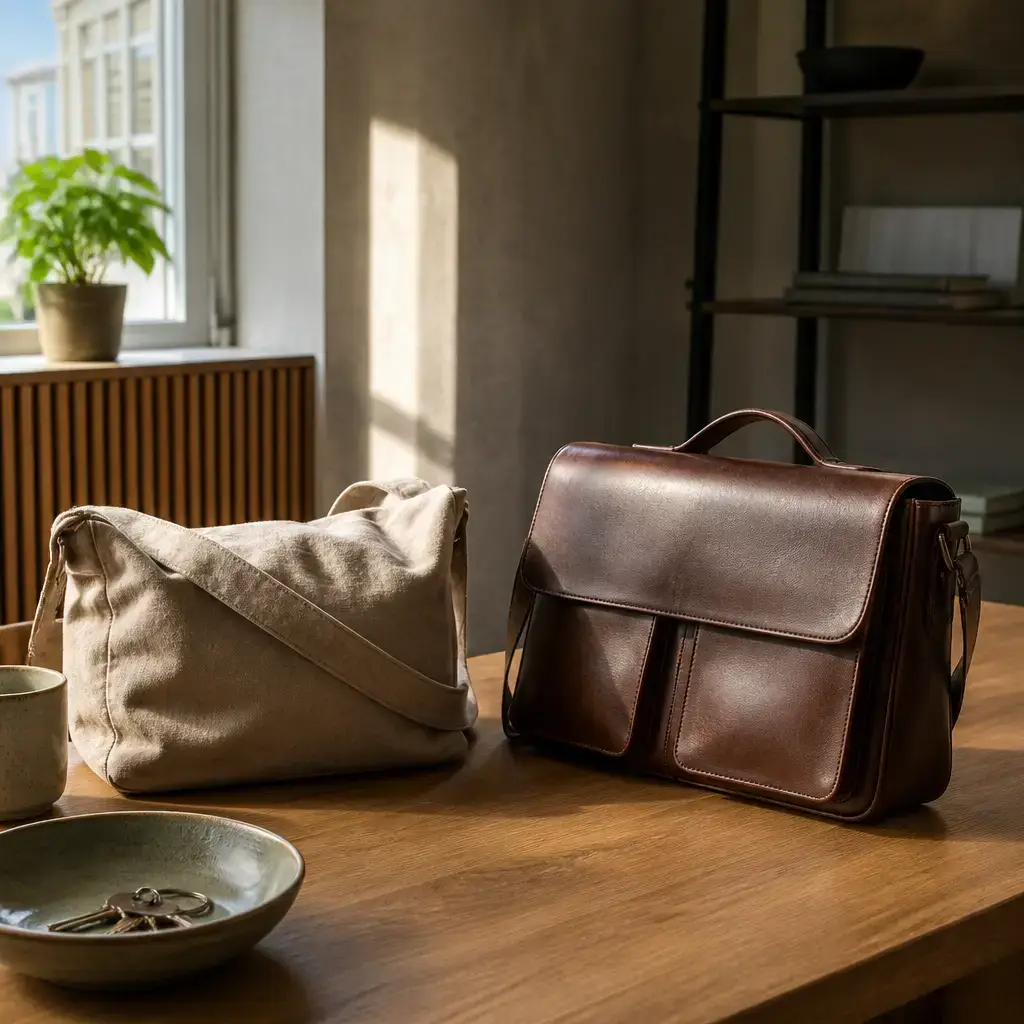
Welche Tasche soll ich wählen?
VEL-khuh TAH-shuh zoll ikh VEH-len? Which bag should I choose?Diese hier ist leicht.
DEE-zuh heer ist lye-kht. This one is light.Die andere Tasche sieht stabiler aus.
Dee AHN-duh-ruh TAH-shuh zeet shtah-BEE-luh ows. The other bag looks stronger.Sie hat auch zwei Fächer.
Zee hat owkh tsvye FEKH-er. It also has two pockets.Ich brauche eine Tasche für die Arbeit.
Ikh BROW-khuh EYE-nuh TAH-shuh fyoor dee AHR-bайт. I need a bag for work.Dann ist die stabilere Tasche sinnvoll.
Dahn ist dee shtah-BEE-luh-ruh TAH-shuh ZINN-fohl. Then the stronger one makes sense.Ich kann meine Papiere in die Fächer legen.
Ikh kahn MY-nuh pah-PEER-uh in dee FEKH-er LAY-gen. I can put my papers in the pockets.Das sollte gut für dich funktionieren.
Dahs ZOLL-tuh goot fyoor dikh foonk-tsyo-NEER-en. That should work well for you.Sentence explanations
Welche Tasche soll ich wählen?
Which bag should I choose?
- Welche
- which
- Tasche
- bag
- soll ich
- should I
- wählen
- choose
More detail
Welche means “which” here and identifies a choice among bags. It is the feminine singular accusative form of the question word welcher, agreeing with Tasche as the direct object of wählen. The form also looks the same in feminine singular nominative, so its ending here is understood from the sentence role as well as the noun’s gender. Example: Welche Tasche kaufst du? — “Which bag are you buying?” Tasche is the noun “bag.” Its base form is the singular die Tasche; the plural is die Taschen. In this sentence it is the object being chosen, which is why the question word before it is Welche. Soll ich combines the first-person singular present form soll of the modal verb sollen with ich, “I.” In this question, sollen expresses what would be advisable or expected for the speaker: “should I …?” The modal verb is conjugated, while the other verb remains an infinitive. Compare Soll ich warten? — “Should I wait?” wählen is the infinitive “to choose” or “to select.” With a modal verb such as sollen, it stays in the infinitive and appears at the end of this question. Its present-tense first-person form without a modal would be ich wähle, “I choose” or “I am choosing.” Together, Welche Tasche asks which bag is intended, and soll ich wählen asks what choice the speaker should make. The complete utterance therefore means “Which bag should I choose?”
Diese hier ist leicht.
This one is light.
- Diese hier
- this one here
- leicht
- light
More detail
Diese hier identifies one feminine singular item as the subject. In the supplied context, the item is understood to be a bag; the wording itself does not state that it has already been selected. Diese is the feminine singular nominative form of the demonstrative pronoun here, and hier adds “here,” as in the reusable pattern Diese hier ist ... (“This one here is ...”). leicht means “light” here, referring to weight. It is the base form of the adjective; its comparative is leichter (“lighter”), and schwer is the relevant opposite for weight (“heavy”). Example: Die Tasche ist leicht. — “The bag is light.” Together, Diese hier identifies the item and ist leicht describes it, giving “This one is light.”
Die andere Tasche sieht stabiler aus.
The other bag looks stronger.
- andere
- other
- Tasche
- bag
- sieht … aus
- looks
- stabiler
- stronger
More detail
andere means “other” here: it marks the bag as different from one already being compared or mentioned. It is the feminine singular nominative form agreeing with Tasche in Die andere Tasche. The base form is ander-; its ending changes with the noun phrase’s gender, number, and case. Example: ein anderer Weg — “another/different route.” Tasche means “bag.” It is a feminine noun: die Tasche; its plural is die Taschen. In this sentence it is singular and is the subject of the clause, so the noun phrase begins with the feminine singular nominative article Die. sieht ... aus is the separable verb aussehen, “to look” or “to appear.” In the present tense, third-person singular is sieht ... aus: the verb stem appears as sieht in the clause, while the prefix aus moves to the end. Example: Die Tasche sieht neu aus. — “The bag looks new.” Do not treat sieht and aus as two independent meanings here; together they form aussehen. stabiler means “stronger” in the supplied translation, more literally “more stable” or “more sturdy.” It is the comparative form of the adjective stabil: stabil — “stable/sturdy,” stabiler — “more stable/sturdier.” Here it describes how the bag appears. The comparative ending -er expresses a comparison, even though the sentence does not state what the comparison is with. Together, Die andere Tasche means “the other bag,” and sieht stabiler aus means “looks stronger.” The complete utterance is therefore “The other bag looks stronger.” The sentence uses the separable-verb pattern subject + sieht + adjective + aus in the present tense.
Sie hat auch zwei Fächer.
It also has two pockets.
- Sie
- it
- hat
- has
- auch
- also
- zwei
- two
- Fächer
- pockets
More detail
Sie means “it” here and refers to the bag. In this use it is the third-person singular feminine pronoun; the German noun Tasche is feminine, so a bag can be referred to as sie. This is not the polite form “you,” which is written with a capital Sie but requires a different context and verb pattern. hat is the present-tense third-person singular form of haben (“to have”): haben → hat. The form expresses possession or a feature here. Example: Die Tasche hat einen langen Riemen. — “The bag has a long strap.” auch means “also” or “too.” It adds this fact to another relevant fact; here, the bag has two pockets in addition to whatever has already been mentioned. Its position can vary in German, but in this sentence it appears directly after the subject. zwei is the number “two.” German cardinal numbers do not change for the gender of the noun they count. Example: zwei Taschen — “two bags.” Fächer is the plural of Fach, meaning “compartments” or, in this bag context, “pockets.” The umlaut and ending mark the plural: das Fach → die Fächer. The fixed translation selects “pockets” as the intended meaning here. Example: Die Tasche hat drei Fächer. — “The bag has three compartments.” Together, Sie hat gives “it has,” auch adds “also,” and zwei Fächer gives “two pockets.” The complete utterance means: “It also has two pockets.”
Ich brauche eine Tasche für die Arbeit.
I need a bag for work.
- Ich
- I
- brauche
- need
- eine
- a/an
- Tasche
- bag
- für
- for
- die Arbeit
- work
More detail
Ich means “I” here. It is the first-person singular pronoun and names the speaker as the subject. The form changes with grammatical role: ich is nominative, while mich is accusative. Example: Ich lerne. — “I am learning.” brauche is the present-tense first-person singular form of brauchen, “to need.” The ending -e marks the form used with ich; compare du brauchst — “you need.” Example: Ich brauche Hilfe. — “I need help.” eine is the indefinite article “a/an” before the feminine singular noun Tasche in the accusative case. The relevant conditions are that Tasche is feminine and functions here as the direct object of brauche: eine Tasche. An indefinite article does not by itself state a numeric count; it introduces an unspecified instance. Example: Ich kaufe eine Lampe. — “I am buying a lamp.” Tasche means “bag.” Its base singular form is die Tasche; its plural is die Taschen. In this sentence, Tasche is the direct object: the thing that is needed. Example: Die Tasche ist schwer. — “The bag is heavy.” für means “for” and is a preposition that takes the accusative case. It links the bag to its intended use or purpose here. Example: Das ist für dich. — “That is for you.” die Arbeit means “work” here. Arbeit is a feminine noun, with singular forms die Arbeit in the nominative and accusative; its plural is die Arbeiten, used for separate tasks or pieces of work. The expression für die Arbeit means “for work” in this sentence. Example: Ich lerne für die Arbeit. — “I am studying for work.” Together, Ich brauche gives “I need,” eine Tasche identifies the needed object as a bag, and für die Arbeit gives its purpose: “for work.” The complete utterance is therefore “I need a bag for work.”
Dann ist die stabilere Tasche sinnvoll.
Then the stronger one makes sense.
- Dann
- then
- stabilere
- stronger; more durable
- Tasche
- bag
- sinnvoll
- sensible; useful
More detail
Dann means “then” here, linking this conclusion to what has just been said. It can also refer to a later time in other sentences. Example: Dann gehe ich nach Hause. — “Then I’m going home.” stabilere is the comparative form of the adjective stabil (“strong” or “durable” in this context): stabil → stabiler → am stabilsten. The form stabilere is an attributive adjective describing Tasche. Because Tasche is feminine singular and is the subject with the definite article die, the adjective has the ending -e: die stabilere Tasche. The comparative indicates that this bag is stronger or more durable than another relevant option; it does not by itself specify how much stronger. Tasche means “bag.” Its plural is Taschen. In this sentence it is the feminine singular noun in the subject phrase die stabilere Tasche. Example: Die Tasche ist neu. — “The bag is new.” ist is the third-person singular present form of sein (“to be”). It connects the subject to the predicate adjective sinnvoll. sinnvoll means “sensible” or “makes sense” here. As a predicate adjective after ist, it does not take the attributive ending used in stabilere: Die Tasche ist sinnvoll. — “The bag makes sense” or, more naturally, “The bag is a sensible choice.” Together, Dann ist introduces a conclusion, die stabilere Tasche identifies the stronger or more durable bag as the subject, and sinnvoll evaluates that choice. The whole utterance means: “Then the stronger one makes sense.” In the supplied context, “the stronger one” refers to the bag, while the German noun Tasche is explicitly present.
Ich kann meine Papiere in die Fächer legen.
I can put my papers in the pockets.
- Ich kann
- I can
- Papiere
- papers
- Fächer
- pockets
- legen
- put; place
More detail
Ich kann combines the subject ich (“I”) with kann, the first-person singular present form of können (“can; be able to”). The modal verb is followed by an infinitive later in the sentence, so Ich kann ... legen means “I can put ...”. Papiere means “papers” here. It is the plural of Papier; in this sentence it is the thing being placed, so it is the accusative object. The plural form Papiere also has the same visible form in the nominative and accusative. The possessive word meine identifies them as the speaker’s papers. Fächer means “pockets” here. It is the plural of Fach, with the vowel change a → ä. The phrase in die Fächer expresses movement into the pockets: with in, movement toward an interior uses the accusative. This contrasts with a location, for example: Die Papiere sind in den Fächern. — “The papers are in the pockets.” legen means “to put; to place” and is the infinitive selected by kann. It describes placing something in a lying or flat position, unlike stellen, which commonly describes putting something upright. Example: Ich lege das Buch auf den Tisch. — “I put the book on the table.” Together, Ich kann meine Papiere in die Fächer legen means “I can put my papers in the pockets.” The modal construction presents this as an ability or possible action, while in die Fächer legen specifies movement of the papers into the pockets.
Das sollte gut für dich funktionieren.
That should work well for you.
- Das
- that
- sollte
- should
- gut
- well
- für dich
- for you
- funktionieren
- work
More detail
Das means “that” here and functions as a demonstrative pronoun. The fixed translation supports that intended pointing meaning, but it does not identify a particular thing. As a pronoun, it is not modifying a noun in this sentence. Compare Das funktioniert. — “That works.” sollte is the form of sollen used with the third-person singular subject Das; in this sentence it expresses the expectation or recommendation translated as “should.” The form can also be the past-tense form of sollen in another context, so the intended meaning comes from the sentence and context. After a modal verb such as sollen, the other verb normally remains an infinitive: Das sollte funktionieren — “That should work.” gut is the basic form of gut used adverbially here, describing how well the action works. The comparative is besser (“better”), and the superlative is am besten (“best” or “the best” in an adverbial use). For example: Das funktioniert besser. — “That works better.” für dich means “for you.” für is a preposition that takes the accusative case, and dich is the accusative form of the second-person singular pronoun du (“you”). The form dich is used for the person affected or intended here; compare mit dir — “with you,” where a different preposition requires a different form. funktionieren is the infinitive of the verb funktionieren, meaning “to work” in the sense of operating or producing the intended result. It follows the modal sollte, so it is not conjugated in this sentence. For example: Der Plan funktioniert. — “The plan works.” Together, Das identifies something as “that,” sollte presents the result as expected or advised, gut says that it works well, and für dich specifies that this result is for you. The complete meaning is: “That should work well for you.”
Grammar Points
aussehen: sieht ... aus
Diese hier sieht leicht aus.
DEE-zuh heer zeet lye-kht ows.This one here looks light.
In a main clause, the prefix aus moves to the end: sieht ... aus.
stabil → stabiler
Die andere sieht stabiler aus.
Dee AHN-duh-ruh zeet shtah-BEE-luh ows.The other one looks sturdier.
For a direct comparison, many adjectives add -er: stabil becomes stabiler.
German Vocabulary
Die andere Tasche sieht stabiler aus.
Ich brauche eine Tasche für die Arbeit.
Die andere Tasche sieht stabiler aus.
Ich brauche eine Tasche für die Arbeit.
Diese hier ist leicht.
Sie hat auch zwei Fächer.
Diese hier ist leicht.
Dann ist die stabilere Tasche sinnvoll.
Die andere Tasche sieht stabiler aus.
Welche Tasche soll ich wählen?
Welche Tasche soll ich wählen?
Welche Tasche soll ich wählen?
Quiz
Word Order
Arrange the words in the correct order.
Which bag should I choose?
Show Answer
Welche Tasche soll ich wählen?This one is light.
Show Answer
Diese hier ist leicht.The other bag looks stronger.
Show Answer
Die andere Tasche sieht stabiler aus.Spelling
Tap the letters to spell the word.
light
Show Answer
leichtsturdy
Show Answer
stabilerother
Show Answer
anderepocket, compartment