10 minutes free every day
Continue audio lessons in the app
Word explanations appear automatically in sync with the audio.
No login required · synced translations · playback with the screen locked
Choose your learning language and open this lesson in the app.

About This Lesson
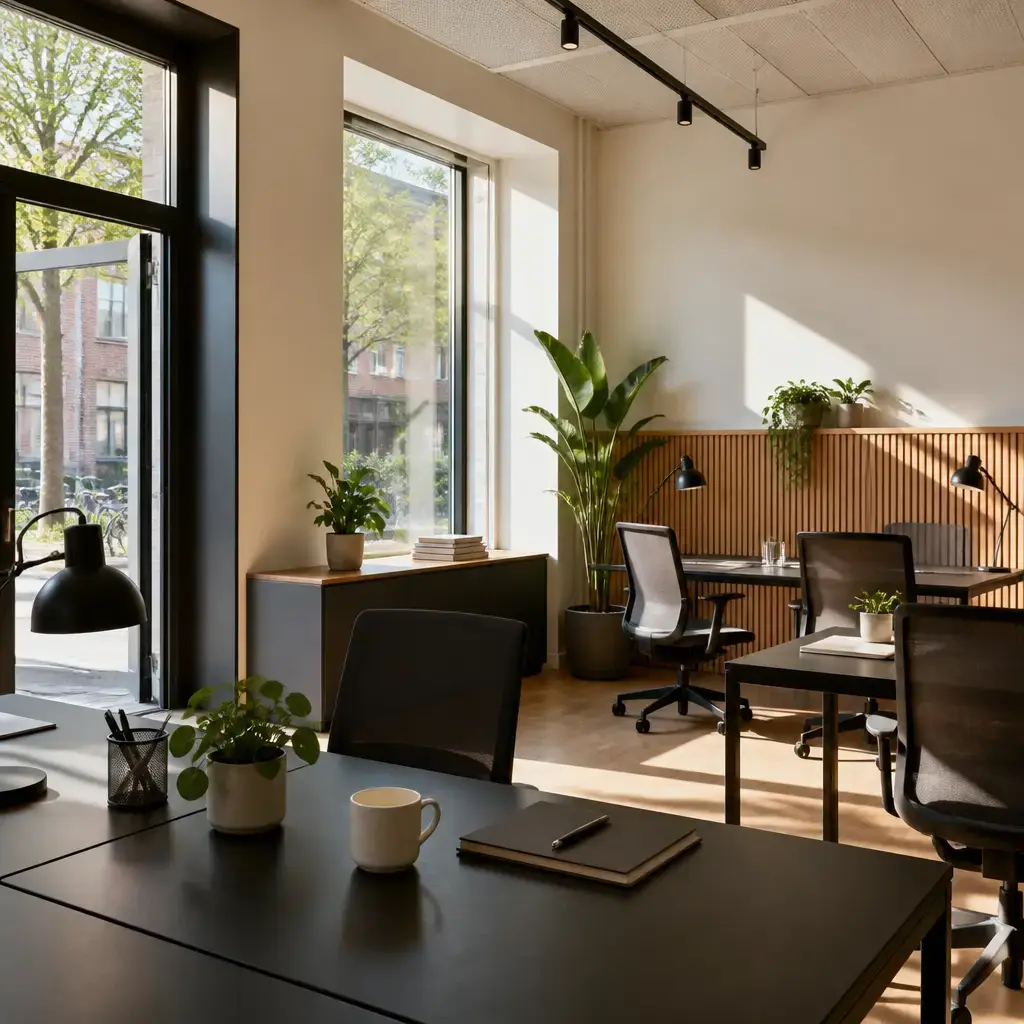
Use Using a shared office to practice German conversation, pronunciation, vocabulary, grammar, and quizzes.
Dialogue
Kann ich in diesem Gemeinschaftsbüro arbeiten?
kahn ikh in DEE-zem geh-MINE-shahfts-byu-ROH AR-bye-ten Can I work in this shared office?Nimm einen freien Schreibtisch.
nim EYE-nen FRY-en SHRIBE-tish Choose an open desk.Ich kann den neben der Tür benutzen.
ikh kahn dehn NAY-ben dair TEWR beh-NOOT-sen I can use the one near the door.Lass ihn sauber, wenn du fertig bist.
lahss een ZOW-ber, ven doo FAIR-tikh bihst Leave it clean when you finish.Ich brauche einen ruhigen Platz.
ikh BROW-khuh EYE-nen ROO-ih-gen plahts I need a quiet place.Probier den Schreibtisch an der Wand aus.
proh-BEER dehn SHRIBE-tish ahn dair vahnt ows Try the desk by the wall.Ich räume meine Sachen weg, bevor ich gehe.
ikh ROY-muh MY-nuh ZAH-khen vek, beh-FOHR ikh GAY-uh I will clear my things before I leave.So bleibt der Schreibtisch für die nächste Person bereit.
zoh blypt dair SHRIBE-tish fewr dee NEKH-stuh pair-ZOHN beh-RITE That keeps the desk ready for the next person.Sentence explanations
Kann ich in diesem Gemeinschaftsbüro arbeiten?
Can I work in this shared office?
- Kann ich
- Can I ...?
- diesem
- this
- Gemeinschaftsbüro
- shared office
- arbeiten
- work
More detail
Kann ich uses the present-tense first-person singular form of können (“can, be able to”). In a yes/no question, the conjugated verb comes first and the subject follows: Kann ich ...? = “Can I ...?” The modal verb is followed by the other verb in the infinitive. diesem is a form of the demonstrative dies- (“this”). Here it is dative masculine/neuter singular, because in describes a location and the noun Gemeinschaftsbüro is neuter: das Gemeinschaftsbüro. Compare dieses for neuter nominative or accusative singular, but diesem for dative masculine or neuter singular. Gemeinschaftsbüro is a compound noun: Gemeinschaft (“community/shared group”) + Büro (“office”). In this sentence it means a shared office. German nouns are capitalized, and the compound as a whole is neuter: das Gemeinschaftsbüro. The plural is Gemeinschaftsbüros. arbeiten is the infinitive “to work.” After the modal können, it remains in the infinitive and stands at the end of this question. The corresponding present-tense form without a modal would be ich arbeite (“I work”); with können, use ich kann ... arbeiten. Together, in diesem Gemeinschaftsbüro means “in this shared office,” with in marking a fixed location and therefore taking the dative here. Kann ich ... arbeiten? asks for permission or possibility: “Can I work in this shared office?”
Nimm einen freien Schreibtisch.
Choose an open desk.
- Nimm
- choose; take
- freien
- available; open
- Schreibtisch
- desk
More detail
Nimm is the informal singular imperative of nehmen (“to take”). Here, with a desk as its object, it is naturally understood as “choose” or “take” one. The imperative addresses one person directly. For a formal address or a plural group, German uses different imperative forms. freien comes from the adjective frei, “free” or, in this context, “available/open.” Its ending is -en because it describes the masculine accusative noun Schreibtisch after the indefinite article einen. The base-to-form pattern here is frei → freien. Example: Ich suche einen freien Platz. — “I am looking for an available seat.” Schreibtisch means “desk.” It is a masculine noun, so the indefinite article in the direct-object phrase is einen: einen Schreibtisch. The adjective agrees with this noun in the phrase einen freien Schreibtisch. Together, einen freien Schreibtisch means “an available/open desk.” It is the direct object of Nimm, so the complete imperative means “Choose an open desk.”
Ich kann den neben der Tür benutzen.
I can use the one near the door.
- Ich kann
- I can
- den
- the one
- neben
- near; beside
- Tür
- door
- benutzen
- use
More detail
Ich kann combines ich (“I”) with kann, the first-person singular present form of können (“can; be able to”). With a modal verb such as können, the other verb normally remains an infinitive and goes to the end of the clause. Example: Ich kann warten. — “I can wait.” den means “the one” here. It is the masculine singular accusative form used for the omitted noun Schreibtisch (“desk”), which is identified by the preceding context. The form is selected because the desk is the object of benutzen; it is not a general meaning of den independent of context. German can use a definite article this way when the noun is understood: Ich nehme den dort. — “I’ll take the one over there.” neben expresses position beside or near something. In neben der Tür, it describes a fixed location, so Tür appears in the dative: der is the dative singular form of feminine die Tür. Example: Der Tisch steht neben der Tür. — “The table is next to the door.” Tür means “door.” Its base form is die Tür; the noun is feminine, and its form here is der Tür because the preposition neben is being used for location. benutzen means “to use.” It is the infinitive in this sentence because it follows the modal kann. Example: Ich kann den Stift benutzen. — “I can use the pen.” Together, den neben der Tür identifies the desk by its location: “the one near the door.” The modal construction Ich kann ... benutzen means “I can use ...,” so the complete utterance means: “I can use the one near the door.”
Lass ihn sauber, wenn du fertig bist.
Leave it clean when you finish.
- Lass
- leave; let
- ihn
- him; it
- sauber
- clean
- wenn
- when
- du
- you
- fertig
- finished; done
- bist
- are
More detail
Lass is the imperative singular form of lassen (“to leave” or “to let”). Here it gives a direct instruction: leave something in a particular state. The subject du is understood from the imperative, but it is not written in the command itself. Compare the infinitive lassen with the command Lass!. ihn is the accusative form of the masculine personal pronoun er; in this sentence, the fixed translation identifies its intended meaning as “it.” The form marks the thing directly affected by Lass, while the English translation does not preserve German grammatical gender. The relevant pronoun forms are er (nominative “he”), ihn (accusative “him/it”), and ihm (dative “to him/it”). sauber means “clean” here. It is used after lassen to describe the resulting state of the object, so it remains in its basic form rather than taking an adjective ending. Reusable pattern: etwas sauber lassen = “leave something clean.” Example: Lass den Tisch sauber. — “Leave the table clean.” wenn introduces a condition or time clause meaning “when” here. In a German wenn clause, the conjugated verb normally moves to the end. This use refers to the time at which the condition is fulfilled, not to a question about whether something happens. du is the informal singular “you” and is the subject of the subordinate clause. Its presence determines the form of the verb bist: du bist means “you are.” fertig means “finished” or “done.” With sein, it describes a person’s completed activity or state: du bist fertig = “you are finished/done.” In another context, fertig can also describe something that is ready, but the fixed sentence concerns the addressee finishing. bist is the second-person singular present form of sein (“to be”). The useful present-tense chain is ich bin, du bist, er/sie/es ist. In the wenn clause, bist comes last: wenn du fertig bist. Together, Lass ihn sauber means “Leave it clean,” and wenn du fertig bist adds the time condition “when you finish” (literally, “when you are done”). The complete utterance is therefore: “Leave it clean when you finish.”
Ich brauche einen ruhigen Platz.
I need a quiet place.
- Ich
- I
- brauche
- need
- ruhigen
- quiet
- Platz
- place
More detail
Ich is the first-person singular pronoun, meaning “I.” It identifies the speaker as the person who needs something. The corresponding plural form is wir (“we”), but Ich is singular here. brauche comes from brauchen, “to need.” It is the present-tense first-person singular form: ich brauche. The same verb has different present forms with other subjects, for example du brauchst (“you need”). Example: Ich brauche Hilfe. — “I need help.” ruhigen means “quiet” here. Its base form is the adjective ruhig. The ending -en marks the form required because the adjective describes the masculine singular noun Platz in the accusative after the indefinite article einen: einen ruhigen Platz. This ending belongs to ruhigen, not to Platz. In the nominative, the corresponding phrase is ein ruhiger Platz (“a quiet place”). Platz means “place” here. It is a masculine noun, so its indefinite forms include ein Platz in the nominative and einen Platz in the accusative. The noun itself does not change between these two forms; the article and adjective show the relevant case. Example: Der Platz ist ruhig. — “The place is quiet.” Together, Ich brauche expresses “I need,” and einen ruhigen Platz names what is needed: “a quiet place.” The complete utterance means “I need a quiet place.”
Probier den Schreibtisch an der Wand aus.
Try the desk by the wall.
- Probier … aus
- try out
- Schreibtisch
- desk
- Wand
- wall
More detail
Probier ... aus is the informal singular imperative of the separable verb ausprobieren, “to try out.” The base form is ausprobieren; in this command, Probier appears at the beginning and the prefix aus moves to the end. The form addresses one person informally. For example: Probier den Stuhl aus. — “Try out the chair.” Schreibtisch means “desk.” It is a masculine singular noun. Here, den Schreibtisch is the accusative object of ausprobieren, and the masculine singular article changes from nominative der to accusative den. an der Wand describes the desk’s location as being by or at the wall. Wand means “wall” and is feminine singular; der is its dative singular article in this phrase. With a stationary location, an takes the dative: an der Wand. For movement toward the wall, German uses the accusative instead: an die Wand. Together, Probier + den Schreibtisch + an der Wand + aus means “Try out the desk by the wall.”
Ich räume meine Sachen weg, bevor ich gehe.
I will clear my things before I leave.
- Ich
- I
- räume … weg
- put away
- Sachen
- things
- bevor
- before
- gehe
- leave
More detail
Ich means “I” here and identifies the speaker as the subject of the main clause. German subject pronouns change with person and number: ich is first-person singular; for example, Wir räumen auf. means “We tidy up.” räume … weg comes from the separable verb wegräumen, “to put away” or “clear away.” In the present-tense first-person singular, the form is räume; the particle weg is placed at the end of the main clause: Ich räume die Bücher weg. — “I put the books away.” The split is part of the verb’s normal pattern, not two unrelated actions. Sachen means “things” here, specifically the speaker’s belongings. Its singular is die Sache; Sachen is the plural form. In meine Sachen, the possessive word meine shows that the things belong to the speaker, and the noun phrase is the object of wegräumen: “my things.” bevor introduces a time clause meaning “before.” It connects an action with an earlier time: Ich dusche, bevor ich schlafe. — “I shower before I sleep.” A clause introduced by bevor is subordinate, so its finite verb normally comes at the end. gehe is the first-person singular present form of gehen, “to go” or, in this context, “to leave.” The subject is again ich, expressed in the clause as ich gehe; the form gehe identifies first-person singular. For example, Ich gehe jetzt. means “I’m leaving now.” Together, Ich räume meine Sachen weg says “I clear away my things.” bevor ich gehe adds the time condition “before I leave.” The complete utterance therefore means “I will clear my things before I leave.” German uses the present tense here for both actions; the English future wording expresses the intended upcoming situation shown by the fixed translation. The pattern is reusable as Ich [main action], bevor ich [later action].
So bleibt der Schreibtisch für die nächste Person bereit.
That keeps the desk ready for the next person.
- So
- that way
- bleibt
- stays
- Schreibtisch
- desk
- nächste
- next
- Person
- person
- bereit
- ready
More detail
So refers to the action just described: putting the speaker’s things away. Here it means “in this way” or “as a result,” not a separate object. Example: So geht es schneller. — “That way, it goes faster.” bleibt comes from bleiben (“to stay, remain”). It is the present-tense form for er/sie/es and for a singular noun such as der Schreibtisch: der Schreibtisch bleibt. The verb describes continuing in a state, so bereit bleiben means “remain ready.” Example: Die Tür bleibt offen. — “The door remains open.” Schreibtisch means “desk.” In this sentence, der Schreibtisch is the singular subject; the masculine article der is not included in the selected phrase. The compound noun is written as one word in German. Example: Der Schreibtisch ist sauber. — “The desk is clean.” nächste means “next” here. It is the inflected form of the adjective nächst- before the feminine singular noun Person: die nächste Person. The ending reflects the noun phrase’s grammatical form; it does not mean that nächste is a different base word. For comparison, der nächste Tag means “the next day,” while die nächsten Personen means “the next people.” Person means “person.” Here it is feminine singular, shown by die nächste Person; after für, the noun phrase is in the accusative, although Person itself has the same form in the singular. Example: Ich sehe die Person. — “I see the person.” bereit means “ready.” After bleiben, it is a predicative adjective, so it does not take an adjective ending: Der Schreibtisch bleibt bereit, not an attributive phrase such as der bereite Schreibtisch. Example: Wir bleiben bereit. — “We remain ready.” Together, So bleibt der Schreibtisch bereit says that, by putting the speaker’s things away, the desk remains ready für die nächste Person, “for the next person.” für introduces the intended beneficiary or user and takes the accusative here: die nächste Person. The full meaning is: “That keeps the desk ready for the next person.”
Grammar Points
trennbare Verben: Verbklammer im Imperativ
Probier den freien Platz aus.
proh-BEER dehn FRY-en plahts owsTry the available spot.
Bei trennbaren Verben steht der abgetrennte Teil im Hauptsatz am Ende: Probier ... aus.
wenn + Nebensatz: konjugiertes Verb am Ende
Wenn du fertig bist, bleibt der Platz ruhig.
ven doo FAIR-tikh bihst, blypt dair plahts ROO-ikhWhen you are finished, the place stays quiet.
Nach wenn steht das konjugierte Verb im Nebensatz am Ende: wenn du fertig bist.
German Vocabulary
Kann ich in diesem Gemeinschaftsbüro arbeiten?
Ich kann den neben der Tür benutzen.
Lass ihn sauber, wenn du fertig bist.
Nimm einen freien Schreibtisch.
Kann ich in diesem Gemeinschaftsbüro arbeiten?
Lass ihn sauber, wenn du fertig bist.
Ich kann den neben der Tür benutzen.
Nimm einen freien Schreibtisch.
Lass ihn sauber, wenn du fertig bist.
Nimm einen freien Schreibtisch.
Ich kann den neben der Tür benutzen.
Lass ihn sauber, wenn du fertig bist.
Quiz
Word Order
Arrange the words in the correct order.
Can I work in this shared office?
Show Answer
Kann ich in diesem Gemeinschaftsbüro arbeiten?Choose an open desk.
Show Answer
Nimm einen freien Schreibtisch.I need a quiet place.
Show Answer
Ich brauche einen ruhigen Platz.Spelling
Tap the letters to spell the word.
to take; to choose
Show Answer
Nimmfree; available
Show Answer
freiento work
Show Answer
arbeitendesk