10 minutes free every day
Continue audio lessons in the app
Word explanations appear automatically in sync with the audio.
No login required · synced translations · playback with the screen locked
Choose your learning language and open this lesson in the app.

About This Lesson
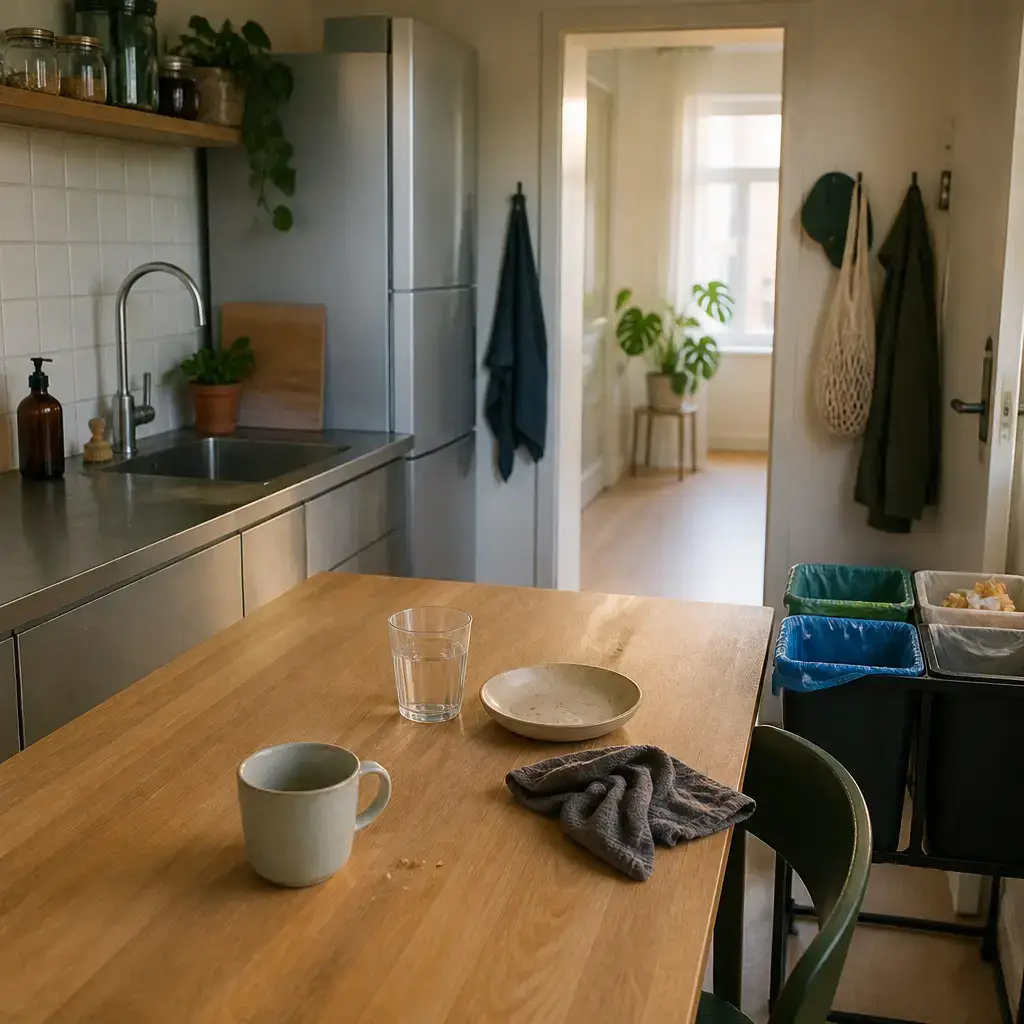
Use Using a shared kitchen to practice German conversation, pronunciation, vocabulary, grammar, and quizzes.
Dialogue
Kann ich meine Tasse hier abwaschen?
kahn ikh MY-nuh TAH-suh heer AHP-vah-shun? Can I wash my cup here?Benutze das Waschbecken links.
buh-NOOT-suh dahs VAHSH-behk-un links. Use the sink on the left.Ich möchte den Raum sauber halten.
ikh MURKH-tuh dehn ROWM ZOW-buh HALL-tun. I want to keep the space clean.Bitte wisch den Tisch ab, wenn du fertig bist.
BIT-tuh VISH dehn TISH AHP, venn doo FEHR-tikh bist. Please wipe the table after you finish.Kommt der Müll in diesen Mülleimer?
kohmt dair MYUL in DEE-zun MYUL-eye-muh? Does trash go in this bin?Tu ihn in den Mülleimer an der Tür.
too een in dehn MYUL-eye-muh ahn dair TEWR. Put it in the bin by the door.Ich kümmere mich jetzt darum.
ikh KYU-muh-ruh mikh yetst dah-ROOM. I will take care of it now.So können alle die Küche benutzen.
zoh KUR-nun AH-luh dee KYU-khuh buh-NOOT-sun. That keeps the kitchen ready for everyone.Sentence explanations
Kann ich meine Tasse hier abwaschen?
Can I wash my cup here?
- Kann ich
- Can I …?
- Tasse
- cup
- hier
- here
- abwaschen
- wash
More detail
Kann ich is a reusable way to ask for permission or possibility: “Can I …?” In this question, kann is the first-person singular present form of können (“can, be able to”), and ich means “I”. With a modal verb such as können, the other verb normally stays in the infinitive at the end: Kann ich hier warten? — “Can I wait here?” Tasse means “cup”. Its plural is Tassen. The form meine before it means “my”; together, meine Tasse means “my cup”. In this sentence, Tasse is the object being washed. hier means “here”, referring to the place where the speaker is asking for permission. A useful contrast is dort — “there”: Kann ich hier sitzen? — “Can I sit here?” abwaschen means “to wash” in the sense of washing an object, often by hand. It is a separable verb: in a main-clause statement, the prefix can separate, as in Ich wasche die Tasse ab. — “I wash the cup.” After the modal kann, however, the complete infinitive remains together at the end: Ich kann die Tasse abwaschen. — “I can wash the cup.” The whole question combines the permission pattern Kann ich ...?, the object meine Tasse, the place hier, and the infinitive abwaschen: “Can I wash my cup here?”
Benutze das Waschbecken links.
Use the sink on the left.
- Benutze
- use
- Waschbecken
- sink
- links
- on the left
More detail
Benutze is the informal singular imperative of benutzen (“to use”). It addresses one person directly: Benutze ...! = “Use ...!” The verb is separate from the noun that follows it. For a formal address or for several people, German uses Benutzen Sie ...!. Waschbecken means “sink” here, specifically a basin for washing. It is a neuter noun: das Waschbecken. In this sentence it is the direct object of benutzen, so the phrase is das Waschbecken; for this neuter noun, the nominative and accusative article are both das. Example: Ich benutze das Waschbecken. — “I use the sink.” links is an adverb meaning “on the left” or “to the left.” It gives the sink’s location. The useful contrast is rechts (“on the right”): Der Eingang ist links. — “The entrance is on the left.” Together, the pattern is Benutze + [object] + [location]: Benutze das Waschbecken links. The imperative tells one person to use das Waschbecken, and links identifies which sink by its position, giving “Use the sink on the left.”
Ich möchte den Raum sauber halten.
I want to keep the space clean.
- Ich
- I
- möchte
- would like to; want to
- Raum
- space; room
- sauber
- clean
- halten
- keep; maintain
More detail
Ich means “I” and is the first-person singular subject. Compare du for one person addressed directly and wir for “we.” möchte expresses a present wish here: “would like to” or, in this translation, “want to.” It is the first-person singular form traditionally analyzed as the Konjunktiv II of mögen; German also uses möchten as the form’s infinitive-like dictionary label in learner materials. Other forms include du möchtest and wir möchten. With this construction, the following verb is an infinitive placed at the end of the clause. Example: Ich möchte gehen. — “I would like to leave.” Raum means “space” or “room.” Here, den Raum is the object of halten. Raum is masculine, and den marks this masculine singular noun in the accusative case. Its plural is Räume (“rooms/spaces”). sauber means “clean.” Here it describes the condition in which the space is to remain. With halten, the adjective stays in its basic form: etwas sauber halten means “keep something clean.” Example: Wir halten die Küche sauber. — “We keep the kitchen clean.” halten means “keep” in this construction. It is the infinitive required after möchte. Its present-tense third-person singular form is hält, and its simple past form is hielt; neither is used here. The pattern etwas + adjective + halten expresses maintaining something in a condition, such as die Tür offen halten — “keep the door open.” Together, Ich möchte ... halten means “I want to keep ...,” while den Raum sauber supplies the object and the condition to be maintained. The complete utterance is: “I want to keep the space clean.”
Bitte wisch den Tisch ab, wenn du fertig bist.
Please wipe the table after you finish.
- Bitte
- please
- wisch … ab
- wipe ... off
- Tisch
- table
- wenn du fertig bist
- when you are finished
More detail
Bitte is the polite word “please.” It can make a request more courteous without changing the requested action. Example: Bitte warte. — “Please wait.” wisch ... ab is the informal singular imperative of the separable verb abwischen, “to wipe off.” The base form is abwischen; in this command, wisch comes from wischen, and the prefix ab moves to the end of the clause. The command is addressed to one person using du. Example: Wisch den Fleck ab. — “Wipe the stain off.” Tisch means “table.” Here it appears as den Tisch, because the table is the object being wiped. The masculine noun has the definite article der in the basic form, but the article changes to den for a masculine accusative object. Example: Ich sehe den Tisch. — “I see the table.” wenn du fertig bist means “when you are finished.” wenn introduces a subordinate clause for a condition or time. du is the informal singular “you”; bist is the du form of sein, “to be,” and fertig means “finished” or “done.” In this subordinate clause, bist stands at the end. Example: Ruf mich an, wenn du fertig bist. — “Call me when you are finished.” Together, Bitte wisch den Tisch ab gives the polite command “Please wipe the table,” and wenn du fertig bist specifies that this should happen when the addressee has finished. The complete utterance therefore means: “Please wipe the table after you finish.”
Kommt der Müll in diesen Mülleimer?
Does trash go in this bin?
- Kommt
- goes
- der Müll
- the trash
- in diesen
- into this
- Mülleimer
- bin
More detail
Kommt is the third-person singular present form of kommen (“to come”); in this question, the intended meaning is “goes.” German places the finite verb first in a yes/no question: Kommt ...? = “Does ... go/come?” The form agrees with the singular subject der Müll. Compare: Der Müll kommt in den Mülleimer. — “The trash goes into the bin.” der Müll means “the trash” or “the garbage.” Müll is a masculine noun, so its definite article is der in the nominative when it is the subject. The noun is singular here; the article, rather than the noun, marks the case distinction. in diesen expresses movement into the bin referred to as “this.” With in, German uses the accusative for a destination or movement into something, so masculine dieser becomes diesen here. The demonstrative agrees with the following masculine noun Mülleimer: dieser Mülleimer (nominative), diesen Mülleimer (accusative). Compare: Der Müll ist in diesem Mülleimer. — “The trash is in this bin.” Here in describes location, so the masculine form is diesem. Mülleimer means “bin” or “trash can.” It is a compound noun, Müll + Eimer, and is masculine: der Mülleimer. Its plural is die Mülleimer; the form does not change in the plural. Together, Kommt der Müll in diesen Mülleimer? asks whether the trash goes into this bin. The verb-first order marks it as a yes/no question, and in diesen Mülleimer identifies the destination.
Tu ihn in den Mülleimer an der Tür.
Put it in the bin by the door.
- Tu
- put
- ihn
- it
- in den
- into the
- Mülleimer
- bin
- an der Tür
- by the door
More detail
Tu is the 2nd-person singular imperative of tun (“to do”). In this command, tun is used colloquially with the meaning “put” or “place”; it is not the ordinary neutral verb for every act of putting something somewhere. Example: Tu das hierhin. — “Put that here.” ihn is the accusative singular masculine form of er (“he” / “it” for a masculine noun). Here the fixed translation identifies it as “it”; the form agrees grammatically with the intended masculine object, while the sentence does not need to name that object again. Compare the object forms ihn (masculine), sie (feminine or plural), and es (neuter or certain other uses). Example: Ich sehe ihn. — “I see him/it.” in den expresses movement into a destination. in takes the accusative here because the command describes putting something into a place, and den is the accusative masculine singular form of the definite article. With a stationary location, in commonly takes the dative instead: Das ist im Mülleimer. — “That is in the bin.” (im is the contraction of in dem.) Mülleimer is a masculine noun meaning “bin” or “wastebasket”; its plural is Mülleimer as well. The noun is the destination of the putting action. Example: Der Mülleimer ist voll. — “The bin is full.” an der Tür identifies the bin’s location: it is by or beside the door. an takes the dative here because this phrase describes a fixed location, and der is the feminine dative singular form of the definite article. Tür is a feminine noun meaning “door.” Example: Der Tisch steht an der Tür. — “The table is by the door.” Together, Tu ihn in den Mülleimer an der Tür. gives the reusable pattern Tu + object + in + accusative destination + location: “Put it in the bin by the door.” The command tells the listener to move the identified object into the bin; an der Tür specifies which bin.
Ich kümmere mich jetzt darum.
I will take care of it now.
- Ich
- I
- kümmere mich
- take care
- jetzt
- now
- darum
- of it
More detail
Ich means “I” here: it is the first-person singular subject, the person who will take care of the matter. The related forms are du (“you,” singular informal) and er/sie/es (“he/she/it”), but the verb form must match the speaker here. kümmere mich is part of the reusable pattern sich um etwas kümmern (“to take care of something”). kümmere is the first-person singular present-tense form of kümmern; mich is the matching reflexive pronoun for “I.” The verb normally uses um plus its object, as in Ich kümmere mich um die Küche. — “I’ll take care of the kitchen.” In this utterance, darum stands for the matter being handled, so kümmere mich and darum work together rather than kümmere meaning “take care” by itself. jetzt means “now.” It places the action at the present time; in this context, the English translation naturally presents it as a commitment or intention: “I will take care of it now.” darum means “about it” or, with sich kümmern, “of it.” It is a pronominal adverb corresponding here to um das or um etwas: da(r)- combines with um, and the r appears before the vowel of um. It refers to the matter already understood without naming it again. Ich kümmere mich darum. means “I’ll take care of it.” Together, Ich identifies the actor, kümmere mich expresses the reflexive verb pattern, jetzt sets the timing, and darum supplies the thing being handled. The complete meaning is: “I will take care of it now.”
So können alle die Küche benutzen.
That keeps the kitchen ready for everyone.
- So
- that way; thus
- können
- can; be able to
- alle
- everyone; all
- Küche
- kitchen
- benutzen
- use
More detail
So means “that way” or “thus” here. It connects the sentence with the preceding action and presents the following situation as its result. This is different from the degree word in a phrase such as “so large.” können is the present-tense form of können, “can” or “be able to.” With the plural subject alle, the form is third-person plural: alle können. A modal verb such as können normally combines with an infinitive, while the modal is the finite verb. Example: Wir können warten. — “We can wait.” alle means “everyone” here because it stands as the subject without a following noun and refers to the people included in the situation. Before a noun, the same word can mean “all,” as in alle Gäste — “all guests.” Its form here does not identify particular individuals beyond the intended group. die Küche is the definite noun phrase “the kitchen”: die is the definite article and Küche is the noun. The noun’s base form is Küche; in this sentence, die Küche is feminine accusative singular because it is the object of benutzen. The article has the same form in feminine nominative and accusative singular, so its shape alone does not show the case. Its plural is die Küchen — “the kitchens.” German nouns are capitalized. benutzen means “to use.” It is the infinitive paired with können, so können ... benutzen means “can use.” In this main clause, the infinitive appears at the end, as is common with a modal verb. Example: Alle können den Raum benutzen. — “Everyone can use the room.” Together, So presents the situation as resulting from the preceding action; alle können expresses that everyone can do something; and die Küche benutzen names the action. The literal structure is “That way, everyone can use the kitchen.” In the fixed translation, this is expressed as “That keeps the kitchen ready for everyone.”
Grammar Points
Trennbare Verben: abwischen → wisch ... ab
Wisch den Tisch ab.
VISH dehn TISH AHP.Wipe the table.
Bei trennbaren Verben steht die Vorsilbe im Hauptsatz am Satzende: wisch ... ab.
sich um etwas kümmern → sich ... darum kümmern
Ich kümmere mich darum.
ikh KYU-muh-ruh mikh dah-ROOM.I’ll take care of it.
Das reflexive Verb braucht mich; darum ersetzt die Sache, um die man sich kümmert.
German Vocabulary
Kann ich meine Tasse hier abwaschen?
Bitte wisch den Tisch ab, wenn du fertig bist.
Bitte wisch den Tisch ab, wenn du fertig bist.
Ich möchte den Raum sauber halten.
Benutze das Waschbecken links.
Ich möchte den Raum sauber halten.
Kommt der Müll in diesen Mülleimer?
Ich möchte den Raum sauber halten.
Ich möchte den Raum sauber halten.
Kann ich meine Tasse hier abwaschen?
Bitte wisch den Tisch ab, wenn du fertig bist.
Benutze das Waschbecken links.
Quiz
Word Order
Arrange the words in the correct order.
Can I wash my cup here?
Show Answer
Kann ich meine Tasse hier abwaschen?Use the sink on the left.
Show Answer
Benutze das Waschbecken links.I want to keep the space clean.
Show Answer
Ich möchte den Raum sauber halten.Spelling
Tap the letters to spell the word.
to want
Show Answer
möchteto keep
Show Answer
haltensink
Show Answer
Waschbeckenclean