10 minutes free every day
Continue audio lessons in the app
Word explanations appear automatically in sync with the audio.
No login required · synced translations · playback with the screen locked
Choose your learning language and open this lesson in the app.

About This Lesson
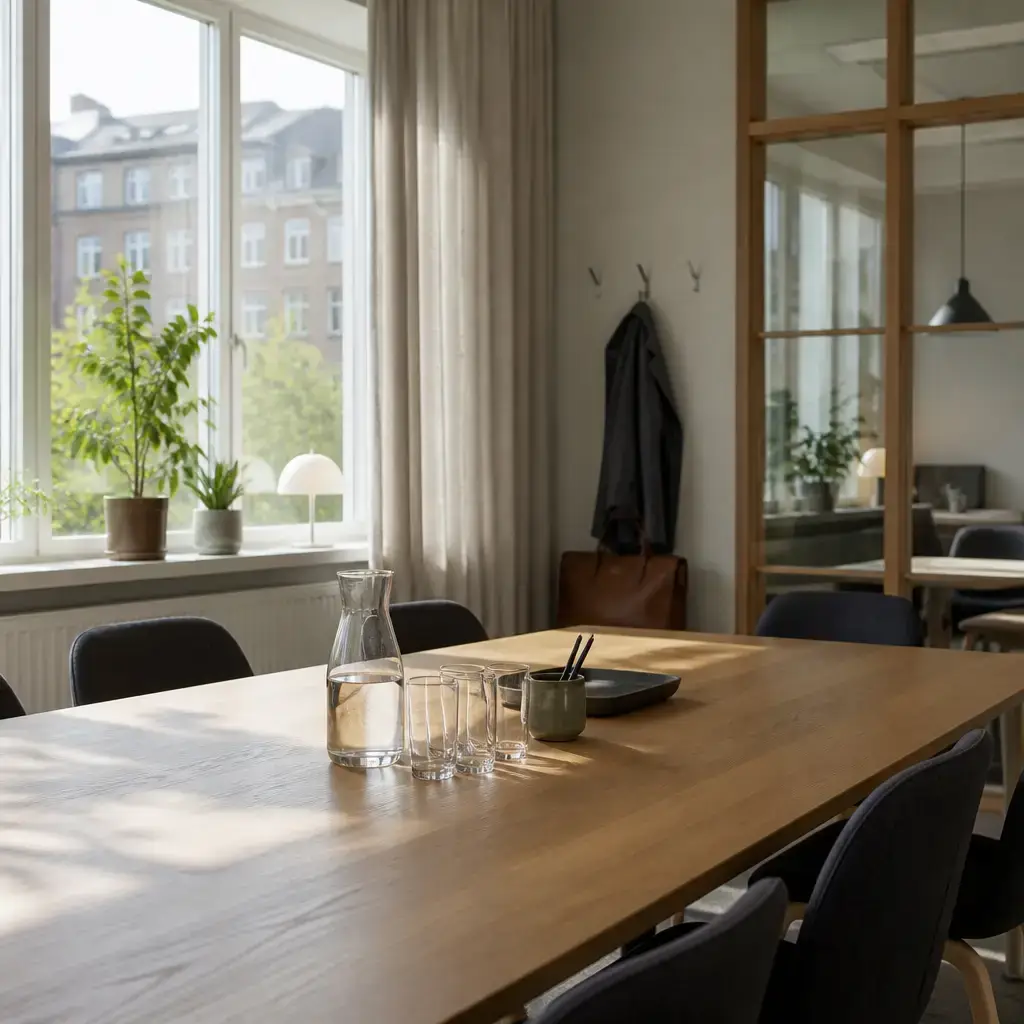
Use Using a shared meeting room to practice German conversation, pronunciation, vocabulary, grammar, and quizzes.
Dialogue
Können wir den gemeinsamen Besprechungsraum benutzen?
KURN-en veer dayn guh-MYN-zah-men beh-SHPRAY-khoongs-rowm beh-NOOT-sen? Can we use the shared meeting room?Du kannst ihn benutzen, aber halte ihn für andere Leute ordentlich.
Doo kahnst een beh-NOOT-sen, AH-ber HAL-tuh een fyoor AHN-duh-ruh LOY-tuh AWRD-n-likh. You can, but keep it tidy for other people.Ist dieser Tisch frei?
IHST DEE-zer TISH fry? Is this table free?Er ist jetzt frei.
Air ist YETST fry. It is available now.Ich werde meine Tasche an die Wand stellen.
Ikh VAYR-duh MY-nuh TASH-uh ahn dee VAHNT SHTEL-len. I will put my bag by the wall.Bitte halte den Tisch frei.
BIT-tuh HAL-tuh dayn TISH fry. Please keep the table clear.Wenn wir fertig sind, lassen wir den Raum sauber.
Ven veer FER-tikh zint, LAH-sen veer dayn rowm ZOW-ber. We will leave the room clean when we finish.Das hilft der nächsten Gruppe.
Dahs hilft dayr NEKH-sten GROO-puh. That helps the next group.Sentence explanations
Können wir den gemeinsamen Besprechungsraum benutzen?
Can we use the shared meeting room?
- Können wir
- Can we
- gemeinsamen
- shared
- Besprechungsraum
- meeting room
- benutzen
- use
More detail
Können wir begins a yes/no question. können is the present-tense first-person plural form of können (“can, be able to”), used with wir (“we”). In a question, the conjugated modal verb comes before the subject: Können wir ...? The infinitive belonging to the modal comes later in the clause. Example: Können wir morgen kommen? — “Can we come tomorrow?” Here kommen is the infinitive placed at the end. gemeinsamen means “shared” here. It is the adjective gemeinsam with the weak masculine accusative singular ending -en, required by the definite article den in den gemeinsamen Besprechungsraum. The ending belongs to the adjective, not to the noun. The same adjective can appear without this ending in another grammatical environment, for example ein gemeinsamer Raum — “a shared room.” Besprechungsraum is a masculine compound noun meaning “meeting room”: Besprechung (“meeting”) plus Raum (“room”). Its plural is Besprechungsräume (“meeting rooms”). In this sentence it is the accusative object of benutzen, marked by den. benutzen is the infinitive “to use.” It is a regular verb and takes the thing being used as an accusative object. Example: Wir benutzen den Raum. — “We use the room.” With the modal können, it remains in the infinitive while können carries the person and number marking. Together, Können wir den gemeinsamen Besprechungsraum benutzen? asks whether we can use the shared meeting room. The structure is the reusable pattern Können wir + accusative object + infinitive?.
Du kannst ihn benutzen, aber halte ihn für andere Leute ordentlich.
You can, but keep it tidy for other people.
- Du kannst
- you can
- ihn
- it
- benutzen
- use
- halte
- keep
- ihn
- it
- andere
- other
- Leute
- people
- ordentlich
- tidy
More detail
Du kannst: können means “to be able to” or “can.” Here kannst is its present-tense second-person singular form with du. The modal verb is followed by the infinitive at the end of its clause: Du kannst ... benutzen = “You can use ...”. ihn (first occurrence): This is the accusative masculine-singular form of the personal pronoun er (“he/it”). In this context, it refers to the room or other masculine object being discussed; the preceding context supports the shared meeting room. The same form can refer to a male person in another context, but here the intended meaning is inanimate “it.” benutzen: The base form is benutzen, “to use.” With the modal kannst, it remains an infinitive rather than taking a finite ending. Example: Ich benutze den Tisch. — “I use the table.” halte: This is the second-person singular imperative of halten, “to keep” here. German commonly uses etwas ordentlich halten for “to keep something tidy.” The subject du is understood and is normally omitted in this imperative. Example: Halte die Tür offen. — “Keep the door open.” ihn (second occurrence): This repeats the accusative masculine-singular pronoun, now as the object of halte. It refers to the same established object as the first ihn, not to a newly introduced participant. andere: In für andere Leute, andere means “other.” It modifies the plural noun Leute. Because für requires the accusative case, this plural form is andere; it does not itself indicate a specific number of people. Leute: This is the plural noun “people.” In ordinary standard German, Leute is used as a plural-only noun rather than as a regular singular/plural pair. For one person, German normally uses eine Person or another singular noun. für introduces the people for whose benefit or consideration the object should be kept tidy. ordentlich: Here this adjective means “tidy” or “neat.” In combination with halten, it describes the maintained state: etwas ordentlich halten = “to keep something tidy.” It is not inflected here because it follows halten as a predicative description rather than directly preceding a noun. Together, Du kannst ihn benutzen means “You can use it.” The coordinating word aber introduces a contrast: halte ihn für andere Leute ordentlich means “keep it tidy for other people.” The complete utterance is therefore: “You can, but keep it tidy for other people.”
Ist dieser Tisch frei?
Is this table free?
- Ist
- is
- dieser
- this
- Tisch
- table
- frei
- free; available
More detail
Ist is the present-tense form of sein (“to be”) for a third-person singular subject. In a yes/no question, the verb comes first: Ist ...? means “Is ...?” Compare the statement order Dieser Tisch ist frei. (“This table is available.”). dieser means “this” and is the masculine singular nominative form of the demonstrative. It agrees with Tisch, which is masculine singular and is the subject here. Other forms are diese for feminine singular or plural and dieses for neuter singular; choose the form according to the noun’s grammatical gender and number, as well as its role in the sentence. Tisch means “table.” Its base form is the singular noun Tisch; its plural is Tische. The noun is masculine, which is why the subject uses dieser rather than diese or dieses. frei means “available” or “unoccupied” here. It is a predicative adjective after sein, so it has no adjective ending in this sentence. The context supports the availability meaning: the question asks whether the table can be used, and the following sentence says that it is available now. The adjective can also mean “free” in other contexts, but this utterance specifically concerns whether the table is available. Together, Ist dieser Tisch frei? forms a yes/no question: “Is this table available?”
Er ist jetzt frei.
It is available now.
- Er
- it (for a grammatically masculine noun)
- ist
- is
- jetzt
- now
- frei
- available
More detail
Er is the German third-person singular pronoun for a grammatically masculine referent. In the supplied context, it refers back to the table mentioned in the preceding question, so it is the appropriate English translation here. German grammatical gender does not by itself mean that the referent is a person. For a feminine noun, German uses sie; for a neuter noun, it uses es. ist is the present-tense, third-person singular form of sein (“to be”): sein → ist. It is used with a singular subject. Example: Sie ist hier. means “She is here.” jetzt means “now” and places the situation at the present time. frei is an adjective meaning “available” in this sentence. It can describe something that is not currently occupied or is otherwise available. Its base form is frei; after ist, it appears without an attributive ending. Example: Der Platz ist frei. means “The seat is available.” Together, Er ist means “it is” here, jetzt adds “now,” and frei describes the table’s current status. The complete utterance means: “It is available now.”
Ich werde meine Tasche an die Wand stellen.
I will put my bag by the wall.
- Ich werde
- I will
- Tasche
- bag
- Wand
- wall
- stellen
- put/place
More detail
Ich werde combines the subject Ich (“I”) with werde, the first-person singular present form of werden. With an infinitive at the end of the clause, werden forms the future: Ich werde ... stellen = “I will ... put/place.” This construction is reusable with other infinitives. Example: Ich werde morgen arbeiten. — “I will work tomorrow.” meine Tasche: Tasche is a feminine noun meaning “bag”; its plural is Taschen. meine is the possessive determiner meaning “my.” Here it has the form used with a feminine singular accusative noun, matching Tasche. A possessive determiner occupies the determiner position, so an additional indefinite article is not used: meine Tasche, not an equivalent combination with “a.” an die Wand: Wand is a feminine noun meaning “wall.” die is the feminine singular accusative article here. With the two-way preposition an, accusative marks movement toward a destination, while dative marks a fixed location: Die Tasche steht an der Wand. — “The bag is by the wall.” Thus an die Wand stellen means “put/place [something] by or against the wall,” focusing on moving it there. stellen is the infinitive meaning “to put/place” something in an upright or standing position. Its present-tense forms include ich stelle, du stellst, and er/sie stellt; the infinitive remains stellen after werde. It contrasts usefully with legen, “to lay/put something down,” when the object is placed lying flat. Example: Ich stelle die Flasche auf den Tisch. — “I put the bottle on the table.” Together, Ich werde supplies the future meaning, meine Tasche is the object being moved, an die Wand gives its destination, and final stellen is the infinitive required by werde. The complete utterance therefore means: “I will put my bag by the wall.”
Bitte halte den Tisch frei.
Please keep the table clear.
- Bitte
- please
- halte
- keep
- Tisch
- table
- frei
- clear
More detail
Bitte is a polite way to make a request: “please.” It can occur at the beginning or elsewhere in a German request. It does not itself express a quantity or tense. halte is the informal singular imperative of halten (“to keep” or “to hold”). The command is addressed to one person using du; the subject is normally omitted in an imperative. Compare haltet when addressing several people informally, and halten Sie for a formal singular or plural request. Here halten means maintaining a condition, not physically holding an object. Tisch means “table.” Its base form is the masculine noun der Tisch. In this sentence it is the direct object, so the masculine accusative article is den: den Tisch. A useful contrast is der Tisch for the subject and den Tisch for the direct object. frei means “clear” here: with nothing occupying or blocking the table. It is an adjective used after the object to describe the condition in which the table should remain. German can use this pattern with other adjectives as well, for example: Halte die Tür offen. — “Keep the door open.” Together, halte den Tisch frei means “keep the table clear.” Bitte makes the imperative polite, so the complete utterance is: “Please keep the table clear.”
Wenn wir fertig sind, lassen wir den Raum sauber.
We will leave the room clean when we finish.
- Wenn
- when
- wir
- we
- fertig
- finished
- sind
- are
- lassen
- leave
- Raum
- room
- sauber
- clean
More detail
Wenn introduces a temporal clause meaning “when.” In German, a clause beginning with wenn places its finite verb at the end. wir is the first-person plural pronoun “we.” fertig means “finished” or “done” here; with sein, it describes the subject’s state. sind is the first-person plural present form of sein (“to be”): ich bin, wir sind. The present form can refer to a future situation when the context is future-oriented. lassen is the first-person plural present form of lassen. In this sentence, lassen means “leave” in the construction etwas ... lassen: leave something in a particular state. The subject is still wir; lassen does not mean that an unspecified person leaves the room. Raum means “room.” The form den Raum is the masculine singular accusative form: der Raum is the basic nominative form, while den Raum marks it as the object of lassen. sauber means “clean.” Here it is a predicative adjective describing the state in which the room is left, so it does not take an ending: den Raum sauber lassen = “leave the room clean.” Because the wenn clause comes first, the main clause begins with the finite verb: Wenn ..., lassen wir .... This is the usual German verb-second pattern in the main clause, with the entire preceding subordinate clause occupying the first position. The complete structure is Wenn + subject + ... + finite verb, finite verb + subject + object + state: Wenn wir fertig sind, lassen wir den Raum sauber. The first clause gives the time condition, and the second says that we will leave the room in a clean state when that condition is met. A reusable example is Wenn wir fertig sind, lassen wir den Tisch sauber. — “When we are finished, we leave the table clean.”
Das hilft der nächsten Gruppe.
That helps the next group.
- Das
- that
- hilft
- helps
- nächsten
- next
- Gruppe
- group
More detail
Das is a demonstrative pronoun meaning “that” here. It is the subject of the sentence and points to something understood from the context; the supplied translation confirms this intended reference without identifying a more specific noun. In this use, das is neuter singular nominative. Compare the forms der, die, and das in other grammatical contexts, but choose the form according to the pronoun’s role and referent. hilft comes from helfen, “to help.” It is the present-tense third-person singular form: helfen → hilft for “he/she/it helps.” helfen takes the dative for the person or group receiving help, so the recipient appears later as der nächsten Gruppe. nächsten means “next” here. Its base form is nächst-; in this phrase it is an adjective describing Gruppe. The ending -en is required by the feminine singular dative phrase with the definite article der: der nächsten Gruppe. The adjective itself carries this inflection; Gruppe is the noun’s base form and does not become the adjective’s base. Gruppe means “group.” It is a feminine noun: die Gruppe in the basic nominative form. After helfen, it is dative singular, shown by der: der Gruppe, “the group” as the recipient of help. The adjective agrees with this noun phrase, producing der nächsten Gruppe, “the next group.” Together, Das is the subject, hilft expresses the present action, and der nächsten Gruppe identifies the group receiving that help. The complete meaning is “That helps the next group.”
Grammar Points
im + Adjektiv auf -en + Nomen
im gemeinsamen Besprechungsraum
im guh-MYN-zah-men beh-SHPRAY-khoongs-rowmin the shared meeting room
After im (in dem), a masculine or neuter adjective takes the ending -en: gemeinsamen.
German Vocabulary
for other people
Can we use the shared meeting room?
the shared meeting room
Please keep the table clear.
Is this table available?
the shared meeting room
It is available now.
Keep it tidy for other people.
I will put my bag by the wall.
I will put my bag by the wall.
Is this table free?
by the wall
Quiz
Word Order
Arrange the words in the correct order.
Can we use the shared meeting room?
Show Answer
Können wir den gemeinsamen Besprechungsraum benutzen?Is this table free?
Show Answer
Ist dieser Tisch frei?It is available now.
Show Answer
Er ist jetzt frei.Spelling
Tap the letters to spell the word.
free; available
Show Answer
freitable
Show Answer
Tischnow
Show Answer
jetztbag