10 minutes free every day
Continue audio lessons in the app
Word explanations appear automatically in sync with the audio.
No login required · synced translations · playback with the screen locked
Choose your learning language and open this lesson in the app.

About This Lesson
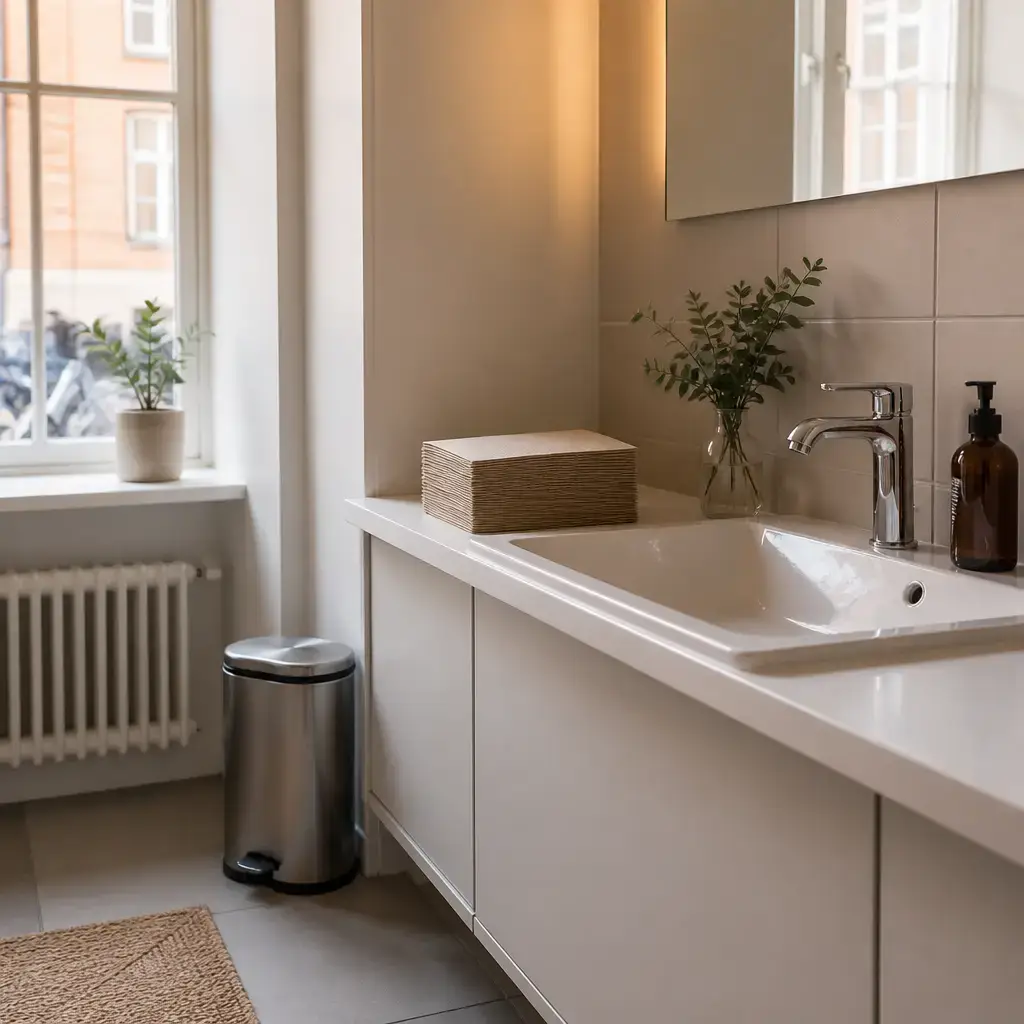
Use Keeping a Shared Bathroom Clean to practice German conversation, pronunciation, vocabulary, grammar, and quizzes.
Dialogue
Kann ich dieses Gemeinschaftsbad benutzen?
kah[n] ikh DEE-zəs gə-MYN-shahfts-baht bə-NOOT-sən? Can I use this shared bathroom?Du kannst es benutzen. Bitte halte den Bereich am Waschbecken sauber.
doo kahnst ės bə-NOOT-sən. BIT-tə HAL-tə dehn bə-RYKH ahm VAHSH-bek-ən ZOW-bər. You can, and please keep the sink area clean.Ich brauche ein Papierhandtuch.
ikh BROW-khə ayn pah-PEER-hahnt-tookh. I need a paper towel.Dort neben dem Waschbecken sind welche.
DORT NAY-bən dehm VAHSH-bek-ən zint VEL-khə. There are some near the sink.Kommt das in den Müll?
kohmt dahs in dehn mihl? Does this go in the trash?Tu es in den kleinen Mülleimer.
too ės in dehn KLY-nən MÜL-lye-mər. Put it in the small bin.Ich wische das Waschbecken auch schnell ab.
ikh VISH-ə dahs VAHSH-bek-ən owkh shnell ahp. I will wipe the sink quickly too.Das hilft der nächsten Person.
dahs hilft dehr NEX-stən pehr-ZOHN. That helps the next person.Sentence explanations
Kann ich dieses Gemeinschaftsbad benutzen?
Can I use this shared bathroom?
- Kann ich
- Can I
- dieses
- this
- Gemeinschaftsbad
- shared bathroom
- benutzen
- use
More detail
Kann ich combines the finite form kann of können with the subject pronoun ich. In a yes/no question, the finite verb comes first, so Kann ich ...? is a reusable way to ask whether you may or are able to do something. Here the intended meaning is a permission request. Example: Kann ich das Fenster öffnen? — “May/Can I open the window?” dieses means “this” and agrees with the noun Gemeinschaftsbad, which is neuter: das Gemeinschaftsbad. Because the bathroom is the object of benutzen, it is in the accusative; for a singular neuter noun, the demonstrative is dieses in both the nominative and accusative. The form is not chosen merely because the noun is singular. Compare dieser Raum (“this room,” masculine) and diese Tür (“this door,” feminine). Gemeinschaftsbad is a compound noun: Gemeinschaft conveys shared/community use, and Bad means “bathroom” here. The complete noun is neuter, so its article is das: das Gemeinschaftsbad. German compounds are written as one word, and the final part normally determines the grammatical gender. Example: Das Gemeinschaftsbad ist sauber. — “The shared bathroom is clean.” benutzen is the infinitive meaning “to use.” It is a regular verb; its base form is also benutzen, while a finite present-tense form changes with the subject, for example ich benutze (“I use”) and du benutzt (“you use”). After the modal verb können, the infinitive remains at the end: Kann ich ... benutzen? Example: Kann ich den Computer benutzen? — “Can I use the computer?” Together, Kann ich forms the yes/no question, dieses Gemeinschaftsbad identifies this particular shared bathroom as the object, and final benutzen supplies the action. The whole utterance therefore means: “Can I use this shared bathroom?”
Du kannst es benutzen. Bitte halte den Bereich am Waschbecken sauber.
You can, and please keep the sink area clean.
- Du kannst
- you can
- es
- it
- benutzen
- use
- Bitte
- please
- halte
- keep
- Bereich
- area
- am
- at the
- Waschbecken
- sink
- sauber
- clean
More detail
Du kannst means “you can” here. kannst is the second-person singular present form of können; with Du, it addresses one person informally. A modal verb is followed by an infinitive at the end of the clause: Du kannst warten = “You can wait.” es is a pronoun meaning “it.” In this context, the preceding question identifies the shared bathroom as what can be used. German es is the form used here for that neuter referent; its form does not change for the speaker’s or listener’s person. benutzen means “to use.” It is the infinitive required after können. The pattern Du kannst es benutzen can be reused with another object: Du kannst den Raum benutzen = “You can use the room.” Bitte means “please.” At the beginning of a request, it makes the request courteous: Bitte warten. = “Please wait.” halte means “keep” here. It is the informal singular imperative of halten (“to keep” or “to hold”), addressed to one person. The imperative form is used for a direct request: Halte die Tür offen. = “Keep the door open.” den Bereich means “the area.” Bereich is a masculine noun, with the base form der Bereich; den marks it as the masculine accusative object of halte. The plural is die Bereiche (“the areas”). am is the contracted form of an dem, commonly meaning “at the” or “by the” for a location. Here it introduces the location associated with the area: am Fenster = “by the window.” Waschbecken means “sink” or “washbasin.” It is a neuter noun: das Waschbecken. In am Waschbecken, am expands to an dem Waschbecken, meaning “at the sink.” sauber means “clean.” It is an adjective describing the state in which the area should remain. In halte ... sauber, it is used predicatively after the object, like “keep the area clean,” rather than as an inflected form before a noun. For example, Halte den Tisch sauber. = “Keep the table clean.” Together, Du kannst es benutzen grants permission to use the shared bathroom. Bitte halte den Bereich am Waschbecken sauber then politely asks the listener to keep the area by the sink clean. The complete meaning is: “You can use it, and please keep the sink area clean.”
Ich brauche ein Papierhandtuch.
I need a paper towel.
- Ich
- I
- brauche
- need
- ein
- a/an
- Papierhandtuch
- paper towel
More detail
Ich is the first-person singular pronoun, meaning “I.” It identifies the speaker as the person who needs something. The corresponding plural form is wir (“we”), but this sentence refers to one speaker. brauche is the present-tense first-person singular form of brauchen (“to need”). The pattern is ich brauche ... = “I need ...”. For example: Ich brauche Wasser. — “I need water.” The ending -e marks this verb form as agreeing with ich here; it is not part of the base form brauchen. ein is the indefinite article used here with the noun Papierhandtuch. Papierhandtuch is neuter (das Papierhandtuch), and after brauchen it is the direct object, so the neuter article remains ein in the accusative: Ich brauche ein Papierhandtuch. This article presents the towel as an unspecified one; it does not by itself assert a numerical count. For a feminine noun, the corresponding form in this role would be eine, as in the example Ich brauche eine Serviette. — “I need a napkin.” Papierhandtuch is a compound noun meaning “paper towel.” Its grammatical gender is neuter: das Papierhandtuch. Its plural is Papierhandtücher (“paper towels”). The compound is written as one word in German, so the article and other agreeing forms belong to the whole noun. Together, Ich brauche (“I need”) and ein Papierhandtuch (“a paper towel”) form the complete meaning: “I need a paper towel.” The sentence is a direct present-tense statement of the speaker’s need.
Dort neben dem Waschbecken sind welche.
There are some near the sink.
- Dort
- there
- neben
- beside; near
- Waschbecken
- sink
- sind
- are
- welche
- some
More detail
Dort means “there” and points to a place already relevant in the situation. It is a location adverb, not a pronoun naming a particular object. neben means “beside” or “near.” For a stationary location, it takes the dative: neben dem Waschbecken = “beside the sink.” With movement toward a place, neben can take the accusative instead, as in Ich stelle es neben das Waschbecken (“I put it beside the sink”). Waschbecken is the noun “sink.” Its base form is das Waschbecken; here dem Waschbecken is dative singular because the location is expressed after neben. The noun itself does not change in this form; the article shows the case. sind is the third-person plural present form of sein (“to be”): sein → sie sind. Here it agrees with the plural items that are understood from the context. In a location statement, sein links the items to their location rather than describing an action. welche means “some” here. It is used independently, without an overt noun, to refer to items understood from the situation; in this context, the preceding mention of a paper towel supplies the relevant kind of item. As an independent plural form, welche can mean “some” or “some ones.” Compare Ich brauche welche (“I need some”). This is different from the question word welche? (“which?”), whose meaning depends on a selection question. Together, Dort neben dem Waschbecken gives the location “there beside the sink,” while sind welche says that some understood items are located there. The whole utterance therefore means: “There are some near the sink.”
Kommt das in den Müll?
Does this go in the trash?
- Kommt
- goes
- das
- this
- in den
- into the
- Müll
- trash
More detail
Kommt is the third-person singular present form of kommen (“to come”). Here, with a destination introduced by in, it asks whether something goes or ends up there. The same form can also mean “comes” in a movement context. For example: Der Bus kommt. — “The bus is coming.” das is a demonstrative pronoun meaning “this” in this utterance. It is the subject of Kommt; its specific referent is supplied by the situation rather than by the sentence itself. As a reusable pattern, Kommt das ...? asks whether “this” belongs in or goes to a particular place. in den combines the preposition in with the masculine accusative article den. in takes the accusative here because the question concerns movement toward a destination, not a fixed location. Compare in den Müll (“into the trash”) with im Müll (in dem Müll, “in the trash” as a location). Müll is a masculine noun meaning “trash” or “rubbish”; its base form is der Müll. In den Müll, the article marks the accusative form required after directional in. The noun itself does not change here. Together, Kommt das in den Müll? asks whether this item should go into the trash. The question uses Kommt ...? in the sense “Does ... go/end up ...?”, places das as the item being discussed, and uses in den Müll for its destination.
Tu es in den kleinen Mülleimer.
Put it in the small bin.
- Tu es
- put it
- in den
- into the
- kleinen
- small
- Mülleimer
- bin
More detail
Tu es is a colloquial imperative construction: tu is the imperative of tun (“do”), and es is the unstressed pronoun “it.” Together here, they mean “put it,” as established by the fixed translation. The pronoun’s grammatical form is neuter accusative, but the supplied text does not identify exactly what “it” refers to. In a reusable pattern, Tu es in ... means “Put it in ...”. Example: Tu es in die Schublade. — “Put it in the drawer.” in den introduces the destination. With a movement toward a place, in takes the accusative; here den is the masculine accusative form of the definite article. This contrasts with location without movement: Es ist in dem Mülleimer. — “It is in the bin.” In that locational use, in takes the dative, shown by dem. kleinen means “small” here and describes Mülleimer. Its base form is klein; in this phrase it has the ending -en because the adjective follows the definite article den in the masculine accusative singular: den kleinen .... The adjective itself carries the inflection, not the noun. Example: Tu es in den großen Mülleimer. — “Put it in the large bin.” Mülleimer is a masculine noun meaning “bin” or “wastebasket.” It is built from Müll (“rubbish/trash”) and Eimer (“bucket”), but it functions as one noun. Its form is the same here for masculine singular accusative and nominative; the article shows the case: der Mülleimer (nominative), den Mülleimer (accusative). The compound can refer to a bin for waste, while Mülltonne commonly refers to a larger outdoor garbage bin. The complete utterance combines the colloquial imperative Tu es (“put it”), the destination marker in den (“into the”), and the noun phrase kleinen Mülleimer (“small bin”). Thus Tu es in den kleinen Mülleimer. means “Put it in the small bin.”
Ich wische das Waschbecken auch schnell ab.
I will wipe the sink quickly too.
- wische … ab
- wipe off
- Waschbecken
- sink
- auch
- too
- schnell
- quickly
More detail
wische ... ab: Together, these separated parts form abwischen (“to wipe off”). wische is the first-person singular present form of wischen, while the prefix ab- moves to the end of the clause: Ich wische ... ab. The full separable pattern is Ich wische den Tisch ab. — “I wipe the table off.” In this sentence, the present-tense form is understood with the future meaning given by the fixed translation: “I will wipe ...”. Waschbecken: This noun means “sink” and is capitalized because it is a German noun. Its article is neuter: das Waschbecken. In the sentence, das Waschbecken is the thing being wiped; the neuter accusative form remains das Waschbecken, identical in form to the nominative. Example: Ich putze das Waschbecken. — “I clean the sink.” auch: This means “too” or “also”. Here it adds the wiping action to something already relevant in the situation, without changing who performs it or what is being wiped. Example: Ich helfe auch. — “I help too.” schnell: Here schnell is an adverb meaning “quickly”; it describes how the wiping is done. German uses the same form for the related adjective and adverb in this position: ein schneller Zug means “a fast train”, while Der Zug fährt schnell means “The train is traveling quickly.” Putting the parts together, Ich supplies the first-person subject, wische ... ab expresses the separable verb “wipe off”, das Waschbecken is the object, auch adds “too”, and schnell describes the manner. The complete utterance means: “I will wipe the sink quickly too.”
Das hilft der nächsten Person.
That helps the next person.
- Das
- That
- hilft
- helps
- nächsten
- next
- Person
- person
More detail
Das is a standalone demonstrative pronoun here, not an article before a noun. It is the subject and means “that”; with the supplied context, it points back to the preceding action or situation. German also uses das as a neuter singular article or pronoun, so its function must be identified from the surrounding structure. hilft comes from helfen (“to help”). It is the present-tense third-person singular form: ich helfe, du hilfst, er/sie/es hilft. In this use, helfen takes the person helped in the dative. Example: Das hilft mir. — “That helps me.” nächsten is an inflected form of the adjective nächst-, meaning “next” here. It describes Person and has the weak dative feminine singular ending -en in der nächsten Person: der is the definite article for this dative feminine singular phrase, and the adjective receives -en. In this sentence, “next” refers to a place in an order or sequence. Example: Wir helfen der nächsten Person. — “We help the next person.” Person is a feminine noun meaning “person.” Here it is dative singular in the phrase der Person; its plural is Personen, which is not used here. The phrase der nächsten Person identifies the person receiving the help. Together, Das hilft der nächsten Person. means “That helps the next person.” Das is what provides the help, hilft expresses the present-tense helping relation, and der nächsten Person names the recipient. A reusable pattern is Das hilft + [dative person], for example Das hilft dem Kind. — “That helps the child.”
Grammar Points
abwischen: wische ... ab
Ich wische das Waschbecken schnell ab.
ikh VISH-ə dahs VAHSH-bek-ən shnell ahp.I quickly wipe off the sink.
In a main clause, the prefix of a separable verb moves to the end: wische ... ab.
den kleinen Mülleimer
Tu den Müll in den kleinen Mülleimer.
too dehn mihl in dehn KLY-nən MÜL-lye-mər.Put the trash in the small bin.
After den in the masculine accusative, the adjective takes the ending -en: den kleinen.
German Vocabulary
dieses Gemeinschaftsbad
halte den Bereich sauber
Kommt das in den Müll?
Quiz
Word Order
Arrange the words in the correct order.
Can I use this shared bathroom?
Show Answer
Kann ich dieses Gemeinschaftsbad benutzen?I need a paper towel.
Show Answer
Ich brauche ein Papierhandtuch.There are some near the sink.
Show Answer
Dort neben dem Waschbecken sind welche.Spelling
Tap the letters to spell the word.
to use
Show Answer
benutzennext to; near
Show Answer
nebento keep; to hold
Show Answer
halteto need