10 minutes free every day
Continue audio lessons in the app
Word explanations appear automatically in sync with the audio.
No login required · synced translations · playback with the screen locked
Choose your learning language and open this lesson in the app.

About This Lesson
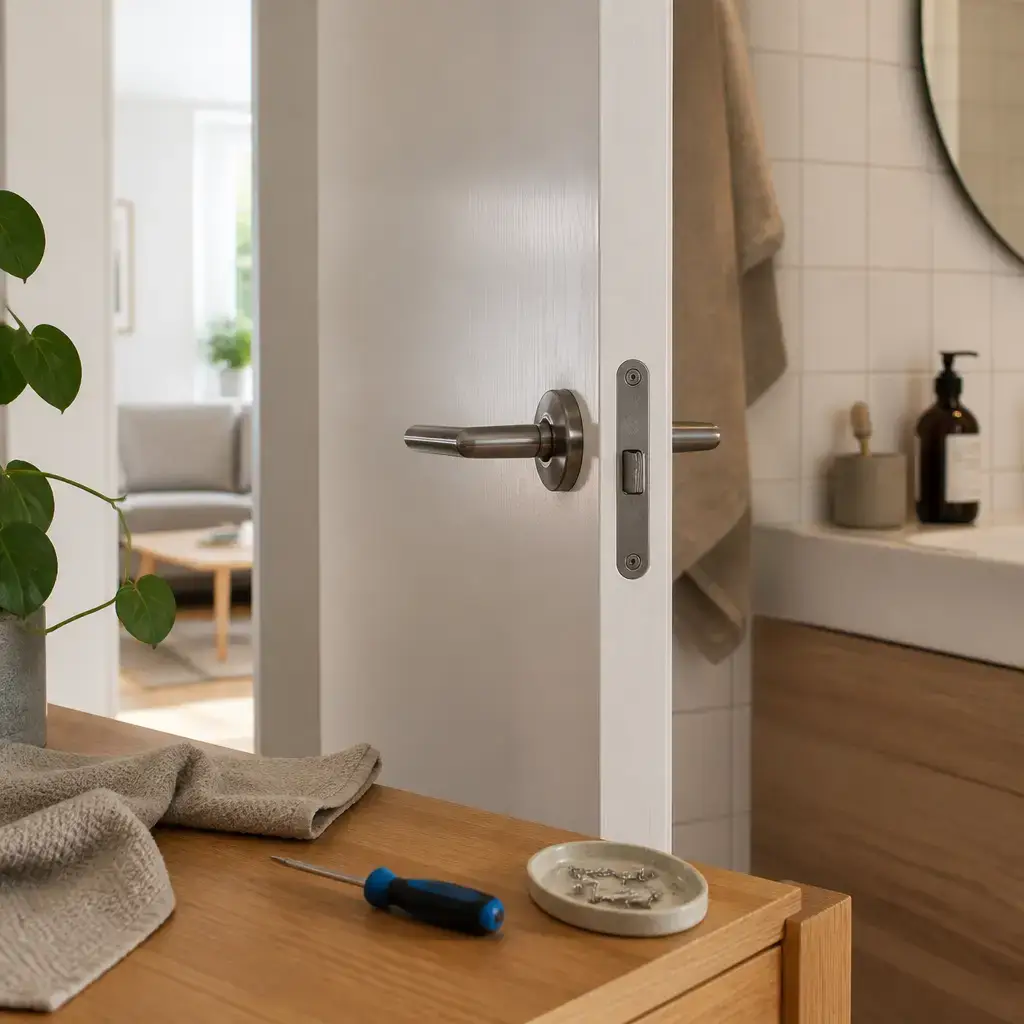
Use Tightening a loose bathroom door handle to practice German conversation, pronunciation, vocabulary, grammar, and quizzes.
Dialogue
Der Türgriff im Badezimmer fühlt sich wieder locker an.
dair TEWR-griff im BAH-duh-tsim-mer fyoolt zikh VEE-der LOCK-er ahn. The bathroom door handle feels loose again.Ich habe es gestern bemerkt, aber vergessen, ihn festzuziehen.
ikh HAH-buh ess GESS-tairn buh-MAIRKT, AH-ber fer-GESS-en, een FESS-tsoo-TSEE-en. I noticed it yesterday but forgot to tighten it.Haben wir einen Schraubenzieher in der Schublade?
HAH-ben veer EYE-nen SHROW-ben-tsee-er in dair SHOO-blah-duh? Do we have a screwdriver in the drawer?Der kleine sollte für diese Schrauben funktionieren.
dair KLY-nuh ZOLL-tuh fewr DEE-zuh SHROW-ben foongk-tsee-oh-NEER-en. The small one should work for these screws.Könntest du den Griff halten, während ich ihn festziehe?
KERN-test doo dair griff HAL-ten, VAIR-ent ikh een FESS-tsee-uh? Could you hold the handle while I tighten it?Ich halte ihn fest, während du ihn drehst.
ikh HAL-tuh een fest, VAIR-ent doo een DRAYST. I'll keep it steady while you turn it.Er fühlt sich jetzt viel fester an.
air fyoolt zikh yetst feel FESS-ter ahn. It feels much firmer now.Lass uns später sicherheitshalber noch einmal nachsehen.
LASS oons SHPAY-ter ZIKH-er-HYTE-shahl-ber nokh EYE-nmahl NAHKH-zay-en. Let's check it once more later, just in case.Sentence explanations
Der Türgriff im Badezimmer fühlt sich wieder locker an.
The bathroom door handle feels loose again.
- Der Türgriff
- the door handle
- Badezimmer
- bathroom
- fühlt sich … an
- feels
- wieder
- again
- locker
- loose
More detail
Der Türgriff is the subject: Türgriff means “door handle,” and der marks this noun phrase as masculine singular in the nominative here. The compound combines Tür (“door”) and Griff (“handle”); the useful reusable form is der Türgriff. Example: Der Türgriff ist kaputt. — “The door handle is broken.” Badezimmer means “bathroom.” In im Badezimmer, im is the contraction of in dem; this form places the bathroom in a location, so the noun phrase is dative. Badezimmer is neuter, but the noun itself does not change in this form. Example: Das Handtuch liegt im Badezimmer. — “The towel is in the bathroom.” fühlt sich … an is the separated reflexive construction sich anfühlen, “to feel” in the sense of having a perceptible quality. In this sentence, fühlt is the present-tense third-person singular form, agreeing with Der Türgriff; sich is the reflexive form used with that subject. The prefix an appears at the end of the clause because anfühlen is a separable verb. Example: Der Stoff fühlt sich weich an. — “The fabric feels soft.” wieder means “again” and indicates that the same condition is occurring once more. It does not itself specify how long the earlier condition lasted. Example: Die Tür ist wieder offen. — “The door is open again.” locker describes the handle’s condition as loose rather than firmly fixed. It is a predicative adjective after sich anfühlen, so it remains in the plain form rather than taking an adjective ending. Its useful opposite in this context is fest (“tight” or “firm”). Example: Die Schraube fühlt sich locker an. — “The screw feels loose.” Together, Der Türgriff identifies the subject, im Badezimmer locates it, and fühlt sich ... an presents a sensory assessment. wieder adds recurrence, while locker gives the perceived condition: “The bathroom door handle feels loose again.”
Ich habe es gestern bemerkt, aber vergessen, ihn festzuziehen.
I noticed it yesterday but forgot to tighten it.
- Ich habe
- I have
- es
- it
- gestern
- yesterday
- bemerkt
- noticed
- aber
- but
- vergessen
- forgot
- ihn
- it
- festzuziehen
- to tighten
More detail
Ich habe introduces a first-person statement in the perfect tense: haben is the auxiliary, and the subject is ich. The pattern Ich habe ... is reusable for “I have ...” or, in a completed past event, “I ...”. Here the completed action is expressed by the later form bemerkt. es is the accusative form of the neuter pronoun es, used here for the thing or situation noticed. The form itself does not identify a person. Its specific referent is not established more precisely by the sentence, but the supplied context concerns a loose door handle. gestern means “yesterday” and places the noticing in the past. It is an adverb, so it does not change form for person or number. bemerkt is the past participle of bemerken, “to notice”. The useful perfect pattern is haben + bemerkt: Ich habe es bemerkt means “I noticed it” here. Example: Sie hat den Fehler bemerkt. — “She noticed the mistake.” aber connects two contrasting parts and means “but”. It does not itself change the tense or identify the subject; the subject of the second action remains understood as ich. vergessen is both the infinitive and the past participle form of the strong verb vergessen, “to forget”. In this sentence it completes the perfect construction with habe: habe ... vergessen means “forgot”. It is followed by an infinitive phrase describing what was forgotten. Example: Ich habe den Termin vergessen. — “I forgot the appointment.” ihn is the accusative form of the masculine pronoun er, meaning “him” or “it” when the referent is grammatically masculine. In the supplied context, it refers to the door handle, der Türgriff, as the object to be tightened. This contrasts with es: the two forms reflect different grammatical genders of their referents, not different English translations of “it”. festzuziehen is the infinitive with zu of the separable verb festziehen, “to tighten”. With zu, the prefix and infinitive marker appear as festzuziehen; this is not a separate verb ziehen in this sentence. The pattern vergessen, etwas festzuziehen means “to forget to tighten something”. Example: Er hat vergessen, die Schraube festzuziehen. — “He forgot to tighten the screw.” Together, Ich habe es gestern bemerkt says “I noticed it yesterday”. aber vergessen, ihn festzuziehen adds the contrast: the speaker noticed the relevant issue but forgot to tighten the door handle. Thus the whole utterance means: “I noticed it yesterday but forgot to tighten it.”
Haben wir einen Schraubenzieher in der Schublade?
Do we have a screwdriver in the drawer?
- Haben wir
- do we have
- Schraubenzieher
- screwdriver
- Schublade
- drawer
More detail
Haben wir is the question pattern “do we have …?” Here haben is the present-tense form of haben for wir (“we”): wir haben becomes haben wir when the yes/no question starts with the verb. A reusable pattern is Haben wir + object?, for example: Haben wir genug Zeit? — “Do we have enough time?” Schraubenzieher means “screwdriver.” It is a masculine noun: der Schraubenzieher. In this sentence it is the direct object of haben, so the indefinite article appears as accusative masculine einen: einen Schraubenzieher. The noun itself has the same form here as in the nominative singular. Example: Ich brauche einen Schraubenzieher. — “I need a screwdriver.” Schublade means “drawer.” Its basic form is the feminine noun die Schublade. After in with a stationary location, German uses the dative, so die Schublade becomes der Schublade: in der Schublade — “in the drawer.” This contrasts with movement into the drawer, where accusative is used: Ich lege den Schraubenzieher in die Schublade. — “I put the screwdriver into the drawer.” Together, Haben wir forms the yes/no question, einen Schraubenzieher names the thing being sought, and in der Schublade gives its location: “Do we have a screwdriver in the drawer?”
Der kleine sollte für diese Schrauben funktionieren.
The small one should work for these screws.
- Der kleine
- the small one
- sollte
- should
- funktionieren
- work
- diese
- these
- Schrauben
- screws
More detail
Der kleine means “the small one.” kleine is the adjective klein used substantivally: the noun is left understood, so the adjective itself stands for “the small one.” With the definite article der, this form is masculine singular nominative. In the supplied context, the understood item can naturally be the screwdriver mentioned in the preceding question. Compare the reusable pattern der + adjective ending in -e for a masculine singular “the ... one,” such as der alte — “the old one.” sollte comes from the modal verb sollen. Here it expresses an expectation translated as “should,” rather than a command. sollte funktionieren is a useful pattern for saying that something is expected to work. The infinitive follows the modal verb and appears at the end of the clause: Das sollte funktionieren. — “That should work.” funktionieren is the infinitive meaning “to work” or “to function” in the sense of operating successfully. Its base form is funktionieren; after a modal verb, German uses this infinitive: Der kleine funktioniert — “The small one works,” but Der kleine sollte funktionieren — “The small one should work.” diese means “these” here and points to more than one nearby or otherwise identified item. It modifies Schrauben and has the plural form. The preposition für requires the accusative in this use; for plural, diese has the same visible form in the nominative and accusative, so the case is shown by the construction rather than by a different ending on diese. Schrauben is the plural of Schraube, “screw.” In für diese Schrauben, it is accusative plural because of für. The pattern für + accusative is reusable: für diese Teile — “for these parts.” Together, Der kleine identifies the understood small item, sollte funktionieren says that it is expected to work, and für diese Schrauben specifies the screws it is suitable for. The complete meaning is: “The small one should work for these screws.”
Könntest du den Griff halten, während ich ihn festziehe?
Could you hold the handle while I tighten it?
- Könntest du
- could you
- Griff
- handle
- halten
- hold
- während
- while
- ich
- I
- ihn
- it
- festziehe
- tighten
More detail
Könntest du is a polite request pattern: können means “can/be able to,” and könntest is its second-person singular subjunctive II form, literally presenting the ability as hypothetical or tentative. With du, the form is könntest; for example, Könntest du warten? means “Could you wait?” Griff means “handle” here. Its useful base form is the masculine noun der Griff; the article and adjective forms around it can show that grammatical gender, as in ein kleiner Griff (“a small handle”). halten means “to hold” or “keep something in position.” It is the infinitive used after the modal verb in Könntest du ... halten?. The object is expressed separately: etwas halten means “hold something.” während introduces a time relation meaning “while” or “during the time that.” In this sentence it introduces a subordinate clause, so the conjugated verb goes to the end of that clause: während ich ihn festziehe. ich is the first-person singular pronoun, “I.” It is the subject of the subordinate clause and identifies the person who will do the tightening. ihn is the accusative singular masculine form of er (“he/it” for a masculine noun). Here the fixed translation identifies it as the handle: the speaker will tighten the handle. Compare the forms er (nominative subject) and ihn (accusative object): Er hält den Griff means “He holds the handle,” while Ich halte ihn means “I hold it.” festziehe comes from the separable verb festziehen, “to tighten.” It is the first-person singular present form: ich ziehe ... fest in a main clause. Because festziehen occurs inside the subordinate clause after während, its parts appear together at the end as festziehe: während ich ihn festziehe. Together, Könntest du den Griff halten asks the listener to hold the handle, and während ich ihn festziehe specifies that this should happen while the speaker tightens it. The complete meaning is: “Could you hold the handle while I tighten it?”
Ich halte ihn fest, während du ihn drehst.
I'll keep it steady while you turn it.
- halte … fest
- keep/hold ... steady
- ihn
- it
- während
- while
- du
- you
- drehst
- turn
More detail
halte ... fest is the first-person singular present form of the separable verb festhalten (“to hold firmly” or “to keep steady”). In the sentence, halte appears in the main-clause position and the prefix fest is placed at the end of that clause. The pattern is: Ich halte etwas fest. — “I hold/keep something steady.” The form halte identifies ich; it is not the form used with du, which is hältst. ihn is the accusative form of the masculine personal pronoun er; here, the fixed translation identifies its intended meaning as “it.” It functions as the object of halte ... fest. The same pronoun form can refer to a masculine noun or, in context, to a thing translated as “it”; its form itself does not identify the specific object. während introduces a clause describing an action happening at the same time. It is a subordinating conjunction, so the finite verb goes to the end of its clause. A reusable pattern is während + subject + ... + verb: Während sie arbeitet, warte ich. — “While she works, I wait.” du is the second-person singular subject pronoun, “you.” It is the subject of the clause introduced by während. German distinguishes this singular informal du from plural or formal forms such as ihr and Sie; the appropriate choice depends on the addressee or addressees. drehst is the second-person singular present form of drehen, “to turn.” Its ending marks du: ich drehe, du drehst. Here it describes the turning action carried out by “you.” For example, Du drehst den Knopf. means “You turn the knob.” Together, Ich halte ihn fest means “I keep it steady,” and während du ihn drehst means “while you turn it.” The complete utterance therefore means: “I’ll keep it steady while you turn it.” The present-tense German forms express this coordinated action in the situation; English naturally uses “I’ll” for the intended future-oriented offer or plan.
Er fühlt sich jetzt viel fester an.
It feels much firmer now.
- fühlt … an
- feels
- jetzt
- now
- viel
- much
- fester
- firmer
More detail
fühlt … an is the separated form of the reflexive verb sich anfühlen, “to feel” or “to seem.” In this sentence, fühlt is the present-tense third-person singular form of anfühlen; its separable prefix an appears at the end. The reflexive sich is part of the construction, so a reusable pattern is etwas fühlt sich … an — “something feels … .” Example: Der Stoff fühlt sich weich an. — “The fabric feels soft.” jetzt means “now” and places the reported impression at the present time. Example: Jetzt fühlt es sich besser an. — “Now it feels better.” viel means “much” here because it strengthens the comparison that follows. In viel fester, it means “much firmer,” not a separate quantity of an object. Example: Der Griff fühlt sich viel stabiler an. — “The handle feels much more stable.” fester is the comparative form of the adjective fest, “firm” or “solid.” The adjective changes as fest → fester (“firm” → “firmer”); viel intensifies the comparison. Example: Dieser Teil ist fester als vorher. — “This part is firmer than before.” Putting the parts together, Er is the third-person singular subject pronoun, rendered here as “it” by the fixed translation, and sich completes the reflexive verb sich anfühlen. The pattern Er fühlt sich jetzt viel fester an therefore means “It feels much firmer now.”
Lass uns später sicherheitshalber noch einmal nachsehen.
Let's check it once more later, just in case.
- Lass uns
- let's
- später
- later
- sicherheitshalber
- just in case
- noch einmal
- once more
- nachsehen
- check
More detail
Lass uns is the reusable German way to suggest an action jointly: Lass uns + infinitive means “let’s …”. Lass is the imperative singular of lassen (“to let/allow”), while uns is the object form meaning “us”. In this construction, it does not mean that someone is literally permitting us; together they introduce a joint proposal. später means “later”, referring to a time after the current moment. It can be moved in a sentence when the intended emphasis changes, but here it places the checking later in time. sicherheitshalber is an adverb meaning “as a precaution” or “just in case”. It explains the reason for checking again: the speakers want to make sure, without stating that a problem definitely exists. It is a useful compact precaution pattern; for example, Nimm sicherheitshalber einen Schirm mit. means “Take an umbrella with you, just in case.” noch einmal means “once more” or “again”. noch contributes the idea of continuation or an additional occurrence, and einmal means “one time” here. Together they request one further check, not necessarily a particular number of earlier checks. nachsehen is the infinitive of the separable verb nachsehen, commonly meaning “to check” or “to look something up/check something”. In the fixed sentence it is the action proposed by Lass uns. In a finite clause, the separable parts can appear apart: Wir sehen später nach. means “We’ll check later.” The German sentence does not state the object explicitly; the fixed translation identifies the intended object as “it”. Taken together, Lass uns introduces a joint proposal, später places it later, sicherheitshalber gives the precautionary motivation, noch einmal adds one further occasion, and nachsehen names the action. The whole utterance therefore means: “Let’s check it once more later, just in case.”
Grammar Points
sich ... anfühlen
Der Türgriff fühlt sich locker an.
dair TEWR-griff fyoolt zikh LOCK-er ahn.The door handle feels loose.
The reflexive verb sich anfühlen splits in a main clause: fühlt ... an. Sich refers back to the thing being described.
Komparativ: -er
Jetzt ist die Schraube fester.
yetst ist dee SHROW-buh FESS-ter.Now the screw is tighter.
The adjective fest becomes fester to compare its degree: firmer or tighter.
German Vocabulary
Der Türgriff im Badezimmer fühlt sich wieder locker an.
Ich habe es gestern bemerkt, aber vergessen, ihn festzuziehen.
Ich habe es gestern bemerkt, aber vergessen, ihn festzuziehen.
Ich habe es gestern bemerkt, aber vergessen, ihn festzuziehen.
Der kleine sollte für diese Schrauben funktionieren.
Der Türgriff im Badezimmer fühlt sich wieder locker an.
Haben wir einen Schraubenzieher in der Schublade?
Haben wir einen Schraubenzieher in der Schublade?
Der Türgriff im Badezimmer fühlt sich wieder locker an.
Der Türgriff im Badezimmer fühlt sich wieder locker an.
Ich habe es gestern bemerkt, aber vergessen, ihn festzuziehen.
Der Türgriff im Badezimmer fühlt sich wieder locker an.
Quiz
Spelling
Tap the letters to spell the word.
door handle
Show Answer
Türgriffloose
Show Answer
lockeryesterday
Show Answer
gesternto notice