10 minutes free every day
Continue audio lessons in the app
Word explanations appear automatically in sync with the audio.
No login required · synced translations · playback with the screen locked
Choose your learning language and open this lesson in the app.

About This Lesson
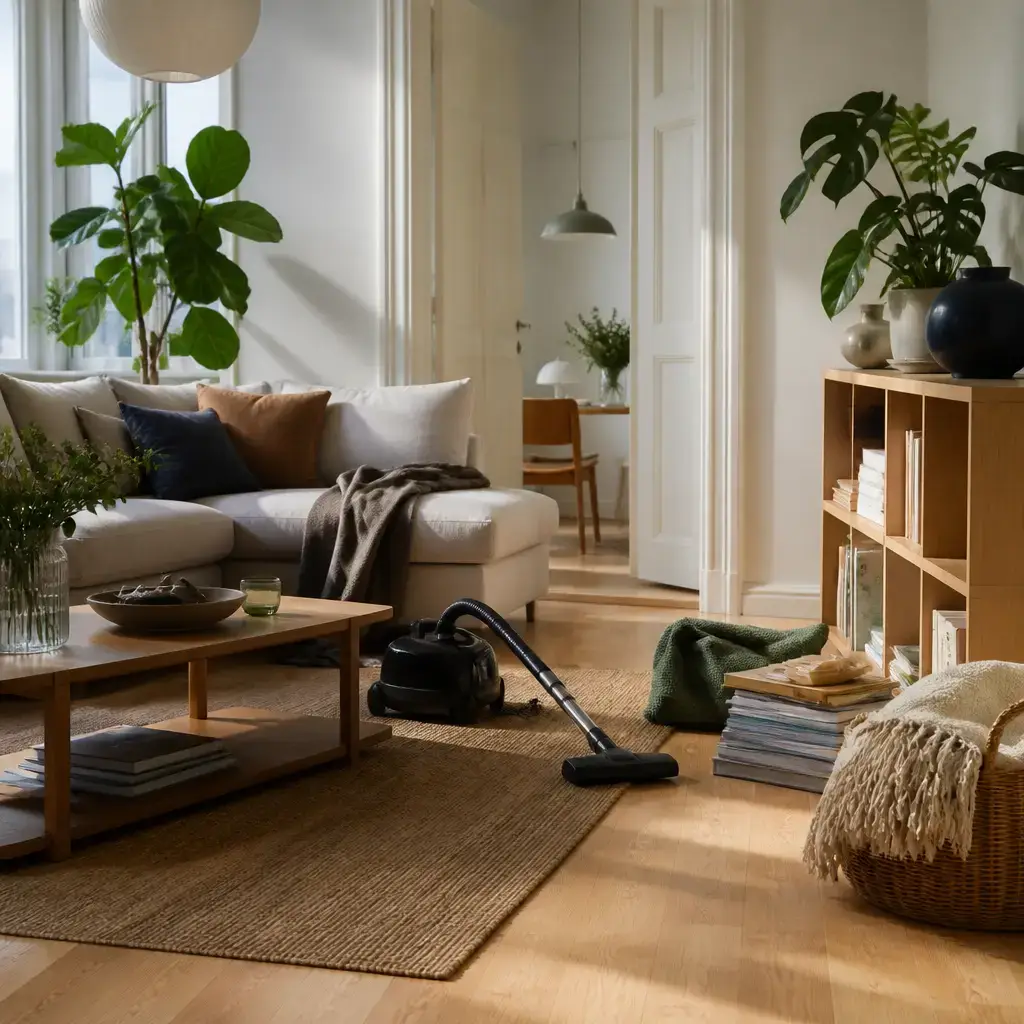
Use Tidying the living room before guests arrive to practice German conversation, pronunciation, vocabulary, grammar, and quizzes.
Dialogue
Unsere Gäste kommen bald.
OON-zuh-reh GES-tuh KOM-men balt. Our guests are coming soon.Dann sollten wir das Wohnzimmer aufräumen, bevor sie ankommen.
dahn SOLL-ten veer dahs VOHN-tsim-mer OWF-roy-men, beh-FOHR zee AHN-kom-men. Then we should clear the living room before they arrive.Ich stelle die Bücher zurück ins Regal.
ikh SHTEL-leh dee BYOO-kher tsoo-ROOK ins reh-GAHL. I'll put the books back on the shelf.Ich richte die Kissen auf dem Sofa.
ikh RIKH-tuh dee KIS-sen owf daym ZOH-fah. I'll straighten the cushions on the sofa.Sollen wir auch den Teppich saugen?
ZOLL-en veer owkh dayn TEP-pikh ZOW-gen? Should we vacuum the rug as well?Staubsaugen würde helfen, besonders in der Nähe der Tür.
SHTOWB-zow-gen VUR-duh HEL-fen, beh-ZON-ders in dair NAY-uh dair TOOR. Vacuuming would help, especially near the doorway.Der Raum fühlt sich schon gemütlicher an.
dayr ROWM FYOOLT zikh shohn geh-MYOOT-likh-er ahn. The room already feels more comfortable.Lass uns Tee machen, sobald alles fertig ist.
lahs oons TAY MAKH-en, soh-BAHLT ALL-es FAIR-tikh ist. Let's make tea once everything is ready.Sentence explanations
Unsere Gäste kommen bald.
Our guests are coming soon.
- Unsere
- our
- Gäste
- guests
- kommen
- come
- bald
- soon
More detail
Unsere means “our” here and is the possessive determiner modifying Gäste. Its base form is unser; the ending changes with the grammatical features of the noun phrase. In unsere Gäste, Gäste is plural and functions as the nominative subject, so unsere has this form. The determiner expresses possession or association, not a specific number beyond the noun’s plural form. Gäste means “guests” here. Its singular base noun is Gast, and its plural is Gäste; the umlaut and plural ending are part of the observed plural form. Because it is the subject of kommen, it is in the nominative case. Example: Die Gäste kommen. — “The guests are coming.” kommen means “come” here. Its base form is kommen, and this observed form is the present-tense form for a plural subject such as sie or wir; with unsere Gäste, it means “come” or, in this context, “are coming.” German commonly uses the present tense for an expected or arranged near-future event when the time is clear. Example: Wir kommen morgen. — “We are coming tomorrow.” bald means “soon.” It is an adverb, so it adds the time of the coming without changing form. Example: Sie kommen bald. — “They are coming soon.” Together, Unsere Gäste is the subject “our guests,” kommen says that they are coming, and bald places this event in the near future: “Our guests are coming soon.”
Dann sollten wir das Wohnzimmer aufräumen, bevor sie ankommen.
Then we should clear the living room before they arrive.
- Dann
- then
- sollten wir
- we should
- das
- the
- Wohnzimmer
- living room
- aufräumen
- clear up
- bevor
- before
- sie
- they
- ankommen
- arrive
More detail
Dann means “then” here and places the suggested action after the situation already mentioned. It is a time adverb and can also introduce a consequence: Dann gehen wir. — “Then we’ll go.” sollten wir expresses “we should.” sollten is the form of sollen used here for a recommendation or obligation that is presented less forcefully than a direct command. wir is the first-person plural subject, “we.” Compare Wir sollen warten. — “We are supposed to wait.” das Wohnzimmer means “the living room.” Wohnzimmer is a neuter noun, and das is its definite article here. The article is accusative because the room is the object of aufräumen; for this neuter noun, das looks the same in nominative and accusative: Das Wohnzimmer ist groß. — “The living room is large”; Ich sehe das Wohnzimmer. — “I see the living room.” aufräumen means “to tidy up” or “to clear up.” It is a separable verb: the base verb is aufräumen, with the prefix auf- and the verb räumen. After the modal verb sollten, it remains an infinitive at the end of the clause. In a simple main clause, the parts separate: Wir räumen das Wohnzimmer auf. — “We tidy up the living room.” bevor introduces a time clause meaning “before.” In a German subordinate clause introduced by bevor, the finite verb goes to the end: Bevor sie kommen, räumen wir auf. — “Before they come, we tidy up.” sie means “they” here. The fixed translation and the preceding context identify the referent as the guests. This plural pronoun is distinct from singular sie, “she,” and formal Sie, “you”; capitalization and context help distinguish them in writing. ankommen means “to arrive.” Its base form is ankommen; in the subordinate clause, ankommen is the finite present form for the plural subject sie, as well as the infinitive form. The verb is separable in a main clause: Die Gäste kommen an. — “The guests arrive.” After bevor, it stays together at the end: bevor die Gäste ankommen — “before the guests arrive.” Together, Dann sollten wir das Wohnzimmer aufräumen says “Then we should clear up the living room.” The subordinate clause bevor sie ankommen adds the time limit “before they arrive.” Thus the whole utterance means: “Then we should clear the living room before the guests arrive.”
Ich stelle die Bücher zurück ins Regal.
I'll put the books back on the shelf.
- stelle
- put; place
- Bücher
- books
- zurück
- back
- ins
- into the
- Regal
- shelf
More detail
stelle is the first-person singular present form of stellen (“to put/place”): ich stelle = “I put/I am putting.” German present tense can also express a planned near-future action, which fits the translation “I’ll put.” In this sentence, stellen combines with zurück; the split word order is Ich stelle ... zurück. A useful contrast is legen (“to lay/place lying down”): the choice depends on how the object is positioned, not simply on the English word “put.” Bücher means “books” here. Its base form is the plural noun Buch (“book”); Bücher is both the nominative and accusative plural form. The article die before it shows the plural accusative object: die Bücher = “the books.” zurück means “back” in this sentence, indicating a return to an earlier place. Together with stellen, it forms the separable verb zurückstellen (“to put back”): Ich stelle das Glas zurück. — “I put the glass back.” The object can occur between the verb part and zurück, as in the supplied sentence. ins is the contraction of in das. Here in introduces a destination, so the destination is expressed with the accusative: in das Regal becomes ins Regal. This is different from a location without movement, where in can take the dative: Die Bücher sind im Regal. — “The books are in the shelf/bookcase.” Regal means “shelf” or “bookcase,” depending on the object referred to in context. Its base form is the neuter noun das Regal; after in with movement toward a destination, the form is das Regal in the contracted phrase ins Regal. The noun itself does not change here. The whole utterance combines Ich stelle (“I put”), the object die Bücher (“the books”), the return adverb zurück (“back”), and the destination ins Regal (“onto/into the shelf”). Thus Ich stelle die Bücher zurück ins Regal. means “I’ll put the books back on the shelf.”
Ich richte die Kissen auf dem Sofa.
I'll straighten the cushions on the sofa.
- richte
- straighten; arrange
- Kissen
- cushions; pillows
- auf dem
- on the
- Sofa
- sofa
More detail
richte is the first-person singular present form of richten. Here it means “straighten” or “arrange,” referring to the cushions. The present tense can describe an action the speaker is about to carry out, which matches “I’ll straighten” in the fixed translation. Do not confuse this observed form with the separable verb aufrichten; the sentence does not contain a separate final auf belonging to that verb. Example: Ich richte den Stuhl. — “I straighten the chair.” Kissen means “cushions” here. Its singular and plural forms are both Kissen; the article die shows the plural in this sentence. The word can also mean “pillows” in a different context, but the fixed translation supports “cushions” here. Example: Die Kissen liegen auf dem Sofa. — “The cushions are on the sofa.” auf dem combines the preposition auf with the dative article dem. With a stationary location, auf takes the dative, so auf dem Sofa means “on the sofa.” The form dem is used with the neuter noun Sofa in this phrase. With movement onto a surface, auf commonly takes the accusative instead: Ich lege das Kissen auf das Sofa. — “I put the cushion onto the sofa.” Sofa means “sofa.” Its usual gender is neuter: das Sofa; after the stationary auf, it appears as dem Sofa. Together, Ich richte die Kissen auf dem Sofa means “I straighten the cushions on the sofa.” Ich identifies the speaker as the actor, die Kissen as what is being straightened, and auf dem Sofa as the location of the cushions. The final period closes the statement.
Sollen wir auch den Teppich saugen?
Should we vacuum the rug as well?
- Sollen wir
- should we?
- auch
- also; as well
- Teppich
- rug; carpet
- saugen
- vacuum
More detail
Sollen wir begins a yes/no question. sollen is the present-tense form used with wir of the modal verb sollen; in this sentence it proposes an action, so the meaning is “Should we …?” A modal verb is followed by the other verb in its infinitive form: Wir sollen den Teppich saugen. means “We should vacuum the rug.” In the question, the finite modal comes first, while wir remains the subject. auch adds the meaning “also” or “as well.” Here it presents vacuuming as an additional possible task, alongside straightening the cushions in the preceding context. Its position can vary in German, but moving it can change what is emphasized. Teppich is the noun for a rug or carpet. It is masculine: der Teppich. After the verb phrase here, it is the direct object, so masculine accusative uses den: den Teppich. Compare the reusable pattern der Teppich (subject form) and den Teppich (direct-object form). Example: Ich sehe den Teppich. — “I see the rug.” saugen is the infinitive meaning “to vacuum” in this context. German also uses it more generally for “to suck,” but the object and the surrounding cleaning context specify the vacuuming sense here. With sollen, the infinitive stays at the end: Wir sollen den Teppich saugen. — “We should vacuum the rug.” Together, the modal question Sollen wir …?, the added-task marker auch, the direct object den Teppich, and the final infinitive saugen form the meaning “Should we vacuum the rug as well?”
Staubsaugen würde helfen, besonders in der Nähe der Tür.
Vacuuming would help, especially near the doorway.
- Staubsaugen
- vacuuming
- würde
- would
- helfen
- help
- besonders
- especially
- in der Nähe
- nearby; in the vicinity
- Tür
- door; doorway
More detail
Staubsaugen is a capitalized noun meaning “vacuuming.” It is formed from the verb staubsaugen and names the activity itself. As a neuter singular subject, it can occupy the subject position here: Staubsaugen hilft means “Vacuuming helps.” würde is the third-person singular form of the conditional form of werden in this construction. Together with an infinitive, würde + infinitive expresses a hypothetical or conditional result, corresponding here to “would.” The infinitive comes at the end of this verbal construction: würde helfen = “would help.” helfen means “to help.” After würde, it remains in the infinitive rather than taking a finite ending. For example, Das würde helfen. means “That would help.” besonders means “especially” and highlights the following location as a particularly relevant place. It can also modify an adjective or adverb, as in besonders schnell (“especially quickly”), but here it emphasizes the location. in der Nähe is a reusable location pattern meaning “near” or “in the vicinity.” With a stationary location, in takes the dative here; Nähe is feminine, so the article is der: in der Nähe der Tür means “near the door.” Tür means “door.” In this sentence, der Tür is the genitive phrase specifying near which door: der Tür = “the door’s / the door.” The fixed translation renders the location naturally as “near the doorway.” Assembled, Staubsaugen würde helfen means “Vacuuming would help,” and besonders in der Nähe der Tür adds the emphasized location, “especially near the doorway.” The complete utterance therefore means: “Vacuuming would help, especially near the doorway.”
Der Raum fühlt sich schon gemütlicher an.
The room already feels more comfortable.
- Raum
- room
- fühlt sich … an
- feels
- schon
- already
- gemütlicher
- more comfortable
More detail
Raum means “room” here. Its base form is the masculine noun der Raum; the plural is die Räume. The article and adjective forms around it can show its grammatical gender and case, but the noun itself names the space. fühlt sich … an comes from the separable verb sich anfühlen, “to feel” or “to seem by sensory impression.” In this sentence, fühlt is the third-person singular present form, matching der Raum. The reflexive pronoun sich belongs to the verb, and the separable part an appears at the end of the clause. In a main-clause pattern, the parts are therefore: Der Raum fühlt sich ... an. Example: Der Stoff fühlt sich weich an. — “The fabric feels soft.” schon means “already” here. It places the feeling at an earlier stage or indicates that the change is noticeable by now. It does not itself say how much time has passed. gemütlicher is the comparative form of the adjective gemütlich, meaning “comfortable,” “cozy,” or “pleasantly homelike.” The useful comparison chain is gemütlich — “comfortable/cozy,” gemütlicher — “more comfortable/cozier,” am gemütlichsten — “most comfortable/coziest.” The comparative ending is on the adjective gemütlicher, not on Raum. In this sentence it describes the room’s perceived state without explicitly naming what it is being compared with. Together, Der Raum supplies the thing being described, fühlt sich ... an expresses its perceived quality, schon means “already,” and gemütlicher gives the comparative quality. The complete meaning is: “The room already feels more comfortable.”
Lass uns Tee machen, sobald alles fertig ist.
Let's make tea once everything is ready.
- Lass uns
- let’s
- Tee
- tea
- machen
- make
- sobald
- as soon as
- alles
- everything
- fertig
- ready
- ist
- is
More detail
Lass uns is a reusable way to suggest a joint action: “let’s …”. Lass is the informal singular imperative of lassen (“to let”); uns is the first-person plural object form (“us”). In this construction, Lass uns is followed by an infinitive: Lass uns gehen. — “Let’s go.” It includes the speaker and the person addressed. Tee means tea. It is a masculine noun: der Tee. Here it is the thing being made, so it functions as the object of machen. German masculine nouns usually show an accusative change in the article, but no visible change appears on Tee itself. machen is the infinitive “to make” or “to do”; here it means “make” in the sense of prepare tea. After Lass uns, the action verb remains in the infinitive. Example: Lass uns eine Pause machen. — “Let’s take a break.” sobald means “as soon as” or “once” and introduces a subordinate time clause. In that clause, the finite verb goes to the end: sobald du kommst — “as soon as you come.” alles is the neuter indefinite pronoun “everything” or “all of it.” It is the subject of the subordinate clause here. It does not identify exactly what “everything” refers to; that must come from context. fertig means “ready” or “finished.” Here it describes the state of alles: everything is ready. As a predicate adjective after sein, it has no adjective ending: alles ist fertig. The related adjective bereit can also mean “ready,” but fertig commonly emphasizes being completed or ready for the next step. ist is the third-person singular present form of sein (“to be”): sein — ist. It agrees with the singular pronoun alles. Because it appears in the sobald clause, it comes at the end of that clause. Together, Lass uns Tee machen gives the joint suggestion “Let’s make tea.” The time clause sobald alles fertig ist gives the condition “once everything is ready.” The complete utterance therefore means: “Let’s make tea once everything is ready.”
Grammar Points
bevor + Nebensatz: Das Verb steht am Ende.
Bevor die Gäste kommen, räumen wir das Wohnzimmer auf.
beh-FOHR dee GES-tuh KOM-men, ROY-men veer dahs VOHN-tsim-mer OWF.Before the guests come, we tidy up the living room.
After bevor, German places the conjugated verb at the end of the subordinate clause.
sich anfühlen: sich ... an
Das Wohnzimmer fühlt sich schon gemütlicher an.
dahs VOHN-tsim-mer FYOOLT zikh shohn geh-MYOOT-likh-er ahn.The living room already feels more comfortable.
This separable verb splits around the subject: fühlt ... an; sich marks the reflexive form.
German Vocabulary
Bevor sie ankommen.
Dann sollten wir das Wohnzimmer aufräumen, bevor sie ankommen.
Unsere Gäste kommen bald.
Bevor sie ankommen.
Ich stelle die Bücher zurück ins Regal.
Unsere Gäste kommen bald.
Ich richte die Kissen auf dem Sofa.
Unsere Gäste kommen bald.
Ich stelle die Bücher zurück ins Regal.
Auf dem Sofa.
Dann sollten wir das Wohnzimmer aufräumen.
Ich stelle die Bücher zurück ins Regal.
Quiz
Word Order
Arrange the words in the correct order.
Our guests are coming soon.
Show Answer
Unsere Gäste kommen bald.Should we vacuum the rug as well?
Show Answer
Sollen wir auch den Teppich saugen?Spelling
Tap the letters to spell the word.
to arrive
Show Answer
ankommento tidy up
Show Answer
aufräumenback
Show Answer
zurückto come