10 minutes free every day
Continue audio lessons in the app
Word explanations appear automatically in sync with the audio.
No login required · synced translations · playback with the screen locked
Choose your learning language and open this lesson in the app.

About This Lesson
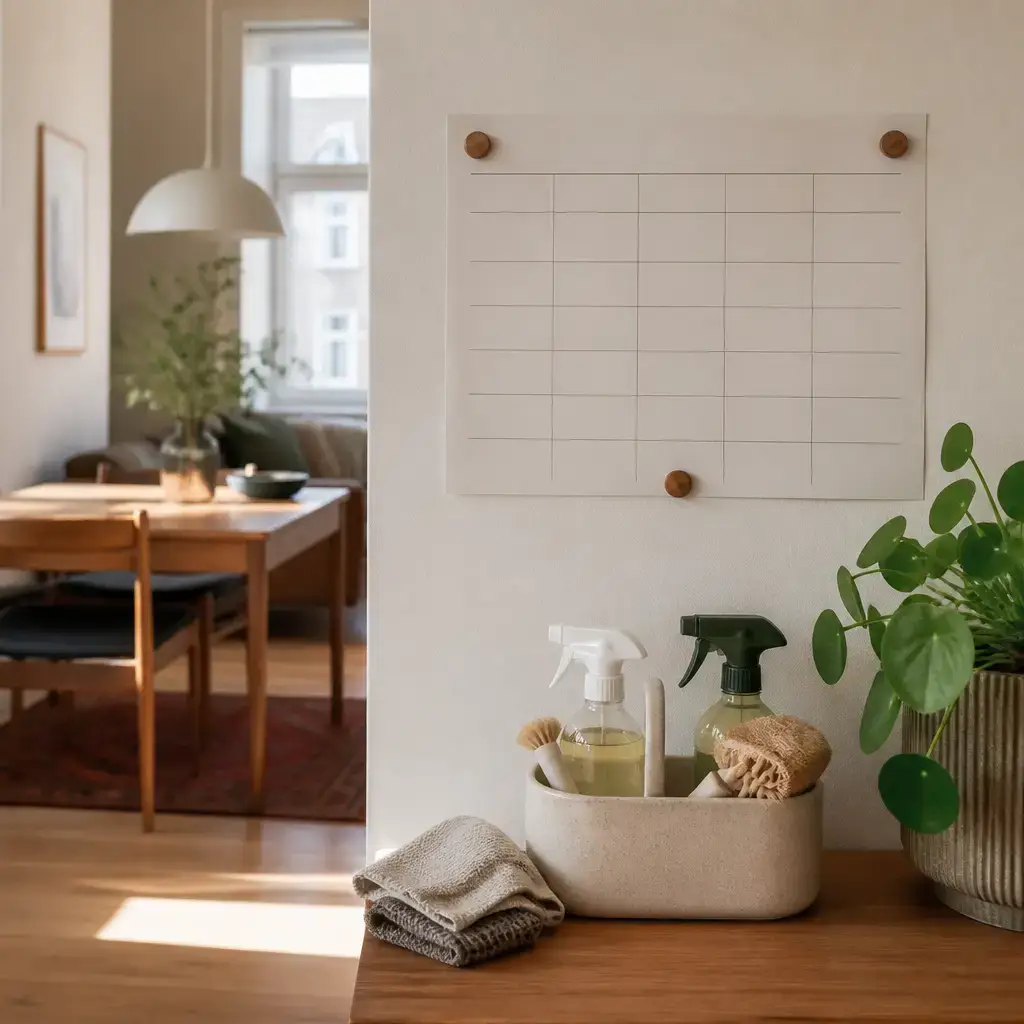
Use A weekly cleaning schedule to practice German conversation, pronunciation, vocabulary, grammar, and quizzes.
Dialogue
Wir brauchen einen besseren Putzplan für die Wohnung.
veer BROW-khen EYE-nen BES-er-en POOTS-plahn fyoor dee VOH-noong. We need a better cleaning schedule for the apartment.Wir teilen die Aufgaben bisher nicht gleichmäßig auf.
veer TYE-len dee OWF-gah-ben biss-HEHR nikht GLEYE-kh-may-sikh owf. We have not been dividing the chores evenly.Ich kann am Samstagmorgen die Regale abstauben.
ikh kahn ahm ZAHM-stahk-MOR-gen dee reh-GAH-leh AHP-shtow-ben. I can dust the shelves on Saturday morning.Dann wische ich nach dem Mittagessen den Küchenboden.
dahn VISH-uh ikh nahkh dehm MIT-tahk-ESS-en dehn KYOO-khen-BOH-den. Then I'll mop the kitchen after lunch.Sollen wir jeden Sonntag das Bad putzen?
ZOL-len veer YAY-den ZON-tahk dahs baht POOTS-en? Should we clean the bathroom every Sunday?Der Sonntag passt, weil das Bad schnell schmutzig wird.
dair ZON-tahk pahst, vyle dahs baht shMOOT-sikh veert. Sunday makes sense because it gets dirty quickly.Ich hänge den Putzplan an den Kühlschrank.
ikh HENG-uh dehn POOTS-plahn ahn dehn KYOOL-shrahngk. I'll put the schedule on the fridge.Das sollte uns helfen, an jede Aufgabe zu denken.
dahs ZOL-teh oons HEL-fen, ahn YAY-deh OWF-gah-beh tsoo DENK-en. That should help us remember each task.Sentence explanations
Wir brauchen einen besseren Putzplan für die Wohnung.
We need a better cleaning schedule for the apartment.
- Wir
- we
- brauchen
- need
- besseren
- better
- Putzplan
- cleaning schedule
- Wohnung
- apartment
More detail
Wir means “we”: it is the first-person plural pronoun, used when the speaker includes themself and at least one other person. Its form is independent of the noun that follows. Example: Wir teilen die Aufgaben. — “We divide the tasks.” brauchen means “need” here. It is the infinitive/base form; with wir, the present-tense form is also brauchen: Wir brauchen ... — “We need ...”. The same verb can be used with a noun or an infinitive, for example Wir brauchen Hilfe. — “We need help.” besseren is the comparative form of gut (“good”): gut → besser (“better”). In this sentence, besseren has an adjective ending because it describes the masculine singular noun Putzplan in the accusative after einen: einen besseren Putzplan. The comparison says that the needed schedule should be better than the relevant existing or alternative schedule; it does not itself specify in what way it is better. Example: Wir brauchen einen besseren Plan. — “We need a better plan.” Putzplan means “cleaning schedule.” It is a German compound: Putz relates to cleaning, and Plan means “schedule” or “plan.” The final part determines the noun’s grammatical gender, so der Putzplan is masculine. As the direct object of brauchen, it appears in the accusative: einen Putzplan or, with the adjective, einen besseren Putzplan. Wohnung means “apartment” or “flat.” It is feminine: die Wohnung. Here it occurs after für, and für requires the accusative; for this feminine noun, the article remains die: für die Wohnung. Example: Der Plan ist für die Wohnung. — “The schedule is for the apartment.” The structure is Wir brauchen (“we need”) + einen besseren Putzplan (“a better cleaning schedule”) + für die Wohnung (“for the apartment”). Together, the utterance means: “We need a better cleaning schedule for the apartment.”
Wir teilen die Aufgaben bisher nicht gleichmäßig auf.
We have not been dividing the chores evenly.
- Wir
- we
- teilen … auf
- divide up
- Aufgaben
- tasks / chores
- bisher
- so far
- nicht
- not
- gleichmäßig
- evenly
More detail
Wir is the first-person plural pronoun, meaning “we.” It refers to the group speaking, without adding any further information about who is in that group. Compare ich (“I”) for one speaker and wir (“we”) for the speaker together with at least one other person. teilen ... auf is the separable verb aufteilen, “to divide up” or “to distribute.” In the present tense, the finite part appears in its ordinary verb position and the prefix auf moves to the end: Wir teilen die Aufgaben auf. — “We divide up the chores.” The form teilen is the present-tense first-person plural form of teilen; auf belongs to the verb aufteilen, not to a separate preposition here. Aufgaben is the plural of Aufgabe, “task.” In this context, the tasks are household chores. The singular and plural forms are die Aufgabe and die Aufgaben; the plural form is appropriate because the utterance concerns more than one task. bisher means “so far” or “up to now.” It places the situation in the time leading up to the present. Example: Bisher hat der Plan funktioniert. — “So far, the plan has worked.” nicht is the standard negation word. Here it negates the manner expressed by gleichmäßig: the dividing has not been even. In Wir teilen die Aufgaben bisher nicht gleichmäßig auf, nicht comes before the adverb it most directly negates. gleichmäßig means “evenly” here. The same form can function as an adjective or an adverb: eine gleichmäßige Verteilung means “an even distribution,” while Wir teilen die Aufgaben gleichmäßig auf means “We divide up the chores evenly.” Its comparative is gleichmäßiger (“more evenly” or “more even”), and its superlative is am gleichmäßigsten (“most evenly” or “most even”). Together, Wir teilen die Aufgaben ... auf gives “we divide up the chores,” while bisher nicht gleichmäßig adds “so far, not evenly.” The complete meaning is: “We have not been dividing the chores evenly.” The German present tense, combined with bisher, presents this as an ongoing situation up to now; it does not by itself specify when the dividing began.
Ich kann am Samstagmorgen die Regale abstauben.
I can dust the shelves on Saturday morning.
- Ich kann
- I can
- Samstagmorgen
- Saturday morning
- Regale
- shelves
- abstauben
- dust
More detail
Ich kann expresses the speaker’s ability or possibility: “I can.” kann is the first-person singular present form of können; the infinitive of the main action comes later in the sentence. With a modal verb, the modal is conjugated and the other verb stays in the infinitive: Ich kann morgen arbeiten. — “I can work tomorrow.” Samstagmorgen is the compound noun “Saturday morning,” used here as a time expression. German commonly joins such elements into one noun; compare Sonntagmorgen — “Sunday morning.” Regale means “shelves.” It is the plural of das Regal; in this sentence, the plural noun is the direct object of abstauben. The plural form is Regale, while the singular is Regal. abstauben means “to dust.” It is a separable verb: in the infinitive it appears as one word, but in a present-tense main clause its parts separate: Ich staube die Regale ab. — “I dust the shelves.” The prefix ab- remains at the end in that finite-clause pattern. Together, Ich kann + am Samstagmorgen + die Regale + abstauben means: “I can dust the shelves on Saturday morning.” The modal kann carries the conjugation, abstauben names the action, die Regale identifies what is dusted, and am Samstagmorgen gives the time. This is a reusable pattern: Ich kann [time] [object] [infinitive].
Dann wische ich nach dem Mittagessen den Küchenboden.
Then I'll mop the kitchen after lunch.
- Dann
- then
- wische
- mop
- ich
- I
- nach dem Mittagessen
- after lunch
- Küchenboden
- kitchen floor
More detail
Dann means “then” here and places this action after the earlier activity in the plan. It can also introduce a consequence in other contexts, but here it marks sequence. wische is the first-person singular present form of wischen, “to wipe” or “to mop.” With a floor as its object, “mop” is the natural meaning here. The present tense can refer to a planned future action when the time is clear from context. The useful pattern is ich wische = “I mop / I’ll mop.” ich is the first-person singular pronoun “I.” It is the subject of wische; the verb form confirms that the speaker is carrying out the action. For comparison, du wischst means “you mop,” while ich wische has the first-person ending -e. nach dem Mittagessen means “after lunch.” The temporal preposition nach takes the dative case. Mittagessen is neuter, so its definite article changes from das to dem after nach: das Mittagessen → nach dem Mittagessen. This phrase gives the time of the mopping, not its object. Küchenboden is a compound noun meaning “kitchen floor”: Küche (“kitchen”) + Boden (“floor”). In the full sentence, it is the direct object of wische, so the masculine definite article appears as den: den Küchenboden. A useful related compound is Küchentisch, “kitchen table.” Together, Dann sets the sequence, wische ich says “I’ll mop,” nach dem Mittagessen specifies “after lunch,” and den Küchenboden identifies what will be mopped. The complete meaning is: “Then I’ll mop the kitchen floor after lunch.”
Sollen wir jeden Sonntag das Bad putzen?
Should we clean the bathroom every Sunday?
- Sollen wir
- Should we
- jeden
- every
- Sonntag
- Sunday
- Bad
- bathroom
- putzen
- clean
More detail
Sollen wir uses present-tense sollen with wir to ask whether the speakers should do something. In this question, it is a suggestion about a shared action, not a statement that they must do it. German places the infinitive at the end of this kind of main clause: Sollen wir ... putzen? — “Should we clean ...?” jeden means “every” here and agrees with the masculine singular noun Sonntag. The useful form chain is jeder (basic form) → jeden in masculine accusative contexts. In jeden Sonntag, the phrase expresses a recurring time: “every Sunday.” It does not assert a particular number of Sundays. Sonntag is the noun “Sunday.” German nouns are capitalized; its basic form is der Sonntag. In this recurring time expression, jeden Sonntag uses the masculine accusative form after jeden. Bad means “bathroom” in this sentence. Its basic form is das Bad, a neuter noun; the form itself does not show a separate accusative ending here. das Bad putzen is a reusable pattern meaning “clean the bathroom.” putzen is the infinitive “to clean.” With the modal verb sollen, it remains an infinitive and moves to the end of the question. Example: Wir sollen das Bad putzen. — “We are supposed to clean the bathroom.” Together, Sollen wir asks for a shared suggestion, jeden Sonntag sets the recurring time, and das Bad putzen names the action. The complete meaning is: “Should we clean the bathroom every Sunday?”
Der Sonntag passt, weil das Bad schnell schmutzig wird.
Sunday makes sense because it gets dirty quickly.
- Sonntag
- Sunday
- passt
- fits; works
- weil
- because
- Bad
- bathroom
- schnell
- quickly
- schmutzig
- dirty
- wird
- becomes
More detail
Sonntag means “Sunday.” The form is the singular noun; the plural is Sonntage. In this sentence it names the day being proposed as suitable for the bathroom-cleaning plan. passt is the present-tense third-person singular form of passen (“to fit,” “to suit,” or “to work”). Der Sonntag passt means “Sunday works” or “Sunday is suitable.” The subject is der Sonntag, so the verb is singular. Example: Der Termin passt. — “The appointment works for me.” weil introduces a reason: “because.” In German, weil normally sends the conjugated verb to the end of its subordinate clause. Here, wird therefore comes after the other elements of the reason clause. Bad means “bathroom” here. It is a neuter noun, as shown by das Bad; its plural is Bäder. The phrase das Bad refers to the bathroom as the thing that becomes dirty. schnell means “quickly” in this sentence. It describes how rapidly the change happens. It can also mean “fast” in other contexts, but here it modifies the becoming-dirty process rather than naming a fast-moving object. schmutzig means “dirty.” It is a descriptive adjective. The useful contrast is sauber (“clean”) versus schmutzig (“dirty”). Example: Das Bad ist schmutzig. — “The bathroom is dirty.” wird is the present-tense third-person singular form of werden (“to become” in this use). With an adjective, werden expresses a change into a state: schmutzig werden means “become dirty.” This is different from ist schmutzig, which describes the state “is dirty” without presenting the change itself. Example: Das Wasser wird kalt. — “The water becomes cold.” Together, Der Sonntag passt says that Sunday is suitable. weil das Bad schnell schmutzig wird gives the reason: the bathroom becomes dirty quickly. The complete utterance therefore means, “Sunday works because the bathroom gets dirty quickly.”
Ich hänge den Putzplan an den Kühlschrank.
I'll put the schedule on the fridge.
- Ich
- I
- hänge
- put / hang
- Putzplan
- cleaning schedule
- an den
- onto the
- Kühlschrank
- fridge
More detail
Ich is the first-person singular pronoun, “I.” It identifies the speaker as the person carrying out the action. A useful contrast is du (“you,” singular informal): Ich hänge den Plan auf. — “I put up the plan.” hänge is the first-person singular present form of hängen (“to hang”); the form changes for the subject: ich hänge, du hängst. Here it is used transitively for placing something in a hanging position, so the intended meaning is “I put/hang it up.” German present tense can also describe a planned or imminent action; the fixed translation renders that context as “I’ll put.” Putzplan is a masculine compound noun meaning “cleaning schedule.” It combines Putz (“cleaning”) with Plan (“schedule/plan”); the compound’s gender is masculine: der Putzplan. In this sentence, den Putzplan is the object being placed. Example: Der Putzplan hängt an der Wand. — “The cleaning schedule is hanging on the wall.” an den is the directional combination of the two-way preposition an with the masculine accusative article den. With placement toward a destination, an takes the accusative: Ich hänge den Plan an die Tür. — “I put the plan on the door.” For a fixed location rather than movement toward it, German uses the dative: Der Plan hängt an der Tür. — “The plan is hanging on the door.” Kühlschrank is the masculine noun “fridge” or “refrigerator”: der Kühlschrank. After directional an, it appears as den Kühlschrank, the accusative form of the masculine noun phrase. The compound contains Kühl (“cool/cold”) and Schrank (“cupboard/cabinet”), but it is used as one noun here. Together, Ich hänge expresses the speaker’s action, den Putzplan is what is being placed, and an den Kühlschrank gives its destination. The complete utterance means: “I’ll put the cleaning schedule on the fridge.”
Das sollte uns helfen, an jede Aufgabe zu denken.
That should help us remember each task.
- Das sollte
- That should
- uns
- us
- helfen
- help
- jede
- each
- Aufgabe
- task
- zu denken
- to think
More detail
Das sollte comes first. Das is the neuter singular demonstrative pronoun used as the subject here; in the fixed translation, it refers to “that” understood from the situation, without identifying a more specific referent. In this sentence, sollte expresses an expected or intended result, giving the useful English meaning “should.” The form can be the third-person singular Präteritum of sollen or the third-person singular Konjunktiv II form; the fixed meaning here is the “should” use, not simply a past-tense statement. The related present form is soll. uns means “us” here and is the first-person plural dative form of wir. The verb helfen takes a dative recipient: Das hilft uns means “That helps us.” Thus, uns is the people who receive the help, not the subject performing the helping. helfen is the infinitive “to help.” After sollte, the lexical verb remains in the infinitive and appears at the end of its clause: Das sollte uns helfen = “That should help us.” In this sentence, helfen is followed by a zu-infinitive construction. Example: Der Hinweis sollte ihr helfen. — “The hint should help her.” jede modifies Aufgabe. In this sentence it is the feminine singular accusative form of jeder (“each/every”), because Aufgabe is feminine and the phrase uses the accusative after an in an etwas denken (“to think of something”). The corresponding noun is die Aufgabe; its plural is die Aufgaben. Example: Ich erledige jede Aufgabe. — “I complete each task.” Aufgabe means “task” here. It is a feminine noun, so its definite article is die: die Aufgabe. The related verb aufgeben has other meanings and should not be used as the noun’s meaning here; learn Aufgabe as the noun “task” in this sentence. zu denken is the infinitive construction “to think.” The base verb is denken. German uses an etwas denken for “to think of/about something”; here, an combines with the accusative phrase jede Aufgabe, and zu denken completes the infinitive construction: an jede Aufgabe zu denken = “to think of each task.” The pattern jemandem helfen, etwas zu tun means “to help someone do something.” Putting the parts together: Das sollte (“That should”) + uns helfen (“help us”) + an jede Aufgabe zu denken (“to think of each task”) gives the complete meaning: “That should help us remember each task.” The English word “remember” reflects the contextually natural meaning of German an etwas denken here; the German wording literally presents it as thinking of each task.
Grammar Points
besser → besseren
besseren
BES-er-enbetter
The adjective changes from besser to besseren in an inflected form; the ending depends on its grammatical context.
wischen → wische
wische
VISH-uhmop or wipe
wische is an inflected present-tense form of the verb wischen.
German Vocabulary
Quiz
Spelling
Tap the letters to spell the word.
cleaning schedule
Show Answer
Putzplantask or chore
Show Answer
Aufgabento need
Show Answer
brauchenevenly