10 minutes free every day
Continue audio lessons in the app
Word explanations appear automatically in sync with the audio.
No login required · synced translations · playback with the screen locked
Choose your learning language and open this lesson in the app.

About This Lesson
Use Fixing a Weak Internet Connection to practice German conversation, pronunciation, vocabulary, grammar, and quizzes.
Dialogue
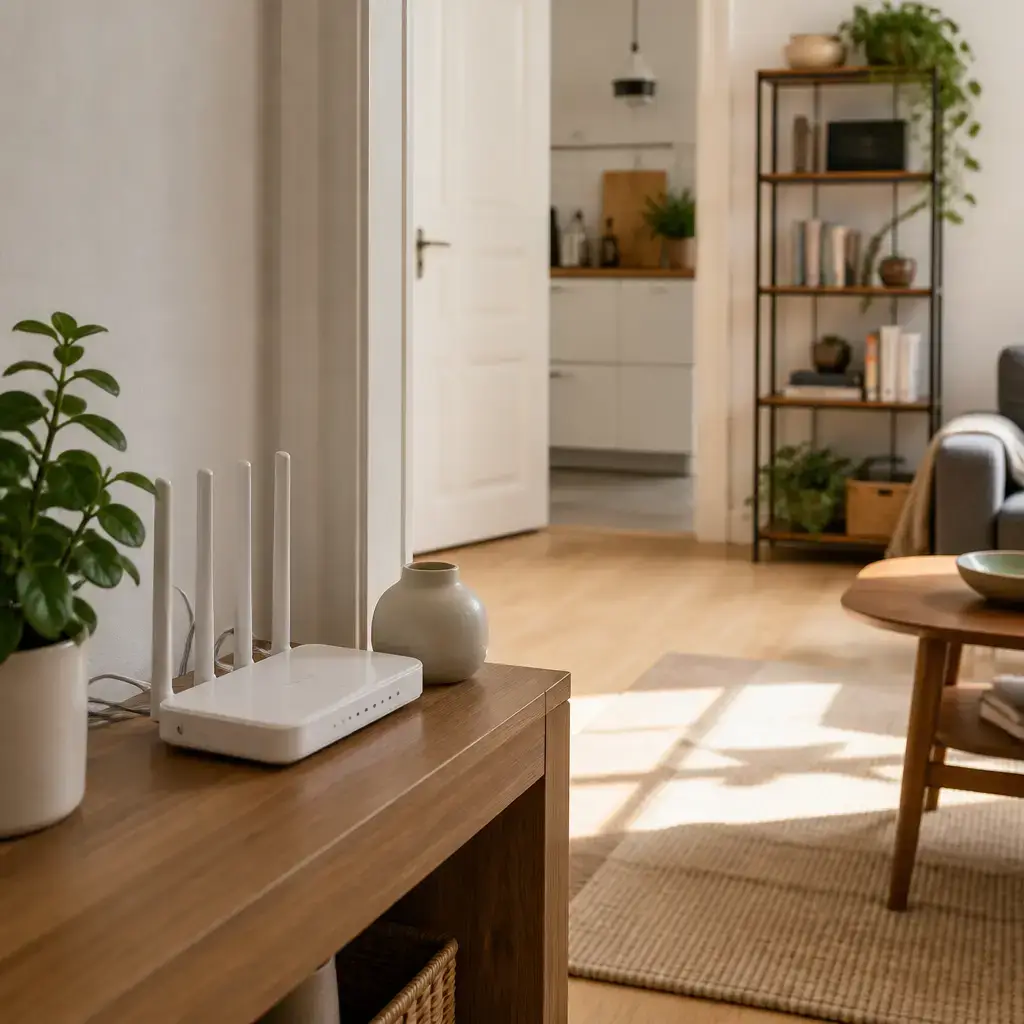
Die Internetverbindung ist in diesem Raum schwach.
dee IN-ter-net-fer-BIN-doong ist in DEE-zem rowm shvahkh. The internet connection is weak in this room.Der Router braucht vielleicht einen kurzen Neustart.
dehr ROO-tuh browkht fee-LYKHT EYE-nen KOOR-tsen NOY-shtart. The router may need a quick restart.Soll ich ihn ausschalten und wieder einschalten?
zoll ikh een OWS-shal-ten oont VEE-der EYN-shal-ten? Should I turn it off and on again?Mach das und warte, bis die Statusleuchte wieder angeht.
makh dahs oont VAR-tuh, bis dee SHTAH-toos-loykh-tuh VEE-der AHN-gayt. Do that, then wait until the status light comes back on.Die Seite lädt jetzt besser.
dee ZY-tuh leht yetst BES-uh. The page is loading better now.Ihn auf ein offenes Regal zu stellen, könnte noch mehr helfen.
een owf eye-n OFF-uh-nes ray-GAHL tsoo SHTEL-en, KURN-tuh nokh mehr HEL-fen. Putting it on an open shelf might help even more.Sollen wir ihn in die Nähe der Tür stellen?
ZOL-en veer een in dee NAY-uh dehr TOOR SHTEL-en? Should we move it near the doorway?So könnte das Signal diesen Raum besser erreichen.
zoh KURN-tuh dahs zee-GNAHL DEE-zen rowm BES-uh air-RY-khen. That could help the signal reach this room.Sentence explanations
Die Internetverbindung ist in diesem Raum schwach.
The internet connection is weak in this room.
- Die Internetverbindung
- the internet connection
- ist
- is
- diesem
- this
- Raum
- room
- schwach
- weak
More detail
Die Internetverbindung means “the internet connection.” Internetverbindung is a feminine compound noun, so its singular nominative definite article is die. The noun is written with a capital letter, as German nouns are. The plural is die Internetverbindungen. ist is the third-person singular present form of sein (“to be”): sein → ist. It links the subject to a description. For example, Die Verbindung ist stabil. means “The connection is stable.” schwach describes the connection as weak. Used after ist, this adjective is predicative and has no adjective ending: Die Verbindung ist schwach. The opposite is stark (“strong”). diesem means “this” in the form required here. The phrase in diesem Raum describes a fixed location, so in takes the dative case. Raum is masculine, singular, and dative in this phrase; its dative demonstrative form is diesem. The related forms are dieser Raum (nominative) and diesen Raum (accusative). Here, diesem modifies Raum, not the subject. Raum means “room.” Its plural is Räume, with the umlaut. in einem Raum means “in a room,” while in diesem Raum means “in this room.” Together, Die Internetverbindung ist schwach says that the internet connection has weak performance, and in diesem Raum specifies where this is true. The complete meaning is “The internet connection is weak in this room.”
Der Router braucht vielleicht einen kurzen Neustart.
The router may need a quick restart.
- Router
- router
- braucht
- needs
- vielleicht
- perhaps; maybe
- kurzen
- short; quick
- Neustart
- restart
More detail
Router is a masculine noun meaning “router.” German nouns are capitalized. Its plural is Router, so the form itself does not show singular or plural; here Der and the singular verb form show that the router is treated as one device. braucht is the third-person singular present form of brauchen (“to need”). The pattern etwas brauchen means “to need something”: Ich brauche Hilfe. — “I need help.” The subject is Der Router, so brauchen appears as braucht. vielleicht means “perhaps” or “maybe.” Here it makes the need uncertain: the sentence says that a restart may be needed, not that it is definitely needed. It is a reusable sentence adverb and can also appear in Vielleicht kommt er später. — “Maybe he will come later.” kurzen is the form of the adjective kurz (“short”) used in einen kurzen Neustart. In this phrase, the fixed translation conveys “quick.” The adjective has the base form kurz; its ending changes because it is describing the masculine noun Neustart in the accusative after einen. For comparison, kurz means “short,” kürzer means “shorter,” and am kürzesten means “shortest.” Neustart is a masculine compound noun meaning “restart.” It is built from neu (“new”) and Start (“start”), but it functions as one noun and is capitalized. After brauchen, the needed thing is in the accusative, so the phrase is einen kurzen Neustart. The indefinite article einen introduces the noun phrase; it does not by itself assert a numerical count. Together, Der Router braucht says “the router needs,” vielleicht adds uncertainty, and einen kurzen Neustart names the possibly needed action or event. The complete utterance means: “The router may need a quick restart.”
Soll ich ihn ausschalten und wieder einschalten?
Should I turn it off and on again?
- Soll ich
- Should I…?
- ihn
- it
- ausschalten
- turn off
- und
- and
- wieder
- again
- einschalten
- turn on
More detail
Soll ich uses sollen with the first-person singular subject ich. In this question, it asks whether the speaker is expected or advised to do something: “Should I …?” A useful pattern is Soll ich + infinitive?, for example, Soll ich warten? — “Should I wait?” ihn is the accusative masculine singular form of er (“he/it”). Here, the surrounding router context and the fixed translation support the referent “the router,” which is masculine in German: der Router, so ihn is the appropriate object form. The accusative marks the thing affected by the action. ausschalten means to switch or turn something off. It is a separable verb: in a finite main clause, ich schalte den Router aus, but after the modal soll its infinitive remains together at the end of the clause. Example: Ich schalte das Licht aus. — “I turn the light off.” und joins the two coordinated actions. The same subject and object can apply to both actions, so they do not need to be repeated. wieder means “again” here. It indicates that the second operation is a renewed switching-on after the device has been switched off; it does not by itself specify how many earlier cycles occurred. einschalten means to switch or turn something on. Like ausschalten, it is separable in a finite clause (Ich schalte den Router ein) but stays intact as an infinitive after soll. In this sentence, wieder einschalten means “turn it on again.” Together, Soll ich ihn ausschalten und wieder einschalten? asks whether the speaker should turn the router off and then turn it on again. The first-person subject is supplied by ich, the same object is ihn for both verbs, and und places the two actions in sequence.
Mach das und warte, bis die Statusleuchte wieder angeht.
Do that, then wait until the status light comes back on.
- Mach
- do; make
- das
- that
- warte
- wait
- bis
- until
- Statusleuchte
- status light
- wieder
- again; back on
- angeht
- comes on
More detail
Mach is the informal singular imperative of machen (“to do; to make”). It addresses one person and normally leaves du unstated: Mach das! means “Do that!” The form is an instruction, not a statement about what the person is currently doing. das is a demonstrative pronoun used here as the accusative object of Mach: “that.” Its exact referent is supplied by the situation rather than identified in this sentence, so it is reusable for an already understood action or thing. The form das is also used for neuter singular nouns, but here it stands independently as a pronoun. warte is the informal singular imperative of warten (“to wait”). Warte! is a direct instruction to one person. The phrase warte auf ... is a related pattern meaning “wait for ...,” but this sentence instead specifies a time limit with bis. bis means “until” and introduces the event that marks the endpoint of the waiting. In the clause after bis, German places the conjugated verb at the end. Statusleuchte is a feminine compound noun: Status + Leuchte, literally a status indicator light. Its plural is Statusleuchten. In this sentence, the noun is the subject of the clause after bis; the article die marks the feminine singular form there. wieder means “again” or “back” in the sense of a previous state returning. Here it combines with the light coming on, so the relevant meaning is “back on,” not a repeated physical movement. A reusable contrast is wieder an (“on again/back on”) versus noch an (“still on”). angeht comes from the separable verb angehen, used here in the sense “to come on” or “to switch on.” It is present-tense third-person singular, agreeing with die Statusleuchte. In a main clause, the separable parts appear as Die Statusleuchte geht wieder an. After bis, the verb-final subordinate-clause form is written together: ..., bis die Statusleuchte wieder angeht. Together, Mach das gives the first instruction, and und warte adds a second one. bis die Statusleuchte wieder angeht sets the endpoint for the waiting: “until the status light comes back on.” The complete meaning is “Do that, then wait until the status light comes back on.”
Die Seite lädt jetzt besser.
The page is loading better now.
- Die Seite
- the page
- lädt
- is loading
- jetzt
- now
- besser
- better
More detail
Die Seite means “the page” here. Seite is a feminine noun, so the definite article is die in the nominative singular when the page is the subject. The plural is die Seiten; the article happens to look the same there, so the noun form and context establish the number. lädt is the third-person singular present form of laden. In this sentence, laden means “to load,” as for a web page. The form agrees with the singular subject Die Seite: Die Seite lädt. The same form can have other meanings in other contexts, so the surrounding noun identifies the intended sense here. Example: Die App lädt langsam. — “The app is loading slowly.” jetzt means “now.” It places the loading in the present situation. It is an adverb and does not change form. Example: Die Datei lädt jetzt. — “The file is loading now.” besser means “better” here. It is the comparative form of gut (“good”) and describes the way the page is loading: its loading is better than before or than the earlier situation. The comparison is understood from the context; no explicit comparison phrase is required. Example: Die Verbindung funktioniert besser. — “The connection works better.” Together, Die Seite supplies the subject, lädt says that it is loading, and jetzt besser says that this is happening better now. The complete meaning is: “The page is loading better now.”
Ihn auf ein offenes Regal zu stellen, könnte noch mehr helfen.
Putting it on an open shelf might help even more.
- Ihn
- it
- offenes
- open
- Regal
- shelf
- zu stellen
- to put
- könnte
- might
- noch mehr
- even more
- helfen
- help
More detail
Ihn means “it” here. It is the accusative form of the third-person masculine singular pronoun er; ihn is used when that referent is the object of an action. The fixed translation identifies the intended referent as “it.” Compare er (“he/it” as subject) with ihn (“him/it” as object): Ich sehe ihn. means “I see him/it.” offenes describes Regal in this phrase. The noun Regal is neuter, singular, and follows auf in a movement-or-placement phrase, so the phrase uses the accusative: auf ein offenes Regal. The adjective has the ending -es after the indefinite article ein. Its base form is offen; for example, ein offenes Fenster means “an open window.” Regal means “shelf.” Its plural is Regale. In the fixed phrase, ein does not by itself state a numerical count; it marks the singular noun phrase here. The pattern auf ein Regal expresses placement onto a shelf. zu stellen is the infinitive construction “to put” or “to place.” The verb is stellen, used when something is placed in an upright or positioned state. A useful contrast is legen, “to lay” something down: Ich stelle die Flasche auf den Tisch. means “I put the bottle on the table” with the bottle standing, while Ich lege das Buch auf den Tisch. means “I lay the book on the table.” Here zu stellen forms an infinitival clause that functions as the subject of the sentence. könnte is a form of können, “can/be able to,” used here to express a possibility: “might” or “could.” The form is Konjunktiv II, which makes the statement less certain than a direct present-tense claim. The pattern könnte + infinitive is reusable: Das könnte helfen. means “That might help.” noch mehr means “even more.” mehr is the comparative form associated with viel (“much/a lot”); noch strengthens the comparison by adding the sense “still/even.” In this sentence it indicates a greater degree of help than some already relevant amount or effect, without specifying a number. helfen means “to help.” It is the base infinitive of the verb and appears after the modal form könnte. The pattern etwas könnte helfen means “something might help.” Together, the infinitival clause Ihn auf ein offenes Regal zu stellen presents placing it on an open shelf as the possible cause or measure. könnte ... helfen says that this action might help, and noch mehr raises the degree: the complete intended meaning is “Putting it on an open shelf might help even more.”
Sollen wir ihn in die Nähe der Tür stellen?
Should we move it near the doorway?
- Sollen wir
- shall we / should we
- ihn
- it
- in die Nähe
- near / close to
- Tür
- door
- stellen
- put / place
More detail
Sollen wir is a reusable question pattern: sollen + subject pronoun asks whether the speakers should do something. Sollen is the present-tense form of sollen for wir; the infinitive comes at the end of this yes/no question. Example: Sollen wir warten? — “Should we wait?” ihn means “it” here, referring to the object already under discussion. It is the accusative form of masculine er (“he/it”): er → ihn when the object is directly acted on. Example: Wir sehen ihn. — “We see him/it.” in die Nähe expresses movement or placement toward a nearby area. in takes the accusative here because stellen describes putting something into a destination area; with a stationary location, the dative is used instead: in der Nähe — “nearby.” Example: Wir stellen die Kiste in die Nähe. — “We put the box nearby.” der Tür specifies what the object is near: “of the door,” giving the phrase in die Nähe der Tür — “near the door.” Tür is a feminine noun, so its genitive form here is der Tür; the noun itself does not change. Example: Der Stuhl steht in der Nähe der Tür. — “The chair is near the door.” stellen means “to put/place” something in an upright or standing position. It is the infinitive required after sollen. A useful contrast is legen, “to lay/put down” something horizontally: Wir stellen die Flasche auf den Tisch. — “We put the bottle on the table” (standing); Wir legen das Buch auf den Tisch. — “We lay the book on the table.” Together, Sollen wir ihn in die Nähe der Tür stellen? asks whether the speakers should place the previously mentioned object near the doorway. The modal sollen marks the suggestion or question about what they ought to do, while stellen remains at the end as the infinitive. In the fixed translation, this is naturally rendered as “Should we move it near the doorway?”
So könnte das Signal diesen Raum besser erreichen.
That could help the signal reach this room.
- So
- in this way
- könnte
- could
- Signal
- signal
- diesen
- this
- Raum
- room
- besser
- better
- erreichen
- reach
More detail
So means “in this way” here. It points back to the proposed placement near the doorway in the previous sentence, so the sentence presents that arrangement as a possible means of improving the signal’s reach. A reusable pattern is So + clause = “That way, …” or “In this way, …”. könnte is the third-person singular form of können in the Konjunktiv II. können means “can/be able to”; könnte expresses a possible result and is naturally translated as “could” here. The form agrees with the singular subject das Signal, not with Raum. For example: Das könnte helfen. — “That could help.” Signal is the noun das Signal, singular; its plural is die Signale. In this sentence it is the subject, the thing that may reach the room. The neuter article das shows the noun’s grammatical gender; it does not mean “this.” diesen belongs to the demonstrative determiner dies-, meaning “this” or “these.” Here it is the masculine accusative singular form because it accompanies Raum, and erreichen takes the room as its direct object. The corresponding nominative masculine form is dieser, as in Dieser Raum ist groß. — “This room is large.” Raum is the masculine noun der Raum, “room” here. Its plural is die Räume. The form diesen Raum marks one specific room as the direct object of erreichen; diesen carries the relevant case and gender marking. besser is the comparative form of gut: gut — “good/well,” besser — “better,” am besten — “best.” Here it describes reaching the room more effectively than under the relevant alternative. Example: Mit diesem Gerät funktioniert es besser. — “It works better with this device.” erreichen is the infinitive meaning “reach” or “reach a place/person.” With the modal verb könnte, it remains an infinitive and appears at the end of the clause: könnte ... erreichen. Example: Wir können den Bahnhof erreichen. — “We can reach the station.” Together, So sets up the proposed way of achieving a result, and könnte presents that result as possible. das Signal is the subject, diesen Raum is the direct object, and besser erreichen means “reach this room better/more effectively.” The whole utterance therefore means: “That could help the signal reach this room.”
Grammar Points
Trennbare Verben: ausschalten
Schalten Sie den Router kurz aus.
SHAL-ten zee dehn ROO-tuh KOORTS ows.Turn the router off briefly.
With a separable verb, the prefix moves to the end of the sentence: ausschalten → schalten ... aus.
Nebensatz mit „bis“
Warte, bis die Statusleuchte angeht.
VAR-tuh, bis dee SHTAH-toos-loykh-tuh AHN-gayt.Wait until the status light comes on.
In a clause with „bis“, the conjugated verb goes to the end: bis ... angeht.
German Vocabulary
Soll ich ihn ausschalten und wieder einschalten?
Der Router braucht vielleicht einen kurzen Neustart.
Soll ich ihn ausschalten und wieder einschalten?
Die Internetverbindung ist in diesem Raum schwach.
einen kurzen Neustart
Mach das
einen kurzen Neustart
in diesem Raum
Der Router braucht vielleicht einen kurzen Neustart.
Die Internetverbindung ist in diesem Raum schwach.
Der Router braucht vielleicht einen kurzen Neustart.
und wieder einschalten
Quiz
Word Order
Arrange the words in the correct order.
The page is loading better now.
Show Answer
Die Seite lädt jetzt besser.Spelling
Tap the letters to spell the word.
short; brief
Show Answer
kurzenrouter
Show Answer
Routerperhaps; maybe
Show Answer
vielleichtroom