10 minutes free every day
Continue audio lessons in the app
Word explanations appear automatically in sync with the audio.
No login required · synced translations · playback with the screen locked
Choose your learning language and open this lesson in the app.

About This Lesson
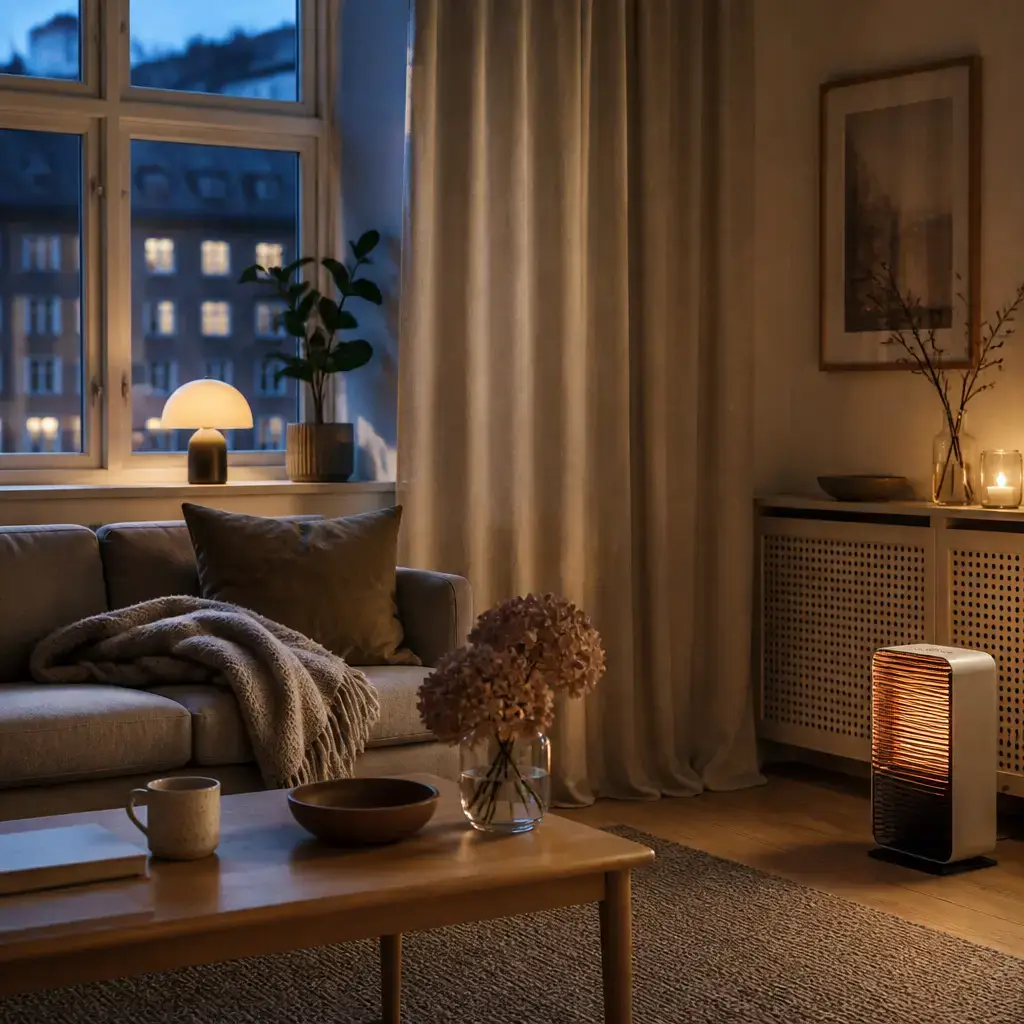
Use A Quiet, Cozy Evening to practice German conversation, pronunciation, vocabulary, grammar, and quizzes.
Dialogue
In letzter Zeit wird es früher dunkel.
in LETS-ter TSYTE veert ess FRYOO-er DOON-kel. It is getting dark earlier these days.Ich werde vor dem Abendessen die Vorhänge schließen.
ikh VAYR-duh fohr dehm AH-bent-ess-en dee FOR-heng-uh SHLEE-sen. I will close the curtains before dinner.Könntest du auch die kleine Heizung einschalten?
KURN-test doo owkh dee KLY-nuh HOY-tsung EYN-shal-ten? Could you switch on the small heater too?Ich kann sie auf eine niedrige Stufe stellen.
ikh kahn zee owf EYE-nuh NEE-drih-guh SHTOO-fuh SHTEL-len. I can set it to low.Aber der Raum fühlt sich schon angenehm an.
AH-ber dair ROWM FYOOLT zikh shohn AHN-guh-NAYM ahn. But the room already feels comfortable.Ich möchte, dass sich der Raum heute Abend gemütlich anfühlt.
ikh MURKH-tuh, dahss zikh dair ROWM HOY-tuh AH-bent guh-MYOOT-likh AHN-fyoolt. I want the room to feel cozy this evening.Eine weichere Lampe könnte den Raum gemütlich machen, ohne ihn zu warm zu machen.
EYE-nuh VYKH-uh-ruh LAM-puh KURN-tuh dehn ROWM guh-MYOOT-likh MAKH-en, OH-nuh een tsoo VARM tsoo MAKH-en. A softer lamp might do that without making it too warm.Das weichere Licht macht den Raum viel ruhiger.
dahss VYKH-uh-ruh likht makht dehn ROWM feel ROO-ih-guh. The softer light makes the room feel much calmer.Dann können wir uns nach dem Essen entspannen.
dahn KURN-en veer oons nahkh dehm ESS-en ent-SHPAN-en. Then we can relax after we eat.Sentence explanations
In letzter Zeit wird es früher dunkel.
It is getting dark earlier these days.
- In letzter Zeit
- these days
- wird
- becomes; is getting
- es
- it
- früher
- earlier
- dunkel
- dark
More detail
In letzter Zeit means “these days” or “lately.” It is a fixed time expression referring to a recent period, not one specific day. Zeit is the noun “time”; letzter is the inflected form of letzt (“last/recent”) used with this noun in this expression. wird is the third-person singular present form of werden (“to become,” “to get”). Here it introduces a change of state: something is becoming dark. With an adjective, werden commonly expresses becoming or getting: Es wird kalt. — “It is getting cold.” In this sentence it is not the future auxiliary; German future werden is normally followed by an infinitive, whereas dunkel is an adjective here. es is the impersonal subject pronoun “it.” In this weather/time expression, it does not identify a particular person or object; German uses es as the grammatical subject of the clause. The form es does not show a change of person or number here. früher is the comparative form of früh (“early”): früh → früher (“earlier”) → am frühesten (“earliest”). It compares the time at which it gets dark with a relevant earlier or usual time; the sentence does not state a precise reference time. Do not confuse früher here with the separate possible meaning “formerly”; the combination with wird ... dunkel gives the intended meaning “earlier.” dunkel is the adjective “dark.” After werden, it appears as a predicate adjective and describes the state that is developing. For example, Der Himmel wird dunkel. — “The sky is getting dark.” Together, In letzter Zeit sets the recent time period, wird ... dunkel says that darkness is developing, and früher specifies that this happens earlier than the relevant comparison point. The whole utterance therefore means: “It is getting dark earlier these days.”
Ich werde vor dem Abendessen die Vorhänge schließen.
I will close the curtains before dinner.
- Ich werde
- I will
- vor dem Abendessen
- before dinner
- die Vorhänge
- the curtains
- schließen
- close
More detail
Ich werde combines the subject Ich (“I”) with werde, the first-person singular present form of werden (“become; will” in this construction). With a second verb in the infinitive, werden forms the German future: Ich werde ... schließen = “I will close ...”. The infinitive goes to the end of the clause. Example: Ich werde morgen arbeiten. — “I will work tomorrow.” vor dem Abendessen expresses the time relation “before dinner.” The preposition vor takes the dative here because it describes a time point, not movement toward a place. dem is the dative singular form of the definite article for the neuter noun Abendessen; the noun itself means “dinner” and can also refer to the evening meal as an event. Example: Wir sprechen vor dem Essen. — “We talk before the meal.” die Vorhänge means “the curtains.” Vorhänge is the plural of Vorhang (“curtain”), and die is the definite article used with this plural. The article does not show the noun’s case by itself here: the form die can be nominative or accusative plural, and schließen makes the curtains the objects being closed, so this phrase is accusative plural. Example: Ich öffne die Vorhänge. — “I open the curtains.” schließen is the infinitive “to close.” In the fixed sentence, it is the lexical verb paired with the future auxiliary werde; it remains in the infinitive rather than taking a person ending. Its opposite is öffnen (“to open”). Example: Bitte schließen Sie die Tür. — “Please close the door.” Together, Ich werde places the action in the future, die Vorhänge identifies what will be closed, schließen names that action, and vor dem Abendessen gives its deadline or time relation. German therefore places the finite auxiliary in the second position and the infinitive at the end: Ich werde vor dem Abendessen die Vorhänge schließen. — “I will close the curtains before dinner.”
Könntest du auch die kleine Heizung einschalten?
Could you switch on the small heater too?
- Könntest du
- could you
- auch
- too / also
- kleine
- small
- Heizung
- heater
- einschalten
- switch on
More detail
Könntest du is a reusable way to make a polite request: “Could you …?” Könntest is the second-person singular form of können (“can, be able to”) in the subjunctive II, which gives the request a tentative, courteous tone. The subject is du, so this form addresses one person informally. Compare the more direct Kannst du …? (“Can you …?”). auch means “too” or “also.” Here it adds the heater to an action the speaker is asking about; it does not itself identify what the earlier action was. Its position can vary in German, but its meaning depends on what part of the sentence it adds to. kleine comes from the adjective klein (“small”). It describes Heizung. The ending -e appears because the adjective is in the noun phrase die kleine Heizung: Heizung is feminine, and this is an accusative form after the verb’s action. The adjective changes, not the noun: klein → kleine here. Example: die kleine Lampe — “the small lamp.” Heizung is a feminine noun meaning “heater” here. Its plural is Heizungen. The noun phrase die kleine Heizung is the thing being switched on, so it is the accusative object of einschalten. einschalten means “to switch on” or “turn on.” It is a separable verb, built in ordinary finite clauses as schaltet ... ein; for example, Du schaltest die Heizung ein. — “You switch on the heater.” After the modal verb könntest, the infinitive remains at the end as einschalten, so it is not separated in this sentence. Together, Könntest du ... einschalten? forms a polite request. auch adds “too,” and die kleine Heizung identifies the object: “Could you switch on the small heater too?”
Ich kann sie auf eine niedrige Stufe stellen.
I can set it to low.
- Ich kann
- I can
- sie
- it
- auf
- to
- niedrige
- low
- Stufe
- level; setting
- stellen
- set; place
More detail
Ich kann combines ich (“I”) with kann, the first-person singular present form of können (“can; be able to”). With a modal verb such as kann, the other verb stays in the infinitive and normally goes to the end of the clause: Ich kann warten. — “I can wait.” sie is the object pronoun meaning “it” here. In the supplied context, it refers to the heater mentioned previously. German sie can also have other functions, but here it is the feminine singular accusative form, matching the feminine noun Heizung when that noun is replaced by a pronoun. auf introduces the target setting in this expression. With a change or placement onto a setting, it is followed here by an accusative noun phrase: auf eine niedrige Stufe — “to a low setting.” niedrige is the adjective form of niedrig (“low”). It describes Stufe, which is feminine singular accusative in eine niedrige Stufe; after the indefinite article eine, the adjective takes the ending -e. The comparison chain is niedrig — “low,” niedriger — “lower,” am niedrigsten — “lowest.” Stufe means “level” or “setting” here, specifically a selectable intensity or degree. Its plural is Stufen: eine höhere Stufe — “a higher setting.” stellen means “to set” in this context. It is the infinitive of the separable? No: stellen is a regular, non-separable verb here. The pattern etwas auf eine Stufe stellen means “set something to a level.” For example, Ich stelle die Heizung auf eine höhere Stufe. — “I set the heater to a higher setting.” Together, sie auf eine niedrige Stufe stellen means “set it to a low setting.” The modal construction adds the ability or possibility: Ich kann sie auf eine niedrige Stufe stellen. means “I can set it to low.”
Aber der Raum fühlt sich schon angenehm an.
But the room already feels comfortable.
- Aber
- but
- Raum
- room
- fühlt sich … an
- feels
- schon
- already
- angenehm
- comfortable
More detail
Aber means “but” and links this statement to a contrasting point. It does not itself identify what the contrast is. der Raum means “the room.” Raum is a masculine noun, so its definite article here is der. Its plural is Räume (“rooms”); the umlaut and plural ending belong to the noun, not the article. fühlt sich … an is the separable verb construction sich anfühlen, “to feel” in the sense of having a certain quality. In the present tense, fühlt is the third-person singular form of fühlen, and the prefix an moves to the end of the main clause: Der Raum fühlt sich angenehm an. The word sich is the reflexive form used with this construction; it does not mean that the room is acting on a separately identified person. Compare the reusable pattern Das + noun + fühlt sich + adjective + an — “The … feels ….” schon means “already” here. It places the comfortable feeling at an earlier point than might otherwise be expected; it is not the same as noch (“still/yet”). Example: Der Raum fühlt sich schon warm an. — “The room already feels warm.” angenehm means “comfortable” or “pleasant” in this sentence. It is an adjective describing how the room feels. After sich anfühlen, the adjective is used without an adjective ending: Der Raum fühlt sich angenehm an. A related contrast is unangenehm (“uncomfortable” or “unpleasant”). Together, der Raum fühlt sich angenehm an says that the room has a comfortable or pleasant feel. Adding schon gives “already feels comfortable,” and aber marks the complete statement as a contrast: “But the room already feels comfortable.”
Ich möchte, dass sich der Raum heute Abend gemütlich anfühlt.
I want the room to feel cozy this evening.
- möchte
- want; would like
- sich … anfühlt
- feel
- Raum
- room
- heute Abend
- this evening
- gemütlich
- cozy; comfortable
More detail
möchte expresses the speaker’s present wish: “would like” or, in this translation, “want.” It is the first-person singular form of mögen used as the conventional Konjunktiv II form for a wish or polite desire, rather than the ordinary present form meaning “like.” A reusable pattern is Ich möchte, dass ... = “I would like ... to ...”. Example: Ich möchte, dass du bleibst. — “I want you to stay.” The separated parts sich and anfühlt belong to sich anfühlen, meaning “to feel” or “to seem” a certain way. Here sich is the reflexive pronoun associated with the subject der Raum; anfühlt is the third-person singular present form of anfühlen. Because this is a dass subordinate clause, the finite verb appears at the end, and the separable verb is written together: dass sich der Raum gemütlich anfühlt. In a main clause, the prefix separates: Der Raum fühlt sich gemütlich an. — “The room feels cozy.” der Raum means “the room.” Raum is a masculine noun, and der is its singular nominative article here because the room is the subject of anfühlt. The noun itself has no special ending in this use. Example: Der Raum ist hell. — “The room is bright.” heute Abend is the time expression “this evening” or “tonight.” heute means “today,” and Abend means “evening”; together they specify when the desired feeling is intended. Example: Wir kommen heute Abend. — “We are coming this evening.” gemütlich describes the room’s perceived atmosphere as cozy, comfortable, or pleasantly inviting. It is a predicative adjective after sich anfühlen, so it has no adjective ending here. Compare the attributive use in the example ein gemütlicher Raum — “a cozy room,” where gemütlicher modifies the noun and carries an ending. The whole structure is Ich möchte, dass ...: the main clause expresses the speaker’s wish, and the dass clause states the situation desired. Within that clause, der Raum is the subject, sich anfühlt is the verb, heute Abend gives the time, and gemütlich gives the perceived quality. Together, Ich möchte, dass sich der Raum heute Abend gemütlich anfühlt. means “I want the room to feel cozy this evening.”
Eine weichere Lampe könnte den Raum gemütlich machen, ohne ihn zu warm zu machen.
A softer lamp might do that without making it too warm.
- weichere
- softer
- Lampe
- lamp
- könnte
- might; could
- Raum
- room
- gemütlich
- cozy
- machen
- make
- warm
- warm
- ohne ihn zu warm zu machen
- without making it too warm
More detail
weichere means “softer” here. It is the comparative form of weich (“soft”): weich → weicher → weichste (“soft” → “softer” → “softest”). In eine weichere Lampe, the adjective has the ending -e because it modifies the feminine singular noun Lampe in this noun phrase. The comparison is with another possible lamp or degree of softness; the sentence does not specify what the comparison is against. Lampe is a feminine noun meaning “lamp.” Its plural is Lampen. The phrase eine weichere Lampe is the subject: “a softer lamp.” könnte is the Konjunktiv II form of können (“can; be able to”). With an infinitive, könnte ... machen expresses a possibility: “might make” or “could make.” The modal form does not assert that the effect will happen. Compare kann ... machen (“can/may make,” more direct or factual in context) with könnte ... machen (“might/could make,” more tentative). Raum means “room.” In den Raum, it is the masculine singular accusative form required for the direct object of machen; the definite article shows this as den, rather than nominative der. The supplied translation identifies this room as the thing being made cozy. gemütlich means “cozy” or “comfortable and pleasant.” Here it is an adjective used after machen, describing the result assigned to the room: “make the room cozy.” It does not take an adjective ending in this position. A reusable pattern is etwas gemütlich machen, “make something cozy.” machen means “make” or “cause to become” here. In könnte ... machen, it remains in the infinitive because it follows the modal könnte; the finite verb is könnte, while machen goes to the end of the main clause. German machen can also mean “do” in other contexts, but this sentence uses the result-causing sense. warm means “warm.” In zu warm, zu means “too,” so the phrase means “too warm,” not merely “warm.” The adjective describes the resulting temperature of the room. ohne ihn zu warm zu machen is an ohne ... zu infinitival construction meaning “without making it too warm.” ohne introduces the condition that is avoided, and zu machen is the infinitive phrase. ihn is the masculine accusative pronoun referring to the room identified by the fixed translation; German uses masculine ihn because Raum is masculine. The repeated zu belongs to the construction: zu warm means “too warm,” while the later zu machen marks the infinitive. The second machen is the same verb as the earlier one, now inside this subordinate infinitival phrase. Together, Eine weichere Lampe könnte den Raum gemütlich machen says “A softer lamp might make the room cozy.” The added ohne ihn zu warm zu machen says that this possible effect would occur without causing the room to become too warm. The complete meaning is: “A softer lamp might make the room cozy without making it too warm.”
Das weichere Licht macht den Raum viel ruhiger.
The softer light makes the room feel much calmer.
- weichere
- softer
- Licht
- light
- macht
- makes
- Raum
- room
- viel
- much
- ruhiger
- calmer
More detail
weichere means “softer” here. It is the comparative form of the adjective weich (“soft”): weich → weicher → am weichsten (“soft” → “softer” → “softest”). In das weichere Licht, the adjective has the ending -e because it modifies the neuter singular noun Licht after the definite article das. Example: Das weichere Kissen ist bequemer. — “The softer pillow is more comfortable.” Licht is the neuter noun for “light.” Its grammatical gender is neuter: das Licht. In this sentence it is the subject, the thing that causes the change. Example: Das Licht ist hell. — “The light is bright.” macht is the third-person singular present form of machen (“to make”): ich mache, du machst, er/sie/es macht. Here machen has the pattern etwas macht etwas + adjective: one thing causes another thing to have a quality. Example: Die Musik macht den Abend ruhiger. — “The music makes the evening calmer.” Raum means “room.” It is masculine: der Raum. In den Raum, it is the direct object of macht, so the masculine definite article changes from nominative der to accusative den. Example: Wir betreten den Raum. — “We enter the room.” viel means “much” here and strengthens the comparative ruhiger: viel ruhiger means “much calmer,” not merely “calmer.” It can similarly intensify other comparatives, as in viel größer (“much bigger”). ruhiger means “calmer.” It is the comparative form of ruhig (“calm”): ruhig → ruhiger → am ruhigsten (“calm” → “calmer” → “calmest”). Here it is the adjective describing the resulting state of den Raum after macht. Example: Der Raum wird ruhiger. — “The room becomes calmer.” Together, Das weichere Licht is the subject, macht introduces a causative pattern, den Raum is the affected object, and viel ruhiger describes the result. The complete meaning is: “The softer light makes the room much calmer.”
Dann können wir uns nach dem Essen entspannen.
Then we can relax after we eat.
- Dann
- then
- können wir
- we can
- uns
- ourselves
- nach
- after
- Essen
- meal; eating
- entspannen
- relax
More detail
Dann means “then” here and places the situation after an understood earlier point in time. It can also introduce a result in other contexts, but this sentence uses the time meaning. können wir expresses “we can.” können is the present-tense form of können for wir; the infinitive is können, and it is a modal verb. The modal is in second position in this statement, while the other verb goes to the end in the infinitive. Example: Wir können warten. — “We can wait.” uns means “ourselves” here. It is the reflexive form that matches the subject wir in this construction: wir entspannen uns means “we relax.” The form is not the subject; wir is the subject, and uns marks that the people relaxing are the same people referred to by wir. nach means “after” in this use. With a time expression, it is followed by the dative: nach dem Essen means “after eating” or literally “after the meal.” This is different from nach in some direction expressions, where it can mean “to” or “toward.” Essen means “eating” in the fixed sentence, expressed as a noun-like form. German capitalizes this nominalized infinitive; its underlying verb is essen (“to eat”). Because it is treated as the neuter noun das Essen, the dative form after nach is dem Essen. The same word can also mean “food” or “meal” in other contexts, but here the fixed translation supports the activity reading “eating.” entspannen is the infinitive “to relax.” In this sentence it is used with the reflexive pronoun uns: sich entspannen is the reusable pattern “to relax,” literally involving oneself. With wir, the corresponding form is wir entspannen uns; the verb itself has the present-tense form entspannen for wir. Together, Dann können wir uns nach dem Essen entspannen means “Then we can relax after we eat.” Dann sets the time, können wir says that this is possible for the speaker and others, uns entspannen gives the reflexive action, and nach dem Essen places it after eating. The wording is a normal neutral way to describe a possible plan or activity.
Grammar Points
sich anfühlen: sich ... anfühlen
fühlt sich ... an
FYOOLT zikh ... AHNfeels ...
This separable reflexive verb uses sich with the subject, while an moves to the end in a main clause.
könnte ... einschalten
könnte ... einschalten
KURN-tuh ... EYN-shal-tencould switch on ...
könnte expresses a possibility or gentle suggestion; the other verb stays in the infinitive form.
German Vocabulary
Quiz
Spelling
Tap the letters to spell the word.
to close
Show Answer
schließenheater
Show Answer
Heizungearly
Show Answer
früherto switch on