10 minutes free every day
Continue audio lessons in the app
Word explanations appear automatically in sync with the audio.
No login required · synced translations · playback with the screen locked
Choose your learning language and open this lesson in the app.

About This Lesson
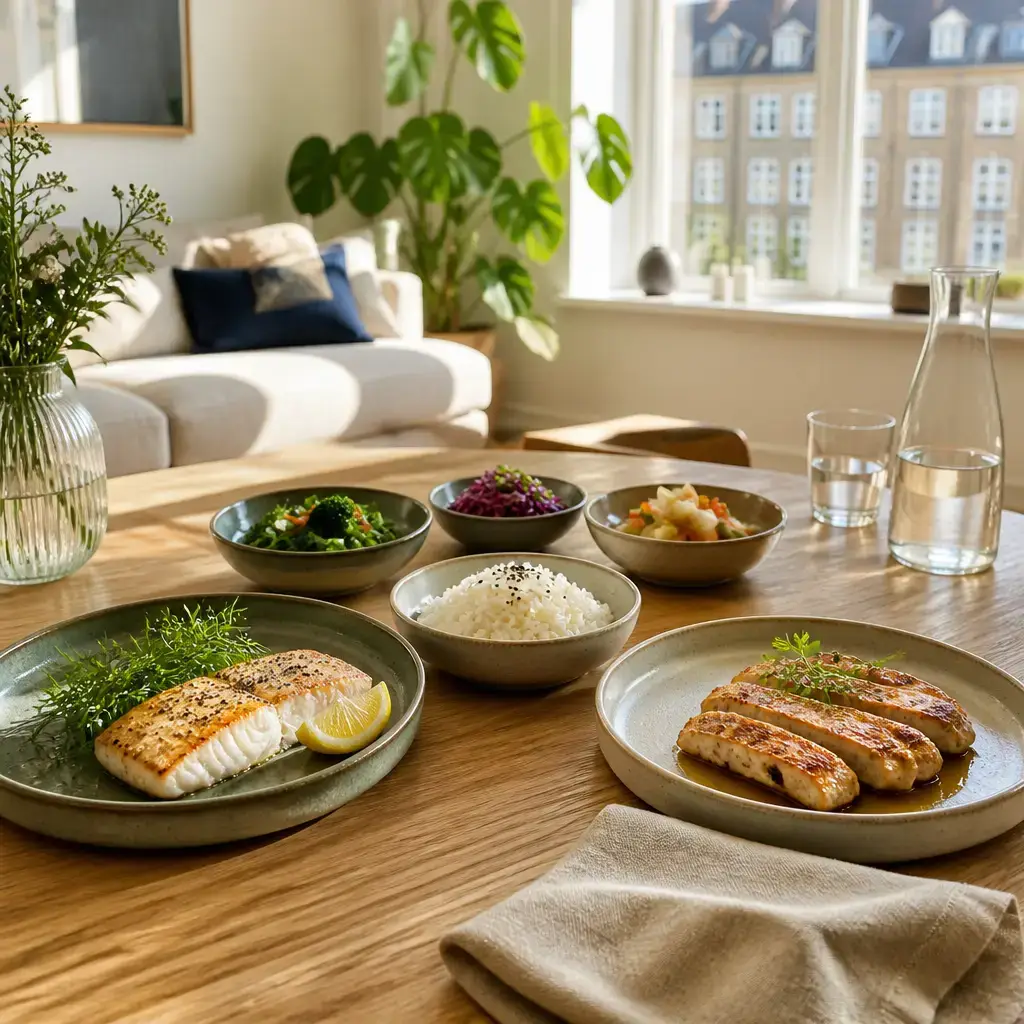
Use Ordering a lunch set with preferences to practice German conversation, pronunciation, vocabulary, grammar, and quizzes.
Dialogue
Ich möchte ein Mittagsmenü für uns bestellen.
ikh MURKH-tuh ayn MIT-tahks-meh-NYOO fyoor oons buh-SHTEL-len. I want to order a lunch set for us.Möchtest du lieber Hähnchen oder Fisch?
MURKH-tes doo LEE-buh HENKH-en OH-duh fish? Would you prefer chicken or fish?Fisch klingt heute für mich besser.
fish klinkt HOY-tuh fyoor mikh BES-uh. Fish sounds better to me today.Dazu gibt es Reis und eine kleine Beilage.
da-TSOO gipt ess RYCE oont EYE-nuh KLYE-nuh buh-LYE-guh. It comes with rice and one small side.Welche Beilage sieht am besten aus?
VEL-khuh buh-LYE-guh zeet am BES-ten owss? Which side looks best?Das Gemüse sieht frisch und einfach aus.
dass guh-MYOO-zuh zeet fresh oont EYE-nfakh owss. The vegetables look fresh and simple.Dann wählen wir das Gemüse.
dahn VAY-len veer dahs guh-MYOO-zuh. Let's choose the vegetables.Ich kann die Bestellung jetzt aufgeben.
ikh kahn dee buh-SHTEL-loong yetst OWF-gay-ben. I can place the order now.Sentence explanations
Ich möchte ein Mittagsmenü für uns bestellen.
I want to order a lunch set for us.
- Ich möchte
- I would like / I want
- Mittagsmenü
- lunch set
- für uns
- for us
- bestellen
- to order
More detail
Ich möchte means “I would like” or, in this context, “I want.” möchte is the first-person singular form used to express a present wish politely; it is related to mögen, but it is not the ordinary present-tense form meaning “like.” The subject is Ich (“I”). A reusable pattern is Ich möchte + infinitive: Ich möchte lernen. — “I would like to learn.” Mittagsmenü is a noun meaning “lunch set” or “lunch menu.” Its components are Mittag (“noon” or “midday”) and Menü (“menu” or “set meal”), but the complete compound noun is the useful form here. German nouns are capitalized. Example: Das Mittagsmenü ist heute günstig. — “The lunch set is inexpensive today.” für uns means “for us.” für is a preposition that takes the accusative case, and uns is the accusative form of wir (“we”) as well as its dative form. Here it identifies the people for whom the lunch set is being ordered. Compare für mich — “for me” — with für uns — “for us.” bestellen means “to order.” It is the infinitive, the base form used after möchte: Ich möchte bestellen. — “I would like to order.” The finite form of the construction is möchte, while bestellen remains an infinitive and appears at the end of this main clause. Compare Ich bestelle ein Menü. — “I am ordering a set meal,” where bestelle is the finite form of bestellen. Together, Ich möchte ... bestellen expresses the speaker’s wish to place an order, ein Mittagsmenü is the thing being ordered, and für uns specifies that it is for the speaker and others included by uns. The complete meaning is: “I want to order a lunch set for us.”
Möchtest du lieber Hähnchen oder Fisch?
Would you prefer chicken or fish?
- Möchtest du
- would you like
- lieber
- rather
- Hähnchen
- chicken
- oder
- or
- Fisch
- fish
More detail
Möchtest du is a reusable way to ask one person what they would like or prefer. möchtest is the second-person singular form of möchten, commonly used for a polite or friendly “would like”; du identifies one informal “you.” The verb form changes with the subject: ich möchte, du möchtest, sie möchten (“she would like” or “they would like”). Example: Möchtest du Tee? — “Would you like tea?” lieber expresses preference: “rather” or “preferably.” It is the comparative form related to gern (“gladly,” “with pleasure”): gern → lieber (“rather/more willingly”) → am liebsten (“most preferably”). Example: Ich trinke lieber Wasser. — “I would rather drink water.” Here, lieber makes the question a choice about preference, not merely about wanting something. Hähnchen means “chicken,” referring here to chicken as food. It is a noun and is capitalized in German. The word is neuter: das Hähnchen; the fixed sentence uses it without an article because it names one of the food choices. Example: Ich esse gern Hähnchen. — “I like eating chicken.” oder links alternatives and means “or.” It introduces the second option in a choice. Example: Möchtest du Tee oder Kaffee? — “Would you like tea or coffee?” Fisch means “fish,” here as a food choice. It is a masculine noun: der Fisch, although no article appears in this list of options. In other contexts, Fisch can refer to the animal or to fish as food; the surrounding choice of dishes supports the food meaning here. Example: Ich esse heute Fisch. — “I’m eating fish today.” Together, Möchtest du lieber ... oder ...? forms a reusable either-or preference question: “Would you prefer ... or ...?” The sentence asks the person addressed to choose between chicken and fish: “Would you prefer chicken or fish?”
Fisch klingt heute für mich besser.
Fish sounds better to me today.
- Fisch
- fish
- klingt
- sounds
- heute
- today
- für mich
- for me
- besser
- better
More detail
Fisch means “fish” here. It is a masculine German noun: der Fisch, plural die Fische. German nouns are capitalized. Example: Ich esse Fisch. — “I eat fish.” klingt is the third-person singular present form of klingen (“to sound”). The subject is Fisch, so the verb has the singular form: Der Fisch klingt ... — “The fish sounds ...”. In this sentence, klingen describes how an option seems or appeals, not necessarily a literal noise. Example: Das klingt gut. — “That sounds good.” heute means “today” and places the preference in the present day. Example: Heute esse ich Reis. — “Today I’m eating rice.” für mich means “for me” or “to me” in the sense of personal judgment. mich is the accusative form of ich (“I”); the preposition für requires the accusative case. Compare für mich (“for me”) with mit mir (“with me”), where mir is used after mit. besser is the comparative form of gut (“good”): gut → besser → am besten (“good” → “better” → “best”). It compares Fisch with another available option in the surrounding question, but the sentence itself does not state every detail of that comparison. Example: Fisch schmeckt besser. — “Fish tastes better.” Together, Fisch klingt gives “fish sounds/seems,” heute adds “today,” für mich identifies the speaker’s personal perspective, and besser expresses the comparison. The complete meaning is: “Fish sounds better to me today.”
Dazu gibt es Reis und eine kleine Beilage.
It comes with rice and one small side.
- Dazu gibt es
- with that, there is / it comes with
- Reis
- rice
- kleine
- small
- Beilage
- side dish
More detail
Dazu gibt es is a reusable way to present something that accompanies something already being discussed. dazu means “with that” or “along with it”; here it connects the accompaniment to the dish under discussion. gibt is the third-person singular present form of geben in the fixed construction es gibt, which commonly means “there is/are” or “there exists/are available.” In this sentence, es gibt presents what comes with the dish rather than describing an action by a specific person. Example: Zum Frühstück gibt es Brot. — “There is bread for breakfast.” Reis means “rice.” It is commonly used as a mass noun for rice in general, so this form does not by itself specify individual grains or a count of portions. kleine is the form of the adjective klein (“small”) used before the noun Beilage here. The phrase eine kleine Beilage is feminine singular and accusative after es gibt; after the indefinite article eine, the adjective takes the ending -e in this form. Compare: ein kleiner Salat — “a small salad,” where the adjective ending changes because the noun phrase has a different grammatical pattern. The article eine is indefinite; the fixed translation presents the item as one small side, but the article itself is not generally a separate counting emphasis. Beilage means “side dish” or “side.” It is a feminine noun: die Beilage; its plural is die Beilagen. The adjective and noun together form eine kleine Beilage, “a small side dish.” The whole utterance combines these parts as follows: Dazu links the accompaniment to the dish under discussion, gibt es presents what is available with it, and Reis und eine kleine Beilage names the two accompanying items. Thus the sentence means: “It comes with rice and one small side.”
Welche Beilage sieht am besten aus?
Which side looks best?
- Welche
- which
- Beilage
- side dish
- sieht … aus
- looks
- am besten
- best
More detail
Welche asks “which” and selects one item from a set. Here it accompanies the feminine noun Beilage, so the phrase is Welche Beilage? (“Which side dish?”). The form also appears with other grammatical cases in German; its exact ending depends on the noun phrase’s gender, number, and case. Example: Welche Suppe möchtest du? — “Which soup do you want?” Beilage means a side dish served with a main dish. Its plural is Beilagen. In the supplied context, it is the kind of side that can be served with rice; the question asks which side dish is being evaluated. Example: Die Beilage ist warm. — “The side dish is warm.” sieht ... aus comes from the separable verb aussehen, “to look” or “to appear.” In this sentence, sieht is the third-person singular present form, used because Beilage is singular. The prefix aus moves to the end in this main-clause pattern: etwas sieht ... aus. Example: Das Gemüse sieht frisch aus. — “The vegetables look fresh.” In the next context sentence, the same verb is used with Gemüse as the subject. am besten is the superlative form meaning “best” when comparing how things look. The related forms are gut (“good/well”), besser (“better”), and am besten (“best”). Here it evaluates appearance: the question asks which side looks best, not which one is physically largest or most suitable. Example: Diese Beilage schmeckt am besten. — “This side dish tastes best.” Together, Welche Beilage asks which side dish is meant, sieht ... aus says how it appears, and am besten makes a comparison among the available sides. The complete meaning is: “Which side looks best?”
Das Gemüse sieht frisch und einfach aus.
The vegetables look fresh and simple.
- Gemüse
- vegetables
- sieht … aus
- looks
- frisch
- fresh
- einfach
- simple
More detail
Gemüse means “vegetables” here. The German noun is usually used as a mass noun, so das Gemüse can refer to vegetables as food without marking an individual count. In this sentence, das is the neuter singular article of the noun phrase; the English plural translation is the natural intended meaning. sieht ... aus is the separable verb aussehen, “to look” or “to appear.” Here sieht is the present-tense third-person singular form of aussehen, matching das Gemüse; the prefix aus moves to the end of the main clause. In a main-clause pattern, use Etwas sieht + adjective + aus. Example: Der Salat sieht frisch aus. — “The salad looks fresh.” frisch means “fresh.” Here it is a predicative adjective after aussehen, so it has no adjective ending: Das Gemüse sieht frisch aus. The same form can describe other food or objects, for example Die Äpfel sehen frisch aus. — “The apples look fresh.” einfach means “simple” here. It is also a predicative adjective, coordinated with frisch by und, so it likewise has no adjective ending. Example: Die Aufgabe sieht einfach aus. — “The task looks simple.” Putting the parts together, Das Gemüse is the thing being evaluated, sieht ... aus expresses its apparent qualities, and frisch und einfach supplies the two coordinated descriptions. The whole utterance therefore means: “The vegetables look fresh and simple.”
Dann wählen wir das Gemüse.
Let's choose the vegetables.
- Dann
- then
- wählen
- choose
- wir
- we
- das
- the
- Gemüse
- vegetables
More detail
Dann means “then” here and places the choosing after something already established or just mentioned. It can also introduce a consequence in other sentences, but here it marks the next step. wählen means “choose” in this utterance. Its form is both the infinitive and the present-tense form used with wir: wir wählen = “we choose” or, in this context, “let’s choose.” The verb is not separable; it remains a single word. Example: Wir wählen den Salat. — “We choose the salad.” wir is the first-person plural pronoun, “we.” It identifies the speaker together with at least one other participant. German uses wir as the subject, and the verb form with it is wählen. das is the definite article “the” here. It marks the noun phrase as definite and agrees with Gemüse, which is grammatically neuter and is in the accusative case because it is the object of wählen. The article is not itself a statement about a numerical count. Gemüse means “vegetables” here. German Gemüse is grammatically neuter and is commonly a mass or collective noun for vegetables as food or as a group; it does not show a regular plural ending in this expression. The fixed translation identifies the intended meaning as the vegetables. Example: Das Gemüse ist frisch. — “The vegetables are fresh.” Together, Dann wählen wir das Gemüse. has the structure Dann + wählen + wir + das Gemüse: “Then let’s choose the vegetables.” The present-tense first-person plural form wählen can express a suggestion in this context, so the English “let’s choose” conveys the intended meaning.
Ich kann die Bestellung jetzt aufgeben.
I can place the order now.
- Ich kann
- I can
- Bestellung
- order
- jetzt
- now
- aufgeben
- place / submit
More detail
Ich kann: können means “to be able to” or “can.” kann is its present-tense form for ich; it is not the infinitive. With a modal verb such as können, the other verb normally stays in the infinitive and moves to the end: Ich kann warten. — “I can wait.” Bestellung: This feminine noun means “order” here, specifically an order being placed. Its useful article pattern is die Bestellung in the basic form; the article changes with grammatical case, for example mit der Bestellung — “with the order.” The related verb bestellen means “to order,” but the observed word Bestellung is the noun. jetzt: This adverb means “now,” referring to the present time. It can also occur in another position: Jetzt kann ich gehen. — “Now I can go.” aufgeben: Here aufgeben means “to place” or “to submit” an order. It is a separable verb in many finite clauses: Ich gebe die Bestellung auf. — “I place the order.” After the modal kann, however, it remains an infinitive at the end: Ich kann die Bestellung aufgeben. Together, Ich kann expresses ability, die Bestellung aufgeben means “place the order,” and jetzt specifies the time. The complete utterance therefore means “I can place the order now.”
Grammar Points
möchte + Infinitiv
Ich möchte ein Mittagsmenü bestellen.
ikh MURKH-tuh ayn MIT-tahks-meh-NYOO buh-SHTEL-len.I would like to order a lunch set.
möchte expresses a polite wish; the second verb stays in the infinitive at the end.
es gibt + Nomen
Es gibt Reis dazu.
ess gipt RYCE da-TSOO.There is rice with it.
es gibt means “there is” or “there are” and introduces something that exists or is available.
German Vocabulary
eine kleine Beilage
ein Mittagsmenü bestellen
Dazu gibt es Reis.
Dazu gibt es Reis und eine kleine Beilage.
Hähnchen oder Fisch
Hähnchen oder Fisch
Fisch klingt heute besser.
Fisch klingt heute besser.
Möchtest du lieber Hähnchen oder Fisch?
ein Mittagsmenü
Ich möchte ein Mittagsmenü bestellen.
gibt es Reis
Quiz
Word Order
Arrange the words in the correct order.
Would you prefer chicken or fish?
Show Answer
Möchtest du lieber Hähnchen oder Fisch?Fish sounds better to me today.
Show Answer
Fisch klingt heute für mich besser.Which side looks best?
Show Answer
Welche Beilage sieht am besten aus?Spelling
Tap the letters to spell the word.
lunch set
Show Answer
Mittagsmenüto sound
Show Answer
klingtto order
Show Answer
bestellenchicken