10 minutes free every day
Continue audio lessons in the app
Word explanations appear automatically in sync with the audio.
No login required · synced translations · playback with the screen locked
Choose your learning language and open this lesson in the app.

About This Lesson
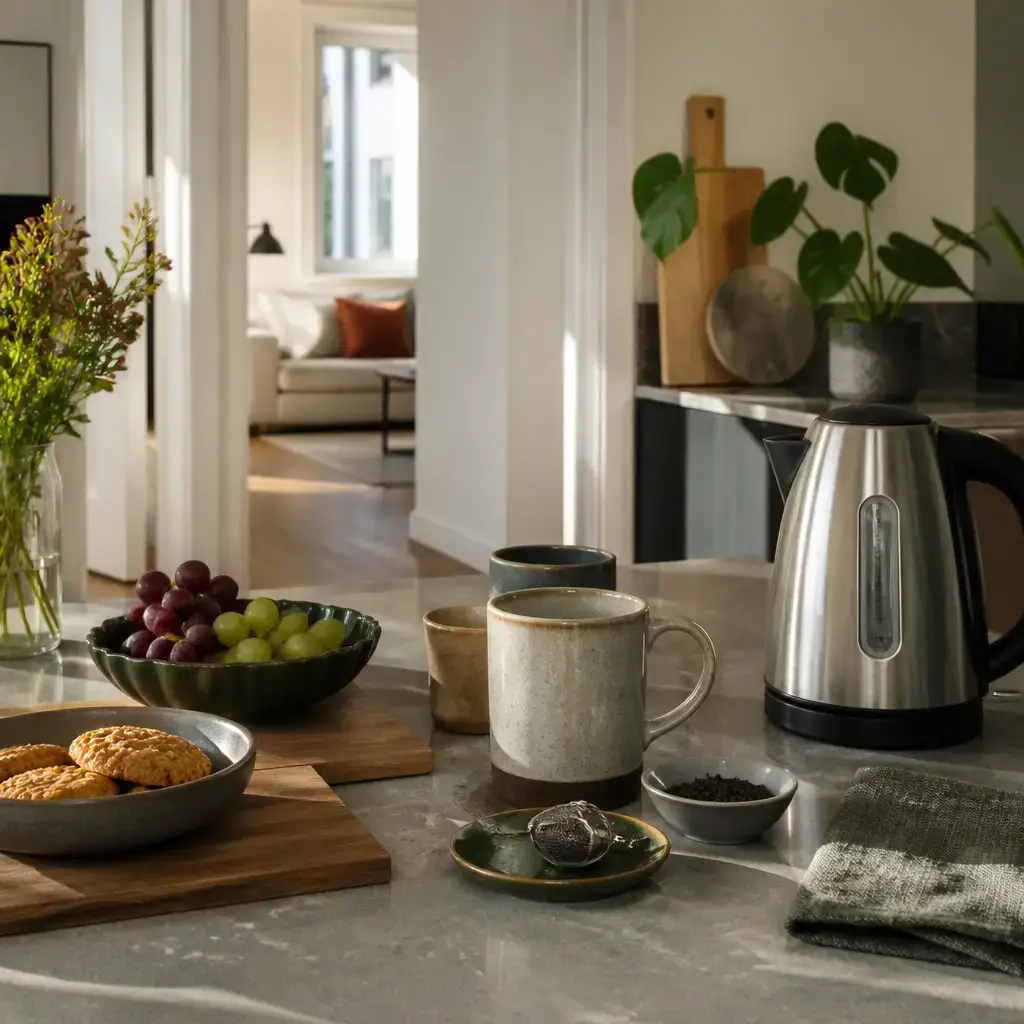
Use Preparing drinks and snacks for a guest to practice German conversation, pronunciation, vocabulary, grammar, and quizzes.
Dialogue
Unser Gast kommt bald.
OON-zuh gahst kohmt bahlt. Our guest will arrive soon.Sollen wir Kaffee oder Tee servieren?
ZOL-len veer kah-FAY OH-duh tay zehr-VEE-ruhn? Should we serve coffee or tea?Heute Abend ist Tee wahrscheinlich besser.
HOY-tuh AH-bent ist tay VAH-shine-likh BES-uh. Tea is probably better this evening.Ich koche etwas Wasser im Wasserkocher.
Ikh KOKH-uh ET-vahs VAH-ser im VAH-ser-koh-khuh. I'll boil some water in the kettle.Bitte benutze die große Tasse für unseren Gast.
BIT-tuh beh-NOOT-suh dee GROH-suh TAS-suh fyoor OON-zuh-ren gahst. Please use the large mug for our guest.Soll ich auch Snacks vorbereiten?
ZOL ikh owkh SNAHKS fohr-beh-RY-tuhn? Would you like me to prepare snacks too?Leg bitte ein paar Kekse auf den kleinen Teller.
Layk BIT-tuh ine pahr KEK-suh owf dayn KLY-nuhn TEL-uh. Put some biscuits on the small plate, please.Alles wird fertig sein, bevor unser Gast ankommt.
AL-les veert FER-tikh zine, beh-FOHR OON-zuh gahst AHN-kommt. Everything will be ready before they arrive.Sentence explanations
Unser Gast kommt bald.
Our guest will arrive soon.
- Unser
- our
- Gast
- guest
- kommt
- arrives
- bald
- soon
More detail
Unser means “our” here and stands before the noun it specifies. Its ending reflects the noun phrase: Gast is masculine singular and is the subject, so the form is unser. For example, unsere Gäste means “our guests”; both the noun and the determiner change there because the number is plural. Gast means “guest.” Its base form is Gast; the plural is Gäste. The noun is the person who arrives, so it is the subject of the sentence. kommt is the third-person singular present form of kommen, “to come.” The pattern is er/sie/es kommt; kommen is the infinitive. German present tense can refer to a future event when the time is clear: Unser Gast kommt morgen. means “Our guest is coming tomorrow” or “Our guest will arrive tomorrow.” bald is an adverb meaning “soon,” indicating that the arrival is expected in the near future. It does not change form. Together, Unser Gast identifies the person arriving, kommt expresses that person’s arrival, and bald places it soon. The whole utterance means: “Our guest will arrive soon.”
Sollen wir Kaffee oder Tee servieren?
Should we serve coffee or tea?
- Sollen wir
- Should we
- Kaffee
- coffee
- oder
- or
- Tee
- tea
- servieren
- serve
More detail
Sollen wir means “should we” here: it is a reusable way to make a suggestion or ask about a proposed action. sollen is the present-tense form of sollen for wir; the subject wir means “we.” In a German question with this modal verb, sollen comes first and the subject follows. Compare Sollen wir gehen? — “Should we go?” Kaffee means “coffee.” It is a masculine noun (der Kaffee), and German nouns are capitalized. Here it is used without an article as an uncounted drink. Example: Ich trinke Kaffee. — “I drink coffee.” oder connects alternatives and means “or.” It introduces the second choice in a choice question, as in Tee oder Wasser? — “Tea or water?” Tee means “tea.” It is also a masculine noun (der Tee) and is capitalized. Like Kaffee, it can appear without an article when the drink is understood generally or as an uncounted substance. Example: Wir trinken Tee. — “We drink tea.” servieren means “to serve.” This is the infinitive form. After the modal verb sollen, the lexical verb remains in the infinitive and goes to the end of the question: Sollen wir Kaffee servieren? — “Should we serve coffee?” The verb changes when it is used without the modal: Wir servieren Kaffee. — “We serve coffee.” Together, Sollen wir asks about a proposed action, Kaffee oder Tee gives the two alternatives, and servieren names the action. Thus the complete utterance means “Should we serve coffee or tea?”
Heute Abend ist Tee wahrscheinlich besser.
Tea is probably better this evening.
- Heute Abend
- this evening
- ist
- is
- Tee
- tea
- wahrscheinlich
- probably
- besser
- better
More detail
Heute Abend means “this evening.” heute is “today,” and Abend is “evening”; together they form a time expression. German nouns are capitalized, so Abend has a capital letter. Example: Heute Abend lese ich. — “This evening I am reading.” ist is the present-tense third-person singular form of sein (“to be”). Here, Tee is the subject, so the sentence uses ist. Example: Der Tee ist heiß. — “The tea is hot.” Tee means “tea.” It is a masculine German noun: der Tee. The form stays Tee here; the article or other surrounding words can show case or number in other contexts. Example: Ich trinke Tee. — “I drink tea.” wahrscheinlich means “probably.” It marks the statement as likely rather than certain. Example: Sie kommt wahrscheinlich später. — “She will probably come later.” besser means “better.” It is the comparative form of gut (“good”): gut → besser → am besten (“best”). Here, besser evaluates the tea as the better option, with the comparison understood from the situation. Example: Tee ist besser als Kaffee. — “Tea is better than coffee.” The sentence begins with the time expression Heute Abend. The finite verb then comes in second position, so ist is followed by the subject Tee; wahrscheinlich qualifies the evaluation, and besser supplies it. Together, Heute Abend ist Tee wahrscheinlich besser. means “Tea is probably better this evening.”
Ich koche etwas Wasser im Wasserkocher.
I'll boil some water in the kettle.
- Ich
- I
- koche
- boil
- etwas
- some
- Wasser
- water
- im
- in the
- Wasserkocher
- kettle
More detail
Ich is the first-person singular pronoun “I”. It is the subject here: the speaker is the person carrying out the action. Its subject form is ich; the corresponding object form is mich, as in Er sieht mich (“He sees me”). koche comes from the verb kochen, “to cook” or, with a liquid such as water, “to boil”. koche is the present-tense first-person singular form: ich koche (“I cook / I boil”). German present tense can also describe a planned or imminent action, so the fixed translation uses “I’ll boil”. Example: Ich koche heute Abend. — “I’m cooking this evening.” etwas means “some” here, indicating an unspecified amount. It does not state an exact quantity. It can also mean “something” in other contexts, so its meaning is determined by what follows: with the mass noun Wasser, it means some water. Example: Ich trinke etwas Tee. — “I drink some tea.” Wasser is the noun “water”. It is normally a mass noun, so etwas Wasser refers to an unspecified amount rather than separate counted units. Its plural, used for different waters or kinds of water, is Wässer in contexts where a plural is needed. im is the contracted form of in dem, literally “in the”. Here it introduces the place where the boiling takes place. With a stationary location, in takes the dative case, which is why the masculine article appears as dem in the expanded form. Example: Das Wasser ist im Topf. — “The water is in the pot.” Wasserkocher is the noun “kettle” (specifically, an electric kettle). It is a compound noun made from Wasser (“water”) and Kocher (“cooker/boiler”), and its grammatical gender is masculine: der Wasserkocher. After in dem, it appears as dem Wasserkocher; im Wasserkocher is the contracted version. Example: Der Wasserkocher ist in der Küche. — “The kettle is in the kitchen.” Together, Ich koche gives the speaker as the subject and the boiling action, etwas Wasser gives the unspecified amount of water, and im Wasserkocher gives the location. The whole utterance therefore means: “I’ll boil some water in the kettle.”
Bitte benutze die große Tasse für unseren Gast.
Please use the large mug for our guest.
- Bitte
- please
- benutze
- use
- große
- large
- Tasse
- mug
- unseren
- our
- Gast
- guest
More detail
Bitte is the standard German word for “please.” It can soften a request or command and is often placed at the beginning or end of the sentence. Example: Bitte warten Sie. — “Please wait.” benutze means “use” here. It is the informal singular imperative of benutzen (“to use”), addressed to one person with du. The imperative places the verb first: Benutze den Schlüssel. — “Use the key.” große means “large” here. Its base form is the adjective groß; the ending in große is an attributive adjective ending. It agrees with feminine singular Tasse, which is the accusative direct object: die große Tasse — “the large cup/mug.” Tasse means “cup” or, in this translation, “mug.” It is a feminine noun: die Tasse. As the thing being used, it is the direct object of benutze, so the noun phrase is in the accusative. Example: Ich nehme eine Tasse. — “I’m taking a cup.” unseren means “our” in this sentence. It is the possessive determiner based on unser (“our”), and its masculine accusative singular form is unseren. The ending reflects Gast, not unseren itself as a noun. Compare: unser Gast — “our guest” (masculine nominative) and unseren Gast — “our guest” (masculine accusative). Gast means “guest.” It is a masculine noun: der Gast. Here it follows für, and für requires the accusative, giving für unseren Gast — “for our guest.” Example: Das Geschenk ist für unseren Gast. — “The gift is for our guest.” The reusable structure is Bitte + imperative + direct object + für + accusative recipient or beneficiary. Benutze is the command, die große Tasse is the object to use, and für unseren Gast identifies who it is intended for. Together, the utterance means: “Please use the large mug for our guest.”
Soll ich auch Snacks vorbereiten?
Would you like me to prepare snacks too?
- Soll ich
- Should I
- auch
- too
- Snacks
- snacks
- vorbereiten
- prepare
More detail
Soll ich combines soll with the subject ich to ask whether the speaker should do something. soll is the first-person singular present form of sollen; here, the fixed translation presents the question as a polite offer: “Would you like me to …?” The infinitive comes later: Soll ich helfen? — “Would you like me to help?” auch means “too” here. It adds preparing snacks to the other relevant preparations. In this utterance it follows ich, although its position can vary in German. Snacks is the plural of the noun Snack, meaning small items of food. German nouns are capitalized. The singular/plural contrast is ein Snack — “a snack” and mehrere Snacks — “several snacks.” The fixed sentence does not specify how many snacks there are. vorbereiten means “to prepare” here. It is a separable verb: in a main-clause statement, the present-tense form is ich bereite ... vor, while the infinitive remains vorbereiten after a modal verb such as sollen. For example, Ich bereite Snacks vor. means “I am preparing snacks.” Together, Soll ich asks whether the speaker should perform the action, auch adds that action to the relevant preparations, and Snacks vorbereiten supplies the action. Thus Soll ich auch Snacks vorbereiten? means “Would you like me to prepare snacks too?”
Leg bitte ein paar Kekse auf den kleinen Teller.
Put some biscuits on the small plate, please.
- Leg
- put; place
- bitte
- please
- ein paar
- some; a few
- Kekse
- biscuits
- kleinen
- small
- Teller
- plate
More detail
Leg is the imperative singular form of legen (“to put” or “to lay”). It addresses one person informally and asks that person to place something. The verb legen describes putting an object into a position; compare liegen, which describes the object already being positioned. Example: Leg das Buch auf den Tisch. — “Put the book on the table.” bitte means “please” here and makes the request more polite. It can also appear elsewhere in a German request, but its position here places it directly after the imperative. ein paar means “some” or “a few.” It indicates an unspecified small amount, not an exact numerical count. ein paar Kekse therefore means “some biscuits.” Kekse is the plural of der Keks, “biscuit” or “cookie.” The plural form is Kekse; the singular would be ein Keks (“one biscuit” or “a biscuit”). Example: Ich esse zwei Kekse. — “I am eating two biscuits.” kleinen is the inflected form of the adjective klein, “small.” Here it describes Teller, and its ending is required by the masculine singular accusative phrase den kleinen Teller. The adjective itself has the base form klein; kleinen is not derived from Teller. Teller means “plate” in this context. Its singular form is der Teller, and its plural is die Teller. The phrase den kleinen Teller names the destination onto which the biscuits are put. The pattern is Leg [object] auf den [masculine singular noun]: auf takes the accusative here because legen expresses movement or placement toward a location. Thus ein paar Kekse is what is being placed, while auf den kleinen Teller gives the destination. Together, Leg bitte ein paar Kekse auf den kleinen Teller. means “Put some biscuits on the small plate, please.”
Alles wird fertig sein, bevor unser Gast ankommt.
Everything will be ready before they arrive.
- Alles
- everything
- wird … sein
- will be
- fertig
- ready
- bevor
- before
- unser
- our
- Gast
- guest
- ankommt
- arrives
More detail
Alles means “everything” here and is the subject of the main clause. It is the neuter singular form of the indefinite pronoun alles; it is not the same as the plural alle (“all” or “everyone,” depending on context). wird ... sein forms the German future: wird is the third-person singular present form of werden, and sein is the infinitive “to be.” The future pattern is werden + infinitive, with the infinitive at the end of the main clause. Here, wird agrees with singular Alles; sein does not carry that person marking. fertig is the predicate adjective “ready.” With sein, it describes the subject rather than receiving an object. For example: Alles ist fertig. — “Everything is ready.” bevor introduces a subordinate time clause meaning “before.” In a clause introduced by bevor, the finite verb normally goes to the end. The time relation is between the main event and the event in this subordinate clause. unser Gast means “our guest.” unser is a possessive determiner meaning “our”; here it has the masculine singular nominative form required before the masculine noun Gast when that noun is the subject of the subordinate clause. Possession does not itself state a numerical quantity beyond the singular form of the noun used here. Gast means “guest.” Its plural is Gäste. ankommt means “arrives” in this sentence. Its base verb is the separable verb ankommen (“to arrive”). In a main clause, its finite form separates, as in Der Gast kommt an. — “The guest arrives.” After bevor, the finite form stays together at the end: bevor unser Gast ankommt — “before our guest arrives.” Together, Alles wird fertig sein says “Everything will be ready.” The subordinate clause bevor unser Gast ankommt specifies that this will be true before our guest arrives. The complete meaning is: “Everything will be ready before our guest arrives.”
Grammar Points
bevor + Verb am Ende
Bevor ich Wasser koche, benutze ich den Wasserkocher.
beh-FOHR ikh VAH-ser KOKH-uh, beh-NOOT-suh ikh dayn VAH-ser-koh-khuh.Before I boil water, I use the kettle.
Nach „bevor“ steht das konjugierte Verb am Ende des Nebensatzes: „Wasser koche“.
Adjektivendung nach „eine“
Ich benutze eine große Tasse.
Ikh beh-NOOT-suh EYE-nuh GROH-suh TAS-suh.I use a large cup.
Nach „eine“ erhält das Adjektiv hier die Endung „-e“: „eine große Tasse“.
German Vocabulary
Unser Gast kommt bald.
Heute Abend ist Tee wahrscheinlich besser.
Unser Gast kommt bald.
Heute Abend ist Tee wahrscheinlich besser.
Sollen wir Kaffee oder Tee servieren?
Ich koche etwas Wasser im Wasserkocher.
Unser Gast kommt bald.
Sollen wir Kaffee oder Tee servieren?
Heute Abend ist Tee wahrscheinlich besser.
Heute Abend ist Tee wahrscheinlich besser.
Ich koche etwas Wasser im Wasserkocher.
Ich koche etwas Wasser im Wasserkocher.
Quiz
Word Order
Arrange the words in the correct order.
Our guest will arrive soon.
Show Answer
Unser Gast kommt bald.Should we serve coffee or tea?
Show Answer
Sollen wir Kaffee oder Tee servieren?Tea is probably better this evening.
Show Answer
Heute Abend ist Tee wahrscheinlich besser.Spelling
Tap the letters to spell the word.
soon
Show Answer
baldto serve
Show Answer
servierento come
Show Answer
kommtbetter