10 minutes free every day
Continue audio lessons in the app
Word explanations appear automatically in sync with the audio.
No login required · synced translations · playback with the screen locked
Choose your learning language and open this lesson in the app.

About This Lesson
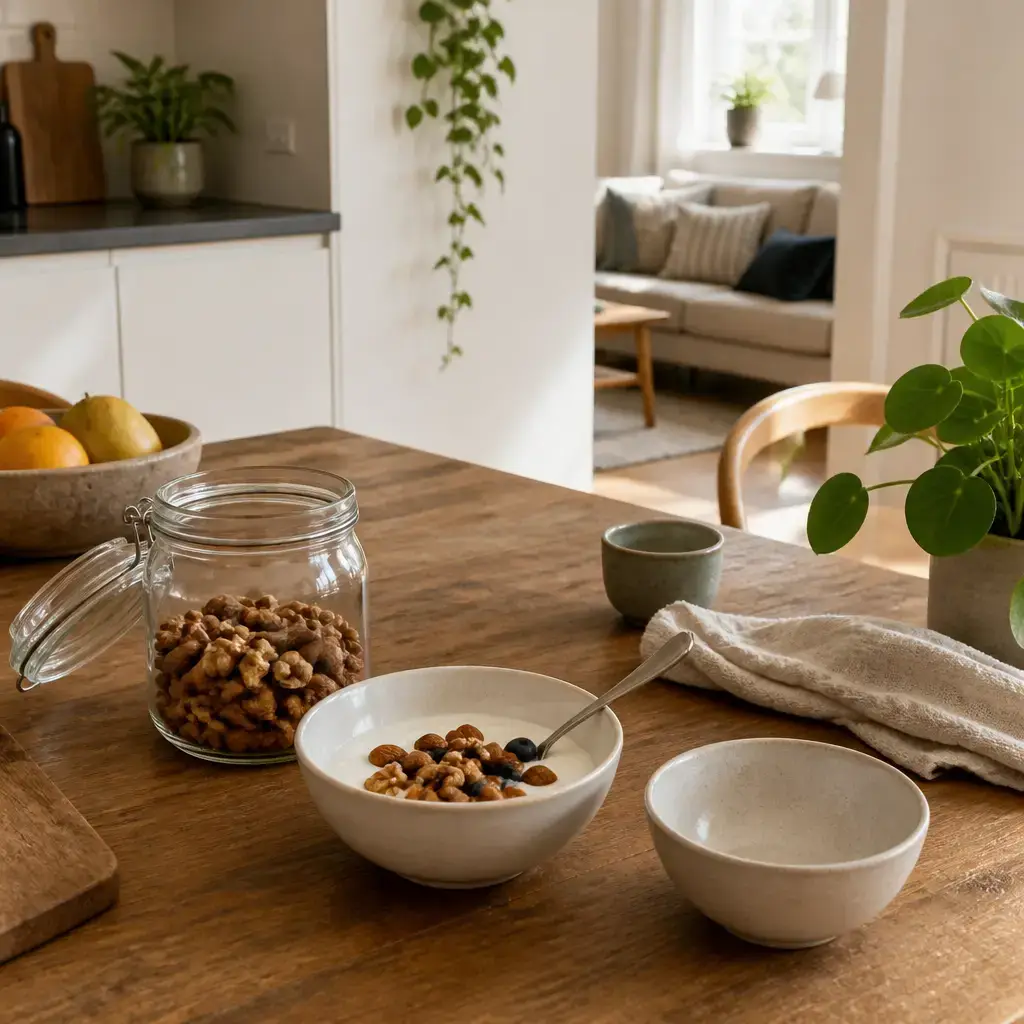
Use Choosing a light snack to practice German conversation, pronunciation, vocabulary, grammar, and quizzes.
Dialogue
Ich möchte einen Snack.
ikh MURKH-tuh EYE-nen SHNEK I want a snack.Ich habe nicht sehr viel Hunger.
ikh HAH-buh nikht zair feel HOONG-er I am not very hungry.Dann nimm etwas Leichtes, zum Beispiel Joghurt.
dahn nim ET-vahs LYEKH-tuhs, tsoom BYE-shpeel YOH-goort Then choose something light, like yogurt.Haben wir auch Nüsse?
HAH-ben veer owkh NUR-suh Do we have nuts too?Im Schrank sind welche.
im SHRAHNK zint VEL-khuh There are some in the cupboard.Joghurt mit Nüssen klingt gut.
YOH-goort mit NUR-sen klinkt goot Yogurt with nuts sounds good.Nimm eine kleine Schüssel.
nim EYE-nuh KLY-nuh SHUR-suhl Take a small bowl.Das ist nicht zu viel.
dahs ist nikht tsoo feel It is not too much.Ich mache jetzt einen Snack.
ikh MAKH-uh yetst EYE-nen SHNEK I will make one now.Lass bitte ein paar Nüsse für mich übrig.
lahss BIT-tuh EYE-nen pahr NUR-suh fyr mikh OO-brihk Leave some nuts for me, please.Sentence explanations
Ich möchte einen Snack.
I want a snack.
- Ich
- I
- möchte
- want
- einen
- a
- Snack
- snack
More detail
Ich is the first-person singular pronoun meaning “I.” It is the form used for the speaker as the subject. Example: Ich lerne. — “I am learning.” möchte expresses the speaker’s wish here: “want” or, more literally in many contexts, “would like.” It is the first-person singular form of mögen used for a present wish; mögen itself can also mean “to like.” Example: Ich möchte Wasser. — “I would like water.” The form möchte is softer than a direct command and is commonly used when requesting something. einen is the masculine singular accusative form of the indefinite article. Snack is the direct object of möchte, so the article takes the accusative form: ein becomes einen with a masculine singular noun. This article does not by itself assert a numerical count; it introduces an unspecified snack. Compare: Ich möchte einen Tee. — “I would like a tea.” Snack is a masculine noun meaning “snack.” Its plural is Snacks. As a noun, it is capitalized in German. Example: Der Snack ist klein. — “The snack is small.” Together, Ich möchte identifies the speaker and expresses the speaker’s wish, while einen Snack names the unspecified masculine singular object of that wish. The complete utterance means: “I want a snack.”
Ich habe nicht sehr viel Hunger.
I am not very hungry.
- Ich habe
- I have
- nicht
- not
- sehr viel
- very much
- Hunger
- hunger
More detail
Ich habe is the first-person singular present form of haben, “to have.” German commonly uses haben with Hunger: Ich habe Hunger means “I am hungry,” literally “I have hunger.” The same form is used for possession, as in Ich habe Zeit (“I have time”). nicht is the standard negator here. It makes the following amount of hunger negative, so the utterance says that the speaker does not have a very large amount of hunger. A useful contrast is Ich habe keinen Hunger (“I am not hungry” / “I have no hunger”); keinen is a form of kein, used to negate the noun phrase directly, whereas nicht sehr viel means “not very much.” sehr viel combines sehr (“very”) with viel (“much” or “a lot”). In this sentence it describes the amount or intensity of Hunger, rather than a countable number. Compare Ich habe viel Hunger (“I am very hungry” / “I have a lot of hunger”) with Ich habe nicht sehr viel Hunger (“I am not very hungry”). Hunger is the noun “hunger.” German uses the masculine noun without an article in the fixed expression Hunger haben; the noun itself remains Hunger in this phrase. For example, Wir haben Hunger means “We are hungry.” Together, Ich habe + nicht sehr viel Hunger gives “I do not have very much hunger.” In the natural fixed translation, this is “I am not very hungry.” The utterance expresses a limited degree of hunger, not necessarily a complete absence of hunger.
Dann nimm etwas Leichtes, zum Beispiel Joghurt.
Then choose something light, like yogurt.
- Dann
- then
- nimm
- choose; take
- etwas
- something
- Leichtes
- something light
- zum Beispiel
- for example
- Joghurt
- yogurt
More detail
Dann means “then” here and links the suggestion to the preceding situation. It is also common at the start of a sentence when describing the next step. nimm is the informal singular imperative of nehmen (“to take”). In this context, the intended choice is “choose,” but the same verb can refer to physically taking something. The imperative addresses one person directly: Nimm den Apfel. — “Take the apple.” etwas means “something.” It is an indefinite pronoun and does not identify a particular item. A useful contrast is nichts (“nothing”): Ich möchte etwas. — “I would like something.” Leichtes is the substantivized adjective leicht (“light”), used here for something light to eat. Because it stands after etwas and refers to an unspecified neuter item, the adjective has the ending -es and is capitalized: etwas Leichtes. The adjective itself is leicht; its comparative is leichter (“lighter”). zum Beispiel is the fixed expression “for example.” It introduces one possible instance, not an exhaustive list: Ich esse Obst, zum Beispiel einen Apfel. — “I eat fruit, for example an apple.” Joghurt is the noun “yogurt.” Here it is the example of etwas Leichtes; the sentence does not say that yogurt is the only possible choice. Together, Dann nimm gives the suggestion “Then choose,” etwas Leichtes specifies the kind of food, and zum Beispiel Joghurt supplies yogurt as one example. The whole utterance means: “Then choose something light, like yogurt.”
Haben wir auch Nüsse?
Do we have nuts too?
- Haben wir
- do we have
- auch
- also; too
- Nüsse
- nuts
More detail
Haben wir contains the verb haben (“to have”) and the subject pronoun wir (“we”). In a present-tense statement, the usual order is Wir haben ...; in a yes/no question, the finite verb moves to the beginning: Haben wir ...? This is a reusable question pattern: Haben wir [thing]? = “Do we have [thing]?” auch means “too” or “also”. It adds the idea that nuts are being asked about in addition to something already under discussion. Its position here, before the noun, is natural: Haben wir auch Brot? means “Do we have bread too?” Nüsse means “nuts” here. Its singular base form is die Nuss; Nüsse is the plural, with the vowel change u → ü. In this question, the plural form names the thing being had. The plural accusative form is Nüsse, the same visible form as the plural nominative. Together, Haben wir + auch + Nüsse? forms a yes/no question: “Do we have nuts too?”
Im Schrank sind welche.
There are some in the cupboard.
- Im
- in the
- Schrank
- cupboard
- sind
- are
- welche
- some
More detail
Im is the contracted form of in dem: in means “in,” and dem is the dative masculine/neuter form of the definite article. With a location rather than movement, German uses the dative after in. Schrank is masculine: der Schrank (“the cupboard”), so the location is in dem Schrank, commonly shortened to im Schrank. Schrank means “cupboard” here. Its plural is Schränke; the vowel change belongs to the noun itself. Example: Die Gläser sind im Schrank. — “The glasses are in the cupboard.” sind is the present-tense third-person plural form of sein (“to be”): sein → sie sind. In this sentence, the plural verb agrees with welche, the plural indefinite pronoun. German uses a present-tense form of sein to say that something is located somewhere. welche means “some” here. It is a plural indefinite pronoun, not an article followed by an omitted noun. In the supplied context, it stands for some nuts, referring back to the nuts asked about previously. Example: Im Schrank sind welche. — “There are some in the cupboard.” The whole utterance follows the pattern place + sein + indefinite pronoun: Im Schrank places the items in the cupboard, sind says they are there, and welche identifies them as some of the previously discussed items. Thus the complete meaning is “There are some in the cupboard.”
Joghurt mit Nüssen klingt gut.
Yogurt with nuts sounds good.
- Joghurt
- yogurt
- Nüssen
- nuts
- klingt
- sounds
- gut
- good
More detail
Joghurt is the noun “yogurt.” German nouns are capitalized. Here it is the head of the subject phrase Joghurt mit Nüssen, so the phrase refers to yogurt accompanied by nuts. Example: Joghurt ist kalt. — “Yogurt is cold.” Nüssen means “nuts” here. Its base form is die Nuss (“the nut”); the plural is die Nüsse. After mit, a plural noun is in the dative, giving mit Nüssen (“with nuts”): the plural has its umlaut, and the dative plural adds -n. Example: Tee mit Nüssen — “tea with nuts.” klingt is the third-person singular present form of klingen (“to sound”). It is singular because the head noun of the subject phrase, Joghurt, is singular; mit Nüssen is an accompanying prepositional phrase, not a second coordinated subject. The form changes with the subject: Es klingt gut — “It sounds good”; Die Ideen klingen gut — “The ideas sound good.” gut means “good.” With klingen, it describes the sound or impression as good, producing the reusable pattern etwas klingt gut — “something sounds good.” Here gut is an adjective used after the verb as a description, so it has no noun ending. Example: Der Plan klingt gut. — “The plan sounds good.” Together, Joghurt mit Nüssen is the subject, klingt means “sounds,” and gut gives the evaluation: “Yogurt with nuts sounds good.”
Nimm eine kleine Schüssel.
Take a small bowl.
- Nimm
- take
- kleine
- small
- Schüssel
- bowl
More detail
Nimm is the informal singular imperative of nehmen (“to take”). The person addressed is understood as du, so German normally leaves the subject out in this command. The vowel changes from e in nehmen to i in nimm; this is part of the verb’s imperative form. Example: Nimm den Löffel. — “Take the spoon.” kleine means “small” here and describes the bowl. Because the adjective comes before the noun, it takes an ending. In eine kleine Schüssel, Schüssel is feminine and the whole noun phrase is the direct object of nehmen, so the adjective has the form kleine. The base form is klein; for example, ein kleiner Löffel means “a small spoon.” Schüssel is the feminine noun “bowl.” Its plural is Schüsseln: zwei Schüsseln means “two bowls.” The article eine marks this as an indefinite feminine noun phrase; it does not by itself state a numerical quantity beyond introducing an unspecified bowl. Together, Nimm + eine kleine Schüssel forms an informal command: “Take a small bowl.” The phrase eine kleine Schüssel is the object taken, and Nimm supplies the command.
Das ist nicht zu viel.
It is not too much.
- Das
- it / that
- ist
- is
- nicht
- not
- zu viel
- too much
More detail
Das is a neuter singular demonstrative pronoun. Here it means “it” and points to something understood from the situation; the sentence itself does not identify exactly what that is. As a demonstrative, it can also mean “that” in other contexts. It is not the article before a noun here. ist is the third-person singular present form of sein (“to be”): sein → ist for “he/she/it is.” The subject here is the singular pronoun Das. nicht negates the following predicate. In this sentence it turns “is too much” into “is not too much.” Its position before zu viel makes the whole amount judgment negative. zu viel means “too much”: zu marks an excessive degree, and viel refers to a large amount. This expression is used for an amount rather than an explicitly stated numeric count. A useful opposite is zu wenig (“too little”). Example: Das ist zu viel. — “That is too much.” Together, Das ist says “It is,” nicht removes the claim of excess, and zu viel supplies the amount judgment. The whole utterance therefore means “It is not too much.”
Ich mache jetzt einen Snack.
I will make one now.
- mache
- make
- jetzt
- now
- Snack
- snack
More detail
mache is the first-person singular present form of machen (“to make”): ich mache = “I make/am making.” German present tense can also refer to an imminent action, so with jetzt this naturally conveys “I will make one now” in the fixed translation. The form mache identifies the subject as ich; other present forms include du machst (“you make”) and sie macht (“she makes”). jetzt means “now” and places the action at the current time. Example: Ich lerne jetzt. — “I am studying now.” Snack is a masculine noun meaning “snack.” Its useful basic form is der Snack; here, einen Snack is the object of machen, so the masculine article appears in the accusative form einen. The article marks the noun phrase’s grammatical role and does not by itself establish a numeric count, even though the fixed translation expresses the intended meaning as “one.” Together, Ich mache (“I make/am making”), jetzt (“now”), and einen Snack (“a snack,” with the object marking) form the complete meaning: “I will make one now.” The sentence presents the speaker as making a snack at the current time or in the immediate future.
Lass bitte ein paar Nüsse für mich übrig.
Leave some nuts for me, please.
- Lass … übrig
- leave ... over
- bitte
- please
- ein paar
- some
- Nüsse
- nuts
- für mich
- for me
More detail
Lass ... übrig means “leave ... over” here. Lass is the informal singular imperative of lassen (“to let; to leave”). In this reusable pattern, lassen means not using or taking something so that it remains: Lass etwas übrig. — “Leave something over.” The separable element übrig appears at the end of the clause. The imperative addresses one person informally. bitte adds “please.” It is a flexible politeness word and can occur in different positions; here it softens the request without changing what should remain. ein paar means “some” or “a few.” It indicates an unspecified small amount, not a precise number. The phrase can be reused with plural countable nouns, for example: ein paar Äpfel — “a few apples.” Nüsse means “nuts” here. It is the plural of die Nuss (“the nut”); the plural changes the vowel to ü and adds -e: Nuss → Nüsse. The noun is the thing that should be left over. für mich means “for me.” für is a preposition that takes the accusative case, and mich is the accusative form of first-person singular ich (“I”). Compare für dich — “for you” when addressing one person informally. Together, Lass gives the request, ein paar Nüsse identifies an unspecified small amount of nuts, and für mich identifies the intended recipient. übrig completes the separable pattern etwas für jemanden übrig lassen: “to leave something for someone.” The whole utterance therefore means: “Leave some nuts for me, please.”
Grammar Points
substantiviertes Adjektiv: Leichtes
Leichtes
LYEKH-tuhssomething light
The adjective is capitalized and used as a noun to mean something light, without repeating a noun.
zu viel
zu viel
tsoo FEELtoo much
The fixed expression zu viel describes an amount that is greater than needed or wanted.
German Vocabulary
Ich habe nicht sehr viel Hunger.
zum Beispiel Joghurt.
Im Schrank sind welche.
Ich möchte einen Snack.
Haben wir auch Nüsse?
Joghurt mit Nüssen klingt gut.
Dann nimm etwas Leichtes.
Joghurt mit Nüssen.
Ich möchte einen Snack.
Dann nimm etwas Leichtes.
Im Schrank sind welche.
zum Beispiel Joghurt.
Quiz
Word Order
Arrange the words in the correct order.
I want a snack.
Show Answer
Ich möchte einen Snack.I am not very hungry.
Show Answer
Ich habe nicht sehr viel Hunger.Do we have nuts too?
Show Answer
Haben wir auch Nüsse?Spelling
Tap the letters to spell the word.
want; would like
Show Answer
möchtenut
Show Answer
Nüssehunger
Show Answer
Hungercupboard