10 minutes free every day
Continue audio lessons in the app
Word explanations appear automatically in sync with the audio.
No login required · synced translations · playback with the screen locked
Choose your learning language and open this lesson in the app.

About This Lesson
Use Comparing jacket quality and fit to practice German conversation, pronunciation, vocabulary, grammar, and quizzes.
Dialogue
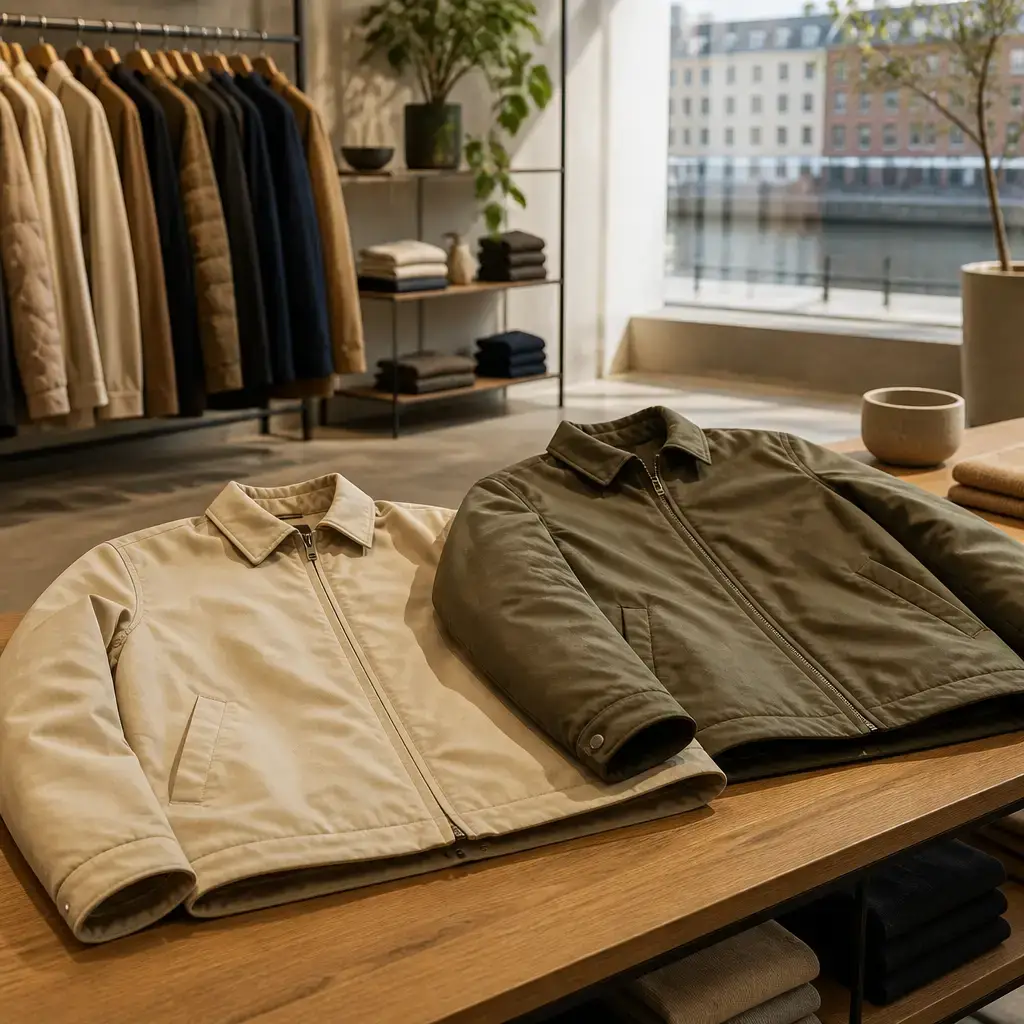
Diese beiden Jacken sehen sehr ähnlich aus.
DEE-zuh BYE-den YAH-ken ZAY-en zair AYN-likh owss. These two jackets look very similar.Vergleichen wir Stoff und Passform.
fer-GLY-khen veer shtof oont PASS-form. Let's compare the fabric and fit.Diese hier fühlt sich leicht an.
DEE-zuh heer fyoolt zikh lykht ahn. This one feels light.Der Stoff wirkt dünn.
dair shtof veerkt duhn. The fabric seems thin.Die andere fühlt sich robuster und wärmer an.
DEE AHN-duh-reh fyoolt zikh roh-BOOS-ter oont VAIR-mer ahn. The other one feels sturdier and warmer.Die könnte für den Alltag besser sein.
DEE KURN-tuh fyoor den ALL-tahk BESS-er zine. That might be better for everyday use.Probier sie zuerst an und schau, wie sie sich anfühlt.
proh-BEER zee tsoo-AIRST ahn oont show vee zee zikh an-FYOOLT. Try it on first and see how it feels.Ich probiere beide an, bevor ich mich entscheide.
ikh proh-BEER-uh BYE-duh ahn, beh-FOHR ikh mikh ent-SHYE-duh. I will try both before I decide.Das sollte die Wahl leichter machen.
dahs SHOLL-tuh dee vahl LYKHT-er MAKH-en. That should make the choice easier.Sentence explanations
Diese beiden Jacken sehen sehr ähnlich aus.
These two jackets look very similar.
- Diese
- these
- beiden
- both; the two
- Jacken
- jackets
- sehen … aus
- look; appear
- sehr
- very
- ähnlich
- similar
More detail
Diese is the plural demonstrative meaning “these” here. It points to the jackets being discussed and stands in the nominative because it is part of the subject. Its form changes with grammatical case and number: for example, diese Jacke is singular, while diese Jacken is plural. beiden means “both” or “the two” and makes the number explicit: the subject contains exactly two jackets. It is the inflected form of beide; after the demonstrative diese, the form is beiden in this noun phrase. Example: Diese beiden Bücher sind neu. — “These two books are new.” Jacken is the plural of Jacke, “jacket.” The singular has -e, while this plural uses -en: eine Jacke — “a jacket”; zwei Jacken — “two jackets.” sehen ... aus is the separable verb aussehen, meaning “to look” or “to appear” in this construction. With the plural subject, its finite form is sehen. In a main clause, the separable prefix aus goes to the end: Die Schuhe sehen neu aus. — “The shoes look new.” The form sehen by itself can also mean “see,” but sehen ... aus has the meaning “look/appear.” sehr is an intensifier meaning “very.” It strengthens the adjective that follows it: sehr ähnlich means “very similar,” not merely “similar.” ähnlich means “similar” or “alike.” It describes a resemblance, not complete identity. Its useful comparison forms are ähnlicher — “more similar” and am ähnlichsten — “the most similar.” Example: Die beiden Muster sind ähnlich. — “The two patterns are similar.” Together, Diese beiden Jacken is the subject “these two jackets.” The construction sehen ... aus says how they appear, while sehr ähnlich gives the appearance being described. The whole utterance therefore means: “These two jackets look very similar.”
Vergleichen wir Stoff und Passform.
Let's compare the fabric and fit.
- Vergleichen wir
- let’s compare
- Stoff
- fabric
- Passform
- fit
More detail
Vergleichen wir uses the verb vergleichen (“to compare”) with wir (“we”) in a verb-first suggestion. In German, this word order can express “let’s …”: Vergleichen wir die beiden Jacken. — “Let’s compare the two jackets.” The form vergleichen is also the infinitive and the present-tense form used with wir; other subjects can require different forms, such as ich vergleiche (“I compare”) and sie vergleichen (“they compare”). Stoff means fabric or textile material here. Its base noun is masculine: der Stoff; its plural is die Stoffe. In other contexts, Stoff can also mean material or substance, so the surrounding topic determines the sense. Example: Der Stoff ist weich. — “The fabric is soft.” Passform means fit, especially how a garment fits the body. It is a feminine compound noun: die Passform, plural die Passformen. The noun refers to the garment’s fit, not to the garment itself. Example: Die Passform dieser Jacke ist bequem. — “The fit of this jacket is comfortable.” Together, Vergleichen wir Stoff und Passform forms the suggestion “Let’s compare the fabric and fit.” The two nouns are coordinated objects of vergleichen: the proposed comparison concerns both the material and how the clothing fits.
Diese hier fühlt sich leicht an.
This one feels light.
- Diese hier
- this one
- fühlt sich … an
- feels
- leicht
- light
More detail
Diese hier means “this one here.” Diese is a demonstrative pronoun; with the singular meaning established by the translation, this form is the feminine singular nominative form, although the omitted noun itself is not stated. Hier adds the indication “here.” The demonstrative changes with grammatical case, number, and gender in German; for example, dieser is masculine nominative singular, while diese can also be a plural form in some contexts. fühlt sich ... an comes from the separable verb sich anfühlen, “to feel” or “to feel like.” In this sentence, fühlt is the third-person singular present form, matching the singular item selected by Diese hier; sich is the reflexive element, and the separable part an moves to the end of the clause. Example: Das Material fühlt sich weich an. — “The material feels soft.” Leicht means “light” here in the sense of having little weight. As a predicate adjective after sich anfühlen, it has no ending: Diese hier fühlt sich leicht an. The useful comparison is leicht – leichter – am leichtesten (“light – lighter – lightest”); its relevant opposite is schwer (“heavy”). Leicht can have other meanings in other contexts, such as “easy,” but the fixed translation supports the weight-related meaning here. Together, Diese hier identifies one item, fühlt sich ... an describes its sensory impression, and leicht specifies that impression as low weight: “This one feels light.”
Der Stoff wirkt dünn.
The fabric seems thin.
- Stoff
- fabric; material
- wirkt
- seems; appears
- dünn
- thin
More detail
Stoff means “fabric” here. It is a masculine noun: der Stoff in the singular and die Stoffe in the plural. The same noun can also mean “material” in other contexts, but the fixed translation supports the fabric sense here. wirkt comes from wirken. In this sentence, the present-tense third-person singular form means “seems” or “appears,” expressing an impression rather than a direct statement that the fabric objectively has the quality. A useful pattern is etwas wirkt + adjective: Der Raum wirkt groß. — “The room seems large.” dünn means “thin.” It is the basic form of the adjective; useful comparison forms are dünner (“thinner”) and am dünnsten (“the thinnest”). Here dünn follows wirken as a predicative adjective, so it does not take an ending: Der Stoff wirkt dünn. Together, Der Stoff (“the fabric”) is the subject, wirkt marks the appearance or impression, and dünn describes that impression. The whole utterance means: “The fabric seems thin.”
Die andere fühlt sich robuster und wärmer an.
The other one feels sturdier and warmer.
- Die andere
- the other one
- fühlt sich … an
- feels
- robuster
- sturdier
- wärmer
- warmer
More detail
Die andere means “the other one” here. It is a feminine singular form: die marks the noun phrase, while andere is an adjective used substantivally because the noun itself is omitted. The phrase identifies the item as the other one without naming the specific noun. fühlt sich … an comes from the separable verb sich anfühlen, “to feel” or “to have a particular feel.” In the sentence, fühlt is the present-tense form of fühlen, sich is reflexive, and the prefix an moves to the end. The complete pattern is etwas fühlt sich + adjective + an. Example: Der Stoff fühlt sich weich an. — “The fabric feels soft.” robuster is the comparative of robust: robust → robuster → am robustesten. It expresses a higher degree of sturdiness; here the intended meaning is “sturdier.” Example: Diese Tasche ist robuster. — “This bag is sturdier.” wärmer is the comparative of warm: warm → wärmer → am wärmsten. The vowel changes from a to ä in the comparative. Here it means “warmer.” Example: Diese Jacke ist wärmer. — “This jacket is warmer.” Together, Die andere is the subject, and fühlt sich ... an forms the separable verb around the description. The two coordinated comparatives, robuster und wärmer, describe the same item: “The other one feels sturdier and warmer.”
Die könnte für den Alltag besser sein.
That might be better for everyday use.
- Die
- that one
- könnte
- might
- für
- for
- Alltag
- everyday life
- besser
- better
- sein
- be
More detail
Die is a feminine singular demonstrative pronoun used independently here: “that one.” Its grammatical form identifies the item as feminine in German, but the supplied sentence does not uniquely identify which item it refers to. As a pronoun, it can stand where a noun phrase would stand; the following context supports treating the referent as an item being tried or compared, without naming it more specifically. könnte is the possibility form of können (“can, be able to”): können → könnte. In this sentence it expresses a tentative possibility, “might,” rather than a firm prediction. Example: Das könnte helfen. — “That might help.” für means “for” and introduces what something is intended or suitable for. It takes the accusative case in German. Here it is followed by den Alltag, so the phrase means “for everyday use/everyday life.” Alltag is a masculine noun meaning “everyday life” or “daily routine.” Its form is der Alltag in the basic form and den Alltag after accusative für. The capitalization marks it as a noun. Example: Das ist praktisch für den Alltag. — “That is practical for everyday use.” besser is the comparative form of gut: gut → besser → am besten (“good” → “better” → “best”). It means “better” here, but the sentence does not state explicitly what it is being compared with. Example: Diese Lösung ist besser. — “This solution is better.” sein means “be.” It is the infinitive used after the modal verb könnte: German modal constructions place the modal in the finite position and the other verb in the infinitive, as in Das könnte einfacher sein. — “That might be easier.” Together, Die könnte ... sein means “That one might be ...”; besser für den Alltag describes its suitability for everyday use. The complete utterance is therefore: “That might be better for everyday use.”
Probier sie zuerst an und schau, wie sie sich anfühlt.
Try it on first and see how it feels.
- Probier … an
- try on
- sie
- it
- zuerst
- first
- schau
- see
- sich anfühlt
- feels
More detail
Probier … an is the informal singular imperative of anprobieren, “to try on.” This is a separable verb: in the imperative, probier comes first and an moves to the end of the clause. The form addresses one person informally. Example: Probier die Jacke an. — “Try the jacket on.” sie is an accusative feminine-singular pronoun here, used for the item being tried on; the fixed translation renders that item as “it.” The pronoun’s grammatical form reflects the item’s gender in German, not a claim that the item is a person. Example: Ich kaufe sie. — “I’m buying it.” zuerst means “first” and places the trying-on action before the next action. It can be reused in a sequence: Zuerst lesen, dann schreiben. — “First read, then write.” schau is the informal singular imperative of schauen, “to look” or, in this construction, “to see.” Schau, wie … introduces an observation about how something is or feels. Example: Schau, ob es passt. — “See whether it fits.” sich anfühlt is the third-person singular present form of the separable verb sich anfühlen, “to feel.” In the subordinate clause introduced by wie, the finite verb appears at the end, so anfühlt remains there; sich is the reflexive element referring to the thing whose feel is being assessed. The base verb is anfühlen, not merely fühlen: fühlen means “feel,” while sich anfühlen means “feel a certain way.” Example: Die Jacke fühlt sich weich an. — “The jacket feels soft.” Together, Probier sie zuerst an means “Try it on first.” Then schau, wie sie sich anfühlt means “see how it feels.” The complete utterance therefore asks one person informally to try the item on before evaluating the sensation it gives.
Ich probiere beide an, bevor ich mich entscheide.
I will try both before I decide.
- probiere … an
- try on
- beide
- both
- bevor
- before
- mich … entscheide
- decide
More detail
probiere … an: Together these are the separable verb anprobieren, “to try on.” probiere is its first-person singular present form, and the prefix an moves to the end of the main clause. The reusable pattern is Ich probiere ... an.: “I try ... on.” In the fixed sentence, the present form refers to the intended future action; German can use the present without a future auxiliary for this meaning. beide: This means “both” and refers to two items treated together. Here it is the accusative object of probiere ... an, so the speaker will try on both items. Example: Ich nehme beide. — “I’ll take both.” bevor: This subordinating conjunction means “before” and introduces a time clause. In the clause bevor ich mich entscheide, the finite verb appears at the end. Example: Ich gehe, bevor es dunkel wird. — “I’m leaving before it gets dark.” mich … entscheide: Together these express “I decide.” entscheide is the first-person singular present form of the reflexive verb sich entscheiden, “to decide.” The subject ich therefore pairs with the first-person reflexive form mich. Useful forms include du entscheidest dich and er/sie entscheidet sich. Here mich marks the reflexive construction rather than expressing a separate English-style object. Whole utterance: Ich probiere beide an means “I will try both on.” bevor links that action to ich mich entscheide, “I decide,” and the verb-final order marks the subordinate clause. Together, the utterance means: “I will try both before I decide.”
Das sollte die Wahl leichter machen.
That should make the choice easier.
- Das
- that
- sollte
- should
- Wahl
- choice
- leichter
- easier
- machen
- make
More detail
Das is a standalone demonstrative pronoun meaning “that” here. It functions as the subject and points to a preceding situation or action; in the supplied context, the preceding attempt to try both options is the relevant situation. As a pronoun, das is the neuter form; it is not the definite article in this sentence. sollte is the form of sollen used here for “should.” It is the past-tense form of sollen, but in this sentence it expresses an expected or intended result rather than simple past time: “should make.” After a modal verb such as sollen, the other verb normally appears as an infinitive at the end: Das sollte ... machen. Wahl means “choice” here. Its base noun is die Wahl; the feminine article die is present in the sentence, although the selected quote contains only the noun Wahl. Wahl can also mean an election in another context, but “choice” is the intended meaning here. leichter means “easier.” It is the comparative form of the adjective leicht (“easy”): leicht → leichter → am leichtesten (“easiest”). In the pattern etwas leichter machen, the comparative describes the result of making something easier. machen means “make” and is the infinitive required after sollte. A useful reusable pattern is etwas + adjective + machen: Das macht den Anfang leichter. — “That makes the beginning easier.” Together, Das sollte gives “That should,” die Wahl gives “the choice,” and leichter machen gives “make easier.” The complete utterance therefore means: “That should make the choice easier.”
Grammar Points
Trennbare Verben: sehen ... aus / sich anfühlen ...
Die Jacken sehen ähnlich aus.
DEE YAH-ken ZAY-en AYN-likh owss.The jackets look similar.
Bei trennbaren Verben steht der zweite Teil oft am Satzende: sehen ... aus.
Komparativ: robuster, wärmer, leichter
Die andere ist robuster und wärmer.
DEE AHN-duh-reh ist roh-BOOS-ter oont VAIR-mer.The other one is sturdier and warmer.
Der Komparativ vergleicht zwei Dinge. Viele Adjektive erhalten die Endung -er.
German Vocabulary
Diese hier fühlt sich leicht an.
Diese beiden Jacken sehen sehr ähnlich aus.
Quiz
Word Order
Arrange the words in the correct order.
Let's compare the fabric and fit.
Show Answer
Vergleichen wir Stoff und Passform.This one feels light.
Show Answer
Diese hier fühlt sich leicht an.The fabric seems thin.
Show Answer
Der Stoff wirkt dünn.Spelling
Tap the letters to spell the word.
fabric; material
Show Answer
Stoffjackets
Show Answer
Jackenseems; appears
Show Answer
wirktsimilar