10 minutes free every day
Continue audio lessons in the app
Word explanations appear automatically in sync with the audio.
No login required · synced translations · playback with the screen locked
Choose your learning language and open this lesson in the app.

About This Lesson
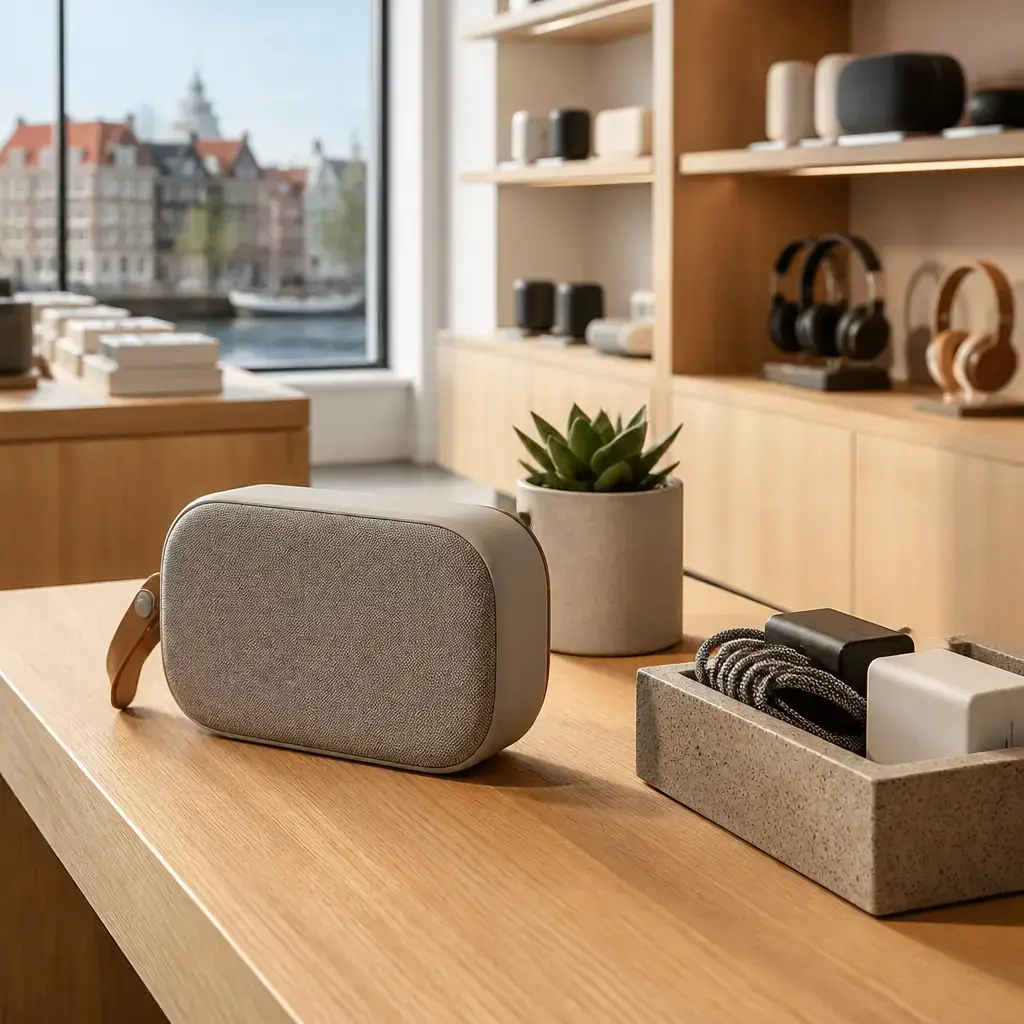
Use Asking about a small speaker warranty to practice German conversation, pronunciation, vocabulary, grammar, and quizzes.
Dialogue
Ich überlege, diesen kleinen Lautsprecher zu kaufen.
ikh oo-beh-RAY-guh DEE-zun KLY-nun LOWT-shpreh-kur tsoo KOW-fun. I'm thinking about buying this small speaker.Ich kann Ihnen die Garantie erklären, bevor Sie sich entscheiden.
ikh KAHN EE-nun dee gah-ran-TEE ehk-LAIR-un, beh-FOHR zee zikh ent-SHY-dun. I can explain the warranty before you decide.Was deckt die Garantie ab?
vahs dekt dee gah-ran-TEE ahp? What does the warranty cover?Sie deckt Produktfehler bei normaler Nutzung ab.
zee dekt proh-DOOKT-fay-lur bye nor-MAH-lur NOO-tsoong ahp. It covers product faults during normal use.Was ist mit Schäden durch Unfälle?
vahs ist mit SHAY-dun doorkh OON-fel-uh? What about accidental damage?Das wäre nicht abgedeckt.
dahs VAIR-uh nikht ahp-guh-DEKT. That would not be included.Wohin soll ich gehen, wenn es nicht mehr funktioniert?
voh-HIN zohl ikh GAY-un, ven es nikht MARE foongk-tsee-oh-NEERT? Where should I go if it stops working?Bringen Sie den Kassenbon und die Schachtel zum Kundenservice.
BRING-un zee den KAH-sun-BOHN oont dee SHAHKH-tul tsoom KOON-dun-zair-vis. Bring the receipt and the box to customer service.Sie können ihn überprüfen.
zee KUR-nun een oo-bur-PROO-fun. They can check it.Sentence explanations
Ich überlege, diesen kleinen Lautsprecher zu kaufen.
I'm thinking about buying this small speaker.
- Ich überlege
- I'm thinking
- diesen
- this
- kleinen
- small
- Lautsprecher
- speaker
- zu kaufen
- to buy
More detail
Ich überlege uses the verb überlegen in the present tense, first-person singular: ich überlege = “I am thinking it over.” Here it introduces a decision under consideration. A useful pattern is Ich überlege, ... zu ... (“I am considering ...-ing”). Example: Ich überlege, morgen zu fahren. — “I’m considering leaving tomorrow.” diesen means “this” here and is the masculine accusative singular form of the demonstrative dieser. It agrees with the masculine noun Lautsprecher because that noun is the object of kaufen. The form is not chosen by proximity alone; the relevant conditions are masculine gender and accusative case. Compare dieser Lautsprecher (nominative) with diesen Lautsprecher (accusative). kleinen is the adjective klein (“small”) with an ending required in this noun phrase. It describes Lautsprecher; diesen already shows masculine accusative singular, so the adjective has the weak ending -en: diesen kleinen Lautsprecher. Example: Ich kaufe diesen kleinen Tisch. — “I’m buying this small table.” Lautsprecher means “speaker,” the device that produces sound. Its base form is der Lautsprecher; the plural is also die Lautsprecher, so the noun itself has the same visible form in singular and plural. In this sentence, diesen and kleinen show that the intended form is masculine singular accusative. zu kaufen is zu plus the infinitive kaufen (“to buy”). In the pattern überlegen, ... zu kaufen, the action being considered is buying the speaker. The infinitive stays kaufen; zu marks its use in this infinitival construction. Example: Sie versucht, den Lautsprecher zu reparieren. — “She is trying to repair the speaker.” Together, Ich überlege introduces a decision being considered, and diesen kleinen Lautsprecher zu kaufen names that decision: “I’m thinking about buying this small speaker.”
Ich kann Ihnen die Garantie erklären, bevor Sie sich entscheiden.
I can explain the warranty before you decide.
- Ich kann
- I can
- Ihnen
- you (formal, recipient)
- Garantie
- warranty
- erklären
- explain
- bevor
- before
- Sie
- you (formal)
- sich entscheiden
- decide
More detail
Ich kann combines ich (“I”) with kann, the first-person singular present form of können (“can, be able to”). With können, the other verb stays in the infinitive: Ich kann das erklären — “I can explain that.” Ihnen is the formal “you” in the dative case. Here it marks the person receiving the explanation. The corresponding formal subject form is Sie; the two forms are not interchangeable. Garantie means “warranty.” It is a feminine noun: die Garantie. In this sentence, die Garantie is the direct object. For a feminine noun, die looks the same in the nominative and accusative, so the article does not visibly distinguish those two cases here. Example: Die Garantie gilt zwei Jahre. — “The warranty is valid for two years.” erklären is the infinitive “to explain.” After kann, it remains an infinitive rather than taking a personal ending. Example: Ich erkläre den Ablauf. — “I explain the process.” bevor introduces a subordinate clause meaning “before.” In this use, the finite verb goes to the end: bevor + subject + other elements + finite verb. Example: Ruf mich an, bevor du gehst. — “Call me before you leave.” Sie is the capitalized formal “you” functioning as the subject of the subordinate clause. It is distinct from lowercase sie, which has other uses. The formal subject form is Sie, while the dative form is Ihnen. sich entscheiden is the reflexive verb construction “to decide.” In the infinitive, sich is part of the construction. With formal Sie, the finite form is Sie entscheiden sich — “you decide”; sich is also the reflexive form used with third-person subjects, but here the subject is formal “you.” Example: Sie entscheidet sich heute. — “She decides today.” Together, Ich kann Ihnen die Garantie erklären means “I can explain the warranty to you.” bevor Sie sich entscheiden adds the time relation “before you decide.” Because bevor begins a subordinate clause, entscheiden comes at its end. The complete utterance means: “I can explain the warranty before you decide.”
Was deckt die Garantie ab?
What does the warranty cover?
- Was
- what
- deckt … ab
- covers
- Garantie
- warranty
More detail
Was asks for an unspecified thing: “what”. It is the question word used here for the thing that receives the warranty’s coverage. Compare wer (“who”) for a person and wo (“where”) for a place. deckt ... ab comes from the separable verb abdecken, “to cover”. In this question, deckt is the present-tense form for die Garantie (third-person singular), while the separable prefix ab moves to the end: Die Garantie deckt das Produkt ab. — “The warranty covers the product.” In a yes/no question, the conjugated verb comes first, as in Deckt die Garantie das Produkt ab? — “Does the warranty cover the product?” Garantie is a feminine noun, shown by die here. Its plural is Garantien. The noun identifies the warranty being asked about; the following context confirms that it covers product faults during normal use. Together, Was asks for the covered thing, deckt ... ab expresses the warranty’s coverage, and die Garantie is the subject: “What does the warranty cover?” This is a direct question about the scope of the warranty.
Sie deckt Produktfehler bei normaler Nutzung ab.
It covers product faults during normal use.
- Sie
- it
- deckt … ab
- covers
- Produktfehler
- product faults
- bei
- during / in
- normaler
- normal
- Nutzung
- use
More detail
Sie means “it” here, as fixed by the translation. It is the third-person singular pronoun; at the beginning of a sentence, its capitalization does not by itself identify the referent. In this context, the intended referent is the thing being described as providing coverage. Example: Sie ist neu. — “It is new.” deckt ... ab is the separable verb abdecken, “to cover.” In this sentence, deckt is the present-tense third-person singular form, while the prefix ab appears at the end of the clause. The construction etwas abdecken can describe what a policy, warranty, or similar arrangement covers. Example: Die Garantie deckt Reparaturen ab. — “The warranty covers repairs.” Produktfehler means “product faults.” It is a compound noun: Produkt + Fehler, and its plural form is identical in spelling to the singular in this sentence, so the surrounding grammar or context identifies the number. Here it is the thing covered by deckt ... ab. Example: Die Versicherung deckt Produktfehler ab. — “The insurance covers product faults.” bei introduces the circumstances in which something applies. With the meaning “during/in” here, it takes the dative: bei normaler Nutzung means “during normal use.” normaler describes Nutzung and is the adjective normal in a form required by the dative feminine singular phrase bei normaler Nutzung. The ending belongs to the adjective, not to the noun. Compare: bei normaler Nutzung — “during normal use,” but bei einer normalen Nutzung — “during a normal use,” with a different adjective ending after the indefinite article. Nutzung is the noun “use” or “usage.” In this phrase it is feminine singular and is governed by bei; the form Nutzung itself does not show the dative ending. The phrase refers to ordinary use as the relevant condition. Together, Sie deckt Produktfehler ab says “It covers product faults,” and bei normaler Nutzung specifies when that coverage applies. The complete utterance therefore means: “It covers product faults during normal use.”
Was ist mit Schäden durch Unfälle?
What about accidental damage?
- Was ist mit
- What about …?
- Schäden
- damage
- durch
- due to; caused by
- Unfälle
- accidents
More detail
Was ist mit is a reusable German question pattern meaning “What about …?” It asks about the status or treatment of the thing named after mit; it is not a literal question about location. For example: Was ist mit dem Vertrag? — “What about the contract?” Schäden means “damage” here. It is the plural form of Schaden (“damage” or “a case of damage”); the plural is useful when referring to multiple kinds or instances of damage. For example: Die Schäden sind groß. — “The damage is extensive.” durch introduces the cause of something. In durch Unfälle, it means “caused by accidents.” With a plural noun such as Unfälle, the form is unchanged because plural nouns have the same form in the accusative and dative; durch governs the accusative. Here, it expresses cause rather than physical movement. Unfälle is the plural of Unfall, meaning “accidents.” German nouns are capitalized. The phrase durch Unfälle therefore means “caused by accidents”; it describes the source of the damage, not the damage itself. Together, Schäden durch Unfälle means “damage caused by accidents.” The pattern Schäden durch + cause can be reused with another cause, for example Schäden durch Wasser — “water damage” or “damage caused by water.” The complete utterance Was ist mit Schäden durch Unfälle? asks, “What about accidental damage?” More literally, it asks what applies to damage caused by accidents. The question uses the same Was ist mit …? pattern to ask about a category that has not yet been addressed.
Das wäre nicht abgedeckt.
That would not be included.
- Das
- that
- wäre
- would be
- abgedeckt
- covered; included
More detail
Das is a demonstrative pronoun meaning “that” here. Its specific referent is the matter under discussion, while the form itself does not identify that referent. As a pronoun, das is neuter singular; the grammatical form and the actual referent are separate matters. wäre is the third-person singular Konjunktiv II form of sein (“to be”), used here with Das. The useful chain is sein → ist (“is”) → wäre (“would be”). It presents the statement as hypothetical rather than as a plain present fact. Example: Das wäre möglich. — “That would be possible.” nicht negates the predicate: it makes the statement mean that the matter would not be included. In this clause, it appears before the participle abgedeckt; the complete negative meaning comes from nicht abgedeckt, not from nicht alone. abgedeckt is the past participle of abdecken (“to cover”). With sein, it describes a state; in this sentence, the intended sense is “included” or “covered” in the relevant coverage. The same participle can occur in a passive construction with werden: Die Kosten werden abgedeckt. — “The costs are covered.” Together, Das wäre nicht abgedeckt means “That would not be included.”
Wohin soll ich gehen, wenn es nicht mehr funktioniert?
Where should I go if it stops working?
- Wohin
- where to
- soll ich
- should I
- gehen
- go
- wenn
- if; when
- nicht mehr
- no longer; not anymore
- funktioniert
- works; functions
More detail
Wohin asks about a destination or direction: “where to?” It is formed with wo- (“where”) and directional -hin. Compare Wo? (“Where?”) for location with Wohin? (“Where to?”) for movement toward a destination. soll ich uses sollen, whose base form means “to be supposed to” or “should.” soll is the present-tense form for ich here; the subject pronoun is placed directly after the modal verb in this question. The other verb remains in the infinitive at the end: Soll ich warten? — “Should I wait?” gehen is the infinitive “to go.” With a modal verb such as soll, the modal is finite and gehen stays in the infinitive: Ich soll gehen. — “I am supposed to go.” wenn introduces a condition, “if” here. In the subordinate clause introduced by wenn, the finite verb comes at the end. It can also mean “when” when the clause describes a time rather than a condition; the intended meaning here is conditional. nicht mehr means “no longer” or “not anymore.” nicht supplies the negation, while mehr normally means “more,” but together they show that a previously existing situation has ended. This phrase negates the continued functioning described by funktioniert. funktioniert comes from funktionieren, “to function” or “to work.” It is the present-tense form for the third-person singular subject es: es funktioniert; the ending differs from the infinitive. For example, Der Drucker funktioniert nicht. means “The printer does not work.” Together, Wohin soll ich gehen asks for the destination the speaker is supposed to go to. wenn es nicht mehr funktioniert adds the condition “if it stops working,” with es as the subject of funktioniert. The complete utterance therefore means: “Where should I go if it stops working?”
Bringen Sie den Kassenbon und die Schachtel zum Kundenservice.
Bring the receipt and the box to customer service.
- Bringen Sie
- please bring
- den Kassenbon
- the receipt
- die Schachtel
- the box
- zum Kundenservice
- to customer service
More detail
Bringen Sie is the formal imperative of bringen (“to bring”). In this form, the verb comes first and Sie is the formal “you”; the same form is used for one person or several people addressed formally. Example: Bringen Sie den Schlüssel. — “Bring the key.” den Kassenbon means “the receipt” here. Kassenbon is a masculine noun; den marks the masculine accusative form, because the receipt is a direct object of bringen. The useful basic pattern is den + masculine noun in the accusative: Ich lese den Brief. — “I am reading the letter.” die Schachtel means “the box.” Schachtel is feminine. For a feminine singular noun, die has the same visible form in the nominative and accusative, so its object role is established here by the sentence structure and the verb. Example: Ich öffne die Schachtel. — “I open the box.” zum Kundenservice means “to customer service.” zum is the contraction of zu dem; zu takes the dative, and dem is the dative form of the masculine noun phrase der Kundenservice. The construction zu + dative expresses the destination: Wir gehen zum Bahnhof. — “We are going to the train station.” Together, the formal imperative Bringen Sie takes two direct objects, den Kassenbon and die Schachtel, joined by und. zum Kundenservice states where they should be brought. The complete meaning is: “Bring the receipt and the box to customer service.”
Sie können ihn überprüfen.
They can check it.
- Sie können
- they can
- ihn
- it
- überprüfen
- check
More detail
Sie können means “they can” here. können is the present-tense form of können for third-person plural; the modal verb expresses ability or possibility. At the beginning of a sentence, sie (“they”) is capitalized as Sie, so capitalization alone does not distinguish it from formal “you.” The fixed translation establishes the intended reading here. With a modal verb, the other verb normally stays in the infinitive and goes to the end: Sie können warten. — “They can wait.” ihn is the accusative singular form of the personal pronoun for a masculine referent. Its meaning here is “it,” as established by the fixed translation; the specific referent is not named in this sentence. Compare the case forms: er is nominative (“he”), while ihn is accusative (“him/it” for a masculine noun). Example: Sie sehen ihn. — “They see him/it.” überprüfen means “to check” or “to verify.” It is the infinitive form, used here after the modal können. The verb can describe checking something for correctness or condition. Example: Wir überprüfen den Beleg. — “We check the receipt.” Together, Sie können + ihn + überprüfen forms a statement of ability: “They can check it.” The modal marks what they are able to do, ihn is the object being checked, and überprüfen remains at the end as the infinitive.
Grammar Points
überlegen, etwas zu kaufen
Ich überlege, einen kleinen Lautsprecher zu kaufen.
ikh oo-beh-RAY-guh, EYE-nun KLY-nun LOWT-shpreh-kur tsoo KOW-fun.I am thinking about buying a small speaker.
Nach „überlegen“ steht oft „zu“ + Infinitiv, wenn man eine mögliche Handlung beschreibt.
bevor + Nebensatz
Bevor Sie sich entscheiden, überprüfen Sie die Garantie.
beh-FOHR zee zikh ent-SHY-dun, oo-bur-PROO-fun zee dee gah-ran-TEE.Before you decide, check the warranty.
Im „bevor“-Nebensatz steht das konjugierte Verb am Ende: „bevor Sie sich entscheiden“.
German Vocabulary
Quiz
Word Order
Arrange the words in the correct order.
What does the warranty cover?
Show Answer
Was deckt die Garantie ab?What about accidental damage?
Show Answer
Was ist mit Schäden durch Unfälle?That would not be included.
Show Answer
Das wäre nicht abgedeckt.Spelling
Tap the letters to spell the word.
to think about
Show Answer
überlegebefore
Show Answer
bevorspeaker
Show Answer
Lautsprecherwarranty