10 minutes free every day
Continue audio lessons in the app
Word explanations appear automatically in sync with the audio.
No login required · synced translations · playback with the screen locked
Choose your learning language and open this lesson in the app.

About This Lesson
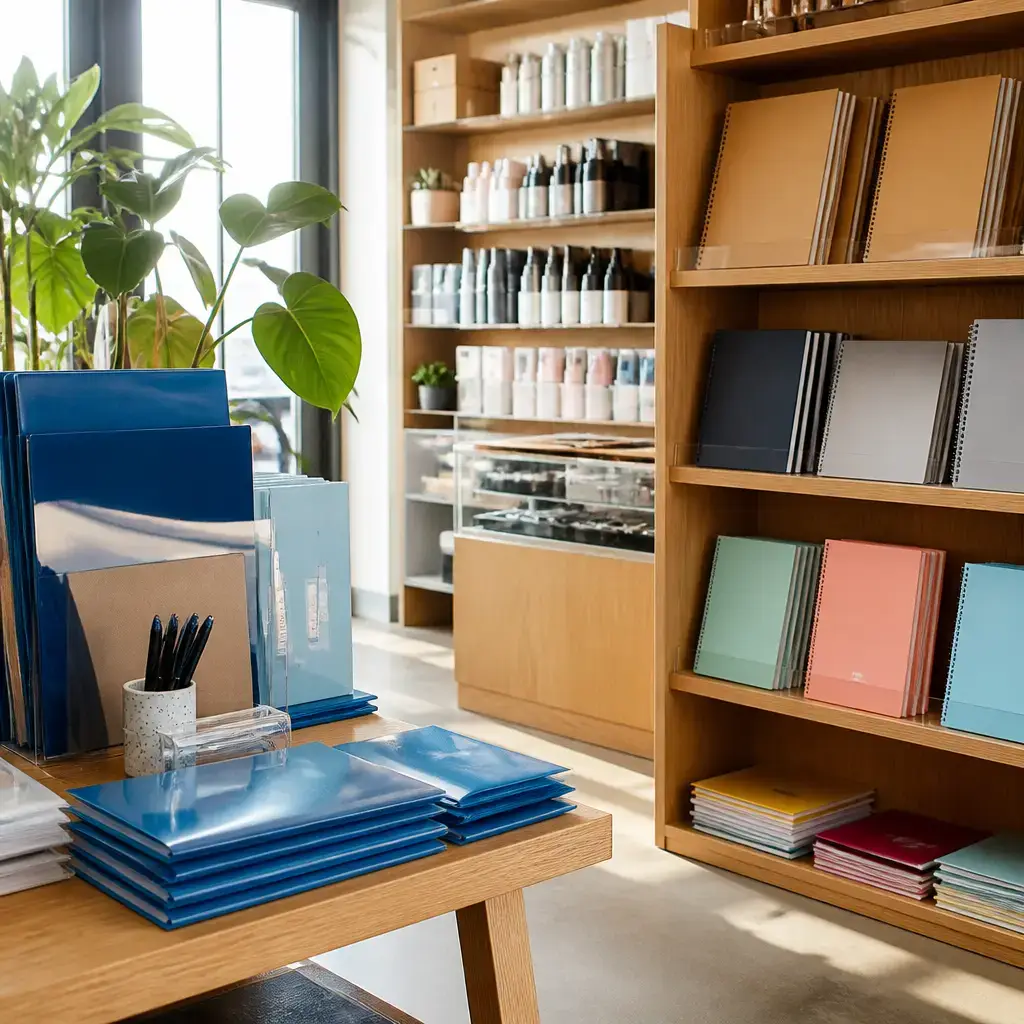
Use Finding blue folders in a shop to practice German conversation, pronunciation, vocabulary, grammar, and quizzes.
Dialogue
Entschuldigung, wo ist die Schreibwarenabteilung?
ent-SHOOL-di-goong, voh ist dee SHRYBE-vah-ren-ahp-TY-loong? Excuse me, where is the stationery section?Sie ist hinter der Notizbuchauslage auf der rechten Seite.
zee ist HIN-ter dare NOH-teets-book-OWS-lah-guh owf dare REKH-ten ZY-tuh. It's past the notebook display on the right.Ich suche blaue Ordner.
ikh ZOO-khuh BLOW-uh ORT-ner. I'm looking for blue folders.Ich prüfe kurz, ob sie noch verfügbar sind.
ikh PROO-fuh koorts, ohp zee nokh fer-FOOK-bar zint. Let me check if they are still available.Gibt es heute welche auf Lager?
gipt ess HOY-tuh VEL-khuh owf LAH-ger? Are there any in stock today?Wir haben welche im Lagerraum.
veer HAH-ben VEL-khuh im LAH-ger-rowm. We have some in the back room.Könnten Sie mir eine Packung bringen?
KURN-ten zee meer EYE-nuh PAK-koong BRING-en? Could you bring one pack for me?Ich bringe Ihnen eine Packung.
ikh BRING-uh EE-nen EYE-nuh PAK-koong. I'll bring a pack over.Bitte warten Sie bei dieser Auslage.
BIT-tuh VAR-ten zee by DEE-zer OWS-lah-guh. Please wait near this display.Sentence explanations
Entschuldigung, wo ist die Schreibwarenabteilung?
Excuse me, where is the stationery section?
- Entschuldigung
- Excuse me
- wo ist
- where is …?
- Schreibwarenabteilung
- stationery section
More detail
Entschuldigung is a polite way to get someone's attention or apologize. In this utterance it means “Excuse me,” rather than specifically naming an apology. The related verb sich entschuldigen means “to apologize.” wo ist combines wo (“where”) with ist, the third-person singular present form of sein (“to be”). German questions commonly place the conjugated verb before the subject: Wo ist die Abteilung? means “Where is the section?” The form wo asks about a location; was would ask “what,” and wer would ask “who.” Schreibwarenabteilung is a compound noun meaning “stationery section.” Its parts are Schreibwaren (“stationery,” literally writing supplies) and Abteilung (“department” or “section”). The whole compound is treated as a feminine noun: die Schreibwarenabteilung. The article and adjective forms used with it would follow feminine singular agreement, for example eine große Schreibwarenabteilung (“a large stationery section”). Together, wo ist asks for the location of die Schreibwarenabteilung, while Entschuldigung politely opens the request. The complete utterance means: “Excuse me, where is the stationery section?”
Sie ist hinter der Notizbuchauslage auf der rechten Seite.
It's past the notebook display on the right.
- Sie ist
- It is
- hinter
- past; behind
- Notizbuchauslage
- notebook display
- rechten
- right
- Seite
- side
More detail
Sie ist means “it is” here. ist is the third-person singular present form of sein (“to be”): ich bin, du bist, sie ist. Sie is the feminine singular third-person pronoun used for the translated “it”; the supplied texts do not identify the noun to which it refers. hinter means “behind” and, in this location description, is rendered as “past.” For a static location, hinter takes the dative case. In hinter der Notizbuchauslage, der is the feminine singular dative article, and Notizbuchauslage is a compound noun meaning “notebook display.” The compound combines Notizbuch (“notebook”) and Auslage (“display” or “displayed goods”). For movement to a position behind something, hinter can instead take the accusative: Ich stelle es hinter die Auslage. — “I put it behind the display.” rechten means “right” in auf der rechten Seite. Its adjective base form is recht (“right”); rechts is commonly used as an adverb, as in rechts (“on the right”). The form rechten has an adjective ending because it describes the feminine noun Seite in the dative phrase der ... Seite. The adjective describes Seite, not Auslage. Seite means “side.” It is feminine: die Seite; after the dative preposition auf in this stationary location, it appears in auf der ... Seite. The phrase auf der rechten Seite means “on the right-hand side.” Because auf describes a fixed position here, it takes the dative; movement onto the right-hand side would use the accusative, as in Ich gehe auf die rechte Seite. — “I go to the right-hand side.” Together, Sie ist + hinter der Notizbuchauslage + auf der rechten Seite gives: “It’s past the notebook display on the right.” The utterance locates the unspecified “it” relative to the notebook display and specifies that the location is on the right-hand side.
Ich suche blaue Ordner.
I'm looking for blue folders.
- Ich
- I
- suche
- am looking for
- blaue
- blue
- Ordner
- folders
More detail
Ich is the first-person singular pronoun, meaning “I.” It is the subject here: the speaker is the person doing the looking. It does not identify any additional participant. suche comes from the base verb suchen, “to look for” or “to search for.” Suche is the present-tense first-person singular form: ich suche. The verb is used with a direct object for what someone is seeking. Example: Ich suche den Schlüssel. — “I’m looking for the key.” blaue is the adjective blau, “blue,” used before the noun it describes. Here it has the ending -e because it is an attributive adjective before a plural noun without an article. The adjective agrees with the noun phrase’s plural and accusative function; the ending is on blaue, not on Ordner. Example: Ich kaufe rote Hefte. — “I’m buying red notebooks.” Ordner means “folders” here. Its singular and plural forms are spelled alike: der Ordner (singular), die Ordner (plural). In this sentence, the plural reading is established by blaue and by the fixed translation. As the object of suche, the noun phrase is accusative; the plural noun itself has no visible accusative ending. Together, Ich suche means “I’m looking for,” and blaue Ordner is the object being sought: “blue folders.” The complete utterance is therefore “I’m looking for blue folders.”
Ich prüfe kurz, ob sie noch verfügbar sind.
Let me check if they are still available.
- Ich
- I
- prüfe
- check
- kurz
- briefly
- ob
- whether
- sie
- they
- noch
- still
- verfügbar
- available
- sind
- are
More detail
Ich means “I” here. It is the first-person singular personal pronoun. Its form does not change according to the speaker’s gender. For example: Ich lerne Deutsch. — “I am learning German.” prüfe comes from the verb prüfen, “to check” or “to examine.” prüfe is the present-tense form used with ich: ich prüfe. The verb is separable neither in this form nor in this sentence. Example: Ich prüfe die Liste. — “I am checking the list.” kurz means “briefly” here. It describes the limited duration or concise nature of the checking, not the thing being checked. The adjective kurz can also describe a noun: eine kurze Prüfung — “a brief check.” ob introduces an embedded yes-or-no question and means “whether” or “if” in this use. In the clause introduced by ob, the finite verb goes to the end. Pattern: Ich prüfe, ob ... [verb]. — “I’ll check whether ...” sie means “they” here, as established by the fixed translation. In this use it is a third-person plural personal pronoun. Its form is distinct from singular sie, which can mean “she” or “it” in some grammatical contexts; the intended plural meaning here is clear from the translation and the plural verb sind. noch means “still.” It indicates that the condition continues to hold at the relevant time. Example: Sie sind noch hier. — “They are still here.” verfügbar means “available.” It is a descriptive adjective and does not carry the plural marking in this sentence; the plural form is expressed by the verb sind. Example: Die Ordner sind verfügbar. — “The folders are available.” sind comes from sein, “to be.” It is the present-tense form used with a third-person plural subject such as sie meaning “they”: sie sind. The same form is also used with the formal second-person pronoun Sie, so the subject and context determine the interpretation. Together, Ich prüfe kurz means “I’ll check briefly,” and ob sie noch verfügbar sind means “whether they are still available.” Because ob introduces the embedded question, sind appears at the end of that clause. The complete utterance means: “Let me check if they are still available.”
Gibt es heute welche auf Lager?
Are there any in stock today?
- Gibt es
- are there
- heute
- today
- welche
- any
- auf Lager
- in stock
More detail
Gibt es is the German existence question pattern, literally asking whether something exists or is available. The verb gibt is the third-person singular present form of geben (“to give”), but in this fixed construction it does not mean that someone gives something. The pattern is Gibt es ...? = “Is/are there ...?” or “Does/do ... exist?” The fixed translation makes the intended sense availability rather than a literal act of giving. heute means “today.” It is an adverb, so it does not change for person, number, or gender. Its position here places the time of the availability question in today’s time frame. Example: Heute ist das Geschäft geschlossen. — “The shop is closed today.” welche means “any” here, referring to some items whose identity is understood from the situation. It is a pronoun, not a noun, and its specific referent is not identified in the supplied sentence. In other contexts, forms of welch- can also introduce or replace a noun and vary with grammatical gender, number, and case; this standalone form should be learned here as the item-replacing form used in the question. Example: Haben Sie welche? — “Do you have any?” auf Lager is the reusable expression “in stock” or “in inventory.” Lager is the noun “stock/inventory” in this expression; auf is the preposition that belongs to the expression. The phrase describes goods being available for sale or supply, not merely being physically somewhere. Example: Der Artikel ist auf Lager. — “The item is in stock.” Together, Gibt es ...? asks whether something is available, welche stands for the unspecified items, auf Lager specifies that availability as being in stock, and heute sets the time. The complete utterance therefore means: “Are there any in stock today?”
Wir haben welche im Lagerraum.
We have some in the back room.
- Wir
- we
- haben
- have
- welche
- some
- Lagerraum
- storage room
More detail
Wir means “we.” It is the first-person plural pronoun, used when the speaker includes themself and at least one other person. Example: Wir lernen Deutsch. — “We are learning German.” haben is the present-tense form of haben (“to have”) used with wir: wir haben. Other present forms include ich habe (“I have”) and sie haben (“they have” or formal “you have”). Example: Wir haben Zeit. — “We have time.” welche stands here independently for “some” or “some of them,” so the noun being discussed is not repeated. In this sentence it is the object of haben and refers to plural items understood from context. The contrasting negative form is keine: Wir haben keine. — “We don’t have any.” The exact items remain implicit. Lagerraum means “storage room.” It is a masculine compound noun: der Lagerraum; its plural is die Lagerräume. The preceding form im is a contraction of in dem, so im Lagerraum means “in the storage room.” This location phrase tells where the items are. Together, Wir haben welche means “We have some,” and im Lagerraum adds their location. The complete utterance is “We have some in the back room.”
Könnten Sie mir eine Packung bringen?
Could you bring one pack for me?
- Könnten Sie
- Could you
- mir
- for me
- Packung
- pack
- bringen
- bring
More detail
Könnten Sie combines könnten, the polite conditional form of können (“can/be able to”), with formal Sie (“you”). In this question it softens a request: “Could you…?” The form könnten is used with formal Sie; it is not the ordinary present-tense form können. mir is the first-person singular dative pronoun, meaning “to me” or “for me.” It marks the person who would receive the benefit of the action. Compare mir (“to/for me”) with Ihnen (“to/for you,” formal), as in the following example: Ich bringe Ihnen eine Packung. — “I’ll bring you a pack.” eine Packung is the noun phrase for “one pack” here. Packung is a feminine noun: die Packung (“the pack”), eine Packung (“a/one pack”). The article is grammatically feminine accusative because the pack is the direct object of bringen; the indefinite article itself does not independently establish a numerical count, although the fixed translation presents the intended item as one pack. bringen means “to bring.” It is the infinitive after the modal verb könnten. In a German main-clause question with this modal construction, the conjugated modal appears near the beginning and the infinitive appears at the end: Könnten Sie ... bringen? — “Could you ... bring?” Together, Könnten Sie makes a polite formal request, mir identifies the beneficiary, and eine Packung is what should be brought. The complete utterance means: “Could you bring one pack for me?”
Ich bringe Ihnen eine Packung.
I'll bring a pack over.
- Ich
- I
- bringe
- bring
- Ihnen
- you (formal)
- Packung
- pack
More detail
Ich means “I” and is the first-person singular personal pronoun. It identifies the speaker as the actor. In German, the subject form is ich; the object forms are different, such as mich for a direct object and mir for an indirect object. bringe is the first-person singular present form of bringen (“to bring”). The ending -e here agrees with the subject ich: ich bringe. German present tense can also describe a planned or expected future action when the context makes that clear. Example: Ich bringe morgen das Buch. — “I’ll bring the book tomorrow.” Ihnen is the formal “you” in the dative case. It is used for the person who receives or benefits from the bringing. The formal pronoun is capitalized: Ihnen. Do not confuse it with lowercase ihnen, which means “to them.” Example: Ich helfe Ihnen. — “I’m helping you.” Packung means “pack” or “package” and is a feminine noun: die Packung. In this sentence it is the direct object of bringen, so it appears in the accusative phrase eine Packung. The indefinite article changes from nominative eine Packung to the same form in feminine accusative; the noun itself does not show an accusative ending. Example: Ich kaufe eine Packung. — “I’m buying a pack.” The reusable structure is Ich bringe Ihnen eine Packung.: ich names the person doing the action, bringe says “bring” in the first-person singular, Ihnen identifies the formal recipient, and eine Packung identifies what will be brought. Although bringe is grammatically present tense, the fixed translation presents the action as “I’ll bring,” a future reading supported by the situation. The complete utterance therefore means “I’ll bring a pack over.”
Bitte warten Sie bei dieser Auslage.
Please wait near this display.
- Bitte
- please
- warten
- wait
- Sie
- you (formal)
- bei
- near; by
- dieser
- this
- Auslage
- display
More detail
Bitte makes the request polite: “please.” It can also be used independently as a polite request for repetition, but here it softens the instruction that follows. warten means “to wait.” The form here is the infinitive, used in the polite request pattern Bitte warten Sie .... In ordinary present-tense statements, the verb changes with the subject: ich warte, Sie warten. Sie is the capitalized formal “you.” In this request, it addresses one or more people formally; the form itself does not identify whether the addressee is singular or plural. The capital letter distinguishes formal Sie from lowercase sie, which has other functions. bei means “near” or “by” here and takes the dative case. The location is therefore expressed as being near the display, not as movement toward it. dieser means “this” and is the form used here with the feminine singular dative noun Auslage: bei dieser Auslage. The demonstrative identifies the display as a particular nearby one; diesem would be the corresponding dative form with a masculine or neuter singular noun, while diesen is used with a plural dative noun. Auslage is a feminine noun meaning “display” or “display area,” especially an arranged presentation of goods. Its plural is Auslagen. In this sentence, Auslage is the location reference after bei. Together, Bitte warten Sie forms a polite formal request to wait. bei dieser Auslage specifies the place. The complete meaning is: “Please wait near this display.”
Grammar Points
bei + Dativ
bei dieser Auslage
by DEE-zer OWS-lah-guhat this display
The preposition bei takes the dative: dieser Auslage means “at this display.”
Dativpronomen: mir / Ihnen
mir; Ihnen
meer; EE-nento me; to you
German uses dative pronouns to mark the recipient: mir is informal “to me,” and Ihnen is formal “to you.”
German Vocabulary
Used to politely get someone's attention.
Quiz
Word Order
Arrange the words in the correct order.
Excuse me, where is the stationery section?
Show Answer
Entschuldigung, wo ist die Schreibwarenabteilung?I'm looking for blue folders.
Show Answer
Ich suche blaue Ordner.Are there any in stock today?
Show Answer
Gibt es heute welche auf Lager?Spelling
Tap the letters to spell the word.
blue
Show Answer
blauebehind; past
Show Answer
hinterto look for
Show Answer
sucheright