10 minutes free every day
Continue audio lessons in the app
Word explanations appear automatically in sync with the audio.
No login required · synced translations · playback with the screen locked
Choose your learning language and open this lesson in the app.

About This Lesson
Use Sticking to the grocery list to practice German conversation, pronunciation, vocabulary, grammar, and quizzes.
Dialogue
Halten wir uns an die Einkaufsliste.
HAL-ten veer oons an dee EYN-kowfs-LISS-tuh. Let's stick to the grocery list.So kaufen wir hoffentlich nicht zu viel.
zoh KOW-fen veer HOFF-ent-likh nikht tsoo FEEL. That should keep us from buying too much.Wo sind die Nudeln und der Reis?
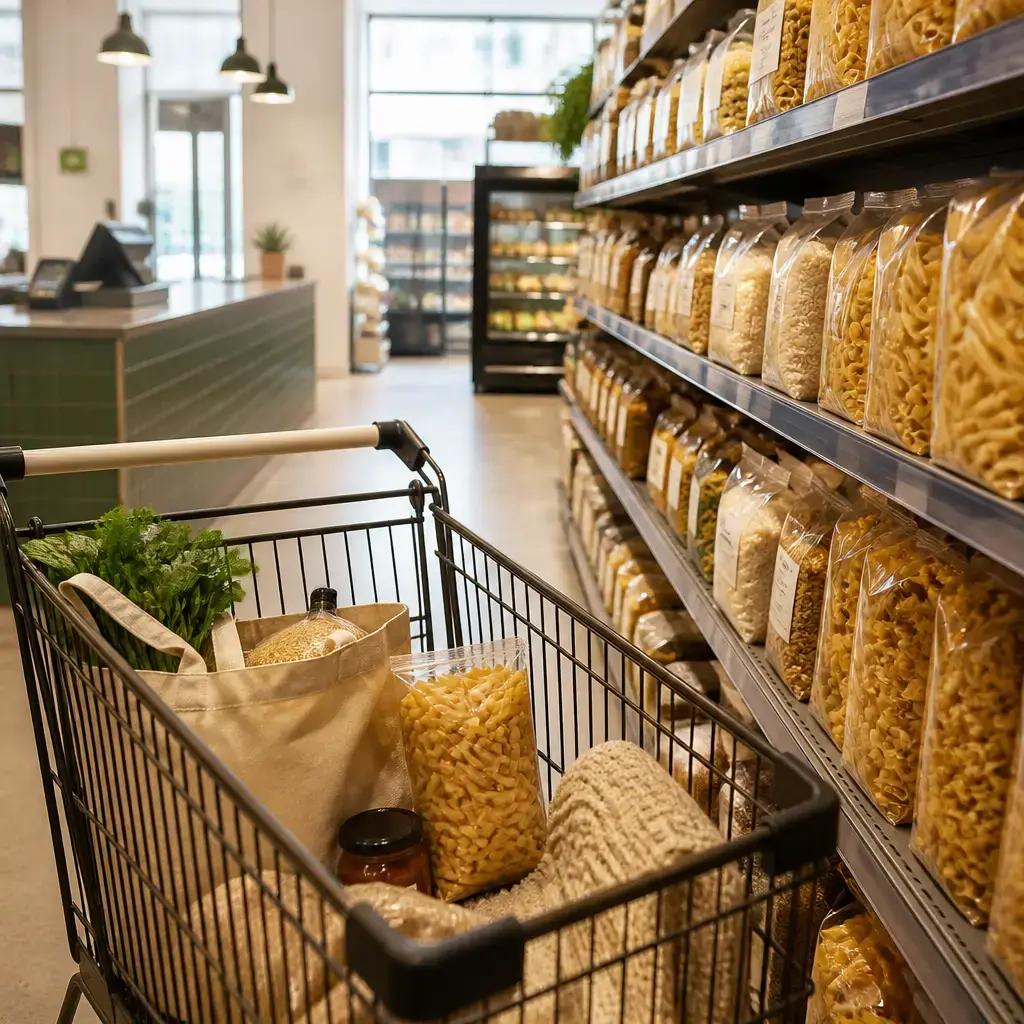
voh zint dee NOO-deln oont dair RICE? Where are the pasta and rice?Sie sind im Gang mit den trockenen Lebensmitteln.
zee zint im GAHNG mit dehn TROHK-uh-nen LAY-bens-mit-len. They are in the dry food aisle.Das sind die Nudeln, die wir letztes Mal gekauft haben.
dahs zint dee NOO-deln, dee veer LETS-tes mahl geh-KOWFT HAH-ben. This is the pasta we bought last time.Legen wir eine Packung in den Einkaufswagen.
LAY-gen veer EYE-nuh PAHK-oong in dehn EYN-kowfs-vah-gen. Let's put one pack in the cart.Danach brauchen wir nur noch Milch.
dah-NAHKH BROW-khen veer noor nokh MILKH. After that, we only need milk.Dann können wir direkt zur Kasse gehen.
dahn KURN-en veer dee-REKT tsoor KAH-suh GAY-en. Then we can head straight to checkout.Sentence explanations
Halten wir uns an die Einkaufsliste.
Let's stick to the grocery list.
- Halten wir uns an
- let’s stick to
- Einkaufsliste
- grocery list
More detail
Halten wir uns an is a reusable German proposal meaning “let’s stick to” or “let’s follow.” The base verb is halten (“hold” or “keep”); in sich an etwas halten, the reflexive construction means “to stick to” or “to comply with” something. Here wir is the first-person plural subject, and uns is its matching reflexive form. The verb-first order in Halten wir ... marks this proposal pattern, which corresponds to “Let’s ...” in English. The construction uses an with an accusative object. Example: Halten wir uns an den Plan. — “Let’s stick to the plan.” Einkaufsliste means “grocery list” here. It is a feminine noun, and its plural is Einkaufslisten. It is a compound of Einkauf (“shopping” or “purchase”) and Liste (“list”). In the sentence, die Einkaufsliste is the accusative object of an; with a feminine noun, die has the same form in the nominative and accusative, so the article alone does not show the case. Together, Halten wir uns an die Einkaufsliste means “Let’s stick to the grocery list.”
So kaufen wir hoffentlich nicht zu viel.
That should keep us from buying too much.
- So
- this way; so
- kaufen
- buy
- wir
- we
- hoffentlich
- hopefully
- zu viel
- too much
More detail
So means “this way” or “thus” here. At the beginning of the sentence, it presents the manner or consequence being referred to: “That way, …” In this context, it can point back to following the shopping list. The pattern So + finite verb + subject is a common German verb-second order when So occupies the first position. kaufen is the form used with wir in the present tense: wir kaufen = “we buy” or “we are buying.” The verb’s base form is kaufen; unlike English, German normally places the finite verb in the second sentence position, so So kaufen wir ... is grammatical even though wir comes after the verb. wir is the first-person plural subject pronoun, “we.” The verb form kaufen agrees with this subject. wir is nominative here because it performs the buying. hoffentlich means “hopefully” and expresses the speaker’s hope about the situation. It is a sentence adverb, so it comments on the whole proposition rather than describing what is bought. For example, Hoffentlich regnet es nicht. means “Hopefully it isn’t raining.” zu viel means “too much,” an excessive amount. The pattern zu + quantity word marks an amount beyond what is wanted or appropriate; it is different from simply viel (“a lot/much”). In this sentence, zu viel describes the amount bought, not a specific object. The separate word nicht negates the phrase zu viel: nicht zu viel means “not too much,” rather than “nothing.” Thus So kaufen wir hoffentlich nicht zu viel. combines “That way,” wir kaufen (“we buy”), hoffentlich (“hopefully”), and nicht zu viel (“not too much”) to mean “That way, hopefully we won’t buy too much.” The fixed translation conveys the same intended result as “That should keep us from buying too much,” although the German sentence expresses the hope directly through hoffentlich rather than using an explicit equivalent of “should.”
Wo sind die Nudeln und der Reis?
Where are the pasta and rice?
- Wo sind
- Where are …?
- Nudeln
- pasta; noodles
- Reis
- rice
More detail
Wo sind asks for a location. Wo means “where,” and sind is the finite form of sein (“to be”) used with a plural subject. In a German question of this type, the question word comes first and the finite verb follows it: Wo sind …? = “Where are …?” Nudeln means pasta or noodles here. It is the plural of Nudel (“noodle”); the plural ending -n is part of the observed form. The noun is feminine in the singular (die Nudel) and has the plural article die when an article is used, but this noun appears without an article in the fixed question. Reis means rice. It is commonly used as a mass noun, so it normally refers to rice without asserting a particular number of individual grains. Its basic article is masculine singular: der Reis. The form itself does not show a plural ending here. The two nouns are coordinated as the subject: die Nudeln und der Reis. Because the subject combines a plural noun with Reis, the verb is plural: sind, not singular ist. The complete pattern is Wo sind [subject]?: “Where are [subject]?” Thus Wo sind die Nudeln und der Reis? means “Where are the pasta and rice?”
Sie sind im Gang mit den trockenen Lebensmitteln.
They are in the dry food aisle.
- Sie sind
- they are
- im Gang
- in the aisle
- trockenen
- dry
- Lebensmitteln
- food
More detail
Sie sind means “they are” here because the fixed translation identifies Sie as a third-person plural pronoun. sind is the plural present form of sein (“to be”): ich bin, du bist, sie sind. In other contexts, capitalized Sie can be formal “you,” but that is not the reading in this sentence. im Gang means “in the aisle.” im is the contraction of in dem (“in the”), and Gang is a masculine noun meaning “aisle” in this context. The same noun can have other meanings, such as “corridor” or “walk,” so the surrounding food-related phrase selects the supermarket-aisle meaning. A reusable pattern is im + masculine/neuter place noun, for example: Das ist im Schrank. — “That is in the cupboard.” trockenen means “dry” here. Its base form is the adjective trocken. The ending -en appears because the adjective is inside mit den trockenen Lebensmitteln: mit requires the dative, den marks a plural dative noun phrase, and the adjective has the corresponding weak ending. The adjective agrees with Lebensmitteln in plural number and dative case; it is not derived from that noun. Lebensmitteln means “food” here, specifically food products. Its base noun is Lebensmittel; the singular and plural forms are both Lebensmittel in the nominative and accusative, while dative plural adds -n: mit Lebensmitteln. The phrase trockene Lebensmittel is a useful expression for non-perishable or otherwise dry food products. Together, mit den trockenen Lebensmitteln means “with the dry food products,” and it specifies which aisle is meant. Combining the parts, Sie sind im Gang mit den trockenen Lebensmitteln. means “They are in the dry food aisle.”
Das sind die Nudeln, die wir letztes Mal gekauft haben.
This is the pasta we bought last time.
- Das sind
- These are
- Nudeln
- noodles; pasta
- wir
- we
- letztes Mal
- last time
- gekauft
- bought
More detail
Das sind identifies something as plural: literally, “These are.” Here das is the demonstrative subject of the identifying construction, while sind is the present-tense form of sein used with a plural identification. The plural is associated with die Nudeln, not because das itself changes to a plural form. With a singular identification, German commonly uses Das ist …. Example: Das sind meine Schlüssel. — “These are my keys.” Nudeln means “noodles” or “pasta” here. It is the plural of Nudel. German uses this plural when referring to noodles or pasta as multiple pieces; the English translation can use the mass noun “pasta.” The noun is what the sentence identifies, and the following relative clause specifies which pasta. Example: Die Nudeln sind fertig. — “The pasta is ready.” wir means “we,” the first-person plural subject pronoun. In the relative clause, it is the subject—the people who carried out the purchase. Its singular counterpart is ich, “I.” Example: Wir kaufen Brot. — “We are buying bread.” letztes Mal means “last time.” Mal is a neuter noun meaning “time” as an occasion, and letztes is the form of letzt that matches this noun in the expression. The phrase refers to a previous occasion, not to a numeric quantity. Example: Letztes Mal war der Laden geschlossen. — “Last time, the shop was closed.” gekauft is the past participle of kaufen, “to buy.” Together with haben, it forms the perfect construction: wir haben gekauft can correspond to “we bought” or “we have bought,” depending on context. The participle does not identify the buyer; wir supplies the subject. Example: Wir haben frisches Gemüse gekauft. — “We bought fresh vegetables.” The relative clause is die wir letztes Mal gekauft haben. die refers back to the plural noun Nudeln and is the relative pronoun functioning as the object of gekauft; wir is its subject. German places the finite auxiliary haben at the end of this relative clause, after the participle gekauft. Together, Das sind die Nudeln identifies the pasta, and die wir letztes Mal gekauft haben specifies it as the pasta bought by “us” on the previous occasion. The whole utterance means “This is the pasta we bought last time.”
Legen wir eine Packung in den Einkaufswagen.
Let's put one pack in the cart.
- Legen
- put; place
- wir
- we
- Packung
- pack; package
- in
- into
- Einkaufswagen
- shopping cart
More detail
Legen is the form of legen, “to put or lay” something somewhere. In Legen wir ..., it forms a first-person-plural suggestion or request: “let’s put ...”. Compare legen with liegen: legen describes placing something, while liegen describes something already lying or being located. Example: Legen wir das Buch auf den Tisch. — “Let’s put the book on the table.” wir means “we” and identifies the group carrying out the action. German uses wir for the first-person plural subject; the verb form agrees with it here. The same form can be used in suggestions such as Gehen wir! — “Let’s go!” Packung means “pack” or “package” here. Its base form is the feminine noun die Packung; after the indefinite article in this sentence, it appears as eine Packung. The fixed translation identifies the intended item as one pack. Example: Ich kaufe eine Packung Reis. — “I’m buying one pack of rice.” in expresses entry into or placement inside a space in this sentence. With a destination or movement into something, German uses the accusative: in den Einkaufswagen. With a stationary location, in normally takes the dative instead: Die Packung ist im Einkaufswagen. — “The pack is in the shopping cart.” Einkaufswagen means “shopping cart.” It is the masculine noun der Einkaufswagen; after in with movement into the cart, it becomes accusative den Einkaufswagen. The word is a compound built from Einkauf (“shopping”) and Wagen (“cart” or “carriage”), but its useful meaning here is the complete noun “shopping cart.” Together, Legen wir gives the reusable pattern “let’s put ...”, eine Packung names the object, and in den Einkaufswagen gives its destination. The whole utterance therefore means: “Let’s put one pack in the cart.”
Danach brauchen wir nur noch Milch.
After that, we only need milk.
- Danach
- after that
- brauchen
- need
- wir
- we
- nur noch
- only ... still
- Milch
- milk
More detail
Danach means “after that” and places the need at a later step relative to something already mentioned. It is a temporal adverb; dann can also mean “then,” while danach more explicitly points back to an earlier event or step. brauchen means “to need.” In wir brauchen, this form is both the infinitive and the present-tense form used with wir; the surrounding subject shows that it means “we need” here. Compare ich brauche (“I need”) and er/sie braucht (“he/she needs”). German brauchen commonly takes the thing needed as an accusative object. Example: Wir brauchen Wasser. — “We need water.” wir is the first-person plural pronoun, “we”: the speaker together with at least one other person. In the present tense, wir takes brauchen, whereas ich takes brauche and er/sie takes braucht. nur noch is a reusable combination meaning “only ... still” or “only ... left,” depending on context. Here, nur restricts the need and noch presents it as remaining at this stage. Example: Wir brauchen nur noch Brot. — “We only need bread now.” Milch means “milk.” It is a mass noun and is feminine in German (die Milch), although the bare form here does not show the article. German can use a noun without an article when referring to an unspecified amount of a substance. Example: Ich kaufe Milch. — “I’m buying milk.” Together, Danach establishes the later step, wir brauchen says “we need,” and nur noch Milch identifies milk as the only remaining thing needed. The complete meaning is: “After that, we only need milk.”
Dann können wir direkt zur Kasse gehen.
Then we can head straight to checkout.
- Dann
- then
- können wir
- we can
- direkt
- straight; directly
- Kasse
- checkout
- gehen
- go; head
More detail
Dann means “then” here, linking this action to the preceding sequence. It can introduce a result or the next step in time. Example: Dann gehen wir nach Hause. — “Then we go home.” können wir combines können (“can; be able to”) with wir (“we”). können is the modal verb; its base form is können, and wir können is its first-person plural form. With a modal verb, the other verb normally appears as an infinitive at the end of the clause: Wir können warten. — “We can wait.” wir identifies the speaker together with at least one other person, without specifying the participants further. direkt means “straight” or “directly” in this sentence. It describes the route or manner of going, so direkt gehen means to go straight rather than take an indirect route. Example: Gehen Sie direkt zum Eingang. — “Go straight to the entrance.” Kasse is the noun for a checkout or cash desk. It is feminine: die Kasse. In zur Kasse, zur is the contraction of zu der; this expresses movement toward the checkout. The noun remains capitalized because German nouns are capitalized. Example: Ich gehe zur Kasse. — “I’m going to the checkout.” gehen is the infinitive “to go.” Its form is unchanged here because it follows the modal können; the modal carries the finite verb marking, while gehen stays at the end. Example: Wir gehen zum Bahnhof. — “We are going to the station.” Together, Dann können wir sets up the next possible action, direkt zur Kasse specifies going straight to the checkout, and final gehen completes the modal construction. The whole utterance means: “Then we can head straight to checkout.”
Grammar Points
Halten wir uns an + Akkusativ
Halten wir uns an die Einkaufsliste.
HAL-ten veer oons an dee EYN-kowfs-LISS-tuh.Let’s stick to the grocery list.
German uses the verb first with wir to make a suggestion meaning “let’s …”. The reflexive phrase takes the accusative.
German Vocabulary
Halten wir uns an die Einkaufsliste.
Sie sind im Gang mit den trockenen Lebensmitteln.
Das sind die Nudeln, die wir letztes Mal gekauft haben.
So kaufen wir hoffentlich nicht zu viel.
So kaufen wir hoffentlich nicht zu viel.
Sie sind im Gang mit den trockenen Lebensmitteln.
Das sind die Nudeln, die wir letztes Mal gekauft haben.
Wo sind die Nudeln und der Reis?
Wo sind die Nudeln und der Reis?
Halten wir uns an die Einkaufsliste.
Sie sind im Gang mit den trockenen Lebensmitteln.
So kaufen wir hoffentlich nicht zu viel.
Quiz
Word Order
Arrange the words in the correct order.
Let's stick to the grocery list.
Show Answer
Halten wir uns an die Einkaufsliste.After that, we only need milk.
Show Answer
Danach brauchen wir nur noch Milch.Spelling
Tap the letters to spell the word.
pasta
Show Answer
Nudelnto buy
Show Answer
kaufenrice
Show Answer
Reisdry