10 minutes free every day
Continue audio lessons in the app
Word explanations appear automatically in sync with the audio.
No login required · synced translations · playback with the screen locked
Choose your learning language and open this lesson in the app.

About This Lesson
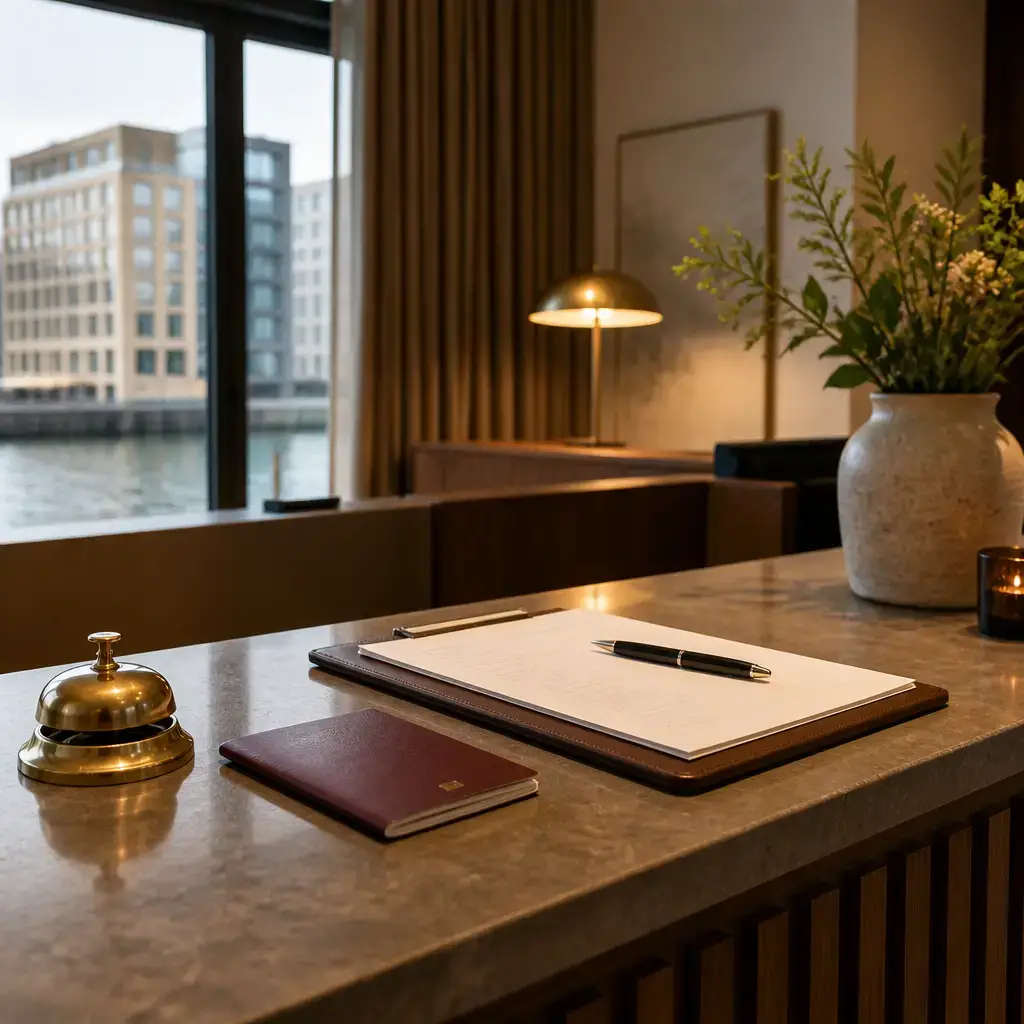
Use Checking in at a hotel to practice German conversation, pronunciation, vocabulary, grammar, and quizzes.
Dialogue
Ich habe hier eine Zimmerreservierung.
ikh HAH-buh heer EYE-nuh TSIM-mer-ray-zair-VOO-roong. I have a room reservation here.Könnte ich bitte Ihren Reisepass sehen?
KURN-tuh ikh BIT-tuh EE-ren RYE-zuh-pahs zay-en? Could I see your passport, please?Hier ist er. Ich habe ihn schon bereitgelegt.
HEER ist air. ikh HAH-buh een shohn buh-RYTE-guh-LAYKT. Here it is. I have it ready.Könnten Sie hier unterschreiben?
KURN-ten zee heer OON-ter-SHrye-ben? Could you sign here?Brauchen Sie auch meine Unterschrift auf diesem Formular?
BROW-khen zee owkh MY-nuh OON-ter-shrift owf DEE-zem for-moo-LAHR? Do you need my signature on this form too?Unten auf dem Formular reicht.
OON-ten owf daym for-moo-LAHR rykht. At the bottom of this form is fine.Wo wird morgen früh das Frühstück serviert?
voh veert MOR-gen fryoo dahs FROO-shtook zair-VEERT? Where is breakfast served tomorrow morning?Im Speisesaal in der Nähe der Rezeption.
im SHPEE-zuh-zahl in dair NAY-uh dair ray-tsep-TSYOHN. In the dining room near reception.Sentence explanations
Ich habe hier eine Zimmerreservierung.
I have a room reservation here.
- habe
- have
- hier
- here
- Zimmerreservierung
- room reservation
More detail
habe is the first-person singular present form of haben (“to have”): ich habe = “I have.” In this sentence, haben expresses possession or availability, not a past-tense auxiliary. Example: Ich habe Zeit. — “I have time.” hier means “here” and places the relevant reservation at the speaker’s current location or in the current situation. It is also useful in patterns such as Hier ist ... — “Here is ...” Zimmerreservierung means “room reservation.” It is a compound noun: Zimmer (“room”) + Reservierung (“reservation”). German nouns are capitalized, and the compound is feminine: die Zimmerreservierung; its plural is die Zimmerreservierungen. Example: Ich brauche eine Zimmerreservierung. — “I need a room reservation.” The remaining words supply the grammatical frame: Ich is “I,” and eine is the feminine indefinite article agreeing with Zimmerreservierung; it does not by itself state a numerical count. Together, Ich habe hier eine Zimmerreservierung. means “I have a room reservation here.”
Könnte ich bitte Ihren Reisepass sehen?
Could I see your passport, please?
- Könnte ich
- Could I
- bitte
- please
- Ihren
- your
- Reisepass
- passport
- sehen
- see
More detail
Könnte ich is a polite way to ask for permission or possibility: “Could I …?” Könnte is the Konjunktiv II form of können (“can, be able to”), used here to make the request less direct than Kann ich …? The pronoun ich means “I,” the person making the request. Example: Könnte ich hereinkommen? — “Could I come in?” bitte means “please.” It can make a request polite and may appear in different positions, including after the opening question phrase as here. Ihren is the formal possessive determiner meaning “your.” It addresses one person formally or more than one person formally. Its form here is Ihren because it modifies the masculine singular noun Reisepass in the accusative case. The formal possessive base is Ihr-; capitalization distinguishes formal Ihr/Ihren from informal ihr/ihren, which means “your” when addressing several people or “their” in other contexts. Example: Ich sehe Ihren Ausweis. — “I see your ID.” Reisepass means “passport.” It is a masculine noun: der Reisepass; after sehen in this sentence it is the direct object, so the form of the determiner is accusative Ihren. German compounds such as Reisepass are written as one word; this one refers to a travel passport. sehen means “to see.” It is the infinitive used after the modal verb könnte; with a modal verb, the other verb normally remains in the infinitive and comes at the end of the question. Example: Könnte ich den Ausweis sehen? — “Could I see the ID?” Together, Könnte ich ... sehen? forms the reusable polite question pattern “Could I see ...?” Ihren Reisepass supplies the thing being requested, and bitte marks the request as polite. The complete utterance therefore means: “Could I see your passport, please?”
Hier ist er. Ich habe ihn schon bereitgelegt.
Here it is. I have it ready.
- Hier
- here
- ist er
- it is
- Ich habe
- I have
- ihn
- it
- schon
- already
- bereitgelegt
- put ready
More detail
Hier means “here” and points to the location where the passport is being presented. German local adverbs such as hier can stand at the beginning to set the scene: Hier ist ... = “Here is ...” or “Here it is.” ist er: ist is the third-person singular present form of sein (“to be”): sein → ist. er is the masculine singular nominative pronoun. In this context, the fixed translation and the preceding request identify its referent as the passport, so er agrees with German der Reisepass. The word order places the verb before the subject because the utterance begins with Hier. Ich habe: habe is the first-person singular present form of haben (“to have”): haben → ich habe. In the second sentence, it is also the auxiliary used to form the perfect tense. The subject Ich is the person who has prepared the passport. ihn: This is the masculine singular accusative form of er (“he/it”): nominative er, accusative ihn. Here it refers to the passport as the direct object of bereitgelegt. A useful contrast is Ich sehe ihn (“I see it”) versus Er ist hier (“It is here”): the object form is ihn, while the subject form is er. schon: schon means “already” here. It says that the preparation has happened by the relevant time; it does not itself specify when it happened. bereitgelegt: This is the past participle of the separable verb bereitlegen (“to put or lay something ready”): bereitlegen → legte bereit (simple past) → hat bereitgelegt (perfect). In the perfect, habe is the auxiliary and bereitgelegt carries the lexical meaning. The separable prefix bereit- is joined in the participle, rather than appearing as a separate word. Together, Ich habe ihn schon bereitgelegt means “I have already put it ready.” German uses the perfect construction haben + past participle here: Ich habe ... bereitgelegt. The first sentence, Hier ist er, presents the passport at the indicated place; the second says that the speaker has already prepared it. The complete utterance therefore means: “Here it is. I have it ready.”
Könnten Sie hier unterschreiben?
Could you sign here?
- Könnten Sie
- Could you…?
- hier
- here
- unterschreiben
- sign
More detail
Könnten Sie is a polite way to ask a person formally whether they would be able or willing to do something. könnten is the Konjunktiv II form of können (“can, be able to”); here it softens the request rather than describing a past ability. Sie is the formal “you” and is capitalized. The infinitive belonging to this modal construction comes later: Könnten Sie ... unterschreiben? Compare the more direct Können Sie ...? (“Can you ...?”). hier means “here,” referring to the place indicated in the situation. It is an adverb and does not change form. Example: Bitte warten Sie hier. — “Please wait here.” unterschreiben means “to sign,” especially to write one’s signature on a document. It is an infinitive and follows the modal verb in this question. The related noun die Unterschrift means “signature,” as in Meine Unterschrift steht auf dem Formular. — “My signature is on the form.” Together, Könnten Sie makes a polite formal request, hier specifies the place, and unterschreiben names the requested action. The complete meaning is: “Could you sign here?”
Brauchen Sie auch meine Unterschrift auf diesem Formular?
Do you need my signature on this form too?
- Brauchen Sie
- do you need
- auch
- too; also
- Unterschrift
- signature
- Formular
- form
More detail
Brauchen Sie means “do you need” here. The verb is brauchen (“to need”); brauchen is the present-tense form used with Sie, which can be either a formal singular “you” or formal plural “you.” In a yes/no question, the finite verb comes first: Brauchen Sie ...? — “Do you need ...?” The capitalized Sie is the formal pronoun; the wording does not by itself identify whether it refers to one person or several. auch adds “too” or “also.” It usually marks an additional item, so auch meine Unterschrift means “my signature too.” Its exact position can vary in German, but here it comes before the added noun phrase. Unterschrift is the feminine noun die Unterschrift, meaning “signature.” The form is singular here, referring to the requested signature as one item. A useful related noun is Formular (“form”), but it is a separate noun and has different grammatical gender: das Formular. Formular means “form.” The phrase auf diesem Formular means “on this form”: auf takes the dative here because the phrase describes a stationary location rather than movement onto the form. Formular is neuter, so the demonstrative is diesem, the dative singular form of dieser for a neuter noun. Compare dieses Formular for a nominative or accusative use, but auf diesem Formular for this location. Together, Brauchen Sie asks whether the addressee needs something, auch adds that the signature is another required item, and meine Unterschrift auf diesem Formular specifies the item and its location. The complete utterance therefore means: “Do you need my signature on this form too?”
Unten auf dem Formular reicht.
At the bottom of this form is fine.
- Unten
- at the bottom
- auf dem
- on the
- Formular
- form
- reicht
- is enough
More detail
Unten means “at the bottom” here. It is a location adverb, so it does not change for gender, number, or case. A useful contrast is oben (“at the top”): oben auf dem Formular means “at the top of the form.” auf dem begins the location phrase auf dem Formular. For a stationary location, German uses auf with the dative. dem is the dative form of the definite article for the neuter noun das Formular; the article, not Formular, shows the case here. With movement toward a surface or location, auf can instead take the accusative, for example Ich lege es auf das Formular (“I put it on the form”). Formular means “form.” Its base form is das Formular, and its plural is die Formulare. In this utterance, the noun identifies the form whose bottom is being specified; in context, it is the form already referred to. reicht is the third-person singular present form of reichen. In this context, reichen means “to be enough” or “to suffice,” not its other possible sense “to reach.” The useful short form is Das reicht. — “That is enough.” The form reicht agrees with a singular subject when one is stated; here, the sufficient location or placement is understood rather than explicitly named. Together, Unten auf dem Formular gives the location “at the bottom of this form,” and reicht says that this placement is sufficient or acceptable. Thus the whole utterance means “At the bottom of this form is fine.”
Wo wird morgen früh das Frühstück serviert?
Where is breakfast served tomorrow morning?
- Wo
- where
- wird … serviert
- is served
- morgen früh
- tomorrow morning
- Frühstück
- breakfast
More detail
Wo means “where” and asks for a place. It is used for a location, not a destination; German commonly uses wo for “where?” and wohin for “where to?”. Example: Wo ist der Speisesaal? — “Where is the dining room?” wird ... serviert is a passive construction: wird is the third-person singular present form of werden, and serviert is the past participle of servieren (“to serve”). The passive presents the serving as something done to the breakfast, without naming the server. The pattern is wird + past participle. Example: Das Essen wird um acht serviert. — “The food is served at eight.” morgen früh means “tomorrow morning.” morgen means “tomorrow,” while früh specifies the early part of that day. Together they form a time expression. Example: Wir fahren morgen früh ab. — “We leave tomorrow morning.” Frühstück is the noun “breakfast.” German nouns are capitalized. It is neuter: das Frühstück; in this sentence, the bare noun refers to breakfast as the meal, without an article. Example: Das Frühstück beginnt um sieben. — “Breakfast begins at seven.” Together, Wo asks for the location, wird ... serviert asks where the meal is served, and morgen früh specifies the time. The complete question is: “Where is breakfast served tomorrow morning?”
Im Speisesaal in der Nähe der Rezeption.
In the dining room near reception.
- Speisesaal
- dining room
- in der Nähe
- nearby; in the vicinity
- Rezeption
- reception desk; reception
More detail
Im is the contraction of in dem. Here in marks a stationary location, and dem is the dative masculine/neuter definite article. It combines with the neuter noun Speisesaal: in dem Speisesaal → im Speisesaal. Speisesaal means “dining room.” It is a compound noun: Speise relates to food or a meal, and Saal means a large room or hall. As a German noun, it is capitalized; its gender is masculine: der Speisesaal. In the dative phrase after in, the article is dem. in der Nähe is the reusable pattern for “near” or “in the vicinity of.” The noun Nähe is feminine (die Nähe), and this fixed location expression uses the dative form der after in: in der Nähe. Rezeption means “reception” or “reception desk” in this setting. It is feminine: die Rezeption. In der Rezeption, der marks the dependent noun phrase after Nähe; the expression is commonly analyzed as in der Nähe + a genitive phrase, “in the vicinity of the reception.” The observed form der is also identical to the feminine dative article, so its exact case shape is not distinguishable from the surface form alone; the construction gives the intended relation here. Together, im Speisesaal gives the first location, and in der Nähe der Rezeption specifies its position relative to reception. The complete utterance is a verbless location phrase: “In the dining room near reception.”
Grammar Points
bereitlegen → bereitgelegt
Ich habe den Reisepass bereitgelegt.
ikh HAH-buh dayn RYE-zuh-pahs buh-RYTE-guh-LAYKT.I have put the passport aside / had it ready.
bereitlegen is a separable verb; its past participle is bereitgelegt.
bereit (Adjektiv) vs. unten (Adverb)
Der Reisepass ist bereit. Die Unterschrift steht unten.
dair RYE-zuh-pahs ist buh-RYTE. dee OON-ter-shrift shtayt OON-ten.The passport is ready. The signature is at the bottom.
bereit describes a state, while unten gives information about location.
German Vocabulary
Wo wird morgen früh das Frühstück serviert?
Quiz
Word Order
Arrange the words in the correct order.
I have a room reservation here.
Show Answer
Ich habe hier eine Zimmerreservierung.Could I see your passport, please?
Show Answer
Könnte ich bitte Ihren Reisepass sehen?Could you sign here?
Show Answer
Könnten Sie hier unterschreiben?Spelling
Tap the letters to spell the word.
to have ready; to put aside
Show Answer
bereitgelegtat the bottom; below
Show Answer
untento see
Show Answer
sehenform