10 minutes free every day
Continue audio lessons in the app
Word explanations appear automatically in sync with the audio.
No login required · synced translations · playback with the screen locked
Choose your learning language and open this lesson in the app.

About This Lesson
Use Pack a bag for an outing to practice German conversation, pronunciation, vocabulary, grammar, and quizzes.
Dialogue
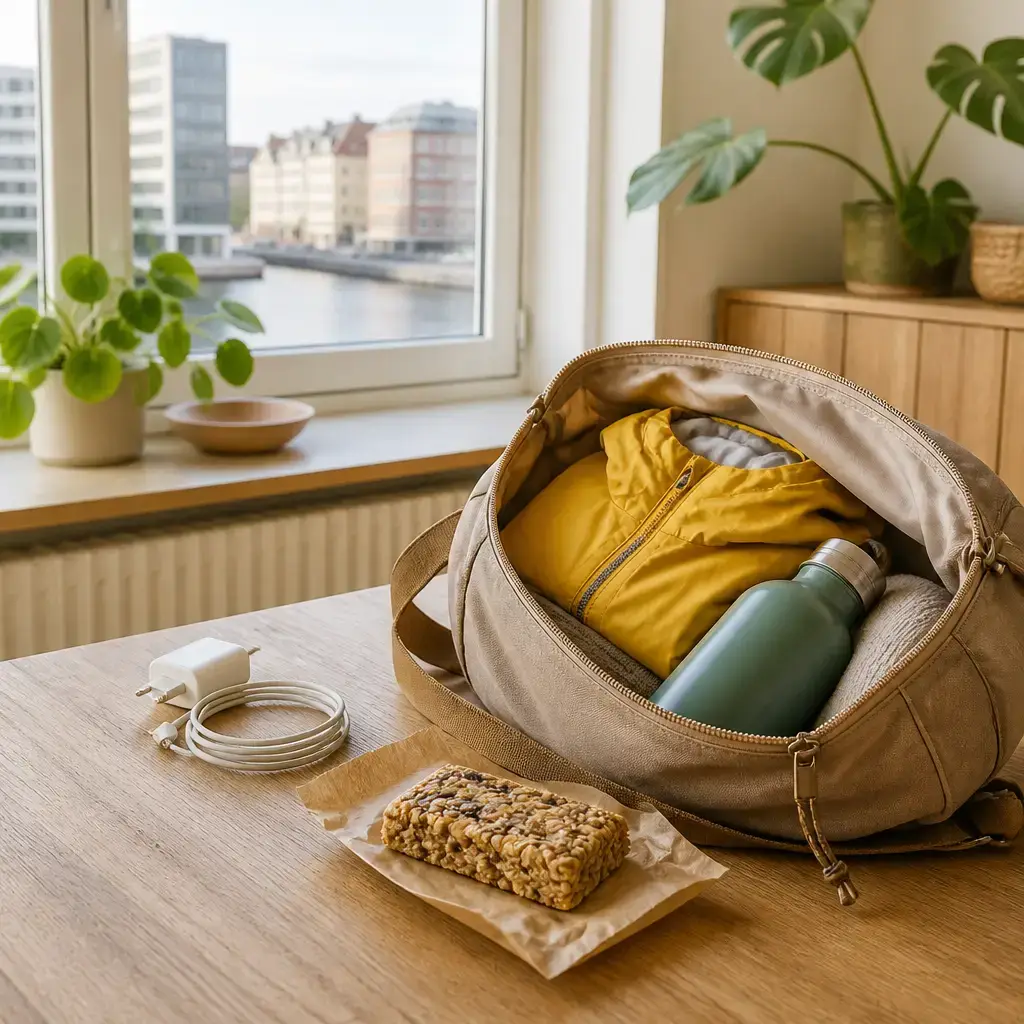
Ich packe meine Tasche für den Ausflug.
ikh PAH-kuh MY-nuh TAH-shuh fyoor dayn OWS-flook. I'm packing my bag for the outing.Was musst du noch mitbringen?
vass MOOST doo nokh MIT-bring-en? What do you still need to bring?Ich habe ein Ladegerät, einen Snack und einen Regenmantel.
ikh HAH-buh ayn LAH-duh-guh-RAYT, AY-nen snak oont AY-nen RAY-gen-man-tel. I have a charger, a snack, and a raincoat.Damit solltest du gut versorgt sein, wenn sich das Wetter ändert.
DAH-mit ZOLL-test doo goot fer-ZORKT zine, ven zikh das VET-uh EN-duht. That should cover you if the weather changes.Soll ich noch eine Flasche Wasser mitbringen?
ZOLL ikh nokh AY-nuh FLAH-shuh VAH-suh MIT-bring-en? Should I bring an extra bottle of water?Bring eine mit, falls der Spaziergang länger dauert als erwartet.
bring AY-nuh mit, falss dayr shpa-TSEER-gang LENG-uh DOW-uht ahls air-VAR-tet. Bring one in case the walk takes longer than expected.Meine Tasche ist voll.
MY-nuh TAH-shuh ist foll. My bag is full.Sie ist nicht zu schwer.
zee ist nikht tsoo shvair. It isn't too heavy.Dann bist du bereit, loszugehen.
dahn bist doo beh-RITE, LOHSS-tsoo-GAY-en. Then you're ready to head out.Sentence explanations
Ich packe meine Tasche für den Ausflug.
I'm packing my bag for the outing.
- Ich
- I
- packe
- am packing
- meine
- my
- Tasche
- bag
- für
- for
- Ausflug
- outing
More detail
Ich is the first-person singular pronoun meaning “I.” It refers to the speaker. Its plural counterpart is wir (“we”), which refers to the speaker together with at least one other person. packe is the first-person singular present form of packen (“to pack”): ich packe. German present tense can describe an action happening now, so it means “am packing” here. The same tense can describe a habitual or scheduled action in another context. meine is the possessive determiner meaning “my.” With the feminine singular noun Tasche in the accusative case, the form is meine: meine Tasche. Possessive determiners take endings according to the noun phrase’s gender, case, and number. For example, masculine accusative is meinen in meinen Rucksack (“my backpack”). Tasche means “bag.” Its base form is the feminine noun die Tasche; its plural is die Taschen. Here it is the direct object of packe, in the phrase meine Tasche (“my bag”). für means “for.” This preposition requires the accusative case. That is why the following masculine noun phrase has den: für den Ausflug (“for the outing”). Ausflug means “outing” or “trip.” Its base form is the masculine noun der Ausflug. In für den Ausflug, the definite article is den because the phrase is accusative singular after für. The definite article presents the outing as identifiable in this context; it does not state how many people are involved. Together, Ich packe means “I am packing,” meine Tasche identifies what is being packed, and für den Ausflug gives the purpose. The complete utterance is: “I’m packing my bag for the outing.”
Was musst du noch mitbringen?
What do you still need to bring?
- Was
- what
- musst du
- must you
- noch
- still
- mitbringen
- bring along
More detail
Was asks for the thing that is to be brought; it is the German question word for “what.” It can also introduce other kinds of questions, but here it asks about an object or objects. Example: Was kaufst du? — “What are you buying?” musst du combines musst, the second-person singular present form of müssen (“must” or “have to”), with du (“you”). The subject is du, and musst agrees with it. The form chain is müssen → du musst → er/sie muss; the final -st in musst marks the du form, while muss is used with er or sie. With a modal verb such as müssen, the other verb normally appears as an infinitive at the end of the clause. Example: Du musst gehen. — “You have to go.” noch means “still” here: the speaker asks what remains for you to bring, suggesting that the task is not yet complete. Its position can change in other sentences, but its meaning must be interpreted from the surrounding clause. Example: Ich muss noch arbeiten. — “I still have to work.” mitbringen means “to bring along” or “to bring with you.” It is an infinitive and a separable verb: in a simple finite clause without a modal, the parts separate, as in Du bringst einen Regenschirm mit. — “You are bringing an umbrella.” After müssen, however, the infinitive stays together at the end: Du musst einen Regenschirm mitbringen. — “You have to bring an umbrella.” Together, Was musst du noch mitbringen? asks which thing or things you still have to bring along: “What do you still need to bring?” The question uses was for the unknown item, du musst for your obligation, noch for what remains, and the final infinitive mitbringen for the action.
Ich habe ein Ladegerät, einen Snack und einen Regenmantel.
I have a charger, a snack, and a raincoat.
- Ich habe
- I have
- Ladegerät
- charger
- Snack
- snack
- Regenmantel
- raincoat
More detail
Ich habe means “I have” here. habe is the first-person singular present form of haben (“to have”): ich habe, du hast, er/sie/es hat. The subject Ich is the speaker, and this construction states possession or what the speaker has available. Example: Ich habe Zeit. — “I have time.” Ladegerät means “charger” here. Its full form is ein Ladegerät; the noun is neuter (das Ladegerät). After haben, the possessed item is normally in the accusative case. For a neuter noun, the indefinite article remains ein in the nominative and accusative: ein Ladegerät. Example: Ich brauche ein Ladegerät. — “I need a charger.” Snack means “snack.” It is masculine (der Snack). In the sentence, the masculine accusative article is einen: einen Snack. This contrasts with the masculine nominative form ein Snack. Example: Ich kaufe einen Snack. — “I am buying a snack.” Regenmantel means “raincoat.” It is a compound noun made from Regen (“rain”) and Mantel (“coat”); the final element determines the grammatical gender, so it is masculine (der Regenmantel). Its accusative form here is einen Regenmantel, just like einen Snack. Example: Sie trägt einen Regenmantel. — “She is wearing a raincoat.” The utterance assembles as Ich habe + ein Ladegerät + einen Snack + und einen Regenmantel: “I have a charger, a snack, and a raincoat.” The repeated accusative articles show the three things presented as what the speaker has. und connects the listed items.
Damit solltest du gut versorgt sein, wenn sich das Wetter ändert.
That should cover you if the weather changes.
- Damit
- with that; in this way
- solltest du
- you should
- gut versorgt
- well provided for
- sein
- be
- wenn
- if; when
- sich … ändert
- changes
- Wetter
- weather
More detail
Damit means “with that” here: it refers to the things already mentioned as available, and the sentence says those things should be enough to cover the listener’s needs. German also uses damit in the sense “thereby” or “so that” in other structures, but the relevant meaning here is “with that.” Example: Damit bist du gut vorbereitet. — “With that, you are well prepared.” Solltest du is the second-person singular form of sollen in the Konjunktiv II. In this sentence, solltest gives a tentative expectation or recommendation: “you should.” The plain present form sollst can sound more like an instruction or an obligation. The pronoun du is the informal singular “you.” Example: Du solltest jetzt gehen. — “You should leave now.” Gut versorgt describes someone whose necessary provisions or care are adequately covered. Versorgt is the participle of versorgen; with sein, it forms a state: versorgt sein — “to be provided for” or “to have one’s needs covered.” Here, gut strengthens that assessment to “well.” Example: Mit diesem Essen sind wir gut versorgt. — “With this food, we are well provided for.” Sein is the infinitive “to be.” It follows the modal verb solltest, so the modal verb carries the finite form and sein remains an infinitive at the end of the main clause. The pattern is Du solltest ... sein — “You should be ... .” Wenn introduces a conditional or time clause. With the intended meaning here, it means “if”: the coverage is expected to hold under the condition that the weather changes. In a wenn subordinate clause, the finite verb normally goes to the end. Sich ändert is the third-person singular present form of sich ändern, “to change.” Ändert carries the present-tense, third-person singular ending because its subject is das Wetter. The reflexive form sich is used with a third-person subject here; sich itself does not mark singularity. Example: Wenn sich der Plan ändert, sage ich dir Bescheid. — “If the plan changes, I’ll let you know.” Wetter means “weather.” It is a neuter noun: das Wetter. In the supplied sentence, it is the subject of sich ändert, so the weather is what changes. Example: Das Wetter ändert sich schnell. — “The weather changes quickly.” Together, Damit solltest du gut versorgt sein means “With that, you should be well provided for,” and wenn sich das Wetter ändert adds the condition “if the weather changes.” The complete utterance therefore means: “That should cover you if the weather changes.”
Soll ich noch eine Flasche Wasser mitbringen?
Should I bring an extra bottle of water?
- Soll ich
- Should I …?
- noch
- another; extra
- Flasche
- bottle
- Wasser
- water
- mitbringen
- bring along
More detail
Soll ich uses the first-person singular form of sollen, soll, with ich. In this question, it asks whether the speaker should perform the action: “Should I …?” A yes/no question places the finite verb before the subject. Compare Du sollst Wasser mitbringen. — “You should bring water.” noch means “extra” here: the speaker is asking about bringing an additional item. Its meaning combines with the following noun phrase; by itself, noch can have other uses, such as “still,” depending on context. Flasche is the noun die Flasche, “bottle.” With eine it is in the accusative as the object of mitbringen; for this feminine noun, the form of the indefinite article is still eine: eine Flasche. Example: Ich kaufe eine Flasche. — “I’m buying a bottle.” Wasser means “water.” In eine Flasche Wasser, it identifies what the bottle contains. German commonly uses this container-plus-content pattern without an additional article: ein Glas Saft — “a glass of juice.” mitbringen is the infinitive meaning “bring along” or “bring with you.” It is a separable verb: in a main-clause statement, its parts separate, as in Ich bringe Wasser mit. — “I’ll bring water along.” In the question, the infinitive remains together at the end because soll is the finite modal verb: Soll ich Wasser mitbringen? Together, Soll ich noch eine Flasche Wasser mitbringen? asks, “Should I bring an extra bottle of water?” The speaker is offering or checking whether bringing that additional bottle is appropriate; the question itself does not assert that the bottle has been brought.
Bring eine mit, falls der Spaziergang länger dauert als erwartet.
Bring one in case the walk takes longer than expected.
- Bring … mit
- bring ... along
- eine
- one
- falls
- in case
- Spaziergang
- walk
- länger
- longer
- dauert
- lasts
- als erwartet
- than expected
More detail
Bring ... mit is the informal singular imperative of the separable verb mitbringen, “to bring along.” In this imperative, the prefix mit appears at the end: Bring das Buch mit. — “Bring the book along.” The person being addressed is understood from the imperative; it is not stated as a separate word here. eine is a standalone feminine accusative pronoun meaning “one” here. The preceding context identifies the intended item as a bottle of water, so it refers to one such bottle. As a determiner, the same form can also mean “a/an” before a feminine noun, as in eine Flasche — “a bottle”; here that noun is omitted because it is understood. falls introduces a condition meaning “in case” or “if.” It marks the following material as a subordinate clause and generally places its finite verb late. In this sentence, dauert follows the subject der Spaziergang and the comparative länger; als erwartet then completes the comparison. Example: Falls es regnet, nehme ich einen Schirm mit. — “If it rains, I’ll bring an umbrella.” Spaziergang is the masculine noun “walk.” Its usual definite-article form is der Spaziergang; the article shows its grammatical gender. A useful contrast is gehen — “to go/walk,” the activity, versus der Spaziergang — “a walk,” the walk as a noun. länger is the comparative form of lang, “long.” The useful chain is lang — “long,” länger — “longer,” am längsten — “the longest.” Here it describes the walk’s duration, not its physical length. dauert is the third-person singular present form of dauern, “to last” or “to take [time].” Its singular form agrees with the singular subject der Spaziergang. Example: Der Film dauert zwei Stunden. — “The film lasts two hours.” als erwartet means “than expected.” erwartet comes from erwarten, “to expect,” and is used here in the shortened comparison “than expected.” German uses als after a comparative: Der Weg ist länger als erwartet. — “The route is longer than expected.” Together, falls der Spaziergang länger dauert als erwartet means “in case the walk takes longer than expected.” The complete utterance is an informal instruction: “Bring one along in case the walk takes longer than expected.”
Meine Tasche ist voll.
My bag is full.
- Meine
- my
- Tasche
- bag
- voll
- full
More detail
Meine belongs to the possessive determiner mein (“my”). Here it has the form meine because it accompanies the feminine singular noun Tasche in the nominative subject position. The same form can also occur in some other grammatical environments, so the form alone does not mean “feminine” in every use. Tasche means “bag” here. Its base singular form is Tasche; the plural is Taschen. Example: Die Tasche ist voll. — “The bag is full.” voll means “full.” It is an adjective used after the linking verb ist, so it stays in its basic form without an adjective ending. Its opposite is leer (“empty”). Example: Das Glas ist voll. — “The glass is full.” Together, Meine Tasche identifies the speaker’s bag as the subject, and ist voll states its condition: “My bag is full.”
Sie ist nicht zu schwer.
It isn't too heavy.
- Sie
- it
- ist
- is
- nicht
- not
- schwer
- heavy
More detail
Sie means “it” here and can refer back to meine Tasche (“my bag”) from the preceding sentence. It is a third-person singular pronoun; because it begins the sentence, it is capitalized. The same written form can serve other functions in German, but this sentence uses it as the subject referring to the bag. ist is the present-tense third-person singular form of sein (“to be”): sein → ist. It agrees with the singular subject Sie. For example, Die Tasche ist voll. means “The bag is full.” nicht negates the adjective phrase that follows. In this sentence, it makes the statement negative: the bag is not too heavy. schwer means “heavy” here. It is an adjective; its basic form is schwer, and it can describe weight. The preceding zu combines with it as the pattern zu + adjective, meaning “too + adjective”: zu schwer = “too heavy.” This is different from sehr schwer (“very heavy”), which intensifies the adjective without expressing that the degree is excessive. Example: Der Koffer ist zu schwer. — “The suitcase is too heavy.” Together, Sie ist gives “it is,” nicht negates the following description, and zu schwer means “too heavy.” The complete utterance therefore means “It isn’t too heavy.”
Dann bist du bereit, loszugehen.
Then you're ready to head out.
- Dann
- then
- bist du
- you are
- bereit
- ready
- loszugehen
- to head out
More detail
Dann means “then” here and places the situation in sequence with something already established. It can also introduce a result or consequence in other sentences, but here it simply points to the next step. bist du uses the present-tense form bist of sein (“to be”) with the second-person singular pronoun du (“you”). The useful present-tense pattern is ich bin, du bist, er/sie/es ist; bist is specifically the form used with du. Example: Du bist müde. — “You are tired.” bereit is an adjective meaning “ready” or “prepared.” With sein, it describes the subject’s state: Du bist bereit. — “You are ready.” The adjective itself does not show a special form here; bist carries the person marking. loszugehen means “to head out” or “to set off.” It is the zu-infinitive of the separable verb losgehen: in this form, zu appears between the prefix los- and the verb stem gehen, producing loszugehen. After an adjective such as bereit, German commonly uses bereit sein, ... zu ... to express being ready to do something. Example: Ich bin bereit, anzufangen. — “I am ready to start.” Together, Dann + bist du bereit + loszugehen gives: “Then you’re ready to head out.” Dann sets the sequence, bist du bereit describes your readiness, and loszugehen states the action you are ready to perform.
Grammar Points
bereit sein, loszugehen
Ich bin bereit, loszugehen.
ikh bin beh-RITE, LOHSS-tsoo-GAY-en.I am ready to head out.
Nach „bereit sein“ steht „zu“ + Infinitiv; bei trennbaren Verben wird es eingeschoben: loszugehen.
falls + Verb am Satzende
Falls sich das Wetter ändert, dauert der Spaziergang länger.
falss zikh das VET-uh EN-duht, DOW-uht dayr shpa-TSEER-gang LENG-uh.If the weather changes, the walk takes longer.
„Falls“ leitet einen Nebensatz ein. Das konjugierte Verb steht dort am Ende.
German Vocabulary
Wenn sich das Wetter ändert.
Ich packe meine Tasche für den Ausflug.
Eine Flasche Wasser mitbringen.
Damit solltest du gut versorgt sein.
Ich habe ein Ladegerät.
Was musst du noch mitbringen?
Was musst du noch mitbringen?
Ich packe meine Tasche für den Ausflug.
Ich habe einen Regenmantel.
Ich habe einen Snack.
Ich packe meine Tasche für den Ausflug.
Wenn sich das Wetter ändert.
Quiz
Word Order
Arrange the words in the correct order.
What do you still need to bring?
Show Answer
Was musst du noch mitbringen?My bag is full.
Show Answer
Meine Tasche ist voll.It isn't too heavy.
Show Answer
Sie ist nicht zu schwer.Spelling
Tap the letters to spell the word.
bag
Show Answer
Tascheto bring along
Show Answer
mitbringenstill; yet; another
Show Answer
nochcharger