10 minutes free every day
Continue audio lessons in the app
Word explanations appear automatically in sync with the audio.
No login required · synced translations · playback with the screen locked
Choose your learning language and open this lesson in the app.

About This Lesson
Use Reporting a Lost Wallet to practice German conversation, pronunciation, vocabulary, grammar, and quizzes.
Dialogue
Ich glaube, ich habe meine Geldbörse liegen lassen.
ikh GLOW-buh, ikh HAH-buh MY-nuh GELT-bur-zuh LEE-gen LAH-sen. I think I left my wallet behind.Gehen wir zurück zum Empfang und melden sie.
GAY-en veer tsoo-ROOK tsoom ent-FANG oont MEL-den zee. Let's go back to the front desk and report it.Sie ist braun und hat einen kleinen silbernen Knopf.
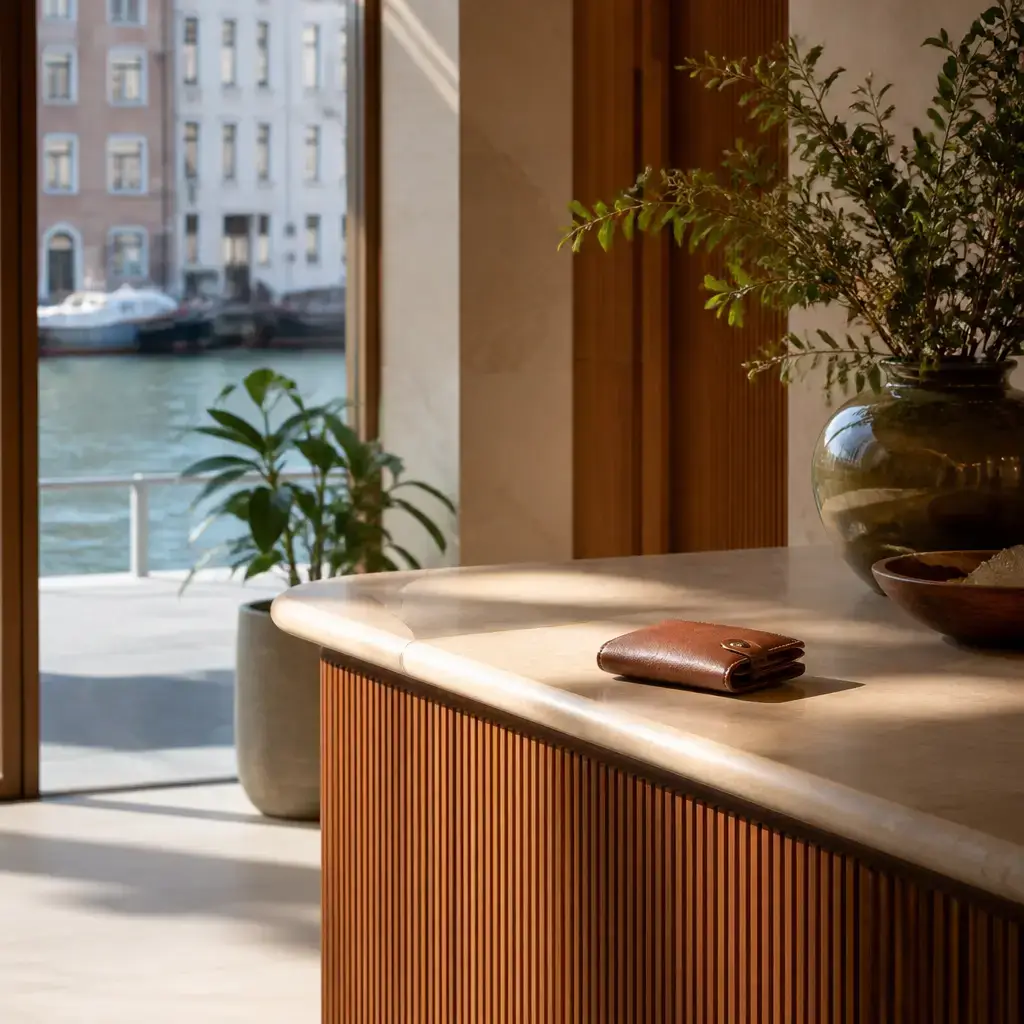
zee ist BROWN oont hat EYE-nen KLY-nen ZIL-ber-nen KNOHPF. It's brown with a small silver button.Diese Angabe hilft ihnen, bei den Fundsachen zu suchen.
DEE-zuh AHN-gah-buh hilft EE-nen, bye den FOONT-tsah-khen tsoo ZOO-khen. That detail will help them check lost property.Was soll ich sagen, wenn sie nach Einzelheiten fragen?
vahs ZOHL ikh ZAH-gen, ven zee nahkh EYE-ntsel-hy-ten FRAH-gen? What should I say if they ask for details?Beschreibe die Geldbörse, aber halte persönliche Informationen geheim.
beh-SHREE-buh dee GELT-bur-zuh, AH-ber HAL-tuh pair-ZURN-li-khuh in-for-mah-TSYOH-nen guh-HYME. Describe the wallet, but keep personal information private.Ich kann eine kurze Notiz für sie schreiben.
ikh kahn EYE-nuh KOOR-tsuh noh-TEETS fyoor zee SHRY-ben. I can write a short note for them.Das macht die Meldung verständlich.
dahs mahkht dee MEL-doong fer-SHTEND-likh. That will make the report clear.Sentence explanations
Ich glaube, ich habe meine Geldbörse liegen lassen.
I think I left my wallet behind.
- Ich glaube
- I think
- meine
- my
- Geldbörse
- wallet
- liegen lassen
- leave behind
More detail
Ich glaube means “I think” here. Ich is the first-person singular subject, and glaube is the present-tense first-person singular form of glauben (“to believe/think”). This is a useful way to introduce a thought or a tentative statement. Example: Ich glaube, er kommt später. — “I think he is coming later.” meine means “my” and is the possessive determiner modifying Geldbörse. Its form agrees with the noun: die Geldbörse is feminine singular, and here the wallet is the object of the perfect-tense verb phrase, so the feminine singular accusative form is meine. The same determiner changes with the noun’s grammatical case and number; for example, mein Geldbeutel uses mein with the masculine noun Geldbeutel in the same object position. Geldbörse is a feminine noun: die Geldbörse, “wallet.” The compound refers to a container for money and is a reusable everyday word. Example: Meine Geldbörse ist in der Tasche. — “My wallet is in the bag.” liegen lassen is the infinitive construction “to leave [something] lying” and, in this context, “to leave behind.” liegen means “to lie/be lying,” while lassen means “to let/leave.” Together they describe leaving an object in the place where it was. The fixed translation identifies the intended result here: the speaker left the wallet behind. Example: Ich habe mein Buch im Zug liegen lassen. — “I left my book on the train.” habe is the first-person singular present form of haben, used here as the perfect auxiliary. With liegen lassen, German places the two infinitives at the end: Ich habe ... liegen lassen. The construction refers to a completed past event, while Ich glaube presents the speaker’s current belief about it. In the full sentence, meine Geldbörse is the object understood with liegen lassen: Ich glaube, ich habe meine Geldbörse liegen lassen. — “I think I left my wallet behind.”
Gehen wir zurück zum Empfang und melden sie.
Let's go back to the front desk and report it.
- Gehen wir
- let’s go
- zurück
- back
- Empfang
- front desk
- melden
- report
- sie
- it
More detail
Gehen wir uses gehen (“to go”) with wir (“we”). In this word order, the verb comes first and the construction functions as a suggestion: “let’s go.” A reusable example is Warten wir! — “Let’s wait!” zurück means “back” and indicates a return toward an earlier place or position. Together, gehen and zurück mean “go back.” Empfang is the noun der Empfang; here it means “the front desk,” as specified by the fixed translation. zum Empfang is zu dem Empfang: zu governs the dative, and zum is the contracted form of zu dem. The noun is masculine: der Empfang. melden means “to report” here. After the suggestion Gehen wir, the coordinated verb melden appears without a repeated wir; this is a coordinated infinitive in the same “let’s …” sequence, not a separately inflected first-person plural form. The ordinary present-tense form with an explicit subject is Wir melden den Verlust. — “We report the loss.” sie is a lowercase feminine singular pronoun in the object position, meaning “her” or “it” when its feminine referent is understood. In the supplied context and translation, it refers to the wallet, meine Geldbörse, which is feminine in German (die Geldbörse); sie is its accusative form. This is distinct from capitalized Sie, the formal “you.” As a whole, Gehen wir zurück zum Empfang und melden sie. means “Let’s go back to the front desk and report it.” The utterance coordinates going back to the front desk with reporting the wallet.
Sie ist braun und hat einen kleinen silbernen Knopf.
It's brown with a small silver button.
- Sie
- it
- ist
- is
- braun
- brown
- hat
- has
- kleinen
- small
- silbernen
- silver
- Knopf
- button
More detail
Sie means “it” here and is the subject of the description. In German, this form is feminine singular nominative in this use; the specific thing it refers to is not identified by the supplied sentence. The same spelling can have other grammatical uses in other contexts, so its form alone does not identify a referent. ist is the third-person singular present form of sein (“to be”). The pattern X ist ... describes a current state or property of X. Example: Der Knopf ist silbern. — “The button is silver.” braun is the adjective “brown.” It appears here as a predicate adjective after ist, so it has no adjective ending. Compare the attributive use in the example ein brauner Knopf — “a brown button,” where brauner carries an ending. hat is the third-person singular present form of haben (“to have”). The pattern X hat Y expresses that X has or possesses Y, or that Y is a feature of X. kleinen means “small” here. Its base form is klein; the -en ending is on the adjective itself. In einen kleinen ..., the noun phrase is masculine singular accusative, selected by the construction with hat. Example: Sie hat einen kleinen Schlüssel. — “It has a small key.” silbernen means “silver” or “silver-colored” here. Its base form is silbern; the -en ending is again on the adjective. It agrees with the same masculine singular accusative noun phrase as kleinen, rather than being a form of the noun. Knopf means “button.” It is a masculine noun: der Knopf (singular), die Knöpfe (plural). After hat, the singular object is marked with einen: einen Knopf; the two adjectives before it therefore appear as kleinen and silbernen. Together, Sie ist braun says that the identified item is brown, and hat einen kleinen silbernen Knopf adds that it has a small silver button. Thus the whole utterance means: “It’s brown with a small silver button.”
Diese Angabe hilft ihnen, bei den Fundsachen zu suchen.
That detail will help them check lost property.
- Diese
- this
- Angabe
- detail
- hilft
- helps
- ihnen
- them
- Fundsachen
- lost property
- zu suchen
- to search
More detail
Diese means “this” here and is the feminine singular nominative form of the demonstrative dies-. It agrees with Angabe, the subject noun; the form changes with grammatical gender, number, and case, for example dieser can mean “this” with a masculine nominative noun. Angabe means “detail” or “piece of information” in this sentence. It is a feminine noun: die Angabe, plural die Angaben. A useful related contrast is Information, which also means “information” but is a different noun with its own grammatical gender. hilft is the third-person singular present form of helfen, “to help”: helfen → hilft for “he/she/it helps.” German helfen takes the person helped in the dative, as in jemandem helfen (“to help someone”). The present form can also describe a future result when the context makes that clear; the German form itself is present tense. ihnen means “them” here. It is the dative plural form of the personal pronoun, matching the dative required by helfen. The same spelling can also be a formal singular “you” in writing, but the fixed translation establishes the plural meaning “them” in this utterance. Fundsachen means “lost property” here. It is the plural form of Fundsache, a feminine noun meaning a lost item or an item found and kept for its owner. In bei den Fundsachen, bei takes the dative, so the plural article is den; this phrase locates the searching at or among the lost-property items or area. zu suchen means “to search” or “to look for.” suchen is the base verb, and zu marks its infinitive in this construction. German commonly uses helfen with a person in the dative and a zu-infinitive for the action being helped: Das hilft mir, die Datei zu finden. — “That helps me find the file.” Putting the parts together, Diese Angabe is the subject, hilft ihnen says that it helps them, and bei den Fundsachen zu suchen specifies the action: searching among or at the lost property. The whole utterance means, “This detail will help them search the lost property.”
Was soll ich sagen, wenn sie nach Einzelheiten fragen?
What should I say if they ask for details?
- Was
- what
- soll ich
- should I
- sagen
- say
- wenn
- if
- sie
- they
- Einzelheiten
- details
- fragen
- ask
More detail
Was asks for information about an unspecified thing or content. It is different from wer (“who”), which asks about a person. Example: Was meinst du? — “What do you mean?” Soll ich combines the first-person singular present form soll of sollen with ich. Here it asks for advice or the appropriate action: “should I …?” The subject is ich (“I”); soll is the inflected modal verb. Compare Soll ich warten? — “Should I wait?” sagen means “to say” and is the infinitive used with the modal verb. With a modal verb, the conjugated modal comes in the main-clause position and the other verb remains in the infinitive: Ich soll sagen — “I should say.” Sagen focuses on expressing words or information; sprechen more generally means “to speak.” wenn introduces the condition “if” here. In the subordinate clause it sends the conjugated verb to the end. Example: Wenn sie anrufen, antworte ich. — “If they call, I answer.” sie means “they” in this sentence, as fixed by the translation. This third-person plural pronoun is distinct from singular sie (“she”) and formal Sie (“you”), whose capitalization and grammatical behavior differ. Einzelheiten is the plural of Einzelheit, meaning “details” or “particulars.” The plural form identifies more than one detail; the ending is part of the noun’s inflection. Example: Bitte nenne die Einzelheiten. — “Please name the details.” fragen means “to ask.” It is the third-person plural present form as used with sie (“they”); its infinitive is also fragen. Example: Sie fragen nach dem Weg. — “They ask for directions.” With nach and the dative, nach etwas fragen means “to ask for something,” as in nach Einzelheiten fragen. Together, Was soll ich sagen asks what words or information the speaker ought to give. wenn sie nach Einzelheiten fragen supplies the condition: this applies if they ask for details. The verb-final subordinate clause places fragen at the end, producing the complete meaning: “What should I say if they ask for details?”
Beschreibe die Geldbörse, aber halte persönliche Informationen geheim.
Describe the wallet, but keep personal information private.
- Beschreibe
- describe
- Geldbörse
- wallet
- halte … geheim
- keep private
- persönliche
- personal
- Informationen
- information
More detail
Beschreibe is the informal singular imperative of beschreiben (“to describe”). It addresses one person and asks that person to describe something. The form is not the infinitive: beschreiben is the base form, while Beschreibe! is the command form for du. Example: Beschreibe das Bild. — “Describe the picture.” Geldbörse means “wallet.” It is a feminine noun: die Geldbörse; its plural is die Geldbörsen. In this sentence, die Geldbörse is the direct object of beschreibe, so the command is to describe the wallet. halte is the informal singular imperative of halten (“to hold” or, in this construction, “to keep”). The useful pattern is etwas geheim halten: “to keep something secret/private.” Here halte is the command addressed to one person; it is not the ordinary present-tense form ich halte (“I hold/keep”). Example: Halte das Passwort geheim. — “Keep the password secret.” persönliche means “personal” here. It is the adjective persönlich, describing Informationen. Because it stands before a plural noun with no article, it has the ending -e: persönliche Informationen. This phrase is the direct object of halte. Informationen means “information” here and is the plural of the feminine noun die Information; the singular is eine Information, and the plural is Informationen. The plural form fits the sentence's reference to personal information in general, without stating a particular number of pieces of information. The first command is Beschreibe die Geldbörse: “Describe the wallet.” aber (“but”) links it to a second command, halte persönliche Informationen geheim: “keep personal information private.” Together, the utterance gives one person two instructions: describe the wallet, but keep personal information private.
Ich kann eine kurze Notiz für sie schreiben.
I can write a short note for them.
- Ich kann
- I can
- kurze
- short
- Notiz
- note
- für sie
- for them
- schreiben
- write
More detail
Ich kann combines the pronoun ich (“I”) with kann, the first-person singular present form of können (“can; be able to”). In this sentence it expresses ability or possibility. The verb können is a modal verb, so the other verb goes to the end in its infinitive form. kurze means “short” here. It is the inflected form of kurz. The ending -e appears because the adjective describes the feminine noun Notiz in the accusative after the indefinite article eine: eine kurze Notiz. Compare the basic form kurz in Die Notiz ist kurz (“The note is short”) with the comparative kürzer (“shorter”). Notiz is a feminine noun meaning “note.” Its plural is Notizen. In the sentence, eine Notiz is the direct object of schreiben, so it is in the accusative; with the feminine indefinite article, the form remains eine. für sie means “for them.” für is a preposition that requires the accusative case. Here sie is the accusative form used for the intended plural pronoun “them”; the wording and fixed translation identify that plural reading. The same spelling can have other grammatical functions in German, but those are not the meaning here. schreiben is the infinitive “to write,” the base form of the verb. After the modal verb kann, it remains an infinitive and appears at the end of the clause. For example: Ich kann einen Brief schreiben. — “I can write a letter.” Together, Ich kann states the speaker’s ability, eine kurze Notiz is what can be written, für sie identifies the intended recipients, and schreiben completes the modal-verb construction. The whole utterance means: “I can write a short note for them.”
Das macht die Meldung verständlich.
That will make the report clear.
- Das
- that
- macht
- makes
- Meldung
- report
- verständlich
- clear; understandable
More detail
Das is a demonstrative pronoun meaning “that” here. It is neuter singular, but the supplied sentence does not identify exactly what “that” refers to. German demonstratives agree in grammatical gender and number with their referent when the referent is expressed; this standalone form is also used when the referent is understood from context. macht is the third-person singular present form of machen (“to make; to do”): machen → macht. In this pattern, machen takes an object and describes causing it to have a result: etwas macht etwas verständlich = “something makes something understandable.” German present tense can refer to a future result when the context supports it, which matches “will make” in the fixed translation. die Meldung means “the report” here. Meldung is a feminine noun, and the form die is both nominative feminine singular and accusative feminine singular; its object role is shown by the sentence structure and by macht taking the thing that becomes understandable as its object. A useful plural form is die Meldungen (“the reports”). verständlich means “clear” or “understandable” here. It is an adjective used after machen to describe the resulting state of the object, not an adjective inflected for an article in this position. Compare Die Erklärung ist verständlich (“The explanation is understandable”) with Das macht die Erklärung verständlich (“That makes the explanation understandable”). Together, Das macht die Meldung verständlich has the pattern subject + machen + object + result adjective: “That makes the report understandable.” With the intended time reading supplied by the translation, the natural English rendering is “That will make the report clear.”
Grammar Points
Adjektivendungen nach einem unbestimmten Artikel: einen + -en
einen kleinen silbernen Knopf
EYE-nen KLY-nen ZIL-ber-nen KNOHPFa small silver button
Nach „einen“ bekommen maskuline Adjektive im Akkusativ die Endung „-en“.
Imperativ bei Verben: Verbstamm ohne Personalpronomen
Beschreibe die Geldbörse.
beh-SHREE-buh dee GELT-bur-zuhDescribe the wallet.
„Beschreibe“ ist die Befehlsform von „beschreiben“ für „du“.
German Vocabulary
Quiz
Word Order
Arrange the words in the correct order.
That will make the report clear.
Show Answer
Das macht die Meldung verständlich.Spelling
Tap the letters to spell the word.
front desk; reception
Show Answer
Empfangsilver; silver-colored
Show Answer
silbernento report
Show Answer
meldenbrown