10 minutes free every day
Continue audio lessons in the app
Word explanations appear automatically in sync with the audio.
No login required · synced translations · playback with the screen locked
Choose your learning language and open this lesson in the app.

About This Lesson
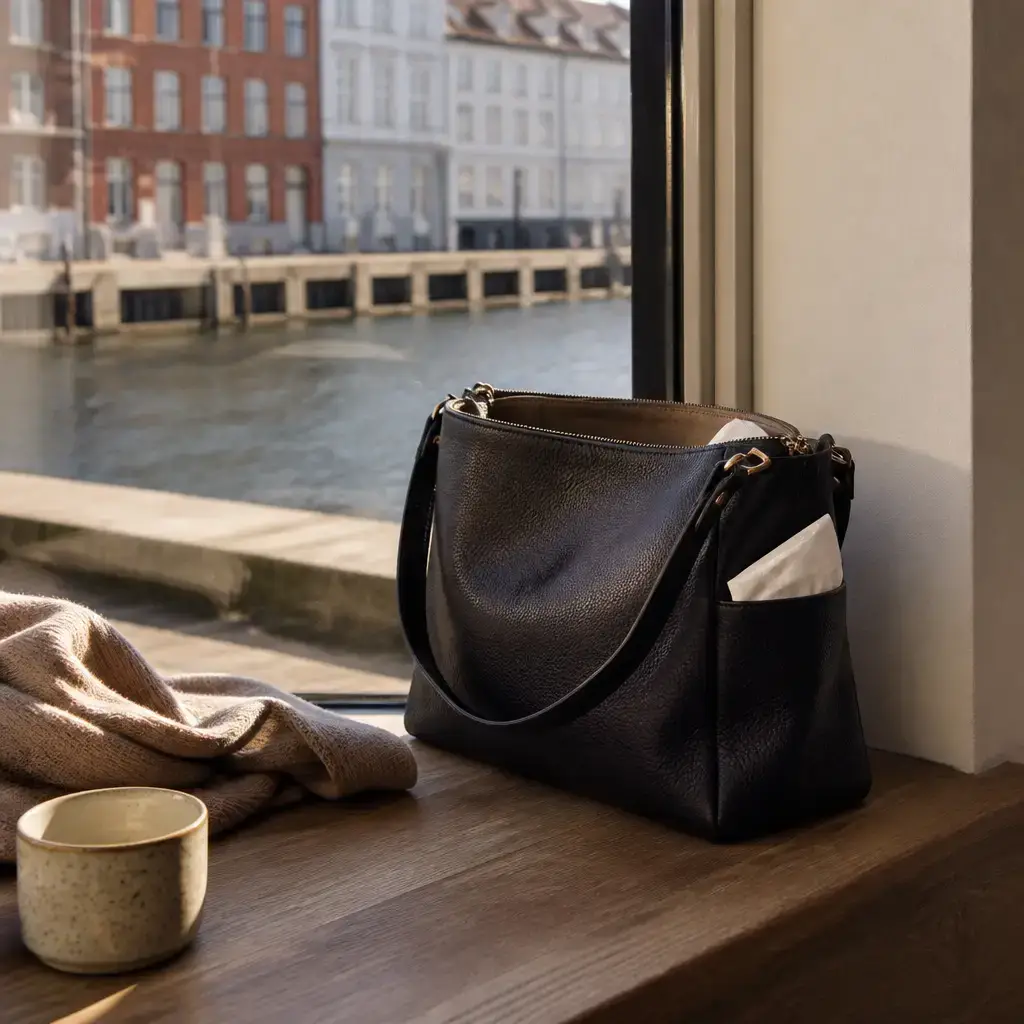
Use Borrowing a tissue from a bag to practice German conversation, pronunciation, vocabulary, grammar, and quizzes.
Dialogue
Könnte ich ein Taschentuch aus deiner Tasche nehmen?
KURN-tuh ikh ayn TAH-shun-tooh ows DYE-nuh TAH-shuh NAY-men? Could I borrow a tissue from your bag?Sie sind in der Seitentasche.
ZEE zint in dair ZY-ten-tah-shuh. They're in the side pocket.Darf ich sie öffnen?
Darf ikh zee URF-nen? May I open it?Möchtest du lieber eins holen?
MURKH-test doo LEE-ber ayns HOH-len? Would you rather get one?Du kannst sie öffnen.
Doo kahnst zee URF-nen. You can open it.Ich habe jetzt eins.
Ikh HAH-buh yetst ayns. I've got one now.Bitte schließe sie, wenn du fertig bist.
BIT-tuh SHLEE-suh zee, ven doo FER-tikh bist. Please close the pocket when you're done.Ich schließe sie vorsichtig.
Ikh SHLEE-suh zee FOR-zikh-tikh. I'll close it carefully.Nimm ein weiteres mit, wenn du es brauchst.
NIM ayn VY-ter-es mit, ven doo ess BROWKHST. Keep another with you if you need it.Sentence explanations
Könnte ich ein Taschentuch aus deiner Tasche nehmen?
Could I borrow a tissue from your bag?
- Könnte ich
- Could I …?
- ein
- a/an
- Taschentuch
- tissue
- aus
- from/out of
- deiner
- your
- Tasche
- bag
- nehmen
- take
More detail
Könnte ich combines könnte, the first-person singular subjunctive II form of können (“can”), with ich (“I”). In this question, it politely asks whether the speaker is allowed to do something: “Could I …?” The wording is less direct than Kann ich …?, which is also possible but more neutral or direct. The form könnte is tied to ich here; it is not the past-tense form of the main verb nehmen. ein Taschentuch: ein is the indefinite article, and Taschentuch is a neuter noun meaning “tissue” or “handkerchief.” The article is accusative here because nehmen has a direct object: the speaker would take a tissue. For a neuter noun, the indefinite article is ein in both nominative and accusative singular. The plural is Taschentücher; for example, Ich nehme ein Taschentuch. means “I am taking a tissue.” aus means “from” or “out of” and introduces the source from which something is taken. It is a preposition that takes the dative case. In this sentence, aus deiner Tasche means “from your bag.” deiner Tasche: Tasche is a feminine noun meaning “bag.” deiner means “your” and has the dative feminine singular form required after aus; its base possessive form is dein. The possessive form agrees with the possessed noun and case, not with the gender of the person who owns it. For comparison, deine Tasche is nominative or accusative feminine singular, while deiner Tasche is dative feminine singular. The following context specifies that the relevant location is the side pocket: Sie sind in der Seitentasche. nehmen is the infinitive “to take.” In this question it remains in the infinitive and follows the modal verb könnte; the modal carries the finite verb information, while nehmen names the proposed action. In the fixed translation, the situation makes “take” naturally understood as “borrow,” but nehmen itself does not specifically mean “borrow.” The more specific German verb for “borrow” is sich leihen or, depending on the construction, ausleihen. Together, Könnte ich politely asks for permission, ein Taschentuch identifies what would be taken, and aus deiner Tasche identifies its source. The whole utterance therefore means: “Could I borrow a tissue from your bag?”
Sie sind in der Seitentasche.
They're in the side pocket.
- Sie
- they
- sind
- are
- in der
- in the
- Seitentasche
- side pocket
More detail
Sie means “they” here, as confirmed by the fixed translation. In this use it is the third-person plural personal pronoun. It is written with a capital letter at the start of the sentence; the same spelling can also represent a formal “you” or singular “she” in other contexts, so the intended meaning comes from the sentence and context. sind is the present-tense plural form of sein (“to be”): sein → sie sind (“they are”). The form agrees with the plural subject Sie. For comparison, ich bin means “I am” and du bist means “you are.” in der expresses location “in the” here. The location is static, so German uses the dative after in: der is the dative form of the feminine definite article die. This is different from a movement meaning such as “into the,” which can use the accusative after in. Seitentasche means “side pocket.” It is a compound noun made from Seite (“side”) and Tasche (“pocket/bag”); the final element determines the noun’s grammatical gender, so die Seitentasche is feminine. German nouns are capitalized. A reusable pattern is in der [feminine noun], for example: Das Buch ist in der Tasche. — “The book is in the bag.” Together, Sie sind gives “they are,” and in der Seitentasche gives “in the side pocket.” The complete utterance is therefore: “They’re in the side pocket.”
Darf ich sie öffnen?
May I open it?
- Darf ich
- May I …?
- sie
- it
- öffnen
- open
More detail
Darf ich combines the first-person pronoun ich (“I”) with darf, the first-person singular present form of the modal verb dürfen (“may/be allowed to”). Together they ask for permission: “May I …?” The modal is conjugated, while the other verb stays in the infinitive. Example: Darf ich hereinkommen? — “May I come in?” Here, sie is the lowercase pronoun meaning “it.” In this sentence it is the accusative object of öffnen, and the fixed translation identifies the referent as singular “it.” The same written form can have other grammatical roles in German, but those readings are not intended here. This lowercase sie is also distinct in capitalization from Sie, the formal “you” or “they” in other contexts. öffnen is the infinitive “to open.” After a modal such as dürfen, German normally uses the infinitive rather than a separately conjugated present-tense form. The infinitive is also the dictionary form; its stem appears in forms such as ich öffne (“I open”) when no modal is used. Example: Ich öffne die Tür. — “I open the door.” The full pattern is Darf ich + object + infinitive: Darf ich sie öffnen? Literally, “May I open it?” The question asks whether the speaker is permitted to perform the action of opening that object.
Möchtest du lieber eins holen?
Would you rather get one?
- Möchtest du
- Would you like
- lieber
- rather
- eins
- one
- holen
- get
More detail
Möchtest du is the second-person singular form used here to ask politely about a wish or preference. Möchtest is the Konjunktiv II form of mögen, used in the common polite expression möchten; du addresses one person informally. Compare Willst du ...?, which asks more directly whether someone wants something. lieber means “rather” or “preferably” here. In this preference use, it is the comparative form of the adverb gern: gern means doing something gladly, lieber means rather, and am liebsten means most preferably. For example: Ich bleibe lieber hier. — “I would rather stay here.” eins is the standalone form for “one” when referring to a thing. The translation establishes the meaning “one,” but the fixed sentence does not identify which item it is. Unlike an indefinite article, this form refers to one thing as a pronoun or numeral form. For example: Ich nehme eins. — “I’ll take one.” holen is the infinitive meaning “to get” or “to fetch.” After the finite form möchtest, it names the desired action and stays in the infinitive. For example: Ich hole Wasser. — “I’ll get water.” In this yes-or-no question, Möchtest is first, followed by the subject du; lieber marks the preference, eins is what is to be obtained, and holen is the final infinitive. Together, Möchtest du lieber eins holen? means “Would you rather get one?”
Du kannst sie öffnen.
You can open it.
- Du kannst
- you can
- sie
- it
- öffnen
- open
More detail
Du kannst means “you can” here. Du is the informal singular “you.” kannst is the present-tense second-person singular form of können (“can; be able to”): ich kann, du kannst, er/sie/es kann. With a modal verb such as können, the other verb stays in the infinitive and goes to the end of the clause. sie means “it” in this sentence, as confirmed by the fixed translation. Here it is the accusative form of the feminine singular pronoun; German pronouns change form according to grammatical case, and this form can have other functions in other contexts. The specific item is not named in this utterance. öffnen means “to open.” It is the infinitive after kannst; the corresponding simple present form with du is du öffnest. The verb keeps its umlaut in öffnen and öffnest. Together, Du kannst + sie + öffnen gives “You can open it.” The modal expresses ability or permission in the intended meaning, and the infinitive öffnen identifies the action. The reusable pattern is Du kannst [object] [infinitive]: “You can [verb] [object].”
Ich habe jetzt eins.
I've got one now.
- Ich
- I
- habe
- have
- jetzt
- now
- eins
- one
More detail
Ich is the first-person singular pronoun, meaning “I.” It is the form used for the person speaking when that person is the subject. Example: Ich lerne. — “I am learning.” habe is the first-person singular present form of haben (“to have”): ich habe. In this sentence it expresses possession or having something, which fits “I’ve got.” The same verb changes with the subject: du hast (“you have”), er/sie/es hat (“he/she/it has”). Example: Ich habe Zeit. — “I have time.” jetzt is the adverb “now.” It places the having in the present moment. Example: Jetzt habe ich Zeit. — “Now I have time.” eins is the standalone form of the numeral “one,” used here without a following noun. It refers to one item, while the particular item is not identified in the supplied sentence. Before a noun, German uses forms such as ein or eine rather than standalone eins: ein Buch — “one book / a book.” Example: Ich nehme eins. — “I’ll take one.” Together, Ich habe means “I have,” jetzt adds “now,” and eins supplies the possessed item as “one.” The complete utterance therefore means “I’ve got one now.”
Bitte schließe sie, wenn du fertig bist.
Please close the pocket when you're done.
- Bitte
- please
- schließe
- close
- sie
- it
- wenn du fertig bist
- when you're done
More detail
Bitte makes the request polite: “please.” It can also be used by itself when asking someone to repeat something, but here it softens the imperative. schließe means “close” here. It is the imperative of schließen for du (“you,” singular informal). The same verb also appears in finite forms such as du schließt (“you close”) and ich schließe (“I close”). Example: Schließe die Tür! — “Close the door!” sie is the accusative form of the feminine singular pronoun, meaning “it” in this sentence. The fixed translation identifies its referent as the pocket. German pronouns must match the grammatical properties of the noun they replace; sie is also used for “she” in another grammatical role, so its meaning here comes from its position as the object of schließe and from the context. wenn du fertig bist means “when you’re done.” wenn introduces a condition or time clause. In this subordinate clause, the finite verb comes at the end: bist is the second-person singular form of sein (“to be”), and fertig means “done” or “finished.” Example: Wenn du fertig bist, ruf mich an. — “When you’re done, call me.” Together, Bitte schließe sie gives the polite request “Please close it,” and wenn du fertig bist specifies that this should happen when the listener has finished. The whole utterance is therefore: “Please close the pocket when you’re done.”
Ich schließe sie vorsichtig.
I'll close it carefully.
- Ich
- I
- schließe
- close
- sie
- it
- vorsichtig
- carefully
More detail
Ich means “I” here: it is the first-person singular subject, the person performing the action. The matching object form is mich, as in Sie sieht mich. — “She sees me.” schließe is the first-person singular present form of schließen, “to close.” The ending -e identifies the ich form in this sentence: ich schließe. The same present-tense form can describe a current action or a planned action understood from context. Example: Ich schließe die Tür. — “I’m closing the door.” sie is the object pronoun meaning “it” in this translation. Here it is the accusative object of schließe; the preceding context supports the pocket as the item being closed. In German, sie can also have other grammatical roles and meanings in other sentences, so its function here comes from its position as the thing affected by the verb and from the context. vorsichtig means “carefully” here and describes how the closing is done. It is the adjective vorsichtig, “careful,” used adverbially, so it does not take an adjective ending in this sentence. Compare ein vorsichtiger Fahrer — “a careful driver,” where the adjective modifies a noun and is inflected. Together, Ich schließe sie means “I’ll close it,” with Ich as the one acting, schließe as the closing action, and sie as the item affected. Adding vorsichtig specifies the manner: “I’ll close it carefully.”
Nimm ein weiteres mit, wenn du es brauchst.
Keep another with you if you need it.
- Nimm … mit
- take ... with you
- ein weiteres
- another one
- brauchst
- need
More detail
Nimm … mit is the informal singular imperative of mitnehmen, “to take along / take with you.” The verb is separable: in the imperative, nimm comes first and mit comes at the end of the clause. Its base form is mitnehmen; the form nimm is the irregular imperative of nehmen, not a separate verb. Example: Nimm deinen Schirm mit. — “Take your umbrella with you.” ein weiteres means “another one.” Here weiteres is an adjective used substantively, so it stands for an understood neuter item and carries the neuter ending after ein. The phrase does not itself state what the item is; that is understood from the situation. Compare ein weiterer for a masculine noun, eine weitere for a feminine noun, and ein weiteres for a neuter noun or an unspecified neuter item. Example: Ich nehme ein weiteres Buch. — “I’ll take another book.” brauchst is the second-person singular present form of brauchen, “to need”: du brauchst. The ending -st marks the informal singular “you” in the present tense. Example: Du brauchst Hilfe. — “You need help.” The conditional clause wenn du es brauchst means “if you need it.” wenn introduces the condition, du is the informal singular subject, and es is the object pronoun “it.” In this sentence, the pronoun’s specific referent is understood from the situation rather than identified by the wording itself. In a clause introduced by wenn, the finite verb goes to the end, giving du es brauchst. Together, Nimm ein weiteres mit says “Take another one with you,” and wenn du es brauchst adds the condition “if you need it.” The complete utterance is therefore: “Keep another with you if you need it.”
Grammar Points
mitnehmen → Nimm ... mit
Nimm bitte ein Taschentuch mit.
NIM BIT-tuh ayn TAH-shun-tooh mit.Please take a tissue along.
mitnehmen is a separable verb: in the imperative, Nimm comes first and mit moves to the end.
ein weiteres + noun
Ich brauche ein weiteres Taschentuch.
Ikh BROWKH-uh ayn VY-ter-es TAH-shun-tooh.I need another tissue.
For a neuter noun after ein, the adjective uses -es: ein weiteres Taschentuch.
German Vocabulary
Bitte schließe sie.
Ich habe jetzt eins.
eins holen
Möchtest du lieber eins holen?
ein Taschentuch aus deiner Tasche nehmen
sie öffnen
Bitte schließe sie, wenn du fertig bist.
Sie sind in der Seitentasche.
in der Seitentasche
deiner Tasche
ein Taschentuch
Quiz
Word Order
Arrange the words in the correct order.
They're in the side pocket.
Show Answer
Sie sind in der Seitentasche.May I open it?
Show Answer
Darf ich sie öffnen?Would you rather get one?
Show Answer
Möchtest du lieber eins holen?Spelling
Tap the letters to spell the word.
to get; to fetch
Show Answer
holento be
Show Answer
sindtissue
Show Answer
Taschentuchrather; preferably