10 minutes free every day
Continue audio lessons in the app
Word explanations appear automatically in sync with the audio.
No login required · synced translations · playback with the screen locked
Choose your learning language and open this lesson in the app.

About This Lesson
Use Identifying a bag at lost property to practice German conversation, pronunciation, vocabulary, grammar, and quizzes.
Dialogue
Ich suche meine Tasche im Fundbüro.
ikh ZOO-khuh MY-nuh TAH-shuh im FOONT-byu-ROH. I'm looking for my bag at lost property.Können Sie sie für mich beschreiben?
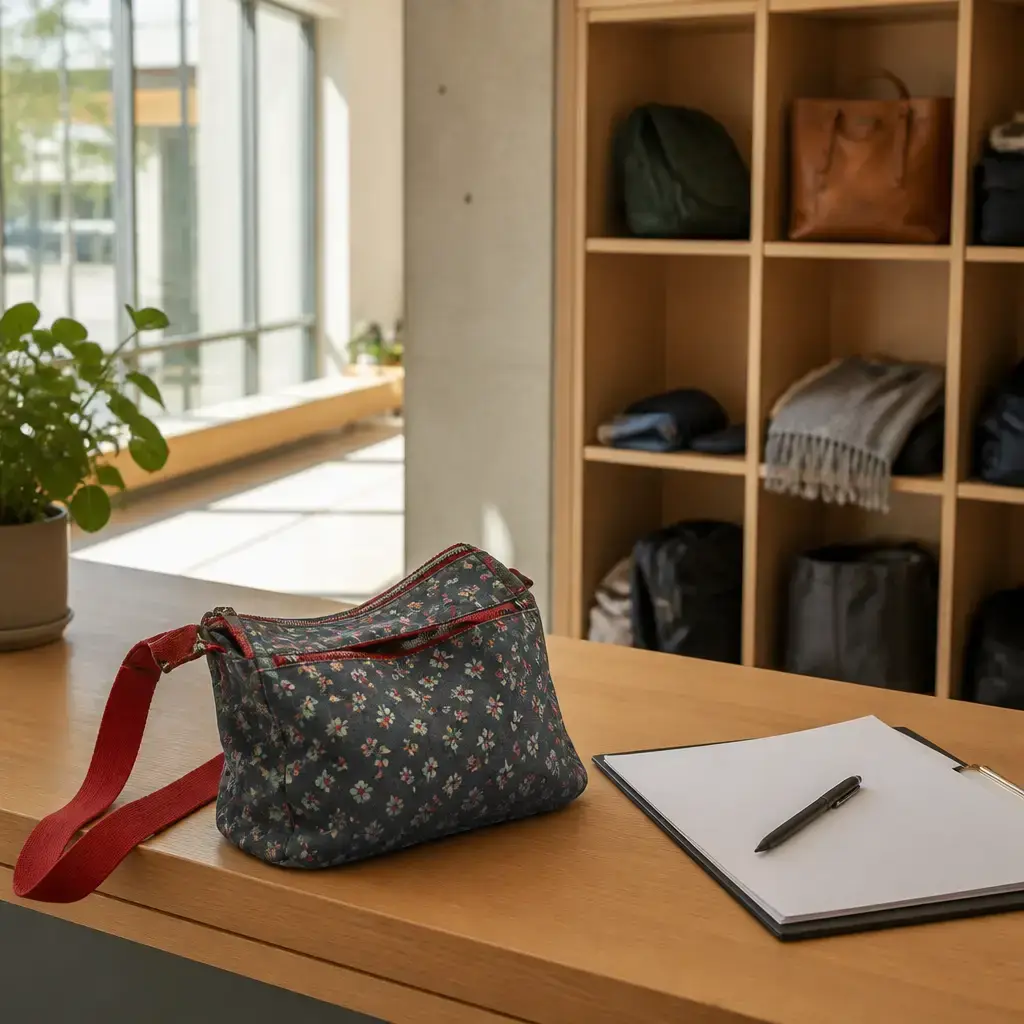
KURN-nen zee zee fyoor mikh beh-SHREYE-ben? Can you describe it for me?Sie hat einen roten Trageriemen und einen kaputten Reißverschluss.
zee hat EYE-nen ROH-ten TRAH-guh-REE-men oont EYE-nen kah-PUT-ten RYSE-fehr-SHLOOS. It has a red strap and a broken zipper.Gibt es vorne ein Muster?
gipt ess FOR-nuh eye-n MUS-ter? Is there any pattern on the front?Da ist ein kleines Blumenmuster.
dah ist ine KLY-nuhs BLOO-men-MUS-ter. There's a small flower pattern.Das könnte Ihre sein.
dahs KURN-tuh EE-reh zine. This might be yours.Das ist ganz sicher meine Tasche.
dahs ist gants ZIKH-uh MY-nuh TAH-shuh. That's definitely my bag.Bitte unterschreiben Sie dieses Formular, bevor Sie sie mitnehmen.
BIT-tuh oon-tuh-SHREYE-ben zee DEE-zuhs for-moo-LAHR, beh-FOHR zee zee MIT-nay-men. Please sign this form before you take it.Sentence explanations
Ich suche meine Tasche im Fundbüro.
I'm looking for my bag at lost property.
- Ich
- I
- suche
- am looking for
- meine
- my
- Tasche
- bag
- im
- in the
- Fundbüro
- lost-property office
More detail
Ich means “I” and is the first-person singular subject form. It identifies the speaker as the person doing the action. Compare du (“you,” singular informal) and Sie (“you,” formal). suche comes from the verb suchen, “to look for” or “to search for.” Here it is the present-tense first-person singular form: ich suche. The verb describes an ongoing search in this sentence. Example: Ich suche meinen Schlüssel. — “I’m looking for my key.” meine means “my” here. It is a possessive determiner, and its ending matches the feminine accusative noun Tasche: meine Tasche. The form changes with the noun phrase’s grammatical case and gender; for example, mein Schlüssel is “my key,” while meiner Tasche can mean “of my bag” or “to my bag” in contexts requiring the feminine dative. Tasche means “bag.” It is a feminine noun: die Tasche; its plural is die Taschen. In this sentence, Tasche is the direct object of suchen, so the phrase is in the accusative: meine Tasche. Example: Ich kaufe eine Tasche. — “I’m buying a bag.” im is the contraction of in dem, meaning “in the” here. With a location that answers “where?”, in takes the dative, so dem Fundbüro becomes im Fundbüro. The contraction is fixed as one written word in this sentence. Fundbüro means “lost-property office” or “lost-and-found office.” It is a neuter noun: das Fundbüro; after in for a stationary location, the dative form is still dem Fundbüro, represented in the contraction im Fundbüro. Example: Das Fundbüro ist im Bahnhof. — “The lost-property office is in the train station.” Together, Ich suche meine Tasche means “I’m looking for my bag,” and im Fundbüro locates that search in the lost-property office. The complete utterance is therefore “I’m looking for my bag at the lost-property office.”
Können Sie sie für mich beschreiben?
Can you describe it for me?
- Können Sie
- Can you
- sie
- it
- für mich
- for me
- beschreiben
- describe
More detail
Können Sie means “can you” here. können is the modal verb meaning “can/be able to”; with the formal pronoun Sie, it has the form können. Capitalized Sie is the polite form of “you” and can refer to one or more people. In a question, the conjugated modal comes first: Können Sie ...? Example: Können Sie warten? — “Can you wait?” sie means “it” here because it refers to the feminine noun Tasche (“bag”) in the supplied context. This lowercase sie is different from capitalized formal Sie. As an object pronoun, sie is the accusative form for a feminine singular referent. Example: Ich sehe die Tasche. Ich sehe sie. — “I see the bag. I see it.” für mich means “for me.” für normally takes the accusative case, so the first-person pronoun is mich, not nominative ich. The phrase can express that an action is done for someone’s benefit. Example: Können Sie das für mich öffnen? — “Can you open that for me?” beschreiben means “describe.” Its base form is beschreiben; it is an infinitive here. After the modal verb können, the infinitive goes to the end of the question: Können Sie sie ... beschreiben? The verb describes putting something into words, such as its appearance or features. Example: Ich kann den Rucksack beschreiben. — “I can describe the backpack.” Together, Können Sie asks about ability or willingness in a polite formal way, sie is the bag being described, für mich gives the beneficiary, and beschreiben names the requested action. The whole utterance therefore means: “Can you describe it for me?”
Sie hat einen roten Trageriemen und einen kaputten Reißverschluss.
It has a red strap and a broken zipper.
- Sie hat
- it has
- einen
- a
- roten
- red
- Trageriemen
- strap
- und
- and
- einen
- a
- kaputten
- broken
- Reißverschluss
- zipper
More detail
Sie hat means “it has” here, as fixed by the translation. hat is the third-person singular present form of haben (“to have”): ich habe, du hast, er/sie/es hat. Sie is the subject in this sentence and has the intended meaning “it” here. Its initial capital is required by sentence position, so the capitalization alone does not identify the pronoun's meaning. einen is the indefinite article for a masculine noun in the accusative case. Here it introduces Trageriemen, the direct object of hat. An indefinite article introduces an unspecified referent; it does not by itself assert a numerical count. The same article form appears again before Reißverschluss because that noun is also masculine and is also a direct object. roten comes from the adjective rot (“red”). It describes Trageriemen and takes the ending -en in this masculine accusative noun phrase after einen. Example: Ich sehe einen roten Ball. — “I see a red ball.” Trageriemen means “strap,” specifically a carrying strap. It is a masculine noun: der Trageriemen. Its plural is die Trageriemen, so the noun form itself is unchanged between singular and plural; the article or other surrounding words can show the number. und connects two equivalent parts: “and.” It joins the first object phrase with the second one. kaputten comes from kaputt (“broken” or “damaged”). It describes Reißverschluss and has the -en ending because it is in the same masculine accusative pattern after einen. Example: Der Reißverschluss ist kaputt. — “The zipper is broken.” In that example, kaputt follows ist and does not take the -en ending. Reißverschluss means “zipper.” It is a masculine noun: der Reißverschluss; its plural is die Reißverschlüsse, with an umlaut and -e. Together, Sie hat states a feature of the described item. einen roten Trageriemen is the first thing it has, and einen kaputten Reißverschluss is the second. The complete meaning is: “It has a red strap and a broken zipper.”
Gibt es vorne ein Muster?
Is there any pattern on the front?
- Gibt es
- is there
- vorne
- at/on the front
- Muster
- pattern
More detail
Gibt es is the reusable German pattern for asking whether something exists or is present: Gibt es ...? = “Is there ...?” or “Are there ...?” The verb is geben; gibt is its present-tense third-person singular form. In this construction, es is a grammatical element of the existence pattern, not a specific person or object. Example: Gibt es hier Kaffee? — “Is there coffee here?” vorne is an adverb meaning “at the front” or “on the front.” It describes location without changing form. Example: Vorne ist ein Fenster. — “There is a window at the front.” Muster means “pattern.” It is a neuter noun: das Muster. Its plural is also Muster, so the article or surrounding context can show whether it is singular or plural. Here, the indefinite noun phrase ein Muster asks about the presence of a pattern; the indefinite article does not by itself assert a numerical count of exactly one. Example: Das Muster ist einfach. — “The pattern is simple.” Together, Gibt es vorne ein Muster? asks whether a pattern is present on the front: “Is there any pattern on the front?” The location vorne is placed between the existence pattern and the noun phrase ein Muster, which is the thing whose presence is being asked about.
Da ist ein kleines Blumenmuster.
There's a small flower pattern.
- Da ist
- there is / there's
- kleines
- small
- Blumenmuster
- flower pattern
More detail
Da ist introduces something that is present or located somewhere: “there is” or “there’s.” ist is the third-person singular present form of sein (“to be”); the fixed phrase uses it with the singular noun phrase that follows. Example: Da ist der Schlüssel. — “There’s the key.” kleines means “small” here and describes Blumenmuster. The base form is klein; kleines is the adjective form used with a neuter singular noun phrase after the indefinite article ein: ein kleines .... The ending agrees with the noun phrase, not with Da ist. Blumenmuster means “flower pattern.” It is a compound noun: Blume means “flower,” and Muster means “pattern.” German compound nouns are written as one word, and the last part determines the grammatical gender; Muster is neuter, so the phrase has ein kleines Blumenmuster. Together, Da ist + ein kleines Blumenmuster produces “There’s a small flower pattern.” The sentence presents the pattern as something that is there; it does not specify an exact location beyond the context.
Das könnte Ihre sein.
This might be yours.
- Das
- this
- könnte
- might or could
- Ihre
- yours (formal)
- sein
- be
More detail
Das is a demonstrative pronoun meaning “this” here. It is neuter singular in form, but that grammatical form does not by itself identify the object being indicated. When a German demonstrative is used with an expressed noun, forms such as dieser, diese, and dieses reflect the noun’s grammatical gender and number. könnte is the third-person singular Konjunktiv II form of können, expressing tentative possibility here: “might” or “could.” The present form kann expresses ability or possibility more directly, while könnte makes it less certain. For example, Das könnte stimmen. means “That might be correct.” Ihre is a standalone formal possessive pronoun meaning “yours” in this sentence. Its capital letter distinguishes formal Ihre, related to Sie (“you,” formal), from lowercase ihre, which can mean “her” or “their.” Because the omitted possessed item is understood rather than stated, the form’s ending reflects that item’s grammatical features; Ihre can be the nominative form for a feminine singular or plural item. The sentence itself does not name the omitted item. For example, Die Tasche ist Ihre. means “The bag is yours.” sein is the infinitive of sein, “to be.” Here it follows the modal form könnte; together, könnte ... sein means “might be.” In another use, Die Tasche könnte dort sein. means “The bag might be there.” Together, Das is the subject, könnte ... sein presents the identification or ownership as uncertain, and Ihre gives the possessor in the formal “your/yours” sense. The complete meaning is “This might be yours.” A reusable pattern is Das könnte [possessive form] sein, for example Das könnte meine sein. — “This might be mine.”
Das ist ganz sicher meine Tasche.
That's definitely my bag.
- Das ist
- That is
- ganz sicher
- definitely
- meine
- my
- Tasche
- bag
More detail
Das ist combines the demonstrative pronoun das (“that”) with ist, the third-person singular present form of sein (“to be”). In this sentence, it identifies something as the speaker’s bag. The same pattern is reusable: Das ist mein Buch. — “That is my book.” ganz sicher strengthens the statement: sicher means “certain” or “sure,” and ganz makes it “completely,” giving “definitely” here. Sicher can also mean “safe” in other contexts, but that is not its meaning in this utterance. Example: Ich komme ganz sicher. — “I’m definitely coming.” meine is the possessive form of mein (“my”). It appears as meine because it accompanies the feminine singular noun Tasche in this noun phrase; the form also matches a plural noun in some grammatical contexts. The possessive identifies the bag as belonging to the speaker. Example: Das ist meine Jacke. — “That is my jacket.” Tasche means “bag.” It is a feminine singular noun, conventionally written with a capital letter in German. Its plural is Taschen. Example: Die Tasche ist hier. — “The bag is here.” Together, Das ist + ganz sicher + meine Tasche produces “That is definitely my bag.” The sentence asserts the identification confidently; ganz sicher modifies the complete identification rather than changing who owns the bag.
Bitte unterschreiben Sie dieses Formular, bevor Sie sie mitnehmen.
Please sign this form before you take it.
- Bitte
- please
- unterschreiben
- sign
- Sie
- you (formal)
- dieses
- this
- Formular
- form
- bevor
- before
- sie
- it
- mitnehmen
- take along
More detail
Bitte makes the request polite. At the beginning of a request, it can stand with the polite imperative pattern Bitte + infinitive + Sie: Bitte warten Sie. means “Please wait.” unterschreiben means “to sign.” This is the infinitive/base form; in the request, Sie supplies the formal subject: Unterschreiben Sie das Dokument. — “Sign the document.” Sie is the formal “you” subject here. Its spelling is identical to the capitalized formal pronoun in other cases, while lowercase sie can have different functions. Capitalization distinguishes formal Sie from the lowercase form in this sentence. dieses means “this” and agrees with the neuter noun Formular: dieses Formular. The same demonstrative changes with grammatical case and gender, for example diese Tasche (“this bag”) but diesen Stift (“this pen”) in the accusative. Formular means “form.” It is a neuter noun: das Formular; its plural is die Formulare. The noun is the object of unterschreiben, so dieses has the neuter accusative form, which is also dieses. bevor introduces a subordinate clause meaning “before.” In a German subordinate clause introduced by bevor, the finite verb normally goes to the end: bevor Sie gehen — “before you leave.” sie is a lowercase feminine singular accusative pronoun, meaning “her” or “it” when the thing referred to is feminine. In the supplied context, it refers to die Tasche (“the bag”), so sie does not grammatically refer to neuter das Formular; that would be es if the form itself were being taken along. The context therefore supports “take it” with the bag as the understood item. mitnehmen means “to take along” or “to take with you.” It is a separable verb: in a main clause, Sie nehmen die Tasche mit means “You take the bag along,” while after bevor the infinitive remains together at the end: bevor Sie die Tasche mitnehmen. Together, Bitte unterschreiben Sie dieses Formular is “Please sign this form.” The following clause, bevor Sie sie mitnehmen, adds “before you take it along,” with sie referring to the feminine Tasche established by the preceding context. The complete utterance is therefore: “Please sign this form before you take it.”
Grammar Points
bevor + Nebensatz: Das konjugierte Verb steht am Ende.
Bevor Sie das Formular unterschreiben, ...
beh-FOHR zee dahs for-moo-LAHR oon-tuh-SHREYE-ben.Before you sign the form, ...
After bevor, German uses a subordinate clause, so the conjugated verb goes to the end.
Trennbares Verb: mitnehmen → nimmt ... mit
Sie nimmt die Tasche mit.
zee NIMT dee TAH-shuh MIT.She takes the bag with her.
In a main clause, the prefix mit separates from nimmt and moves to the end.
German Vocabulary
sie für mich beschreiben
ein kleines Blumenmuster
im Fundbüro
einen kaputten Reißverschluss
Gibt es vorne ein Muster?
einen kaputten Reißverschluss
ganz sicher
Ich suche meine Tasche
meine Tasche
einen roten Trageriemen
dieses Formular unterschreiben
vorne ein Muster
Quiz
Word Order
Arrange the words in the correct order.
I'm looking for my bag at lost property.
Show Answer
Ich suche meine Tasche im Fundbüro.Can you describe it for me?
Show Answer
Können Sie sie für mich beschreiben?Is there any pattern on the front?
Show Answer
Gibt es vorne ein Muster?Spelling
Tap the letters to spell the word.
pattern
Show Answer
Musterat the front
Show Answer
vornebag
Show Answer
Taschebroken