10 minutes free every day
Continue audio lessons in the app
Word explanations appear automatically in sync with the audio.
No login required · synced translations · playback with the screen locked
Choose your learning language and open this lesson in the app.

About This Lesson
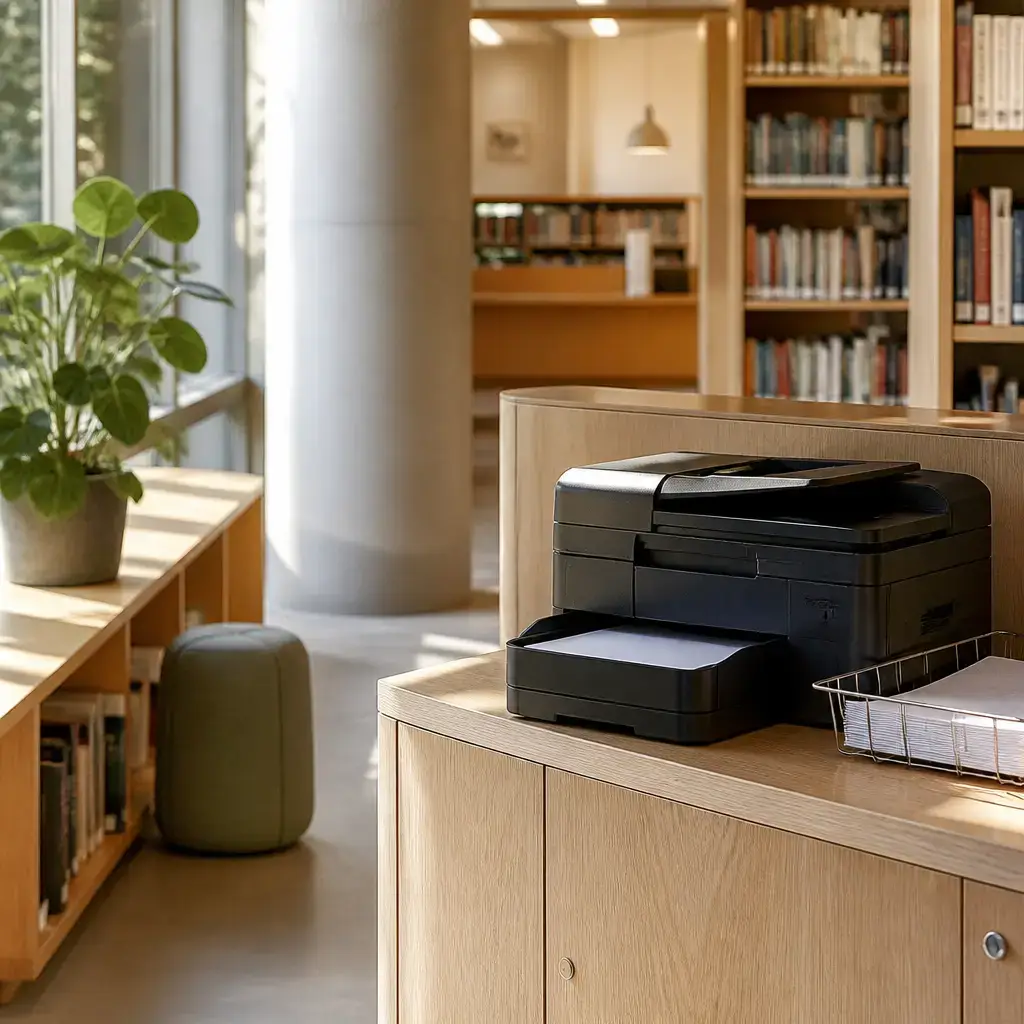
Use Using the library printer to practice German conversation, pronunciation, vocabulary, grammar, and quizzes.
Dialogue
Wie benutze ich den Drucker in der Bibliothek?
vee beh-NOOT-suh ikh dayn DROOK-uh in dayr bee-blee-oh-TAYK? How do I use the printer in the library?Wählen Sie zuerst den Drucker auf diesem Bildschirm aus.
VAY-len zee tsoo-AIRST dayn DROOK-uh owf DEE-zem BILT-shirm ows. First, choose the printer on this screen.Kann ich doppelseitiges Drucken auswählen?
kahn ikh DOP-el-ZY-tig-es DROOK-en OWS-VAY-len? Can I choose double-sided printing?Ändern Sie die Einstellung, bevor Sie drucken.
EN-durn zee dee EYN-shtel-oong beh-FOHR zee DROOK-en. Change the setting before you print.Ich muss nur ein kurzes Dokument drucken.
ikh moos noor ayn KOORT-ses doh-koo-MENT DROOK-en. I only need to print a short document.Dann prüfen Sie die Vorschau, bevor Sie starten.
dahn PRUE-fen zee dee FOHR-show beh-FOHR zee SHTAHR-ten. Then check the preview before you start.Wo kommen die gedruckten Seiten heraus?
voh KOM-en dee geh-DROOK-ten ZY-ten heh-ROWS? Where do the printed pages come out?Sie kommen unten aus dem Fach.
zee KOM-en OON-ten ows daym FAHKH. They come out in the tray below.Sentence explanations
Wie benutze ich den Drucker in der Bibliothek?
How do I use the printer in the library?
- Wie
- how
- benutze
- use
- Drucker
- printer
- Bibliothek
- library
More detail
Wie asks about the manner or method: “how”. It is used to ask how an action is carried out. For example, Wie öffne ich die Datei? means “How do I open the file?” benutze means “use” here. It is the first-person singular present form of benutzen: ich benutze = “I use” or, in a question about the current task, “do I use”. The verb keeps the same stem in the present tense; the ending -e marks ich in this form. Example: Ich benutze den Computer. — “I use the computer.” den Drucker identifies the thing being used. Drucker is a masculine noun meaning “printer”; its base dictionary form is der Drucker. Here den shows the masculine accusative form, because the printer is the direct object of benutzen. The noun itself is unchanged. Example: Ich benutze den Drucker. — “I use the printer.” in der Bibliothek gives the location: “in the library”. Bibliothek is a feminine noun, die Bibliothek. With in for a stationary location, German uses the dative, so die becomes der: in der Bibliothek. With movement into the library, the accusative is used instead: Ich gehe in die Bibliothek. — “I go into the library.” Together, Wie benutze ich den Drucker asks for the method of using the printer, and in der Bibliothek specifies the location. The complete utterance means: “How do I use the printer in the library?”
Wählen Sie zuerst den Drucker auf diesem Bildschirm aus.
First, choose the printer on this screen.
- Wählen … aus
- choose; select
- Sie
- you (formal)
- zuerst
- first
- Drucker
- printer
- diesem
- this
- Bildschirm
- screen
More detail
Wählen ... aus is the separable verb auswählen, meaning “to choose” or “to select.” In the fixed sentence, Wählen is the infinitive-shaped verb form used in a formal command, while the separable prefix aus moves to the end of the clause. The reusable pattern is Wählen Sie ... aus. Example: Wählen Sie eine Sprache aus. — “Choose a language.” Sie is the formal “you” used for one person or more than one person. In a formal imperative, German uses the verb form followed by Sie: Wählen Sie .... zuerst means “first” or “first of all.” It places this action before the other actions being discussed. Example: Öffnen Sie zuerst die Datei. — “First, open the file.” Drucker means “printer.” Here, den Drucker is the direct object of wählen ... aus, the thing being selected. The noun is masculine, and the masculine accusative article is den; the basic form of the noun phrase is der Drucker. Example: Ich sehe den Drucker. — “I see the printer.” diesem means “this” in the form required here. It agrees with the masculine noun Bildschirm and is in the dative case because auf describes a location in auf diesem Bildschirm. The demonstrative forms include dieser for masculine nominative, diese for feminine nominative, and diesem for masculine or neuter dative. Its form expresses the grammatical relationship; the sentence identifies the particular screen as “this screen.” Bildschirm means “screen.” In auf diesem Bildschirm, it is the noun governed by the location phrase “on this screen.” The noun is masculine: der Bildschirm. With auf for a fixed location, German uses the dative here; movement toward a destination can instead use the accusative, as in the example Ich stelle das Gerät auf den Tisch. — “I put the device on the table.” Together, Wählen Sie ... aus gives the formal command “choose/select ...,” zuerst means that this should happen first, den Drucker names what must be selected, and auf diesem Bildschirm specifies the screen where it appears. The complete meaning is: “First, choose the printer on this screen.”
Kann ich doppelseitiges Drucken auswählen?
Can I choose double-sided printing?
- Kann ich
- Can I
- doppelseitiges
- double-sided
- printing
- auswählen
- choose
More detail
Kann ich is the reusable question pattern for asking whether the speaker is allowed or able to do something. kann is the present-tense form of können for ich; the subject ich follows the verb because this is a yes/no question. For example, Kann ich hier bezahlen? means “Can I pay here?” doppelseitiges means “double-sided” here. It is the adjective doppelseitig, used before the neuter noun Drucken; its ending -es agrees with that noun in this noun phrase. The word describes printing on both sides. For example, doppelseitiges Papier means “double-sided paper,” although the ending changes because Papier has a different grammatical gender and article context. Drucken is the nominalized infinitive of drucken, “to print,” so it is written with a capital letter and functions as a noun: “printing.” The verb drucken is separate from Drucken in spelling and grammatical use. For example, Ich möchte drucken. means “I would like to print,” while Das Drucken dauert lange. means “Printing takes a long time.” auswählen means “to choose” or “to select.” It is a separable verb formed with aus- and the verb wählen. In the infinitive, as here, it remains together as auswählen; in a main clause, the prefix can separate: Ich wähle den Drucker aus. means “I select the printer.” Together, Kann ich asks about permission or possibility, doppelseitiges Drucken names the option “double-sided printing,” and auswählen expresses selecting it. The whole utterance therefore means: “Can I choose double-sided printing?”
Ändern Sie die Einstellung, bevor Sie drucken.
Change the setting before you print.
- Ändern Sie
- change (formal command)
- Einstellung
- setting
- bevor
- before
More detail
Ändern Sie is a formal command meaning “change.” The base verb is ändern; the form Ändern is used with formal Sie in the polite imperative. German formal Sie takes the same verb form as third-person plural, but here it addresses one or more people formally. For an informal singular command, German uses Ändere instead. Einstellung means “setting.” It is a feminine noun: die Einstellung; its plural is die Einstellungen. The noun can refer to a configuration or option in a device or program. Example: Die Einstellungen sind neu. — “The settings are new.” bevor introduces a clause for an earlier event: “before.” In the clause introduced by bevor, the finite verb normally goes to the end. Example: Bevor Sie beginnen, lesen Sie die Anleitung. — “Before you begin, read the instructions.” drucken means “to print.” It is the infinitive, and it also appears as the verb form used with formal Sie in the present tense: Sie drucken — “you print.” In this sentence, drucken is at the end of the bevor clause because that clause has subordinate-clause word order. Together, Ändern Sie die Einstellung gives the formal instruction “Change the setting.” bevor Sie drucken adds the time condition “before you print”: the addressee should change the setting first and print afterward. The complete utterance is therefore: “Change the setting before you print.”
Ich muss nur ein kurzes Dokument drucken.
I only need to print a short document.
- Ich muss
- I need to
- nur
- only
- kurzes
- short
- Dokument
- document
More detail
Ich muss means “I need to” here. muss is the first-person singular present form of müssen (“to have to; must”). In a main clause, the finite form comes in the second position, while the other verb stays at the end: Ich muss arbeiten. — “I have to work.” The form muss expresses necessity; it is not the same as möchte (“would like to”), which expresses a wish. nur narrows the statement to one limited action or purpose: “only.” It does not mean that the speaker is describing a quantity of one; the limitation here concerns what the speaker needs to do. Its position can affect what is being limited, so in Ich muss nur drucken, the focus is on only printing. kurzes means “short” in this sentence. The base form is the adjective kurz; kurzes is an inflected form agreeing with the neuter noun Dokument in this noun phrase. With the indefinite article ein, a neuter adjective takes the ending -es: ein kurzes Dokument. The adjective describes the document’s length here, not the duration of the printing. Dokument is the noun “document.” Its plural is Dokumente: zwei Dokumente — “two documents.” In the sentence, ein Dokument is the object of drucken, the thing that is printed. drucken means “to print.” This is the infinitive, and it follows the finite modal verb muss at the end of the main clause. The reusable pattern is Ich muss + infinitive: Ich muss die Datei speichern. — “I need to save the file.” Putting the parts together, Ich muss states the speaker’s necessity, nur limits that necessity, and ein kurzes Dokument drucken specifies the action and its object. The whole utterance therefore means: “I only need to print a short document.”
Dann prüfen Sie die Vorschau, bevor Sie starten.
Then check the preview before you start.
- Dann
- then
- prüfen
- check
- die Vorschau
- the preview
- bevor
- before
- starten
- start
More detail
Dann is a temporal adverb meaning “then” here: it places the checking step after an earlier step. Example: Dann drucken Sie das Dokument. — “Then print the document.” prüfen means “to check” or “to inspect.” In prüfen Sie, it is the infinitive used in the formal imperative pattern Verb + Sie: Prüfen Sie ... — “Check ...” The formal Sie is the subject addressed respectfully; the verb form is also the form used with formal Sie in ordinary statements. die Vorschau means “the preview.” Vorschau is a feminine noun, and die marks the accusative here because the preview is the direct object of prüfen; for this feminine noun, nominative and accusative both use die. Example: Ich öffne die Vorschau. — “I open the preview.” bevor introduces a time clause meaning “before.” In the clause after bevor, the finite verb goes to the end: bevor Sie starten — “before you start.” This is a subordinating conjunction, so the clause has the same subject Sie as the person being addressed, but the word order differs from a main clause. starten means “to start.” In Sie starten, it is the finite present-tense form with formal Sie; it looks identical to the infinitive. Example: Sie starten das Programm. — “You start the program.” Together, Dann prüfen Sie die Vorschau gives the formal instruction “Then check the preview.” bevor Sie starten adds the time condition “before you start,” so the complete utterance is: “Then check the preview before you start.”
Wo kommen die gedruckten Seiten heraus?
Where do the printed pages come out?
- Wo
- where
- kommen
- come
- gedruckten
- printed
- Seiten
- pages
- heraus
- out
More detail
Wo asks for a place: “where”. It is used for a location, not a destination. Example: Wo ist das Fach? — “Where is the tray?” kommen is the present-tense form of kommen (“to come”) for the plural pronoun sie (“they”) here. It agrees with the plural subject die gedruckten Seiten, so it means “come”. In this W-question, the finite verb is in the second position, while the separable prefix moves to the end. gedruckten means “printed” here. It is the adjective gedruckt, used before the plural noun Seiten with the definite article die; the ending -en is the weak adjective ending in this nominative plural phrase. It describes the pages as pages that have been printed. Example: die gedruckten Dokumente — “the printed documents.” Seiten is the plural of Seite, “page”. The singular is eine Seite (“a page”). Example: Die Seite ist leer. — “The page is blank.” heraus is the separable prefix in herauskommen, “to come out”. In this question, kommen ... heraus forms that verb: kommen is conjugated and heraus appears at the end. The directional sense is “out”, as in something emerging from an enclosure or opening. Together, die gedruckten Seiten is the subject, kommen ... heraus says that they emerge, and Wo asks for the place of that emergence. The whole utterance therefore means: “Where do the printed pages come out?”
Sie kommen unten aus dem Fach.
They come out in the tray below.
- Sie
- they
- kommen
- come
- unten
- below
- aus dem
- out of the
- Fach
- tray; compartment
More detail
Sie means “they” here, as confirmed by the fixed translation. Because it begins the sentence, it is written with a capital letter; the corresponding third-person plural pronoun is normally written lowercase sie elsewhere. Capitalized Sie can also mean formal singular or plural “you,” but that is a different use and is not the meaning here. kommen is the present-tense form of kommen (“to come”). With the third-person plural subject sie, the form is sie kommen. Example: Die Seiten kommen heraus. — “The pages come out.” unten means “below” or “down below” and specifies the location here. Example: Der Schalter ist unten. — “The switch is below.” aus dem combines aus (“out of; from”) with the dative singular definite article dem. aus governs the dative, so the following noun phrase is dative. This combination can be reused before a masculine or neuter singular noun, for example aus dem Drucker — “out of the printer.” Fach is a neuter noun meaning “compartment,” “slot,” or “tray.” Its dictionary form is das Fach; in aus dem Fach, the article marks the dative singular, while the noun itself has the same form as in the nominative singular. Here, the fixed translation supports the sense “tray.” Together, Sie kommen means “they come,” unten places the tray below, and aus dem Fach expresses movement out of that tray. The complete utterance means “They come out in the tray below,” referring to the printed pages established by the preceding question.
Grammar Points
Trennbare Verben: auswählen → ... aus
Wählen Sie doppelseitiges Drucken aus.
VAY-len zee DOP-el-ZY-tig-es DROOK-en ows.Select double-sided printing.
Bei trennbaren Verben steht „aus“ am Satzende: auswählen → Wählen Sie ... aus.
Trennbares Verb: herauskommen → ... heraus
Die Seite kommt unten heraus.
dee ZY-tuh KOMT OON-ten heh-ROWS.The page comes out below.
Bei „herauskommen“ steht „heraus“ am Satzende: Die Seite kommt ... heraus.
German Vocabulary
Ändern Sie die Einstellung
den Drucker ... auswählen
Wie benutze ich den Drucker?
in der Bibliothek
auf diesem Bildschirm
ein kurzes Dokument
doppelseitiges Drucken
doppelseitiges Drucken
den Drucker
die Einstellung
ein kurzes Dokument
Wählen Sie zuerst
Quiz
Word Order
Arrange the words in the correct order.
Can I choose double-sided printing?
Show Answer
Kann ich doppelseitiges Drucken auswählen?Where do the printed pages come out?
Show Answer
Wo kommen die gedruckten Seiten heraus?They come out in the tray below.
Show Answer
Sie kommen unten aus dem Fach.Spelling
Tap the letters to spell the word.
to change
Show Answer
Ändernlibrary
Show Answer
Bibliothekto choose
Show Answer
Wählento use