10 minutes free every day
Continue audio lessons in the app
Word explanations appear automatically in sync with the audio.
No login required · synced translations · playback with the screen locked
Choose your learning language and open this lesson in the app.

About This Lesson
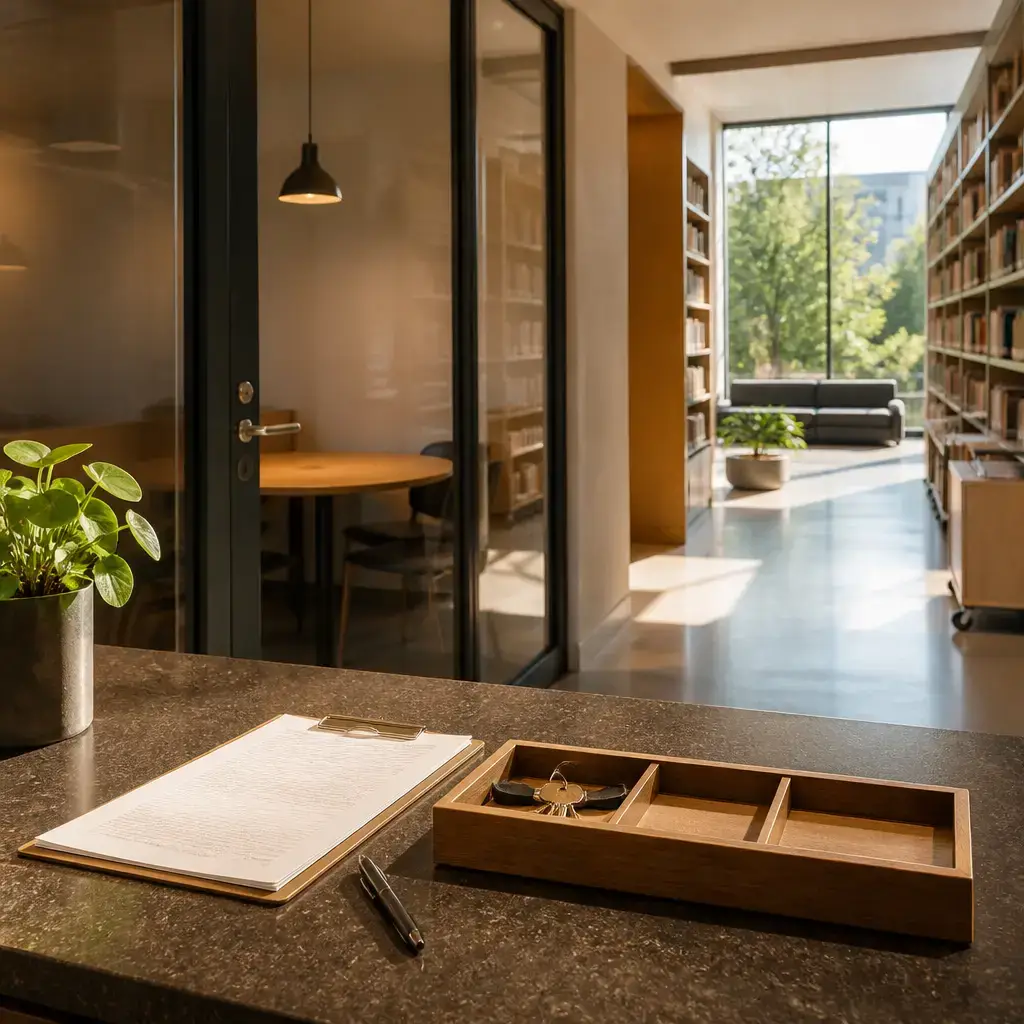
Use Reserving a Study Room to practice German conversation, pronunciation, vocabulary, grammar, and quizzes.
Dialogue
Ich möchte einen Lernraum reservieren.
ikh MURKH-tuh EYE-nen LAIRN-rowm reh-zehr-VEE-ren. I would like to reserve a study room.Ich schaue nach, welche Räume heute frei sind.
ikh SHOW-uh nahkh, VEL-khuh ROY-muh HOY-tuh fry zint. Let me check which rooms are open today.Ich brauche einen ruhigen Ort, um mit einem Klassenkameraden zu lernen.
ikh BROW-khuh EYE-nen ROO-ih-gen ORT, oom mit EYE-nem KLAH-sen-kah-meh-RAH-den tsoo LAIR-nen. I need a quiet place to study with a classmate.Heute Nachmittag ist ein kleiner Raum frei.
HOY-tuh NAKH-mit-tahk ist eye-n KLY-nuh rowm fry. A small room is free this afternoon.Kann ich ihn am Serviceschalter buchen?
KAHN ikh een ahm ZAIR-vis-SHAHL-tuh BOO-khen? Can I book it at the service desk?Bitte füllen Sie hier das Anfrageformular aus.
BIT-tuh FEWL-len zee heer dahs AHN-frah-guh-for-MOO-lahr ows. Please fill in the request form here.Gebe ich den Schlüssel an diesem Serviceschalter zurück?
GAY-buh ikh dane SHLEW-sel ahn DEE-zem ZAIR-vis-SHAHL-tuh tsoo-ROOK? Do I return the key to this service desk?Bringen Sie ihn vor der Schließzeit zurück.
BRING-en zee een fohr dair SHLEESS-tsайт tsoo-ROOK. Bring it back before closing.Sentence explanations
Ich möchte einen Lernraum reservieren.
I would like to reserve a study room.
- Ich möchte
- I would like
- Lernraum
- study room
- reservieren
- to reserve
More detail
Ich möchte expresses the speaker’s polite wish: “I would like.” möchte is the form used here from mögen (“to like”); in this use, it is a polite way to state what the speaker wants, rather than a simple present-tense statement of liking. With a verb, the pattern is Ich möchte + ... + infinitive. Lernraum means “study room.” It is a masculine compound noun: der Lernraum, plural die Lernräume. In this sentence, the preceding indefinite article appears as einen because the masculine noun is the object of reservieren in the accusative case. The compound combines Lern- (“learning/studying”) with Raum (“room”); the useful word to remember as a whole here is Lernraum. reservieren is the infinitive “to reserve.” After möchte, the second verb remains in the infinitive and moves to the end of the main clause. For example: Ich möchte einen Tisch reservieren. — “I would like to reserve a table.” Together, Ich möchte einen Lernraum reservieren has the structure I would like + an object + to reserve: “I would like to reserve a study room.” The finite verb möchte is in the second position, while the infinitive reservieren closes the sentence.
Ich schaue nach, welche Räume heute frei sind.
Let me check which rooms are open today.
- schaue nach
- check
- welche
- which
- Räume
- rooms
- heute
- today
- frei
- open; available
More detail
schaue nach comes from the separable verb nachschauen, meaning “to check” or “to look something up.” In the present tense with ich, the finite part is schaue and the particle moves to the end of the clause: Ich schaue nach. In the supplied sentence, the following clause says what is being checked. Example: Ich schaue nach, ob der Raum frei ist. — “I’ll check whether the room is available.” welche asks which member or members of a known set are intended. Here it is used with the plural noun Räume; as a determiner, it agrees with that noun in number. Compare the singular pattern welcher Raum — “which room” — with the plural welche Räume — “which rooms.” Räume is the plural of Raum, “room.” The umlaut marks the plural form: der Raum → die Räume. In this sentence, the word refers to rooms whose availability is being checked. Example: Die Räume sind groß. — “The rooms are large.” heute means “today” and places the situation on the current day. It can also be moved for emphasis without changing the basic time reference, for example: Heute sind die Räume frei. — “Today the rooms are available.” frei is an adjective meaning “available” in this context: the rooms are not occupied or otherwise unavailable. Its basic form is frei; the comparative is freier, “more available” or, depending on context, “freer.” Example: Ist dieser Raum frei? — “Is this room available?” Together, welche Räume heute frei sind is a subordinate question meaning “which rooms are available today.” Because this is an embedded question after Ich schaue nach, the finite verb sind comes at the end of that clause. The complete utterance therefore means: “Let me check which rooms are open today.”
Ich brauche einen ruhigen Ort, um mit einem Klassenkameraden zu lernen.
I need a quiet place to study with a classmate.
- Ich
- I
- brauche
- need
- ruhigen
- quiet
- Ort
- place
- um … zu lernen
- in order to study
- mit
- with
- Klassenkameraden
- classmate
More detail
Ich is the first-person singular pronoun, meaning “I.” It is the subject here, so it is in the nominative case. A useful contrast is ich “I” versus mich “me” when the pronoun is an object. brauche comes from brauchen “to need.” It is the present-tense first-person singular form: ich brauche = “I need.” The verb normally takes the needed thing as its object: Ich brauche Zeit. — “I need time.” ruhigen comes from the adjective ruhig “quiet, calm.” Here it describes Ort and has the ending -en because the masculine noun phrase einen ruhigen Ort is accusative singular. The adjective itself, not the noun, is the word carrying this ending. Compare ein ruhiger Ort in the nominative with einen ruhigen Ort in the accusative. Ort means “place.” Its base form is Ort; in this sentence it is masculine, singular, and accusative after brauchen. The singular nominative and accusative forms are both Ort, so the case is shown mainly by einen and ruhigen. Example: Dieser Ort ist ruhig. — “This place is quiet.” um ... zu lernen is a purpose construction meaning “in order to study” or, more naturally here, “to study.” lernen is the infinitive “to learn/study,” and zu lernen places it in the infinitive phrase. With a purpose clause, um comes at the beginning and zu directly precedes the infinitive: Ich gehe in die Bibliothek, um zu lernen. — “I go to the library to study.” mit means “with” and takes the dative case. It introduces the person accompanying the studying activity. Klassenkameraden means “classmate” here. The base noun is the masculine weak noun Klassenkamerad; in the dative singular after mit, it appears as Klassenkameraden. The same ending also appears in several other cases for this noun, so the preceding article helps show the form: mit einem Klassenkameraden = “with a classmate.” Example: Ich lerne mit einem Klassenkameraden. — “I study with a classmate.” The sentence combines Ich brauche (“I need”) with the object einen ruhigen Ort (“a quiet place”). The purpose phrase um mit einem Klassenkameraden zu lernen specifies what the place is needed for: studying with a classmate. Together, the sentence means “I need a quiet place to study with a classmate.”
Heute Nachmittag ist ein kleiner Raum frei.
A small room is free this afternoon.
- Heute Nachmittag
- this afternoon
- ist
- is
- kleiner
- small
- Raum
- room
- frei
- free; available
More detail
Heute Nachmittag means “this afternoon.” heute is “today,” and Nachmittag is the masculine noun “afternoon”; German nouns are capitalized. The phrase can be reused as a time expression: Heute Abend means “this evening.” ist is the present-tense third-person singular form of sein, “to be”: sein → ist. In this sentence, the time expression comes first, but the finite verb still occupies the second position: Heute Nachmittag ist .... kleiner describes Raum as small. Its base form is the adjective klein; here it has the ending -er because ein kleiner Raum is masculine singular nominative. The adjective changes with the noun phrase: ein kleines Zimmer uses kleines with the neuter noun Zimmer. Raum means “room” here. Its plural is Räume, with an umlaut: ein Raum / zwei Räume. The noun is masculine, as shown by ein and the adjective form kleiner in this sentence. frei means “free” in the sense of available or unoccupied. For example, Der Platz ist frei. means “The seat is available.” This is different from using frei to mean generally “free” in another context; here it describes the room’s availability. Together, Heute Nachmittag sets the time, ist links the subject with its description, and ein kleiner Raum identifies the subject. frei says that this small room is available. The whole utterance therefore means: “A small room is free this afternoon.”
Kann ich ihn am Serviceschalter buchen?
Can I book it at the service desk?
- Kann ich
- Can I
- ihn
- it
- Serviceschalter
- service desk
- buchen
- book
More detail
Kann ich begins a yes/no question. kann is the first-person singular form of können (“can, be able to”), and ich is the subject “I”. In a German question, the finite verb comes before the subject: Kann ich ...? = “Can I ...?” The infinitive belonging to kann comes later in the clause. ihn means “it” here and is the accusative form of the masculine singular pronoun er (“he/it”). The form ihn is used for a masculine singular object; the relevant form choice depends on the pronoun’s grammatical case and gender, not simply on its role as an object. Example: Ich sehe ihn. — “I see him/it.” The exact referent in this sentence is the thing identified by the fixed translation as “it”. Serviceschalter is a compound noun meaning “service desk”. Its parts are Service and Schalter, but the complete compound is the useful noun in this sentence. German nouns are capitalized. The preposition-and-article combination am before it means “at the”; it is the contracted form of an dem. buchen is the infinitive “to book” or “to reserve”. After the modal verb kann, German uses the infinitive: Kann ich ... buchen? Example: Kann ich den Raum buchen? — “Can I book the room?” Together, Kann ich forms the permission/ability question, ihn is the thing being booked, am Serviceschalter gives the location, and buchen supplies the main action. The complete meaning is: “Can I book it at the service desk?”
Bitte füllen Sie hier das Anfrageformular aus.
Please fill in the request form here.
- Bitte
- please
- füllen … aus
- fill in
- Sie
- you (formal)
- hier
- here
- Anfrageformular
- request form
More detail
Bitte means “please” here and makes the instruction polite. It can also introduce other polite requests, for example: Bitte warten Sie. — “Please wait.” füllen … aus are the two parts of the separable verb ausfüllen, “to fill out” or “to complete” a form. In this sentence, füllen is the verb form used with formal Sie, while the separable prefix aus moves to the end: Sie füllen das Formular aus. — “You fill out the form.” In the formal imperative, the same pattern gives Füllen Sie das Formular aus. — “Fill out the form.” Sie is the formal second-person pronoun, “you.” It is written with a capital letter and is used for one or more people; the form itself does not show that number distinction. With formal Sie, the verb uses the same form as the third-person plural: Sie füllen. hier means “here,” indicating the relevant place or location. Its position can vary without changing its basic meaning; for example, Füllen Sie hier das Formular aus. means “Fill out the form here.” Anfrageformular means “request form.” It is a compound noun: Anfrage means “request” or “inquiry,” and Formular means “form.” German nouns are capitalized, and this compound is neuter: das Anfrageformular. The plural is die Anfrageformulare. Together, Bitte füllen Sie ... aus forms a polite formal instruction, and hier specifies the place. das Anfrageformular is what should be completed. The complete meaning is: “Please fill in the request form here.”
Gebe ich den Schlüssel an diesem Serviceschalter zurück?
Do I return the key to this service desk?
- Gebe
- give
- Schlüssel
- key
- diesem
- this
- Serviceschalter
- service desk
- zurück
- back
More detail
Gebe is the first-person singular present form of geben (“to give”). In this utterance it combines with the separated particle zurück to form zurückgeben, “to return” or “to give back.” Because this is a yes/no question, the finite verb comes first: Gebe ich ... zurück? means “Do I return ...?” Example: Ich gebe den Schlüssel zurück. — “I return the key.” Schlüssel means “key.” The phrase den Schlüssel uses the masculine accusative article den because the key is the direct object of zurückgeben. Its base form is der Schlüssel; the noun itself has the same singular form here as in the nominative. Example: Ich brauche den Schlüssel. — “I need the key.” diesem is a form of the demonstrative dies-, meaning “this” here. It is dative masculine singular in an diesem Serviceschalter, agreeing with the masculine noun Serviceschalter. German uses the dative after an when describing a location or position. The corresponding masculine nominative form is dieser, as in dieser Schalter (“this desk”); diesem is the form required in this dative phrase. Serviceschalter is a compound noun meaning “service desk.” Its parts are Service and Schalter, but the complete compound is the noun used in the sentence. It is masculine: der Serviceschalter. In an diesem Serviceschalter, an presents the desk as the place associated with the return. zurück is the separable part of zurückgeben; by itself it contributes the idea “back.” In a finite main-clause question, geben is conjugated near the beginning and zurück appears at the end: Gebe ich ... zurück? The infinitive keeps the parts together: Ich möchte den Schlüssel zurückgeben. — “I would like to return the key.” Together, Gebe ich marks a first-person yes/no question, den Schlüssel is the item being returned, and an diesem Serviceschalter identifies this service desk as the location. The complete meaning is: “Do I return the key to this service desk?”
Bringen Sie ihn vor der Schließzeit zurück.
Bring it back before closing.
- Bringen … zurück
- bring back
- Sie
- you (formal)
- ihn
- him; it
- vor
- before
- Schließzeit
- closing time
More detail
Bringen … zurück is the separable verb zurückbringen, meaning “to bring back” here. In a formal command, its imperative pattern is Bringen Sie … zurück: the finite part Bringen comes first, Sie marks formal “you,” and zurück appears at the end. The verb is separated around the intervening object and time phrase. Example: Bringen Sie das Buch zurück. — “Bring the book back.” Sie is the formal second-person pronoun. It is written with a capital letter and uses the same form for one or more people; the surrounding verb form and context establish the formal command. This is distinct from informal du: Bring das Buch zurück! — “Bring the book back!” ihn is an accusative masculine singular pronoun. In this sentence, the fixed translation gives its intended meaning as “it,” referring to the thing being brought back; the German form reflects the grammatical gender and case of that understood object. The nominative counterpart is er, while ihn is used when the pronoun is the object: Ich sehe ihn. — “I see him.” vor means “before” here and introduces the time limit. With a noun phrase for a time, German uses vor in the sense “before [that time].” Schließzeit is a feminine noun meaning “closing time.” After this use of vor, the noun phrase is dative: die Schließzeit becomes der Schließzeit. Example: Komm vor der Abfahrt. — “Come before departure.” The complete structure is Bringen Sie ihn vor der Schließzeit zurück: formal “you” are commanded to bring the object back, with vor der Schließzeit setting the deadline. Thus the utterance means “Bring it back before closing.”
Grammar Points
möchte + Infinitiv am Satzende
Ich möchte einen Lernraum reservieren.
ikh MURKH-tuh EYE-nen LAIRN-rowm reh-zehr-VEE-ren.I would like to reserve a study room.
With möchte, the second verb stays in the infinitive at the end of the sentence.
Trennbare Verben: Präfix am Satzende
Ich fülle das Anfrageformular aus.
ikh FEWL-uh dahs AHN-frah-guh-for-MOO-lahr ows.I fill in the request form.
In a main clause, the prefix of a separable verb moves to the end: ausfüllen → fülle ... aus.
German Vocabulary
Ich brauche einen ruhigen Ort.
welche Räume heute frei sind
mit einem Klassenkameraden
Ein kleiner Raum ist frei.
um mit einem Klassenkameraden zu lernen
Ich möchte einen Lernraum reservieren.
Ich möchte einen Lernraum reservieren.
Ich schaue nach, welche Räume heute frei sind.
Ich brauche einen ruhigen Ort.
welche Räume heute frei sind
Ich möchte einen Lernraum reservieren.
einen ruhigen Ort
Quiz
Word Order
Arrange the words in the correct order.
I would like to reserve a study room.
Show Answer
Ich möchte einen Lernraum reservieren.Can I book it at the service desk?
Show Answer
Kann ich ihn am Serviceschalter buchen?Spelling
Tap the letters to spell the word.
would like to
Show Answer
möchteto need
Show Answer
brauchento reserve
Show Answer
reservierenfree; available