10 minutes free every day
Continue audio lessons in the app
Word explanations appear automatically in sync with the audio.
No login required · synced translations · playback with the screen locked
Choose your learning language and open this lesson in the app.

About This Lesson
Use Borrowing a Bicycle Pump to practice German conversation, pronunciation, vocabulary, grammar, and quizzes.
Dialogue
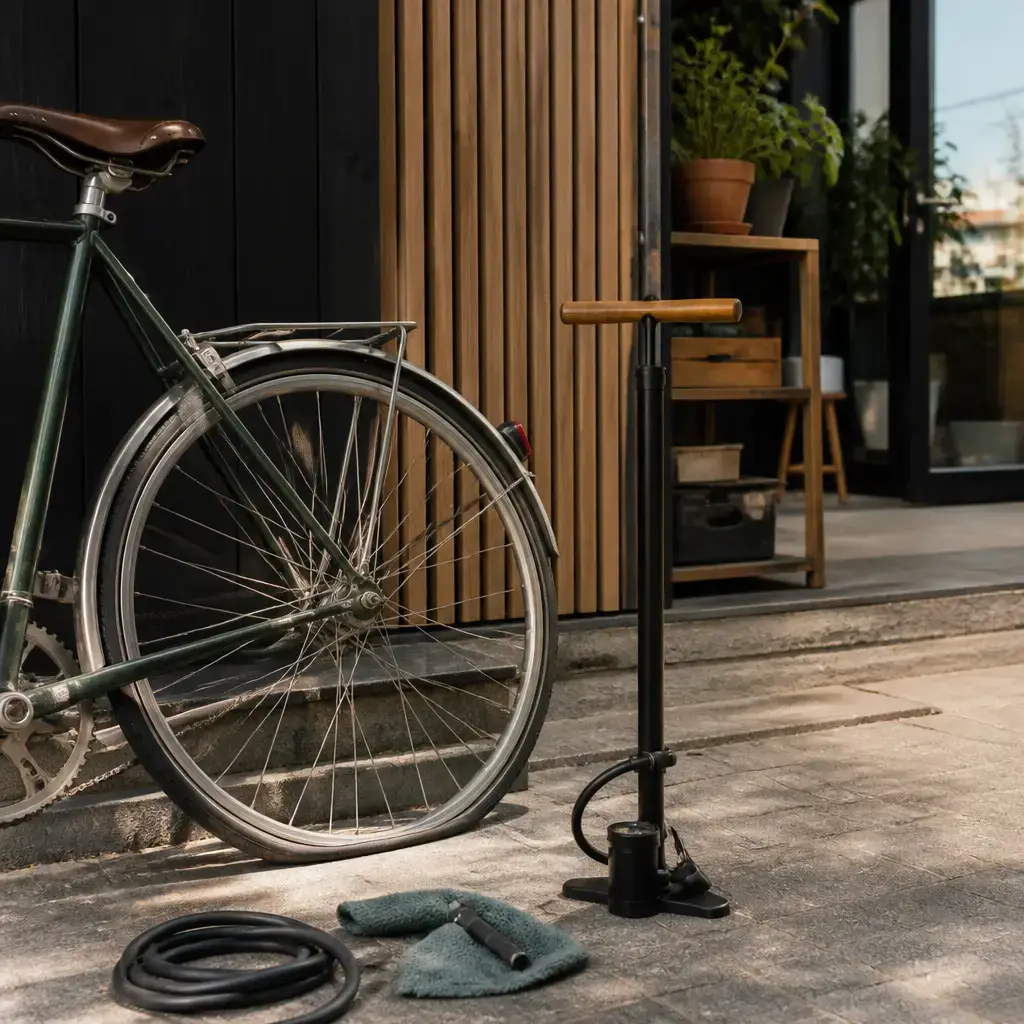
Mein Hinterreifen ist fast platt.
mine HIN-tuh-RYE-fen ist fahst plaht. My back tire is almost flat.Ich habe eine Pumpe, die du dir leihen kannst.
ikh HAH-buh EYE-nuh PUM-puh, dee doo deer LYE-en kahnst. I have a pump you can borrow.Soll ich zuerst nach einem Loch suchen?
zoll ikh tsoo-AIRST nahkh EYE-num lokh ZOO-khen? Should I check for a leak first?Schau vor dem Aufpumpen an der Seitenwand entlang.
show fohr dehm OWF-PUM-pen ahn dair ZYE-ten-vahnt ent-LAHNG. Look along the sidewall before adding air.Kannst du mir zeigen, wie man sie befestigt?
kahnst doo meer TSEYE-gen, vee mahn zee beh-FES-tikt? Can you show me how to attach it?Drück dieses Teil auf das Ventil und pumpe langsam.
DRYUK DEE-zes tyle owf dahs vehn-TEEL oont PUM-puh LAHNG-zahm. Press this part onto the valve and pump slowly.Der Reifen fühlt sich jetzt fest genug an.
dair RYE-fen fyoolt zikh yetst fest guh-NOOKH ahn. The tire feels firm enough now.Bring die Pumpe zurück, wenn du fertig bist.
bring dee PUM-puh tsoo-ROOK, venn doo FEHR-tikh bist. Bring the pump back when you finish.Sentence explanations
Mein Hinterreifen ist fast platt.
My back tire is almost flat.
- Mein
- my
- Hinterreifen
- back tire
- ist
- is
- fast
- almost
- platt
- flat
More detail
Mein means “my” here and is the possessive determiner for a first-person singular possessor. It takes the form mein because it accompanies the masculine singular noun Hinterreifen in the nominative. Useful contrast: meine is used with feminine singular or plural nouns in some cases, while meinen appears with a masculine singular accusative noun. The form agrees with the possessed noun, not with the possessor. Hinterreifen means “back tire” or “rear tire.” It is a masculine noun: der Hinterreifen; its plural form is also Hinterreifen. The related noun Reifen means “tire,” while Hinterreifen specifies the rear position. Example: Der Hinterreifen ist neu. — “The back tire is new.” ist is the third-person singular present form of sein (“to be”): ich bin, du bist, er/sie/es ist. Here it links the tire to its condition. Example: Der Reifen ist alt. — “The tire is old.” fast is an adverb meaning “almost” or “nearly.” It modifies platt, reducing the statement from completely flat to close to flat. Example: Der Reifen ist fast leer. — “The tire is almost empty.” platt is an adjective meaning “flat” in this tire context. After sein, it is used predicatively and therefore has no adjective ending: Der Reifen ist platt. — “The tire is flat.” Before a noun, an adjective normally takes an ending, as in ein platter Reifen — “a flat tire.” Together, Mein Hinterreifen identifies the speaker’s rear tire, and ist fast platt states its condition with sein plus the adverb fast and the predicative adjective platt. The complete meaning is: “My back tire is almost flat.”
Ich habe eine Pumpe, die du dir leihen kannst.
I have a pump you can borrow.
- Ich
- I
- habe
- have
- Pumpe
- pump
- die
- that; which
- du
- you
- dir
- to you
- leihen
- borrow
- kannst
- can
More detail
Ich is the first-person singular pronoun, “I.” It is the subject here. German pronouns include ich (“I”), du (“you,” singular informal), and Sie (“you,” formal), so the choice of du later marks an informal singular addressee. habe is the first-person singular present form of haben (“to have”): ich habe, du hast, er/sie hat. Here it expresses possession: “I have.” Pumpe means “pump.” Its base form is the feminine noun die Pumpe; an indefinite noun phrase uses eine Pumpe (“a pump”). The plural is Pumpen (“pumps”). In this sentence, the pump is the thing that can be borrowed. die is a relative pronoun referring back to Pumpe. It introduces the clause that describes the pump. Here die is feminine singular accusative: it is the object of leihen, while du is the subject of the relative clause. For a feminine noun, nominative and accusative die have the same form, so its role is determined by the clause structure rather than by a visible ending. du is the informal singular “you” and is the subject of the relative clause. Compare du kannst (“you can”) with ihr könnt (“you [plural] can”); the verb form changes with the subject. dir is the dative form corresponding to du, meaning “to you” or “for you.” With sich etwas leihen, German commonly uses this dative reflexive pattern for borrowing something for oneself: Du leihst dir ein Buch means “You borrow a book for yourself.” The form is dative even though the English translation often does not need a separate word for it. leihen is the infinitive “to borrow” in this sentence. It can also mean “to lend” in suitable contexts, so the surrounding roles matter. Here du is the borrower and die refers to the pump being borrowed. Example: Kann ich dein Fahrrad leihen? — “Can I borrow your bicycle?” kannst is the second-person singular present form of the modal verb können (“can; be able to”): ich kann, du kannst, er/sie kann. With a modal verb, the other verb normally stays in the infinitive and moves to the end of the clause: Du kannst die Pumpe leihen — “You can borrow the pump.” Together, die du dir leihen kannst means “that you can borrow.” The relative pronoun die identifies the pump as the object of leihen; du is the borrower, dir marks the borrowing for the person’s own use, and kannst expresses ability or permission in this context. The complete utterance is Ich habe eine Pumpe, die du dir leihen kannst. — “I have a pump that you can borrow.”
Soll ich zuerst nach einem Loch suchen?
Should I check for a leak first?
- Soll ich
- Should I ...?
- zuerst
- first
- Loch
- hole; here, a leak
- suchen
- look for
More detail
Soll ich combines sollen with ich. In this question, the speaker asks whether they should do something: “Should I …?” The first-person singular present form is soll; the infinitive sollen is used with other forms, such as du sollst (“you should”) and wir sollen (“we should”). zuerst means “first” or “before doing something else.” It establishes the order of the proposed actions. For example: Ich prüfe zuerst den Reifen. — “I check the tire first.” Loch is the noun “hole.” Here, the fixed translation and the surrounding pump-and-tire context support the intended meaning “leak”: the speaker is asking about checking for a leak, not necessarily a visible open hole. Loch is neuter, so the indefinite article changes to dative einem after nach. nach einem Loch is the reusable pattern nach + dative for searching or looking for something. The preposition nach is part of the construction with suchen: nach etwas suchen means “to look for something.” The dative form is visible in einem Loch; the noun itself remains Loch. suchen is the infinitive “to look for” or “to search.” In a question with the modal verb soll, the lexical verb stays in the infinitive and appears at the end: Soll ich nach einem Leck suchen? — “Should I look for a leak?” Together, Soll ich asks whether the speaker should act, zuerst places that action first, and nach einem Loch suchen expresses looking for a leak. The complete meaning is: “Should I check for a leak first?”
Schau vor dem Aufpumpen an der Seitenwand entlang.
Look along the sidewall before adding air.
- Schau
- look
- vor dem Aufpumpen
- before inflating
- Seitenwand
- sidewall
- an der … entlang
- along ...
More detail
Schau is the informal singular imperative of schauen (“to look”). The subject is an understood “you”: Schau! means “Look!” For more than one person, the informal imperative is Schaut!; formal singular address uses Schauen Sie!. vor dem Aufpumpen means “before inflating” and, here, “before adding air.” vor refers to an earlier time in this use and is followed by the dative in vor dem Aufpumpen. Aufpumpen is a capitalized nominalized infinitive from aufpumpen, “to pump up” or “to inflate.” A reusable pattern is vor dem + nominalized infinitive: vor dem Öffnen means “before opening.” Seitenwand is a feminine compound noun: die Seitenwand, meaning “sidewall” here. Its plural is Seitenwände. The final element of this compound is Wand, so the compound has feminine gender like die Wand. an der ... entlang is the construction “along ...”; in the sentence, the intervening noun is Seitenwand, producing an der Seitenwand entlang. Here der Seitenwand is the dative form of feminine die Seitenwand. entlang follows the noun phrase in this construction. Example: Wir gehen am Fluss entlang. means “We walk along the river.” Together, Schau gives the command, an der Seitenwand entlang says where to look, and vor dem Aufpumpen says when to do it. The complete meaning is: “Look along the sidewall before adding air.”
Kannst du mir zeigen, wie man sie befestigt?
Can you show me how to attach it?
- Kannst du
- Can you
- mir
- me
- zeigen
- show
- wie man
- how one
- sie
- it
- befestigt
- attaches
More detail
Kannst du combines können (“can/be able to”) with du (“you”). kannst is the present-tense second-person singular form of können; the modal verb is separated from the infinitive zeigen, which comes later. This makes a reusable question pattern: Kannst du ...? — “Can you ...?” mir means “to me/for me” here. It is the dative form of ich (“I”), used for the person who receives the showing. Compare mich, the accusative form of “me”: Du siehst mich means “You see me,” whereas Du zeigst mir etwas means “You show me something.” zeigen means “to show.” It is the base-form infinitive used after the modal kannst. For example, Kannst du mir den Weg zeigen? means “Can you show me the way?” wie man introduces “how one” or, naturally here, “how to.” man is an impersonal pronoun for people in general; it is not the same as the specific pronoun du. In a subordinate clause introduced by wie, the conjugated verb goes to the end: wie man etwas macht means “how one does something” or “how to do something.” sie means “it” in the fixed translation. Here it is the accusative pronoun referring to the item being attached, while its specific identity is not stated in the supplied sentence. The form sie also has other grammatical uses in German, so its exact meaning must be determined from context; the fixed translation establishes the intended “it” reading here. befestigt means “attaches” or “fastens” in this clause. It is the present-tense third-person singular form of befestigen (“to attach/fasten”), agreeing with impersonal man. Because this is the subordinate clause after wie, befestigt appears at the end. For example, Man befestigt das Teil am Ventil means “One attaches the part to the valve.” Together, Kannst du mir zeigen means “Can you show me,” and wie man sie befestigt means “how to attach it.” The complete utterance is therefore: “Can you show me how to attach it?”
Drück dieses Teil auf das Ventil und pumpe langsam.
Press this part onto the valve and pump slowly.
- Drück
- press
- dieses
- this
- Teil
- part
- auf das
- onto the
- Ventil
- valve
- pumpe
- pump
- langsam
- slowly
More detail
Drück is the informal singular imperative of drücken (“to press”). The subject du is understood rather than stated, so this form is used when addressing one person informally. The imperative has the form drück; the vowel is not changed from the ü in drücken. dieses means “this” here and agrees with Teil. Teil is a neuter noun (das Teil), and in this phrase it is the thing being pressed, so it is accusative: dieses Teil. For a masculine noun, the corresponding form would be diesen in the accusative, as in the example Drück diesen Knopf. — “Press this button.” Teil means “part” or “piece.” Its article is das: das Teil. In the fixed utterance, it is the object of drücken, while dieses identifies which part. auf das means “onto the” in this sentence. auf is a two-way preposition: with movement or placement onto a destination, it takes the accusative. Thus das Ventil appears as auf das Ventil; the neuter article das has the same form in nominative and accusative. With a stationary location, auf normally takes the dative instead, for example auf dem Ventil — “on the valve.” Ventil means “valve.” It is neuter: das Ventil. The phrase auf das Ventil identifies the destination or surface onto which the part is pressed. pumpe is the informal singular imperative of pumpen (“to pump”). As with Drück, the understood subject is du. The two imperatives are coordinated by und, giving two instructions. langsam means “slowly” here. It is an adverb modifying pumpe; the same form can also be the adjective “slow” when it describes a noun, as in eine langsame Bewegung — “a slow movement.” Together, Drück dieses Teil auf das Ventil und pumpe langsam. gives the instruction to press this part onto the valve and pump slowly. The first imperative specifies the placement, while the second specifies the pumping action and its manner.
Der Reifen fühlt sich jetzt fest genug an.
The tire feels firm enough now.
- Reifen
- tire
- fühlt sich … an
- feels
- jetzt
- now
- fest
- firm
- genug
- enough
More detail
Reifen means “tire” here. It is a masculine noun: der Reifen (singular), die Reifen (plural). The article der therefore marks the singular masculine noun in this sentence. Example: Der Reifen ist leer. — “The tire is flat.” fühlt sich … an is the separable reflexive verb sich anfühlen, “to feel” or “to feel like.” In this sentence, the tire is the thing whose condition is being sensed, so German uses the reflexive form sich. With the singular subject der Reifen, the present-tense form is fühlt; the separable prefix an appears at the end of the clause. Pattern: etwas fühlt sich + adjective + an — “something feels + adjective.” Example: Der Stoff fühlt sich weich an. — “The fabric feels soft.” jetzt means “now” and places the judgment in the present situation. It can also contrast the current state with an earlier one, but this sentence does not specify what the earlier state was. fest means “firm” or “solid” here. It is an adjective describing how the tire feels, and it remains in its basic form after sich anfühlen: fühlt sich fest an. This is different from fester, the comparative “firmer.” Example: Der Reifen fühlt sich fester an. — “The tire feels firmer.” genug means “enough” or “sufficiently.” After an adjective, the pattern is Adjektiv + genug: fest genug means “firm enough.” It says that the tire has reached a sufficient degree of firmness, without specifying a numerical measurement. Example: Das Seil ist stark genug. — “The rope is strong enough.” Together, Der Reifen fühlt sich jetzt fest genug an means “The tire feels firm enough now.” The subject is der Reifen; fühlt … an presents a sensory assessment, fest genug gives the required degree of firmness, and jetzt locates that assessment in the current situation.
Bring die Pumpe zurück, wenn du fertig bist.
Bring the pump back when you finish.
- Bring
- bring
- Pumpe
- pump
- zurück
- back; returned to a place
- wenn
- when
- fertig
- finished; done
More detail
Bring is the imperative singular of bringen (“to bring”). It addresses one person informally. In this sentence it belongs with the later zurück: Bring ... zurück is the separable verb zurückbringen, “to bring back.” A reusable example is Bring das Buch zurück. — “Bring the book back.” Pumpe means “pump” here. Its base form is die Pumpe; after the imperative, die Pumpe is the direct object, and the feminine accusative has the same visible form: die Pumpe. A useful example is Ich repariere die Pumpe. — “I am repairing the pump.” zurück means “back,” expressing return to an earlier place or position. With bringen, it completes the separable verb zurückbringen: Bring die Pumpe zurück means “Bring the pump back.” In a finite statement, the parts separate in a main clause: Du bringst die Pumpe zurück. — “You bring the pump back.” wenn introduces the condition or time at which the other action is to happen. In the subordinate clause beginning with wenn, the finite verb goes to the end. A reusable example is Ruf mich an, wenn du ankommst. — “Call me when you arrive.” fertig means “finished” or “done.” Here it describes the state of the person addressed: du bist fertig, literally “you are done,” which the fixed translation renders as “you finish.” fertig is an adjective used after sein; it does not itself carry the person marking. For example, Ich bin fertig. means “I am done.” The sentence has the reusable pattern Imperative + object + separable prefix, wenn + subject + ... + finite verb: Bring die Pumpe zurück, wenn du fertig bist. The main request is to bring the pump back, and wenn du fertig bist specifies that this should happen when the addressee is done.
Grammar Points
sich anfühlen: sich + Verbform + ... + an
Die Seitenwand fühlt sich fest an.
dee ZYE-ten-vahnt fyoolt zikh fest ahn.The sidewall feels firm.
Bei diesem trennbaren reflexiven Verb steht sich vor dem Prädikativ; an steht am Satzende.
zurückbringen im Imperativ: Bring ... zurück!
Bring die Pumpe zurück!
bring dee PUM-puh tsoo-ROOK!Bring the pump back!
Bei trennbaren Verben steht zurück im Imperativ am Satzende.
German Vocabulary
vor dem Aufpumpen
wie man sie befestigt
Drück dieses Teil auf das Ventil.
Mein Hinterreifen ist fast platt.
Soll ich zuerst nach einem Loch suchen?
Mein Hinterreifen ist fast platt.
Ich habe eine Pumpe, die du dir leihen kannst.
an der Seitenwand entlang
die du dir leihen kannst
nach einem Loch suchen
Drück dieses Teil auf das Ventil.
auf das Ventil
Quiz
Word Order
Arrange the words in the correct order.
My back tire is almost flat.
Show Answer
Mein Hinterreifen ist fast platt.Spelling
Tap the letters to spell the word.
to attach; fasten
Show Answer
befestigtflat
Show Answer
plattsidewall
Show Answer
Seitenwandinflating; pumping up