10 minutes free every day
Continue audio lessons in the app
Word explanations appear automatically in sync with the audio.
No login required · synced translations · playback with the screen locked
Choose your learning language and open this lesson in the app.

About This Lesson
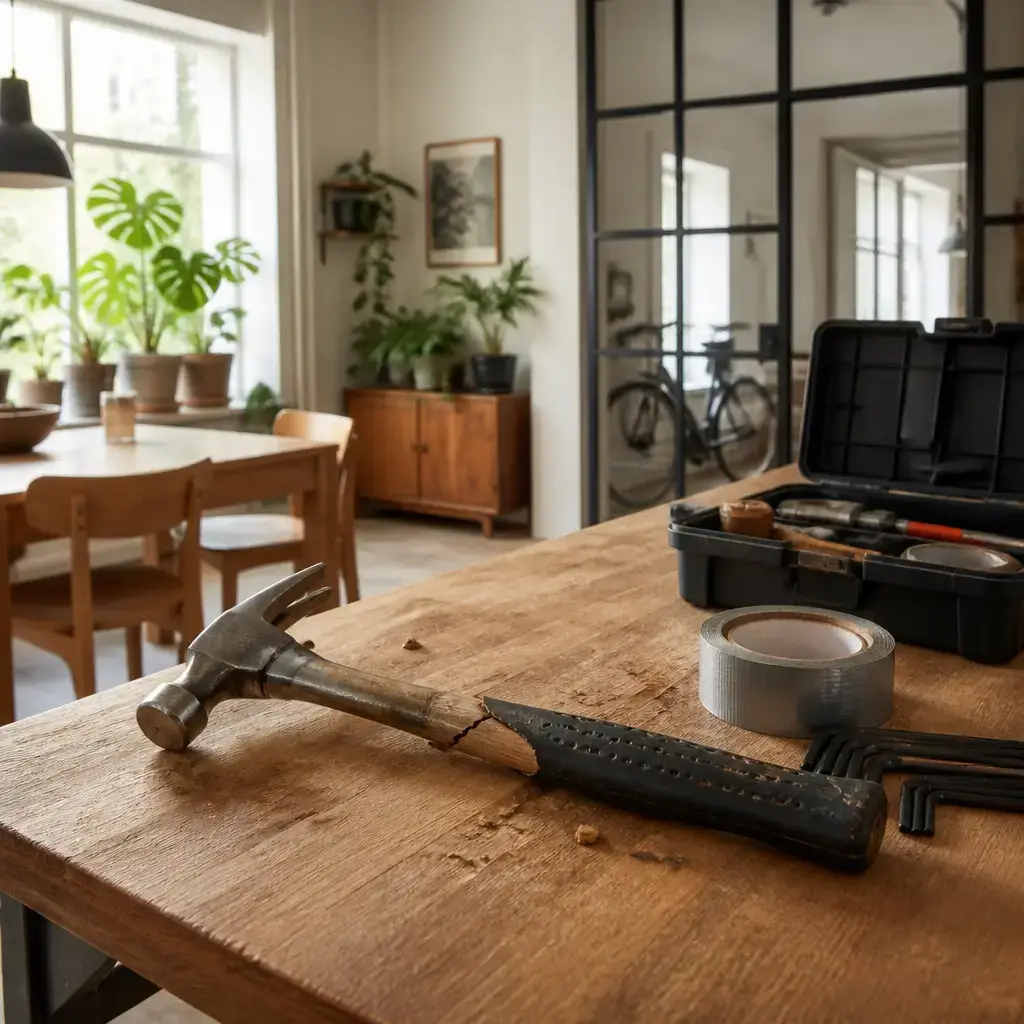
Use Apologizing for damaging a borrowed tool to practice German conversation, pronunciation, vocabulary, grammar, and quizzes.
Dialogue
Ich muss mich dafür entschuldigen, was mit dem geliehenen Werkzeug passiert ist.
ikh mooss mikh dah-FYOOR ent-SHOOL-di-gen, vahs mit daym geh-LEE-eh-nen VAIRK-tsoyk pah-SSEERT ist. I need to apologize for what happened to the tool I borrowed.Was ist damit passiert?
vahs ist dah-MIT pah-SSEERT? What happened to it?Der Griff ist gerissen, während ich es benutzt habe.
dair grif ist geh-RISS-en, VAY-rent ikh ess beh-NOOTST HAH-buh. The handle cracked while I was using it.Lass mich sehen, wie schlimm der Schaden ist.
lahss mikh ZAY-en, vee shlim dair SHAH-den ist. Let me see how bad the damage is.Ich kann es ersetzen oder bei der Reparatur helfen.
ikh kahn ess er-SET-tsen OH-dair bye dair reh-pah-rah-TOOR HEL-fen. I can replace it or help repair it.Wir sollten prüfen, ob die Reparatur hält.
veer SHOOL-ten PROO-fen, ohp dee reh-pah-rah-TOOR helt. We should check whether a repair will hold.Es tut mir leid, dass ich zusätzliche Arbeit verursacht habe.
ess toot meer lite, dahss ikh tsoo-ZETS-li-khuh AR-bite fer-OOR-zahkht HAH-buh. I am sorry for causing extra work.Sag mir nächstes Mal sofort Bescheid.
zahk meer NEKH-stes mahl zoh-FORT beh-SHYDE. Tell me right away next time.Wir kriegen das hin.
veer KREE-gen dahss hin. We can sort it out.Sentence explanations
Ich muss mich dafür entschuldigen, was mit dem geliehenen Werkzeug passiert ist.
I need to apologize for what happened to the tool I borrowed.
- Ich muss
- I need to / must
- mich
- myself / me
- dafür
- for that / for it
- entschuldigen
- apologize
- was
- what
- geliehenen
- borrowed
- Werkzeug
- tool
- passiert ist
- happened
More detail
Ich muss uses the first-person singular form of müssen, meaning that the speaker is required to do something or considers it necessary. Its base form is müssen; the infinitive is müssen, while muss is the present-tense form for ich and er/sie/es. With another verb, the modal is conjugated and the other verb stays in the infinitive: Ich muss gehen = “I need to go.” mich is the accusative reflexive pronoun referring back to ich. The verb is used reflexively here: sich für etwas entschuldigen means “to apologize for something.” The form changes with the subject: ich entschuldige mich, but du entschuldigst dich. dafür is a da-compound meaning “for that” or “for it.” In this sentence it points forward to the matter expressed by the following was-clause, so mich dafür entschuldigen means “apologize for what happened.” German commonly uses dafür with sich entschuldigen; a person can be added with bei: Ich entschuldige mich bei ihr dafür = “I apologize to her for it.” entschuldigen is the infinitive “to apologize” in this construction. The reusable pattern is sich für etwas entschuldigen: Sie entschuldigt sich für den Fehler = “She apologizes for the mistake.” The reflexive pronoun and für phrase are important parts of this use. was introduces the subordinate meaning “what” here; it is not a direct question in this sentence. The pattern was + clause can mean “what ...” as a whole: Ich weiß, was passiert ist = “I know what happened.” In the supplied utterance, the clause identifies the matter for which the speaker apologizes. geliehenen is the adjective-like form of the past participle geliehen, from leihen (“to lend” or “to borrow”). The fixed translation gives the intended reading here: the tool was borrowed by the speaker. In dem geliehenen Werkzeug, geliehenen describes Werkzeug and has the -en ending because the phrase is dative singular with the definite article dem. The participle can also describe something lent in another context, so the intended direction comes from the sentence and translation. Werkzeug is the noun “tool.” Its lexical gender is neuter: das Werkzeug; its plural is die Werkzeuge. After mit, a noun phrase is dative, giving mit dem Werkzeug in the singular. Here it is the thing affected by the event, not the person who performs the borrowing. passiert ist is the perfect-tense form of passieren (“to happen”). passiert is the past participle, and ist is the auxiliary form of sein used with this intransitive verb. Because this is a subordinate clause, the finite auxiliary comes at the end: was ... passiert ist. A short question using the same verb is Was ist passiert? = “What happened?” Together, Ich muss mich dafür entschuldigen says “I need to apologize for that,” and was mit dem geliehenen Werkzeug passiert ist specifies what “that” is: what happened to the borrowed tool. The complete meaning is therefore “I need to apologize for what happened to the tool I borrowed.”
Was ist damit passiert?
What happened to it?
- Was
- what
- damit
- with it
- passiert
- happened
More detail
Was asks about an unspecified thing or event: “what.” Compare wer “who” for a person and wo “where” for a place. damit is a pronominal adverb made from da + mit, meaning “with it” or “with that.” In this utterance, the construction mit etwas passieren is naturally translated as “happen to something,” and the fixed translation and context identify the thing as the borrowed tool. Example: Ich arbeite damit. — “I work with it.” passiert comes from passieren, “to happen.” Here it is the past participle in the perfect construction ist passiert, meaning “happened” or “has happened.” It has the same spelling as the third-person singular present form passiert; the auxiliary ist shows its role here. This perfect construction uses sein. Example: Was ist passiert? — “What happened?” Together, Was ist damit passiert? asks, “What happened to it?” Here damit supplies the thing involved, while passiert expresses the event. The next sentence specifies that the tool’s handle cracked while the speaker was using it; that result comes from the context, not from the question alone.
Der Griff ist gerissen, während ich es benutzt habe.
The handle cracked while I was using it.
- Griff
- handle
- gerissen
- cracked
- während
- while
- benutzt
- used
More detail
Griff means “handle” here. Its base form is der Griff, a masculine noun; the article der marks the nominative singular subject in this sentence. The plural is die Griffe. Example: Der Griff ist locker. — “The handle is loose.” gerissen is the form used here for “cracked” or “split.” It is the past participle of reißen (“to tear, rip, or crack”), not of a similarly meaning-looking verb. In ist gerissen, the auxiliary ist combines with the participle to form the German perfect: because the handle undergoes a change of state, this intransitive use takes sein. Example: Das Seil ist gerissen. — “The rope broke.” während introduces a time relation: one event happens during the time of another. It introduces the subordinate clause während ich es benutzt habe; in this clause, the finite verb comes at the end. Example: Während ich gekocht habe, hat er angerufen. — “While I was cooking, he called.” benutzt is the past participle of benutzen, “to use.” Together with habe, it forms the perfect habe benutzt. The subject is ich, and es is the object represented as “it” in the fixed translation. In this context, the perfect describes the using activity viewed in relation to the cracking; English naturally uses the progressive “was using.” Example: Ich habe den Schlüssel benutzt. — “I used the key.” As a whole, Der Griff ist gerissen states that the handle cracked or broke. während ich es benutzt habe adds that this happened while the speaker was using the object referred to by es. Thus the complete meaning is: “The handle cracked while I was using it.” The previous and following context support this as an explanation of what happened and a transition to examining the damage.
Lass mich sehen, wie schlimm der Schaden ist.
Let me see how bad the damage is.
- Lass mich
- let me
- sehen
- see
- wie schlimm
- how bad
- der Schaden
- the damage
- ist
- is
More detail
Lass mich is a reusable way to say “let me …”. Lass is the singular informal imperative of lassen (“to let”); mich is the accusative form of ich (“me”). German commonly uses Lass mich followed by an infinitive: Lass mich kurz nachdenken. — “Let me think for a moment.” sehen is the infinitive “to see”. After Lass mich, the second verb stays in the infinitive: Lass mich prüfen. — “Let me check.” Here, sehen introduces what the speaker wants permission or opportunity to do. wie schlimm means “how bad”. wie introduces the degree being assessed, and schlimm is the adjective “bad” or “severe”. In wie schlimm der Schaden ist, this begins an embedded question about the damage’s severity. Compare wie groß (“how big”) and wie teuer (“how expensive”) in the same pattern. der Schaden means “the damage”. Schaden is a masculine noun, so its definite article is der in the nominative singular here. Its plural is die Schäden (“the damages” or “the instances of damage”). The article is not a separate statement about quantity; it marks a specific damage situation in this context. ist is the third-person singular present form of sein (“to be”). The base form is sein; the relevant chain is sein → ist. In the embedded clause, the conjugated verb comes at the end: wie schlimm der Schaden ist — literally, “how severe the damage is.” Together, Lass mich sehen means “Let me see”, and wie schlimm der Schaden ist states what the speaker wants to determine. The complete utterance is therefore “Let me see how bad the damage is.”
Ich kann es ersetzen oder bei der Reparatur helfen.
I can replace it or help repair it.
- Ich kann
- I can
- es
- it
- ersetzen
- replace
- oder
- or
- Reparatur
- repair
- helfen
- help
More detail
Ich kann means “I can” here. kann is the present-tense form of können for ich; it expresses ability or possibility. With a second verb, können is a modal verb and the other verb remains in the infinitive: Ich kann helfen = “I can help.” es is an unstressed accusative pronoun meaning “it.” It functions here as the object of ersetzen. Its grammatical form is neuter singular accusative; the supplied sentence does not identify exactly what the object is. ersetzen is the infinitive “to replace.” The useful pattern is etwas ersetzen (“to replace something”), so the object appears directly with this verb. For example: Ich ersetze das Teil. — “I am replacing the part.” oder links alternatives and means “or.” It connects the two things the speaker says they can do: replace the object, or help with the repair. Reparatur is the feminine noun “repair.” In bei der Reparatur, bei requires the dative, so the feminine singular article is der: die Reparatur becomes bei der Reparatur. This phrase means “during the repair” or “with the repair,” depending on the wording of the translation. helfen is the infinitive “to help.” Here it is used with bei der Reparatur: bei etwas helfen means “to help with something.” For example: Sie hilft bei der Reparatur. — “She is helping with the repair.” The sentence has the reusable pattern Ich kann [infinitive] oder [bei etwas helfen]. kann is the finite modal verb, while ersetzen and helfen are infinitives. The first alternative is es ersetzen, “replace it”; the second is bei der Reparatur helfen, “help with the repair.” Together, the utterance means: “I can replace it or help repair it.”
Wir sollten prüfen, ob die Reparatur hält.
We should check whether a repair will hold.
- Wir sollten
- we should
- prüfen
- check
- Reparatur
- repair
- hält
- holds; will hold
More detail
Wir sollten expresses a recommendation: “we should.” Wir is the first-person plural subject, and sollten is the first-person plural form of sollen in its subjunctive-II form. In this use, sollten is softer than a direct command and presents checking as a sensible course of action. The infinitive belonging to it comes later: Wir sollten prüfen. prüfen means “to check” or “to examine.” It is the infinitive after sollten; the same verb can be used in patterns such as etwas prüfen (“check something”) and prüfen, ob ... (“check whether ...”). Example: Wir sollten den Plan prüfen. — “We should check the plan.” Reparatur is the noun “repair” or “repair work.” It is feminine, as shown by the definite article die in the sentence: die Reparatur. German nouns are capitalized. The related noun Reparatur names the repair itself, while reparieren is the verb “to repair”; they are related forms, not the same grammatical word. hält means “holds” here, in the sense of continuing to work or remaining sound. It is the third-person singular present form of halten (“to hold”). In the subordinate clause introduced by ob, the finite verb comes at the end: ob die Reparatur hält. German present tense can refer to a future result when the context concerns what will happen, so the fixed translation naturally says “whether a repair will hold.” Together, Wir sollten prüfen gives “we should check,” and ob die Reparatur hält gives “whether the repair will hold.” The complete utterance is therefore: “We should check whether a repair will hold.”
Es tut mir leid, dass ich zusätzliche Arbeit verursacht habe.
I am sorry for causing extra work.
- Es tut mir leid
- I am sorry
- zusätzliche
- additional; extra
- Arbeit
- work
- verursacht
- caused
More detail
Es tut mir leid is the standard German way to say “I am sorry.” The fixed expression uses leidtun, whose present-tense form here is tut ... leid: tut agrees with the formal subject es, while mir is the person who feels sorry in the dative. A useful pattern is Es tut mir leid, dass ... (“I am sorry that ...”). zusätzliche means “additional” or “extra” here and modifies Arbeit. Its base form is zusätzlich; comparative forms can be zusätzlicher (“more additional/extra,” used only where that comparison is meaningful) and superlative am zusätzlichsten. In zusätzliche Arbeit, the adjective has the ending -e; the ending belongs to the adjective, not to the noun. Arbeit is the feminine noun die Arbeit, meaning “work.” Its plural is Arbeiten, but the fixed sentence uses singular Arbeit for the work as a mass or uncounted amount. In zusätzliche Arbeit, it is the object of verursachen, so the phrase has the role of “cause extra work.” verursacht comes from the verb verursachen, “to cause.” Here it is the past participle, not a finite present-tense verb: ich habe ... verursacht means “I have caused ...”. A reusable example is Ich habe ein Problem verursacht. — “I caused a problem.” The clause begins with dass, which introduces what the speaker is sorry about. In this subordinate clause, ich is the subject and the conjugated auxiliary habe goes to the end: dass ich zusätzliche Arbeit verursacht habe. The participle verursacht appears before that final auxiliary, giving the perfect construction for a completed causing event. Together, Es tut mir leid expresses the apology, and dass ich zusätzliche Arbeit verursacht habe identifies its content: “I am sorry that I have caused extra work.” In natural English, the fixed translation is “I am sorry for causing extra work.”
Sag mir nächstes Mal sofort Bescheid.
Tell me right away next time.
- Sag … Bescheid
- let me know
- mir
- me
- nächstes Mal
- next time
- sofort
- right away
More detail
Sag ... Bescheid is the reusable German construction Bescheid sagen, meaning “to let someone know” or “to inform someone.” Sag is the informal singular imperative of sagen (“to say”): sagen → du sagst → Sag!. The construction is discontinuous here because mir and the time expressions come between Sag and Bescheid. Example: Sag mir morgen Bescheid. — “Let me know tomorrow.” mir is the first-person singular dative pronoun, “to me” or “me” as the recipient of the information. The dative form is mir; it is different from accusative mich, as in Ruf mich an. — “Call me.” nächstes Mal means “next time.” Mal is a neuter noun, and nächstes is the neuter singular form of the adjective nächst- in this expression. The phrase refers to a subsequent occasion; it does not by itself specify how many occasions are involved. Example: Nächstes Mal komme ich früher. — “Next time I’ll come earlier.” sofort is an uninflected adverb meaning “immediately” or “right away.” It specifies that the informing should happen without delay. Example: Komm sofort! — “Come right away!” The sentence begins with the informal imperative Sag. The recipient is marked by mir, nächstes Mal sets the relevant future occasion, and sofort adds the requirement of immediate action. Together, Sag mir nächstes Mal sofort Bescheid. means “Tell me right away next time.” The imperative and du form make this direct and informal; the sentence does not use a formal address form.
Wir kriegen das hin.
We can sort it out.
- Wir
- we
- kriegen … hin
- manage; sort out
- das
- it
More detail
Wir means “we”: it includes the speaker and at least one other person. It is the first-person plural personal pronoun. Compare ich (“I”) for one speaker and ihr (“you” plural, informal) for the people addressed. kriegen ... hin is the separable verb construction hinkriegen, meaning “manage” or “sort out.” In a main clause, the conjugated part kriegen appears in the second position and hin moves to the end. In this construction, kriegen does not simply mean “get”; the whole verb means “manage to do or solve something.” Example: Wir kriegen das morgen hin. — “We’ll manage that tomorrow.” das means “it” here and functions as a neuter singular object pronoun. Its specific referent is supplied by the context; the form alone does not identify the matter or task more precisely. Compare dieses (“this,” neuter singular) when a speaker points something out more explicitly. Together, Wir kriegen das hin. means “We can sort it out.” The separated hin completes hinkriegen, while das is the thing being managed. This is a conversational way to express that the speakers will manage or solve the matter.
Grammar Points
bei + Dativ
bei der Reparatur helfen
bye dair reh-pah-rah-TOOR HEL-fento help with the repair
Bei verlangt hier den Dativ: der Reparatur.
kriegen ... hin
Wir kriegen das hin
veer KREE-gen dahss hinWe can sort it out
Bei diesem trennbaren Verb steht hin am Satzende.
German Vocabulary
Quiz
Word Order
Arrange the words in the correct order.
What happened to it?
Show Answer
Was ist damit passiert?Tell me right away next time.
Show Answer
Sag mir nächstes Mal sofort Bescheid.We can sort it out.
Show Answer
Wir kriegen das hin.Spelling
Tap the letters to spell the word.
tool
Show Answer
Werkzeugborrowed
Show Answer
geliehenhandle
Show Answer
Grifffor that; about that