10 minutes free every day
Continue audio lessons in the app
Word explanations appear automatically in sync with the audio.
No login required · synced translations · playback with the screen locked
Choose your learning language and open this lesson in the app.

About This Lesson
Use Cleaning coffee from documents to practice German conversation, pronunciation, vocabulary, grammar, and quizzes.
Dialogue
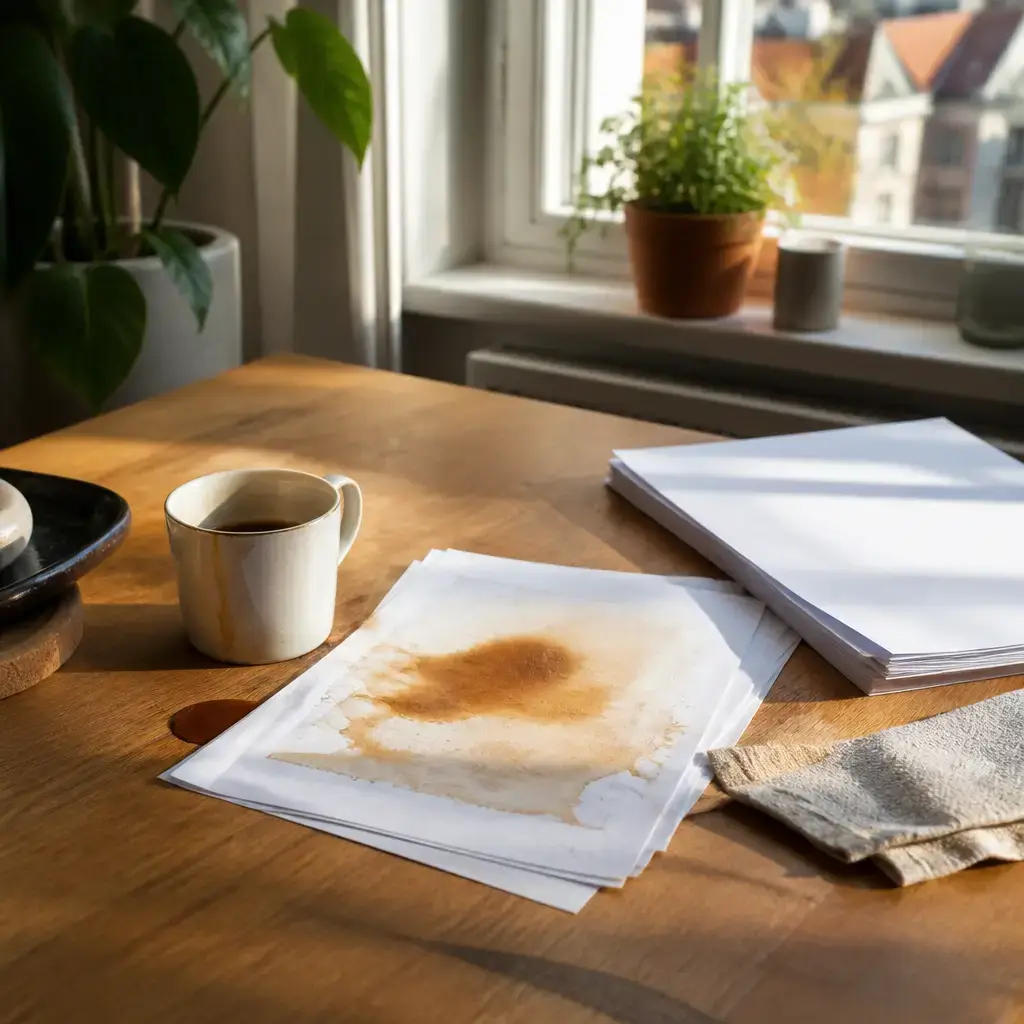
Ich habe Kaffee auf diese Dokumente verschüttet.
ikh HAH-buh kah-FAY owf DEE-zuh doh-koo-MEN-tuh fer-SHUE-tet I spilled coffee on these documents.Bring sie von der Tasse weg, bevor sich der Fleck ausbreitet.
bring zee fon dair TAH-suh vek, beh-FOHR zikh dair flehk OWS-bry-tet Move them away from the cup before the stain spreads.Die oberste Seite ist schon ganz durchnässt.
dee OH-bur-stuh ZY-tuh ist shohn gahnts DOORKH-nest The top page is already soaked.Lass die Seite flach trocknen, bevor du sie anfasst.
lahss dee ZY-tuh flahkh TROK-nen, beh-FOHR doo zee AHN-fahst Let it dry flat before you handle it.Soll ich eine saubere Kopie dieser Seite ausdrucken?
zohl ikh EYE-nuh ZOW-buh-ruh koh-PEE DEE-zur ZY-tuh OWS-drook-en Should I print a clean copy of that page?Das wäre sicherer, weil der Text verlaufen kann.
dahss VAIR-uh ZIKH-uh-rur, vyle dair tehkst fer-LOW-fen kahn That would be safer because the text may blur.Ich werde die trockenen Seiten trennen, während diese hier trocknet.
ikh VAIR-duh dee TROK-nun-en ZY-ten TREN-en, VAIR-ent DEE-zuh heer TROK-net I will separate the dry pages while this one dries.Stell die Getränke nächstes Mal auf einen anderen Tisch.
shtel dee geh-TRENG-kuh NEKH-stes mahl owf EYE-nen AHN-duh-run tish Keep the drinks on another table next time.Sentence explanations
Ich habe Kaffee auf diese Dokumente verschüttet.
I spilled coffee on these documents.
- Ich habe
- I have
- Kaffee
- coffee
- auf
- on; onto
- diese
- these
- Dokumente
- documents
- verschüttet
- spilled
More detail
Ich habe combines the subject Ich (“I”) with habe, the first-person singular present form of haben. Together with the past participle at the end, it forms the German perfect tense. Pattern: Ich habe ... [past participle] can mean “I ...-ed” in a past context. Kaffee means “coffee.” It is masculine: der Kaffee. Here it appears without an article because it is treated as an unspecified substance. Example: Ich trinke Kaffee. — “I drink coffee.” auf means “on” here and introduces the surface onto which the coffee ended up. With a static location, it takes the dative: auf dem Tisch — “on the table.” With movement or a resulting placement toward a surface, it takes the accusative: auf den Tisch — “onto the table.” diese means “these.” It is the accusative plural form of the demonstrative used with Dokumente; the same form is also used for nominative plural. Example: Ich lege diese Bücher auf den Tisch. — “I put these books on the table.” Dokumente means “documents.” Its singular is das Dokument, and Dokumente is the plural form. This plural noun has the same visible form in nominative and accusative here. Example: Diese Dokumente sind wichtig. — “These documents are important.” verschüttet means “spilled” here. It is the past participle of verschütten (“to spill”), and it appears at the end in this perfect-tense clause. verschütten can describe accidentally spilling a liquid or loose substance, but the word itself does not require that the action was accidental. Example: Sie hat Wasser verschüttet. — “She spilled water.” Together, Ich habe marks the perfect construction, Kaffee is the substance, auf diese Dokumente identifies the affected surface, and final verschüttet supplies the action. The complete meaning is: “I spilled coffee on these documents.” The demonstrative phrase refers to the documents identified in the fixed translation.
Bring sie von der Tasse weg, bevor sich der Fleck ausbreitet.
Move them away from the cup before the stain spreads.
- Bring
- move; bring
- sie
- them
- von … weg
- away from
- Tasse
- cup
- bevor
- before
- Fleck
- stain
- ausbreitet
- spreads
More detail
Bring is the imperative singular of bringen (“to bring”). In this sentence, the fixed translation gives the intended action as “move”; German bringen can describe moving something to a different place. The imperative addresses one person. For a plural addressee, German uses Bringt, and for a formal addressee, Bringen Sie. sie is the unstressed accusative plural pronoun meaning “them.” Here the fixed translation and the preceding context identify the moved items as the documents. Do not confuse it with capitalized Sie, which can be a formal “you.” The singular feminine accusative form is also sie, but the translation’s “them” establishes the plural reading here. von ... weg is a reusable pattern meaning “away from ...”: etwas von etwas wegbringen means “to move something away from something.” von takes the dative here. The article der marks the dative form of feminine die in der Tasse; it is not the noun’s gender by itself. Tasse means “cup.” Its base form is die Tasse; after von, the phrase is von der Tasse. Example: Der Ball rollt von der Tasse weg. — “The ball rolls away from the cup.” bevor introduces a time clause meaning “before.” In a clause introduced by bevor, the finite verb normally goes to the end: bevor ... ausbreitet. Example: Geh, bevor es dunkel wird. — “Go before it gets dark.” Fleck means “stain” or “spot.” In this clause, der Fleck is the nominative subject of ausbreitet, so it is the thing that spreads. Its base form is der Fleck; the plural is die Flecken. ausbreitet is the third-person singular present form of the reflexive verb sich ausbreiten, “to spread.” In the subordinate clause, the separable-looking parts are written together at the end: bevor sich der Fleck ausbreitet. The sich belongs to the verb and refers back to the spreading subject; it is not the stain’s translation as a separate word. Compare Der Fleck breitet sich aus. — “The stain is spreading.” Together, Bring sie von der Tasse weg gives the command “Move them away from the cup.” bevor sich der Fleck ausbreitet adds the time limit “before the stain spreads.” The complete utterance therefore means: “Move them away from the cup before the stain spreads.”
Die oberste Seite ist schon ganz durchnässt.
The top page is already soaked.
- oberste
- topmost
- Seite
- page
- ist
- is
- schon
- already
- ganz
- completely
- durchnässt
- soaked
More detail
oberste means “topmost” here. It is the superlative form of ober (“upper/top”), used before the noun. In die oberste Seite, the ending -e reflects the feminine singular nominative noun Seite together with the definite article die. A useful comparison is obere (“upper”) versus oberste (“topmost”): oberste selects the highest or top position. Seite is a feminine noun meaning “page” in this sentence. Its plural is Seiten. The fixed translation identifies the relevant sense as a page, rather than another possible meaning such as “side.” Example: Die Seite ist leer. — “The page is blank.” ist is the third-person singular present form of sein (“to be”). With a singular subject such as die oberste Seite, it states the subject’s current condition. Example: Die Seite ist nass. — “The page is wet.” schon means “already.” It places the condition earlier than the relevant current point: the page is already soaked. Example: Die Seite ist schon trocken. — “The page is already dry.” ganz means “completely” here and strengthens the following description. It does not describe a separate object; together with durchnässt, it conveys that the page is soaked through. Example: Das Papier ist ganz nass. — “The paper is completely wet.” durchnässt means “soaked through” or “thoroughly wet.” It is the adjective-like form related to the verb durchnässen (“to soak through”); in this sentence it describes the page’s resulting condition. Compared with simple nass (“wet”), durchnässt presents a much stronger degree of wetness. Example: Der Stoff ist durchnässt. — “The fabric is soaked through.” Together, Die oberste Seite identifies the topmost page, ist links that subject to its condition, and schon ganz durchnässt says that it is already completely soaked through. The whole utterance therefore means: “The top page is already soaked.”
Lass die Seite flach trocknen, bevor du sie anfasst.
Let it dry flat before you handle it.
- Lass
- let; allow
- Seite
- page
- flach
- flat
- trocknen
- dry
- bevor
- before
- anfasst
- handle; touch
More detail
Lass is the informal singular imperative of lassen (“to let; to allow”). In Lass ... trocknen, lassen means that the addressee should allow something to dry. This pattern takes another verb in the infinitive without zu: Lass ihn warten. — “Let him wait.” Seite means “page” here. Its plural is Seiten; the definite form die Seite identifies a particular page. In the supplied context, the surrounding references support understanding sie as this page, but Seite itself is the noun that names it. flach means “flat.” Here it describes the position in which the page should dry and is used without an ending because it functions adverbially with trocknen. The reusable pattern is etwas flach trocknen — “dry something flat.” trocknen is the infinitive “to dry.” With lassen, it expresses the allowed or caused action: Lass die Kleidung trocknen. — “Let the clothes dry.” The form trocknen itself does not mark who performs the drying. bevor introduces a time clause meaning “before.” It places the event in that clause earlier than the event in the main clause. In a German bevor clause, the finite verb goes to the end: Bevor du gehst, ruf mich an. — “Before you leave, call me.” anfasst comes from the separable verb anfassen, “to touch; to handle.” It is the present-tense form for du: du fasst ... an in a main clause, but the prefix is joined to the verb at the end of the subordinate clause: bevor du sie anfasst. The intended meaning here is “before you handle it.” The whole sentence uses the imperative construction Lass ... trocknen with die Seite as the thing being allowed to dry. flach specifies how it should dry. The bevor clause then sets the timing: first the page should dry flat, and only afterward should “you” handle it. Thus the sentence means, “Let it dry flat before you handle it.”
Soll ich eine saubere Kopie dieser Seite ausdrucken?
Should I print a clean copy of that page?
- Soll ich
- Should I …?
- eine
- a/an
- saubere
- clean
- Kopie
- copy
- dieser
- that
- Seite
- page
- ausdrucken
More detail
Soll ich combines the present-tense form soll of sollen with ich. In this question, sollen asks whether the speaker is expected or advised to do something: “Should I …?” Useful forms include ich soll (“I should/am supposed to”) and du sollst (“you should”). The question pattern is Soll ich + infinitive ...? eine is the feminine singular accusative form of the indefinite article. It introduces Kopie, which is the direct object of ausdrucken. An indefinite article does not by itself assert a numerical count; here it presents the copy as a non-specific one. saubere means “clean” here and describes Kopie. Its base form is sauber; the ending -e marks agreement with the feminine singular accusative noun phrase after eine: eine saubere Kopie. For comparison, sauberer means “cleaner” and am saubersten means “cleanest.” Kopie is a feminine noun meaning “copy.” In this sentence it is the direct object: the speaker is asking about printing a copy. A useful example is Ich brauche eine Kopie. — “I need a copy.” dieser belongs with Seite in dieser Seite. Here it is the feminine singular genitive form of the demonstrative dies-, expressing the relation “of that page” in the fixed translation. The form also has other grammatical uses in German, so its exact role comes from the surrounding noun phrase. In this phrase, dieser is the demonstrative determiner and Seite is the noun it identifies. Seite is a feminine noun meaning “page.” In dieser Seite, it is the noun related to the copy: the copy is a copy of that page. The noun’s plural is Seiten (“pages”). ausdrucken is the infinitive meaning “to print out.” It is a separable verb: in a main-clause statement, its parts can separate, as in Ich drucke die Seite aus. — “I am printing the page out.” After the modal verb soll, the infinitive remains together at the end: Soll ich ... ausdrucken? Together, eine saubere Kopie dieser Seite means “a clean copy of that page.” The modal question Soll ich ... ausdrucken? asks whether the speaker should print it. The complete utterance therefore means, “Should I print a clean copy of that page?”
Das wäre sicherer, weil der Text verlaufen kann.
That would be safer because the text may blur.
- Das
- that
- wäre
- would be
- sicherer
- safer
- weil
- because
- Text
- text
- verlaufen
- blur
- kann
- may
More detail
Das stands alone as a demonstrative pronoun meaning “that.” It points to an understood option or situation in the conversation; here, the surrounding exchange supports the option being discussed without requiring a more specific referent. A demonstrative can also accompany a noun, as in dieser Text (“this text”), but Das here is independent. wäre is the Konjunktiv II form of sein (“to be”). The chain is ist = “is,” war = “was,” and wäre = “would be” in a hypothetical or conditional assessment. For example: Das wäre besser. — “That would be better.” sicherer is the comparative form of the adjective sicher (“safe” or “secure”): sicher, sicherer, am sichersten. The adjective itself carries the comparison; Text is not its base form. Here it compares the understood option with another option: “safer.” weil introduces a reason and normally sends the finite verb to the end of its subordinate clause. For example: Ich bleibe hier, weil es regnet. — “I am staying here because it is raining.” der Text means “the text.” Text is a masculine noun; in this clause, singular nominative der Text is the thing that may blur. Its plural is die Texte. The definite article marks a particular text in this context, not a numeric quantity. verlaufen is the infinitive meaning “to blur” here, in the fixed translation’s sense of text or ink becoming unclear. The same verb can describe something spreading or running, depending on what is spreading. With a modal verb, the infinitive stays in this form: Die Tinte kann verlaufen. — “The ink may blur.” kann is the third-person singular present form of können (“can; may”). The form carries the person and number, while verlaufen remains an infinitive. In this sentence, the context gives kann the possibility meaning “may,” not a firm prediction. Compare: Der Text kann verlaufen. — “The text may blur.” Together, Das wäre sicherer says that the understood option would have greater safety. weil then introduces the reason: der Text is the subject, verlaufen describes the possible blurring, and final kann marks that possibility. The complete meaning is: “That would be safer because the text may blur.”
Ich werde die trockenen Seiten trennen, während diese hier trocknet.
I will separate the dry pages while this one dries.
- Ich werde
- I will
- trockenen
- dry
- Seiten
- pages
- trennen
- separate
- während
- while
- diese hier
- this one here
- trocknet
- dries
More detail
Ich werde combines the first-person pronoun ich with the future auxiliary werden. Together with a later infinitive, it forms a future construction: Ich werde ... trennen = “I will separate ...”. The lexical verb is trennen; werde is the inflected form of werden, not the verb meaning “separate.” trockenen describes Seiten here as “dry.” Its base form is trocken. Because it stands before a plural noun with the definite article die, it has the attributive ending -en: die trockenen Seiten. The adjective agrees with the noun phrase; it is not an inflection of Seiten. Seiten means “pages” here. Its singular is Seite, and its plural is Seiten. In this sentence, the plural pages are the object of trennen, so the phrase is die trockenen Seiten = “the dry pages.” trennen is the infinitive “to separate.” With Ich werde, the infinitive stays at the end of the main clause. For example: Ich werde die Blätter trennen. — “I will separate the sheets.” während introduces a time relation meaning “while.” It begins a subordinate clause, and German places that clause’s finite verb at the end. The pattern is während ... [verb]: während diese hier trocknet = “while this one here dries.” diese hier means “this one here.” In this sentence, diese is a feminine singular demonstrative form in the subject role; hier emphasizes the nearby or indicated item. The fixed translation identifies it as one item, but does not require naming a more specific noun. Together, the two words form a demonstrative noun phrase with no explicitly stated noun. trocknet means “dries” here. Its base form is trocknen; trocknet is the present-tense third-person singular form. In this subordinate clause, the present tense describes the drying occurring during the future separation. The same verb can also be used in other time frames, for example Das Tuch trocknete. — “The cloth dried.” Together, Ich werde die trockenen Seiten trennen states the future action: “I will separate the dry pages.” während diese hier trocknet adds the simultaneous event: “while this one here dries.” The complete utterance is therefore: “I will separate the dry pages while this one dries.”
Stell die Getränke nächstes Mal auf einen anderen Tisch.
Keep the drinks on another table next time.
- Stell
- put / place
- die Getränke
- the drinks
- nächstes Mal
- next time
- anderen
- other / different
- Tisch
- table
More detail
Stell is the informal singular imperative of stellen (“to put/place”), addressing one person as du. The verb takes the thing being moved and can specify a destination: etwas auf einen Tisch stellen means “put something on a table.” die Getränke means “the drinks.” Getränk is the singular noun, and Getränke is the plural. Here the noun phrase is the thing being placed; its accusative function is shown by the sentence structure, while the plural article die has the same form as in the nominative. Example: Ich stelle die Getränke auf den Tisch. — “I put the drinks on the table.” nächstes Mal is the time expression “next time.” nächstes modifies the neuter noun Mal in this expression. Example: Nächstes Mal komme ich früher. — “Next time I’ll come earlier.” anderen is a form of andere, meaning “other” or “different.” It modifies Tisch. With the masculine accusative phrase einen anderen Tisch, the adjective has the ending -en; compare ein anderer Tisch in the nominative. Example: Wir brauchen einen anderen Stuhl. — “We need a different chair.” Tisch means “table” and is masculine: der Tisch. In auf einen anderen Tisch, auf is a preposition expressing movement toward a surface or destination, so the noun phrase is accusative. This contrasts with a location: Die Getränke stehen auf einem anderen Tisch. — “The drinks are on another table.” Here auf is not a separable prefix of stellen. Together, Stell die Getränke gives the instruction to put the drinks somewhere, nächstes Mal specifies the next occasion, and auf einen anderen Tisch gives the destination. The complete utterance means “Keep the drinks on another table next time” in the supplied translation; more literally, the German instruction is “Put the drinks on a different table next time.”
Grammar Points
Nebensatz mit bevor: Das konjugierte Verb steht am Ende.
Stell das Getränk auf den Tisch, bevor du die Dokumente anfasst.
shtel dahss geh-TRENGK owf dehn tish, beh-FOHR doo dee doh-koo-MEN-tuh AHN-fahstPut the drink on the table before you touch the documents.
Nach „bevor“ steht das konjugierte Verb am Ende des Nebensatzes: „du ... anfasst“.
German Vocabulary
Bring sie von der Tasse weg, bevor sich der Fleck ausbreitet.
Ich habe Kaffee auf diese Dokumente verschüttet.
Die oberste Seite ist schon ganz durchnässt.
Bring sie von der Tasse weg, bevor sich der Fleck ausbreitet.
Ich habe Kaffee auf diese Dokumente verschüttet.
Die oberste Seite ist schon ganz durchnässt.
Die oberste Seite ist schon ganz durchnässt.
Bring sie von der Tasse weg, bevor sich der Fleck ausbreitet.
Bring sie von der Tasse weg, bevor sich der Fleck ausbreitet.
Lass die Seite flach trocknen, bevor du sie anfasst.
Ich habe Kaffee auf diese Dokumente verschüttet.
Bring sie von der Tasse weg, bevor sich der Fleck ausbreitet.
Quiz
Spelling
Tap the letters to spell the word.
document
Show Answer
Dokumentetopmost; highest
Show Answer
oberstecoffee
Show Answer
Kaffeeto move; to bring