10 minutes free every day
Continue audio lessons in the app
Word explanations appear automatically in sync with the audio.
No login required · synced translations · playback with the screen locked
Choose your learning language and open this lesson in the app.

About This Lesson
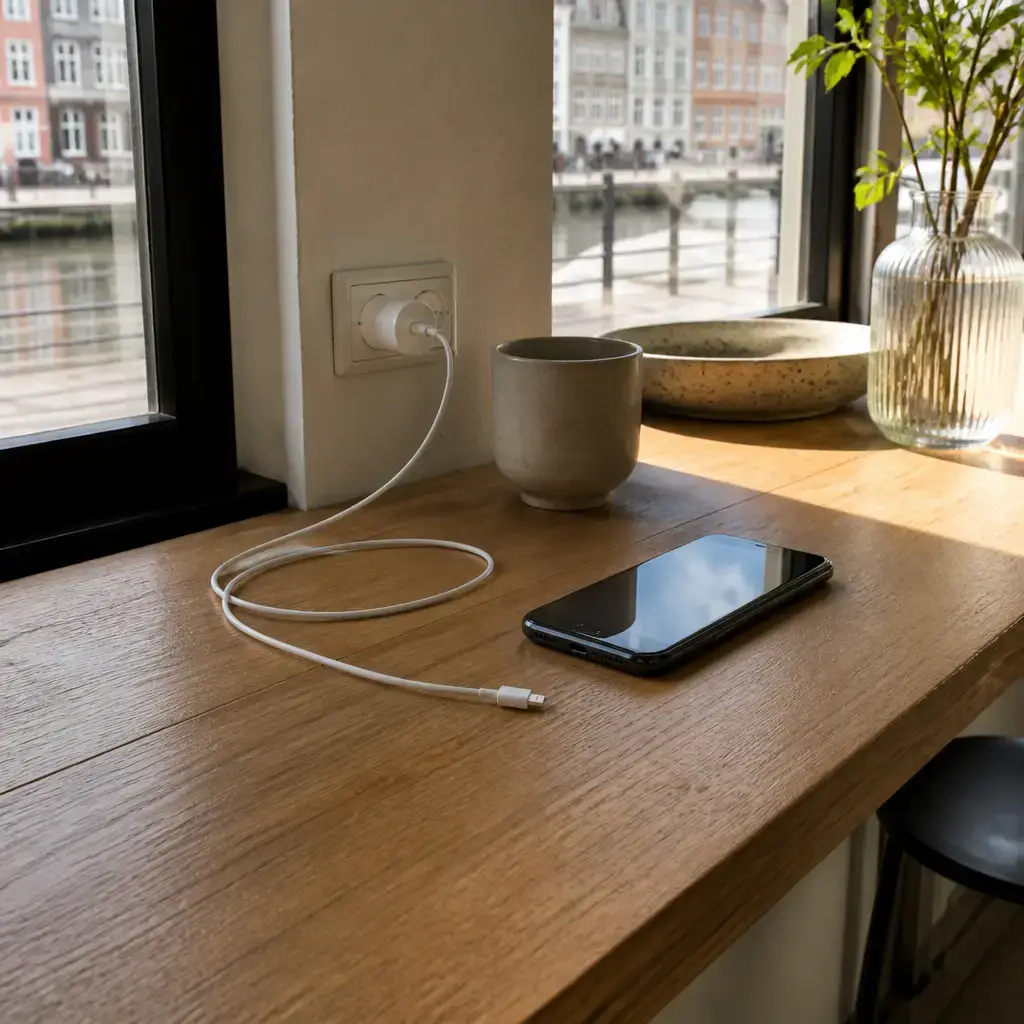
Use Using a charging cable for an urgent call to practice German conversation, pronunciation, vocabulary, grammar, and quizzes.
Dialogue
Der Akku meines Handys ist fast leer.
dayr AH-koo MY-nuhs HEN-dee ist fahst layr. My phone battery is almost dead.Hast du ein Ladegerät oder eine Powerbank dabei?
hahst doo ayn LAH-duh-guh-RAYT OH-dur EYE-nuh POW-ur-bank dah-BYE? Do you have a charger or power bank with you?Ich habe beides zu Hause gelassen.
ikh HAH-buh BY-dus tsoo HOW-zuh guh-LAH-sen. I left both at home.Ich muss dringend telefonieren.
ikh mooss DRING-ent tay-lay-foh-NEER-en. I need to make an urgent call.Neben dem Fenster ist eine Steckdose.
NAY-ben dehm FEN-stur ist EYE-nuh SHTECK-doh-zuh. There is an outlet beside the window.Kann ich dein Kabel ein paar Minuten benutzen?
kahn ikh dine KAH-bel ayn pahr mee-NOOT-en buh-NOOT-sen? Could I use your cable for a few minutes?Du kannst es lange genug benutzen, um anzurufen.
doo kahnst ess LAHNG-uh guh-NOOK buh-NOOT-sen, oom AN-tsoo-ROO-fen. You can use it long enough to make the call.Ich gebe es zurück, sobald mein Handy angeht.
ikh GAY-buh ess tsoo-RUEK, zoh-BAHLT mine HEN-dee AHN-gayt. I will return it as soon as my phone turns on.Lass es eingesteckt, bis dein Handy genug Akku hat.
lahss ess EYE-nguh-SHTEKT, biss dine HEN-dee guh-NOOK AH-koo haht. Keep it plugged in until you have enough battery.Sentence explanations
Der Akku meines Handys ist fast leer.
My phone battery is almost dead.
- Akku
- battery
- meines
- my
- Handys
- phone
- ist
- is
- fast
- almost
- leer
- empty/dead
More detail
Akku means “battery,” specifically the rechargeable battery or battery unit of a device. It is masculine: der Akku; its plural is die Akkus. Example: Der Akku ist leer. — “The battery is empty.” meines means “my” here, but its form reflects the possessive relationship in meines Handys. The phone is expressed in the genitive, meaning roughly “of my phone,” and mein becomes meines with the neuter singular noun Handy in this construction. Example: Die Farbe meines Autos ist schön. — “The color of my car is nice.” Handys means “phone” here, in the form “of my phone.” The base noun is das Handy; its singular genitive is des Handys or, with a possessive determiner, meines Handys. This borrowed noun also has the plural Handys, so the surrounding determiner or context distinguishes the forms. ist is the third-person singular present form of sein (“to be”). It links the subject to a state: Der Akku ist ... — “The battery is ...” The infinitive is sein; other present forms include ich bin and du bist. fast means “almost” or “nearly.” It modifies leer, so the battery is not described as completely empty: it is close to that state. Example: Der Akku ist fast voll. — “The battery is almost full.” leer means “empty.” With a battery, it commonly describes a lack of remaining charge, which explains the natural translation “almost dead.” As a predicate adjective after ist, it has no adjective ending: Der Akku ist leer. Example: Die Flasche ist leer. — “The bottle is empty.” Together, Der Akku meines Handys is “my phone’s battery” or “the battery of my phone.” Adding ist fast leer says that this battery is nearly out of charge. The complete utterance therefore means: “My phone battery is almost dead.”
Hast du ein Ladegerät oder eine Powerbank dabei?
Do you have a charger or power bank with you?
- Hast
- have
- Ladegerät
- charger
- oder
- or
- Powerbank
- power bank
- dabei
- with you
More detail
Hast is the second-person singular present form of haben (“to have”). In a yes/no question, the finite verb comes first: Hast du ...? = “Do you have ...?” The subject du is the person being asked; the form hast is specifically used with du. Example: Hast du Zeit? — “Do you have time?” Ladegerät means “charger,” especially a device used to charge a battery. Its base noun is das Ladegerät, so the indefinite article is ein: ein Ladegerät. The article marks the noun as neuter in this phrase; ein here does not by itself assert a numerical count. Example: Ich brauche ein Ladegerät. — “I need a charger.” oder connects alternatives and means “or.” Here it links the two things being asked about: a charger and a power bank. Example: Tee oder Kaffee? — “Tea or coffee?” Powerbank means “power bank,” a portable battery for charging devices. The noun is feminine in standard German: die Powerbank, so the indefinite article is eine: eine Powerbank. Example: Ich habe eine Powerbank. — “I have a power bank.” dabei means “with you” in this context: having or carrying something with oneself at the relevant time. It is a separable adverbial element related to the idea of having something present, rather than a literal equivalent of every use of “with.” Example: Hast du deinen Ausweis dabei? — “Do you have your ID with you?” Together, Hast du ein Ladegerät oder eine Powerbank dabei? forms a yes/no question. Hast du asks about the addressee’s possession, ein Ladegerät oder eine Powerbank presents two alternatives, and dabei adds the idea of having one of them with the person now. The complete meaning is: “Do you have a charger or power bank with you?”
Ich habe beides zu Hause gelassen.
I left both at home.
- Ich habe
- I have
- beides
- both
- zu Hause
- at home
- gelassen
- left
More detail
Ich habe combines the subject Ich (“I”) with the present-tense form habe of haben (“to have”). Here, habe is an auxiliary that helps form the perfect tense; it does not mean simple possession in this sentence. The perfect pattern is subject + haben/sein + ... + past participle. beides means “both” or “both things.” In this context, it refers to the two items mentioned in the preceding question, the charger and the power bank. The form beides is used for two things treated together; it is not the ordinary form for two people. zu Hause is the fixed expression “at home.” Hause is capitalized in this expression, and zu Hause functions as a place expression. For example: Ich bin zu Hause. — “I am at home.” gelassen is the past participle of lassen, whose basic meaning here is “to leave” or “to leave behind.” Its infinitive is lassen, and in the perfect it combines with haben: Ich habe ... gelassen. The participle appears at the end of this main clause, as is typical in German perfect constructions. Together, Ich habe + beides + zu Hause + gelassen forms the perfect-tense sentence “I left both at home.” The two items are the objects left behind, and zu Hause identifies where they were left.
Ich muss dringend telefonieren.
I need to make an urgent call.
- Ich muss
- I need to / I must
- dringend
- urgently
- telefonieren
- to make a phone call
More detail
Ich muss means “I need to” or “I must.” Ich is the first-person singular pronoun “I,” and muss is the first-person singular present form of müssen (“must/need to”): ich muss, du musst, er/sie muss. With a second verb, müssen is a modal verb, so the other verb stays in the infinitive and moves to the end of the clause. Example: Ich muss arbeiten. — “I need to work.” dringend means “urgently” here. It is related to the adjective meaning “urgent” and can modify an action as an adverb. Its form does not change in this use. Example: Sie muss dringend gehen. — “She urgently needs to leave.” telefonieren is the infinitive “to make a phone call / to telephone.” It is a verb formed with the ending -ieren; unlike many German verbs, its infinitive does not take zu after a modal verb. Example: Wir müssen später telefonieren. — “We need to make a phone call later.” Together, Ich muss + dringend + telefonieren gives “I need to make an urgent call.” More literally, it says “I must telephone urgently.” The modal verb expresses the speaker’s need or obligation, dringend emphasizes that it should happen soon, and telefonieren is the required infinitive at the end.
Neben dem Fenster ist eine Steckdose.
There is an outlet beside the window.
- Neben
- beside; next to
- Fenster
- window
- ist
- is
- Steckdose
- electrical outlet
More detail
Neben means “beside” or “next to.” It is a two-way preposition: for a fixed location, as here, it takes the dative; with movement toward a position, it can take the accusative. Pattern: neben + dative for “beside [something].” Fenster means “window.” Its base form is the neuter noun das Fenster. Here, dem Fenster is dative singular because the location phrase follows neben: neben dem Fenster, “beside the window.” The form Fenster itself does not show the case; the article dem does. ist is the third-person singular present form of sein, “to be.” It agrees with the singular subject eine Steckdose, not with the noun inside the location phrase. A useful form chain is sein → ist for “is.” Steckdose means “electrical outlet” or “power outlet.” It is the feminine noun die Steckdose; here, eine Steckdose is nominative singular, the thing whose presence is stated. The indefinite article identifies an outlet without asserting a numerical contrast such as “one rather than two.” The sentence uses a common German location pattern: Neben dem Fenster gives the place, and ist eine Steckdose states what is there. The location phrase comes first, so the finite verb ist comes next, while the subject eine Steckdose follows it. Together, the utterance means: “There is an outlet beside the window.”
Kann ich dein Kabel ein paar Minuten benutzen?
Could I use your cable for a few minutes?
- Kann ich
- Could I?
- dein
- your
- Kabel
- cable
- ein paar
- a few
- Minuten
- minutes
- benutzen
- use
More detail
Kann ich places the modal verb können in a yes/no question: kann is its present-tense form for ich, and the finite verb comes first. Here it politely asks whether the speaker is allowed to do something, not whether they are physically able to do it. Example: Kann ich hereinkommen? — “May I come in?” dein means “your” and agrees with the possessed noun, not with the owner. With the neuter singular noun Kabel, the form is dein; in the accusative here, it remains dein. Compare dein Kabel — “your cable” with deine Tasche — “your bag,” where the feminine singular form is deine. Kabel is the neuter noun “cable.” Its plural is Kabel, so the form itself can be singular or plural; the surrounding words identify the singular here: dein Kabel means “your cable.” ein paar is a reusable quantity expression meaning “a few” or “a small number of.” The following noun is plural: ein paar Minuten — “a few minutes.” It does not specify an exact number. Minuten is the plural of Minute, “minute.” In this sentence, the plural phrase expresses the approximate duration for which the cable would be used. Example: Ich warte ein paar Minuten. — “I’ll wait a few minutes.” benutzen means “to use.” It is the infinitive form, and it stays at the end because it follows the modal verb kann: Ich kann das Kabel benutzen. — “I can use the cable.” Unlike können, benutzen is not the verb carrying the tense or subject agreement in this question. Together, Kann ich asks for permission, dein Kabel identifies the object, ein paar Minuten gives the approximate duration, and benutzen names the requested action. The complete utterance therefore means: “Could I use your cable for a few minutes?”
Du kannst es lange genug benutzen, um anzurufen.
You can use it long enough to make the call.
- Du kannst
- you can
- es
- it
- lange genug
- long enough
- benutzen
- use
- um anzurufen
- in order to make the call
More detail
Du kannst means “you can” here. kannst is the second-person singular present form of können, expressing ability or possibility. With a modal verb, the other verb normally appears as an infinitive at the end: Du kannst warten. — “You can wait.” es is an accusative pronoun meaning “it.” In this context, it refers to the item being borrowed, identified in the preceding context as dein Kabel (“your cable”). The pronoun form is es because the referenced noun is neuter; the pronoun’s grammatical form and its real-world referent are separate issues. lange genug means “long enough.” lange is the adverb describing duration, and genug means “enough”; together they express that the duration reaches the required amount. Compare kurz genug — “short enough.” Example: Wir haben lange genug gewartet. — “We have waited long enough.” benutzen is the infinitive “to use.” Its useful present-tense forms include ich benutze (“I use”), du benutzt (“you use”), and sie benutzen (“they use”). The formal or plural “you use” form is capitalized Sie benutzen; informal plural “you use” is ihr benutzt. In this sentence, benutzen remains an infinitive because it follows the modal verb kannst. um anzurufen expresses purpose: “in order to make the call.” German commonly uses the pattern um ... zu plus an infinitive for a purpose. anrufen is a separable verb meaning “to call,” and its infinitive with zu is anzurufen; zu is inserted into the verb rather than placed before the whole form. Example: Ich gehe nach draußen, um anzurufen. — “I go outside in order to make the call.” Taken together, Du kannst es lange genug benutzen says that you are able to use the item for a sufficient amount of time. um anzurufen gives the purpose of that use, so the whole utterance means: “You can use it long enough to make the call.”
Ich gebe es zurück, sobald mein Handy angeht.
I will return it as soon as my phone turns on.
- gebe … zurück
- return
- es
- it
- sobald
- as soon as
- mein
- my
- Handy
- phone
- angeht
- turns on
More detail
gebe ... zurück is the separable verb zurückgeben, “to return” or “to give back.” In this sentence, gebe is the first-person singular present form of geben; the prefix zurück appears at the end of the clause. German present tense can refer to a planned future action when the context makes that timing clear. Example: Ich gebe das Buch morgen zurück. — “I will return the book tomorrow.” es is an accusative pronoun meaning “it.” Its specific referent is not named in this sentence, but the translation confirms that it refers to the thing being returned. The same form can also be used for a neuter noun in other grammatical roles; here its role is the object of zurückgeben. sobald means “as soon as” and introduces a subordinate clause for the condition or time at which the main action will happen. In this construction, the finite verb goes to the end of that subordinate clause. Example: Ich rufe dich an, sobald ich Zeit habe. — “I will call you as soon as I have time.” mein means “my.” It is a possessive determiner agreeing here with Handy, which is neuter singular: das Handy, so the nominative form is mein Handy. The form changes with the noun’s grammatical case, gender, and number; for example, meinen Handy would not be correct for this noun. Handy means “mobile phone” or “cell phone.” It is a neuter noun in German: das Handy. Example: Mein Handy ist leer. — “My phone is out of battery.” angeht is the third-person singular present form of the separable verb angehen, here meaning “to turn on” or “to come on.” In the subordinate clause after sobald, the finite form appears at the end: sobald mein Handy angeht. The subject is mein Handy, which is singular, so the verb is third-person singular. Example: Der Bildschirm geht an. — “The screen turns on.” Together, Ich gebe es zurück means “I will return it,” and sobald mein Handy angeht means “as soon as my phone turns on.” The complete utterance is therefore: “I will return it as soon as my phone turns on.”
Lass es eingesteckt, bis dein Handy genug Akku hat.
Keep it plugged in until you have enough battery.
- Lass
- keep; leave
- es
- it
- eingesteckt
- plugged in
- bis
- until
- dein
- your
- Handy
- phone
- genug
- enough
- Akku
- battery
- hat
- has
More detail
Lass is the informal singular imperative of lassen (“to let” or “to leave”). Here it means “leave” or “keep,” telling one person to maintain a situation. The informal plural imperative is Lasst; the formal imperative is Lassen Sie. es is a neuter singular object pronoun meaning “it.” Its form is accusative here; the supplied sentence does not identify the concrete thing it refers to. eingesteckt comes from einstecken (“to plug in” or “to insert”). Here it describes the state to be maintained: “plugged in.” The pattern Lass ... eingesteckt means “leave ... plugged in,” with the object between Lass and the state description. bis introduces the endpoint in time, “until.” A useful pattern is bis + clause: Warte, bis er kommt. — “Wait until he comes.” dein means “your” and is the possessive determiner for “your.” It takes the form required by the noun phrase; in dein Handy, the noun is neuter singular nominative, so the form is dein. For example, deine Tasche means “your bag,” with a different form for a feminine singular noun in this case. Handy is the German noun for a mobile phone. It is neuter, and in dein Handy it is the nominative subject of hat; the noun itself has no visible case ending here. genug means “enough.” Before a noun, it expresses a sufficient amount: genug Zeit means “enough time.” It is invariable in this use. Akku means “battery,” especially a rechargeable battery. Here, genug Akku haben refers naturally to having enough battery charge. hat is the third-person singular present form of haben (“to have”): ich habe, du hast, er/sie/es hat. Together, Lass es eingesteckt gives the instruction “keep it plugged in,” and bis dein Handy genug Akku hat sets the endpoint: “until your phone has enough battery charge.” The complete meaning is: “Keep it plugged in until you have enough battery.”
Grammar Points
sobald + Nebensatz: Verb am Ende
Sobald das Handy angeht, anrufen.
zoh-BAHLT dahss HEN-dee AHN-gayt, AN-roo-fen.As soon as the mobile phone turns on, call.
Nach „sobald“ steht das konjugierte Verb am Ende des Nebensatzes.
bis + Nebensatz: Verb am Ende
Benutzen, bis der Akku genug geladen ist.
buh-NOOT-sen, biss dayr AH-koo guh-NOOK guh-LAH-den ist.Use it until the battery is charged enough.
Nach „bis“ steht das konjugierte Verb im Nebensatz am Ende.
German Vocabulary
Der Akku meines Handys ist fast leer.
Ich habe beides zu Hause gelassen.
Hast du ein Ladegerät oder eine Powerbank dabei?
Ich muss dringend telefonieren.
Der Akku meines Handys ist fast leer.
Neben dem Fenster ist eine Steckdose.
Der Akku meines Handys ist fast leer.
Hast du ein Ladegerät oder eine Powerbank dabei?
Neben dem Fenster ist eine Steckdose.
Hast du ein Ladegerät oder eine Powerbank dabei?
Ich muss dringend telefonieren.
Ich habe beides zu Hause gelassen.
Quiz
Word Order
Arrange the words in the correct order.
I left both at home.
Show Answer
Ich habe beides zu Hause gelassen.I need to make an urgent call.
Show Answer
Ich muss dringend telefonieren.There is an outlet beside the window.
Show Answer
Neben dem Fenster ist eine Steckdose.Spelling
Tap the letters to spell the word.
charger
Show Answer
Ladegeräturgently
Show Answer
dringendwith you; on you
Show Answer
dabeipower bank