10 minutes free every day
Continue audio lessons in the app
Word explanations appear automatically in sync with the audio.
No login required · synced translations · playback with the screen locked
Choose your learning language and open this lesson in the app.

About This Lesson
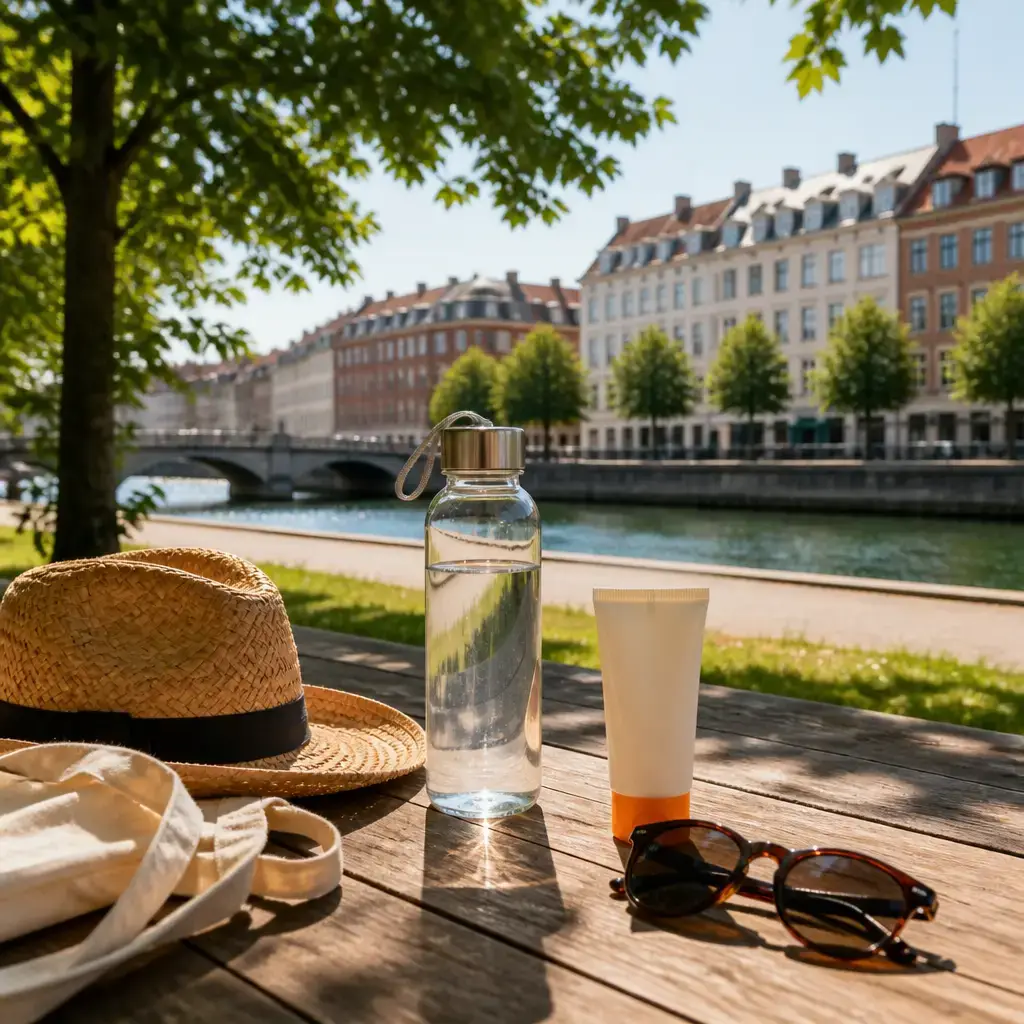
Use Planning for a Very Hot Day to practice German conversation, pronunciation, vocabulary, grammar, and quizzes.
Dialogue
Heute wird es wirklich heiß.
HOY-tuh veert ess VEERK-likh HICE. It's going to be really hot today.Lass uns während der heißesten Zeit des Tages nicht spazieren gehen.
LASS oons VARE-nt dare HICE-ess-ten TSITE dess TAHK-ess nikht shpah-TSEER-en GAY-en. Let's avoid walking during the hottest part of the day.Ich werde Sonnencreme auftragen, bevor wir losgehen.
ikh VARE-duh ZON-en-KRAY-muh OUF-trah-gen, buh-FORE veer LOHSS-gay-en. I'll put on sunscreen before we leave.Bleib auch im Schatten, wann immer du kannst.
BLYBE OWKH im SHAT-ten, vahn IM-mer doo kahnst. Stay in the shade whenever you can, too.Bei dieser Hitze könnte ich schnell dehydrieren.
BYE DEE-zar HIT-suh KURN-tuh ikh SHNELL day-hyd-REE-ren. I could get dehydrated quickly in this heat.Nimm Wasser mit und trink oft.
NIM VAHSS-er mit oont TRINK oft. Carry water and drink often.Lass uns später in den Park gehen, wenn es kühler ist.
LASS oons SHPAY-ter in dayn PARK GAY-en, venn ess KYOOL-er ist. Let's visit the park later when it's cooler.Das wird sicherer und angenehmer sein.
dahs veert ZIKH-er-er oont AHN-guh-NAY-mer zine. That will be safer and more comfortable.Sentence explanations
Heute wird es wirklich heiß.
It's going to be really hot today.
- Heute
- today
- wird es
- it becomes / it will be
- wirklich
- really
- heiß
- hot
More detail
Heute means “today” and places the time in the current day. It is a time adverb and can move in German: Heute wird es heiß and Es wird heute heiß have the same basic meaning, with a different emphasis. wird es uses werden, whose base form is werden. Here wird is the present-tense form for third-person singular, and es is the impersonal subject used in this weather statement; it does not refer to a particular person or thing. In this pattern, werden expresses a change or developing condition: Es wird kalt means “It is becoming cold.” With a time expression such as Heute, the present-tense German sentence naturally gives the prediction “It’s going to be … today.” wirklich is an adverb meaning “really” and strengthens the following description. For example, Das ist wirklich gut means “That is really good.” heiß is the predicative adjective “hot.” It describes the condition that es will have. Its useful comparison chain is heiß (hot), heißer (hotter), am heißesten (hottest). In the following context, heißesten is the superlative form used in der heißesten Zeit; that is a different inflected form of the same adjective. Together, Heute sets the time, wird es presents the weather condition as developing or expected, wirklich intensifies it, and heiß names the condition. The complete meaning is: “It’s going to be really hot today.”
Lass uns während der heißesten Zeit des Tages nicht spazieren gehen.
Let's avoid walking during the hottest part of the day.
- Lass uns
- let’s
- während
- during
- heißesten
- hottest
- Zeit
- time; period
- Tages
- day
- nicht
- not
- spazieren gehen
- go for a walk
More detail
Lass uns is a reusable way to suggest an action together: “let’s …”. Lass is the informal singular imperative of lassen; with uns (“us”), the construction addresses one person and proposes that the speaker and addressee do something. Example: Lass uns anfangen. — “Let’s start.” während means “during” and introduces the time period in which something happens. In this sentence it is followed by a genitive phrase, der heißesten Zeit des Tages. Example: Während des Essens telefoniere ich nicht. — “I don’t make phone calls during the meal.” heißesten is the superlative form of the adjective heiß (“hot”): heiß → heißer (“hotter”) → am heißesten (“hottest”) or, before a noun, heißeste/heißesten with an ending required by the noun phrase. Here heißesten describes Zeit, and its -en ending fits the feminine genitive phrase der heißesten Zeit. Zeit means “time” or “period.” In der heißesten Zeit, it is a feminine singular noun; the form of the article and adjective shows the phrase’s role after während. Example: Das ist eine ruhige Zeit. — “That is a quiet period.” Tages is the genitive singular form of Tag (“day”). The ending -es on the noun marks the relation “of the day” in des Tages; it is not an inflection of Zeit. Together, die Zeit des Tages means “the time of day.” Example: Die Länge des Tages verändert sich. — “The length of the day changes.” nicht supplies negation. Here it negates the proposed activity spazieren gehen, so the suggestion is not to go for a walk during that time. Its exact scope comes from the surrounding construction; it does not mean “no” by itself as a noun or pronoun. spazieren gehen is the infinitive expression “to go for a walk.” gehen is the infinitive of gehen (“to go”), while spazieren specifies leisurely walking. The same expression can be reused after other verbs: Wir wollen heute spazieren gehen. — “We want to go for a walk today.” Putting the parts together, Lass uns proposes a shared action, während der heißesten Zeit des Tages places it during the hottest time of the day, nicht negates it, and spazieren gehen names the activity. The whole utterance means: “Let’s avoid walking during the hottest part of the day.”
Ich werde Sonnencreme auftragen, bevor wir losgehen.
I'll put on sunscreen before we leave.
- Ich werde
- I will
- Sonnencreme
- sunscreen
- auftragen
- apply
- bevor
- before
- losgehen
- leave
More detail
Ich werde expresses a future action by combining werden with the infinitive later in the clause. werde is the first-person singular present form of werden, used here with the subject Ich; the lexical action is supplied by auftragen. This pattern is reusable: Ich werde morgen anrufen. — “I will call tomorrow.” Sonnencreme means sunscreen in this sentence. It is a German noun and is therefore capitalized. The word refers here to the topical product being applied, not to the act of applying it. auftragen means to apply or spread a substance onto a surface. It is a separable verb in other finite forms: Ich trage die Creme auf. — “I apply the cream.” With the future auxiliary werde, it stays as the infinitive auftragen rather than splitting. bevor introduces a subordinate clause meaning “before.” In the clause wir losgehen, the finite verb is placed at the end, as is normal for this type of German subordinate clause. Bevor wir essen, waschen wir uns die Hände. — “Before we eat, we wash our hands.” losgehen means to leave or set off. It is a separable verb: Wir gehen jetzt los. — “We are leaving now.” In the subordinate clause after bevor, its finite form remains together at the end: bevor wir losgehen. Together, Ich werde Sonnencreme auftragen states that the speaker will apply sunscreen, and bevor wir losgehen places that action earlier than the group’s leaving. The complete meaning is: “I’ll put on sunscreen before we leave.”
Bleib auch im Schatten, wann immer du kannst.
Stay in the shade whenever you can, too.
- Bleib
- stay
- auch
- also; too
- Schatten
- shade
- wann immer du kannst
- whenever you can
More detail
Bleib is the informal singular imperative of bleiben, “to stay.” It addresses one person and gives a direct instruction. The polite form for one or more people is Bleiben Sie. Example: Bleib hier! — “Stay here!” auch means “also” or “too.” Here it adds this instruction to another relevant action: staying in the shade is something the person should do as well. Its position can vary, but its scope depends on what it accompanies. Example: Ich komme auch. — “I’m coming too.” Schatten is the masculine noun “shade” or “shadow”; its basic singular form is der Schatten. In the utterance, im Schatten means “in the shade.” im is the contraction of in dem, and the noun remains Schatten. Example: Wir sitzen im Schatten. — “We are sitting in the shade.” wann immer du kannst is a reusable clause meaning “whenever you can.” wann immer introduces a repeated or open-ended condition, while du kannst literally expresses “you can”; kannst is the second-person singular form of können. Example: Ruf mich an, wann immer du kannst. — “Call me whenever you can.” Together, Bleib gives the instruction, auch adds it as another advisable action, im Schatten states the place, and wann immer du kannst specifies the occasions when the instruction applies. The complete meaning is: “Stay in the shade whenever you can, too.”
Bei dieser Hitze könnte ich schnell dehydrieren.
I could get dehydrated quickly in this heat.
- Bei
- in; under
- dieser
- this
- Hitze
- heat
- könnte ich
- I could
- schnell
- quickly
- dehydrieren
- become dehydrated
More detail
Bei introduces the conditions or circumstances in which something happens. With a noun, it is used with the dative case: bei + dative. For example, Bei Regen bleibe ich zu Hause. means “In the rain, I stay at home.” Dieser means “this” and changes according to the noun’s grammatical gender, number, and case. Here, dieser is feminine singular dative because it agrees with Hitze after bei. The pattern is bei dieser + feminine noun. Hitze means “heat” and is a feminine noun: die Hitze. Its dative singular form is also Hitze; the case is shown by the accompanying determiner here, not by a visible change in the noun. A useful contrast is Bei dieser Kälte ... — “In this cold ...”, where Kälte is another feminine noun. Könnte ich expresses “I could.” Könnte is the first-person singular Konjunktiv II form of können (“can, be able to”). In this sentence it presents a possible outcome, not a definite one. In a modal construction, the conjugated modal comes in the main-clause position and the other verb stays as an infinitive later in the clause: Ich könnte ... arbeiten. means “I could work.” Schnell is an adverb here, modifying how quickly the possible event may happen. The same form can also be an adjective before a noun, as in ein schneller Zug — “a fast train”; as an adverb, it does not receive an adjective ending. Dehydrieren is the infinitive meaning “become dehydrated” or “get dehydrated.” After the modal form könnte, it remains in the infinitive. The related noun is die Dehydrierung (“dehydration”), but the observed word is the verb dehydrieren. Together, Bei dieser Hitze sets the condition, könnte ich marks the result as possible for the speaker, and schnell dehydrieren describes becoming dehydrated quickly. The complete meaning is: “I could get dehydrated quickly in this heat.”
Nimm Wasser mit und trink oft.
Carry water and drink often.
- Nimm … mit
- take ... along
- Wasser
- water
- trink
- drink
- oft
- often
More detail
Nimm ... mit is the separable verb mitnehmen, “to take/carry along.” In this sentence, Nimm is the informal singular imperative of nehmen; its irregular imperative form is nimm, not nehm. The separable prefix mit- moves to the end of the clause: Nimm Wasser mit. Example: Nimm deinen Schirm mit. — “Take your umbrella with you.” Wasser means “water.” It is a mass noun, so this sentence does not specify a number of containers or a particular amount. Example: Ich trinke Wasser. — “I drink water.” trink is the informal singular imperative of trinken, “to drink.” The imperative addresses one person directly. Example: Trink langsam. — “Drink slowly.” oft means “often,” indicating that an action happens frequently. It modifies trink here; it is not part of the imperative form itself. Example: Sie kommt oft hierher. — “She often comes here.” Together, Nimm Wasser mit gives the instruction “Carry water along,” and trink oft gives the further instruction “drink often.” The complete utterance is therefore: “Carry water and drink often.”
Lass uns später in den Park gehen, wenn es kühler ist.
Let's visit the park later when it's cooler.
- Lass uns
- let’s
- später
- later
- in den
- to the
- Park
- park
- gehen
- go
- wenn
- when
- kühler
- cooler
More detail
Lass uns is a reusable way to suggest an action together: “let’s …”. Lass is the imperative singular of lassen (“let”); with uns (“us”), the construction functions as a first-person plural suggestion. The action itself comes afterward in the infinitive. Example: Lass uns warten. — “Let’s wait.” später means “later” and places the proposed action after the current or previously understood time. It is an adverb, so it does not change form. in den expresses movement into or to a location here. German uses in with the accusative for movement toward a destination; the masculine noun der Park therefore has the form den after in. This is different from location without movement, where the dative is used: Wir sind im Park. — “We are in the park.” Park means “park.” Its base form is the masculine noun der Park; in this sentence, den Park is the accusative form required as the destination of gehen after in. gehen means “to go” and is an infinitive here. In the Lass uns ... construction, the infinitive names the suggested action and stays at the end of that main clause. Example: Lass uns nach Hause gehen. — “Let’s go home.” wenn introduces a condition or time clause meaning “when” here. It places the clause in a subordinate structure, so the conjugated verb comes at the end of that clause. kühler means “cooler.” It is the comparative form of kühl (“cool”): kühl → kühler → am kühlsten (“cool” → “cooler” → “coolest”). In es kühler ist, kühler is a predicate adjective describing the state of the impersonal subject es; it has no adjective ending in this position. The comparison means cooler than the relevant earlier or expected temperature, without specifying a numeric temperature. Together, Lass uns später in den Park gehen means “Let’s go to the park later.” The clause wenn es kühler ist adds the time condition “when it’s cooler.” The complete utterance therefore means: “Let’s visit the park later when it’s cooler.”
Das wird sicherer und angenehmer sein.
That will be safer and more comfortable.
- Das
- that; it
- wird
- will be; will become
- sicherer
- safer
- angenehmer
- more comfortable
- sein
- be
More detail
Das is the sentence’s subject form. In this fixed utterance, the translation supports “that”; the supplied text does not identify more specifically what das refers to. German das is the neuter form used for a demonstrative pronoun or article, but here it stands independently rather than introducing a noun. wird is the third-person singular present form of werden. Together with an infinitive later in the sentence, werden forms the future: Das wird ... sein = “That will be ...”. werden can also mean “become,” but the following sein makes the future reading clear here. Example: Sie wird morgen kommen. — “She will come tomorrow.” sicherer is the comparative form of the adjective sicher (“safe”): sicher → sicherer (“safer”). It describes the subject as having a greater degree of safety in the intended comparison. Example: Dieser Weg ist sicherer. — “This route is safer.” angenehmer is the comparative form of angenehm (“comfortable” or “pleasant”): angenehm → angenehmer (“more comfortable” or “more pleasant”). The ending belongs to this adjective, not to another noun. Here it is coordinated with sicherer by und, so both adjectives describe das. Example: Der neue Stuhl ist angenehmer. — “The new chair is more comfortable.” sein is the infinitive “be.” In this sentence it appears at the end because German places the infinitive in this future construction after the other sentence elements. The structure is Das wird [comparative adjective] und [comparative adjective] sein: “That will be safer and more comfortable.” The subject is das; wird ... sein gives the future meaning, and the two coordinated comparative adjectives state the two qualities attributed to it.
Grammar Points
bevor + Nebensatz: Das konjugierte Verb steht am Ende
Trag Sonnencreme auf, bevor du losgehst.
TRAHK ZON-en-KRAY-muh OUF, buh-FORE doo LOHSS-gayst.Apply sunscreen before you set off.
After „bevor“, the conjugated verb goes to the end. A separable verb such as „losgehen“ stays together.
Imperativ mit trennbarem Verb: Präfix am Satzende
Nimm Wasser mit.
NIM VAHSS-er MIT.Take water with you.
In the imperative, the verb prefix is separated and placed at the end: „Nimm ... mit“.
German Vocabulary
Quiz
Word Order
Arrange the words in the correct order.
It's going to be really hot today.
Show Answer
Heute wird es wirklich heiß.Carry water and drink often.
Show Answer
Nimm Wasser mit und trink oft.That will be safer and more comfortable.
Show Answer
Das wird sicherer und angenehmer sein.Spelling
Tap the letters to spell the word.
to apply
Show Answer
auftragentoday
Show Answer
heutetime
Show Answer
Zeitsunscreen