10 minutes free every day
Continue audio lessons in the app
Word explanations appear automatically in sync with the audio.
No login required · synced translations · playback with the screen locked
Choose your learning language and open this lesson in the app.

About This Lesson
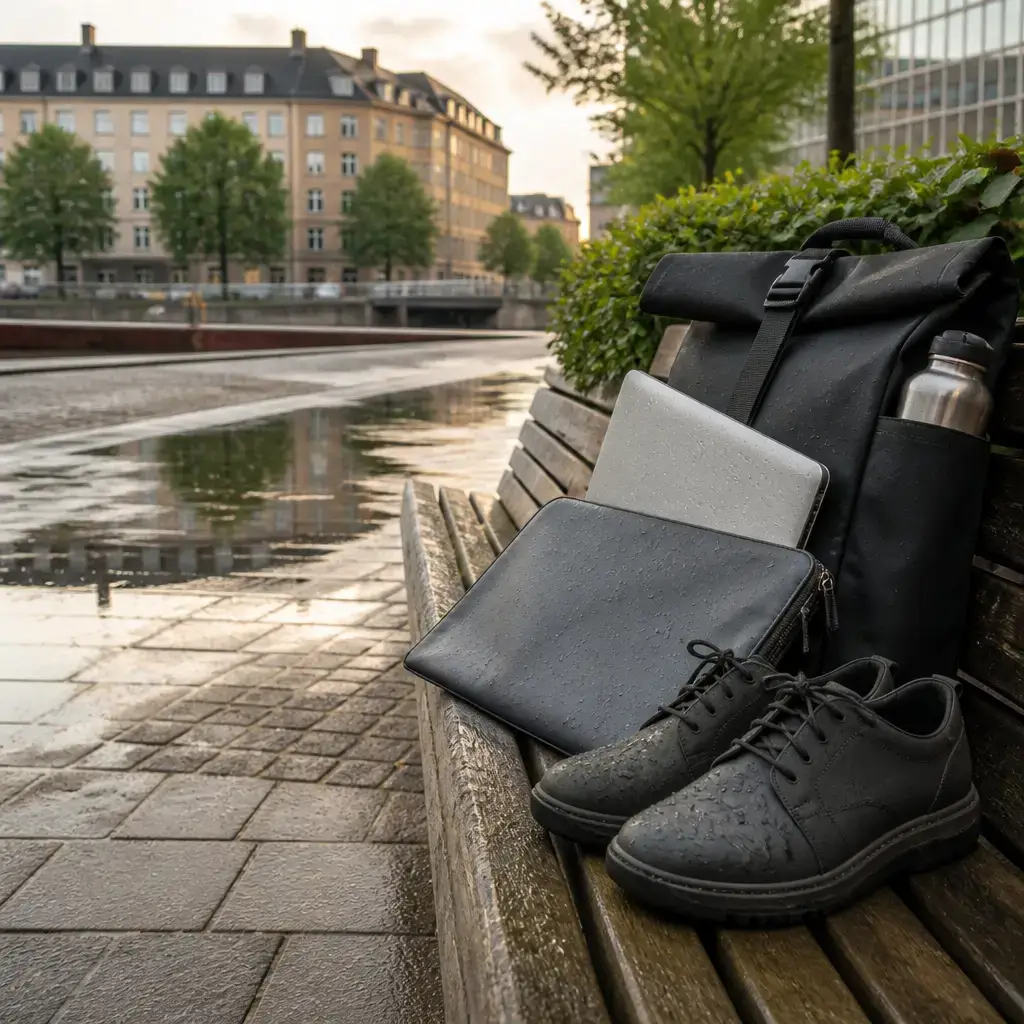
Use Preparing to go out in heavy rain to practice German conversation, pronunciation, vocabulary, grammar, and quizzes.
Dialogue
Der Wetterbericht sagt, dass bald starker Regen beginnt.
dehr VET-uh-buh-rikht zahkt, dahss bahlt SHTAR-kuh RAY-gen buh-GINT. The forecast says heavy rain will start soon.Dann trag heute wasserdichte Schuhe.
dahn trahk HOY-tuh VAH-ser-dikh-tuh SHOO-uh. Then wear waterproof shoes today.In der Nähe des Bahnhofs gibt es immer Pfützen.
in dehr NAY-uh dess BAHN-hohfs gipt ess IM-mer PFEWT-sen. There are always puddles near the station.Du brauchst vielleicht auch mehr Zeit wegen Verspätungen.
doo browkst fee-LYKHT owkh mehr TSITE VAY-gen fehr-SHPAY-toong-en. You may also need extra time for delays.Soll ich meinen Laptop in eine wasserdichte Hülle stecken?
zoll ikh MY-nen LEP-top in EYE-nuh VAH-ser-dikh-tuh HUE-luh SHTEK-en? Should I put my laptop in a waterproof sleeve?Lass ihn in deiner Tasche, wo er trocken bleibt.
lahss een in DYE-ner TAH-shuh, voh ehr TROK-en blypt. Keep it inside your bag where it stays dry.Dann sollte ich früher als sonst losgehen.
dahn ZOLL-tuh ikh FRYOO-uh ahls zonst LOHSS-gay-en. Then I should leave earlier than usual.Das sollte die Fahrt weniger stressig machen.
dahss ZOLL-tuh dee FAHRT VAY-nih-ger SHTRESS-ikh MAKH-en. That should make the trip less stressful.Sentence explanations
Der Wetterbericht sagt, dass bald starker Regen beginnt.
The forecast says heavy rain will start soon.
- Wetterbericht
- forecast
- sagt
- says
- dass
- that
- bald
- soon
- starker
- heavy
- Regen
- rain
- beginnt
- starts
More detail
Wetterbericht means “weather forecast” here. It is a masculine compound noun: das Wetter (“weather”) + der Bericht (“report”), with the final element determining the grammatical gender, so the sentence uses Der Wetterbericht. Example: Der Wetterbericht ist zuverlässig. — “The weather forecast is reliable.” sagt is the present-tense form of sagen (“to say”) for er/sie/es: er sagt — “he/she/it says.” In this sentence, the weather forecast is presented as the source of the information. Example: Der Bericht sagt die Wahrheit. — “The report tells the truth.” dass introduces the content of what is said: “that …”. In a German dass clause, the conjugated verb normally goes to the end. This is why beginnt appears after Regen, rather than directly after the subject. bald means “soon,” referring here to a time shortly after the statement. Example: Der Zug kommt bald. — “The train is coming soon.” starker is the adjective form of stark (“strong, heavy”). With weather, starker Regen means “heavy rain,” not physically strong rain. The adjective is describing Regen; it is not derived from that noun. Because Regen is masculine singular nominative and there is no article before this noun phrase, the adjective has the ending -er: starker Regen. Compare the uninflected base form in Der Regen ist stark. — “The rain is heavy.” Regen means “rain.” It is a masculine noun: der Regen. In weather expressions it is commonly used without an article, as in Starker Regen beginnt. — “Heavy rain starts.” beginnt is the present-tense form of beginnen (“to begin, start”) for er/sie/es. The vowel changes from e in the base form to i in the third-person singular: beginnen → er beginnt. Example: Der Film beginnt um acht Uhr. — “The film starts at eight o’clock.” Together, Der Wetterbericht sagt gives “The weather forecast says.” The dass clause supplies the content of that statement: dass bald starker Regen beginnt — “that heavy rain will start soon.” German uses the present tense beginnt; the future meaning is understood from the time word bald and the context. The complete utterance therefore means: “The forecast says heavy rain will start soon.”
Dann trag heute wasserdichte Schuhe.
Then wear waterproof shoes today.
- Dann
- then
- trag
- wear
- heute
- today
- wasserdichte
- waterproof
- Schuhe
- shoes
More detail
Dann means “then” here, linking this instruction to what has just been mentioned. It can also introduce a consequence or next step. Example: Dann gehen wir. — “Then we’ll go.” trag is the informal singular imperative of tragen, “to wear” or “to carry.” Here it tells one person to wear something. The imperative is directed at du; the subject is normally omitted. Compare Trag den Mantel! — “Wear the coat!” The form for addressing several people formally or informally is different, so trag should not be treated as a general command form. heute means “today” and specifies when the wearing should take place. Example: Heute arbeite ich zu Hause. — “Today I’m working at home.” wasserdichte is the adjective wasserdicht, “waterproof,” in the form required before plural Schuhe. With no article before the adjective, it takes the ending -e here: wasserdichte Schuhe. The adjective describes protection against water; it does not itself express a comparison. A related contrast is nicht wasserdicht — “not waterproof.” Schuhe is the plural of der Schuh, “shoe.” In this sentence it is the object of trag, so the instruction is to wear waterproof shoes. The plural form is Schuhe; the singular is Schuh. Together, Dann trag gives the next-step instruction “Then wear,” heute places it today, and wasserdichte Schuhe names what should be worn. The complete utterance means: “Then wear waterproof shoes today.”
In der Nähe des Bahnhofs gibt es immer Pfützen.
There are always puddles near the station.
- In der Nähe
- nearby
- Bahnhofs
- station
- gibt es
- there is/are
- immer
- always
- Pfützen
- puddles
More detail
In der Nähe means “near” or “in the vicinity.” In this fixed expression, in describes a location and therefore takes the dative: der Nähe is the dative singular of feminine die Nähe. A place can be specified after it with von plus dative or, as here, a genitive noun: in der Nähe des .... Example: Das Hotel liegt in der Nähe. — “The hotel is nearby.” Bahnhofs is the genitive singular of der Bahnhof (“station”). The genitive shows which station’s vicinity is meant: in der Nähe des Bahnhofs means “near the station.” The masculine singular genitive commonly adds -s or -es: der Bahnhof → des Bahnhofs. gibt es is the reusable German existential construction for saying that something exists or is present: “there is” or “there are.” Although gibt is the present-tense third-person singular form of geben (“to give”), in this construction it is not normally understood as a literal act of giving. The thing that exists follows the construction, and its singular or plural does not change gibt es. Example: In der Stadt gibt es einen Park. — “There is a park in the city.” immer means “always.” It states that the situation occurs consistently or repeatedly, rather than only at one particular time. Its position here is between the existential construction and the noun phrase, but German can place it differently depending on emphasis. Pfützen means “puddles” here. Its singular is die Pfütze; the plural is die Pfützen, with the umlaut remaining in the plural. The plural form tells us that more than one puddle is being referred to in the sentence. Together, in der Nähe des Bahnhofs identifies the location, gibt es presents something as present there, immer says this is consistently the case, and Pfützen names what is present. The complete meaning is: “There are always puddles near the station.”
Du brauchst vielleicht auch mehr Zeit wegen Verspätungen.
You may also need extra time for delays.
- Du
- you
- brauchst
- need
- vielleicht
- perhaps
- auch
- also
- mehr
- more
- Zeit
- time
- wegen
- because of
- Verspätungen
- delays
More detail
Du is the informal singular “you” used as the subject. The verb brauchst comes from brauchen, “to need,” and is the present-tense form for du: ich brauche, du brauchst, sie brauchen. Here it states a possible need, not a command. vielleicht means “perhaps” or “maybe.” It makes the statement uncertain: the speaker says that the need is possible rather than certain. In this sentence, it supplies the sense of “may.” auch means “also” or “too.” It adds this possible need to something already relevant in the situation; its exact scope is supplied by context, while its basic contribution here is addition. mehr means “more.” It compares the amount of time needed with an understood amount: “more time.” This word does not change for gender, number, or case. A useful contrast is weniger (“less”): Ich brauche mehr Zeit. — “I need more time.” Zeit is the noun “time.” It is feminine in German (die Zeit), and the expression mehr Zeit means “more time.” The noun remains singular here because the sentence refers to time as an amount, not to separate units of time. wegen is a preposition meaning “because of” or “on account of.” It introduces the reason or circumstance connected with the need: the delays are why extra time may be needed. In careful standard German, wegen commonly takes the genitive, as in wegen des Regens (“because of the rain”); plural forms such as wegen Verspätungen do not show a visible genitive ending on the noun. Verspätungen is the plural of die Verspätung, “delay.” The plural ending is -en: eine Verspätung — “one delay,” Verspätungen — “delays.” Here the fixed translation identifies these as delays, without specifying how many. Together, Du brauchst gives “you need,” vielleicht makes that need possible rather than certain, and auch mehr Zeit adds the need for additional time. wegen Verspätungen gives the reason or circumstance. The whole utterance therefore means: “You may also need extra time for delays.”
Soll ich meinen Laptop in eine wasserdichte Hülle stecken?
Should I put my laptop in a waterproof sleeve?
- Soll ich
- Should I …?
- Laptop
- laptop
- wasserdichte
- waterproof
- Hülle
- sleeve
- stecken
- put; place
More detail
Soll ich is a reusable German way to ask whether the speaker ought to do something: Soll ich + ...? means “Should I ...?” Here soll is the present-tense form of sollen for ich; the subject pronoun comes directly after the verb because this is a yes/no question. Compare the statement Ich soll ... (“I am supposed to ...”) with the question Soll ich ...?. meinen means “my” here and modifies Laptop. It is the masculine accusative form of mein because Laptop is masculine and is the direct object of stecken. The possessive form agrees with the noun it accompanies: mein Laptop is nominative, while meinen Laptop is accusative. This form does not itself mean “me”; it is a possessive determiner. Laptop is a masculine noun in German: der Laptop. In this sentence it appears as meinen Laptop, the direct object of the action. A useful related pattern is Mein Laptop ist ... (“My laptop is ...”) for the subject position versus Ich nehme meinen Laptop (“I take my laptop”) for the accusative object. in eine introduces the destination of the placement: “into a.” in can describe location or movement toward an interior space; with movement toward a destination, German uses the accusative here. eine is the feminine accusative form of the indefinite article, matching Hülle, which is feminine (die Hülle). The article does not by itself state a numerical count; it identifies an unspecified sleeve. wasserdichte means “waterproof” in this sentence. It is the adjective wasserdicht with an ending that agrees with the feminine accusative noun phrase eine ... Hülle. The adjective comes before the noun, so its ending is visible: eine wasserdichte Hülle. For comparison, eine wasserdichte Tasche uses the same feminine pattern, while ein wasserdichter Beutel has a different ending because the noun phrase is masculine. Hülle means “sleeve” here, specifically the protective covering into which the laptop would be placed. It is feminine: die Hülle; after in with movement into it, the phrase is in eine Hülle. The same noun can also mean a cover or casing in other contexts, but “sleeve” is the intended meaning here. stecken is the infinitive “to put” or “to place” here. With sollen, the lexical verb stays in the infinitive and comes at the end: Soll ich ... stecken? The construction etwas in etwas stecken means “to put something into something”; the object being put is meinen Laptop, and the destination is in eine wasserdichte Hülle. Together, Soll ich meinen Laptop in eine wasserdichte Hülle stecken? asks whether the speaker should place their laptop into a waterproof sleeve. The question expresses a request for guidance about that action; it does not itself state that the action has happened.
Lass ihn in deiner Tasche, wo er trocken bleibt.
Keep it inside your bag where it stays dry.
- Lass
- keep
- ihn
- it
- deiner
- your
- Tasche
- bag
- wo
- where
- er
- it
- trocken
- dry
- bleibt
- stays
More detail
Lass is the informal singular imperative of lassen. Here it means “keep” or “leave” something in a place. The imperative addresses one person directly; the subject du is understood. Example: Lass das Fenster offen. — “Leave the window open.” ihn is the accusative form of the masculine singular personal pronoun. In this sentence it means “it,” referring to the laptop from the preceding context. Compare er for a masculine singular subject and ihn for a masculine singular object: Ich sehe ihn. — “I see him/it.” deiner is the dative feminine singular form of the possessive determiner dein (“your”). It appears because in takes the dative when it describes a fixed location rather than movement into a location. Tasche is feminine, so dein becomes deiner here. The phrase in deiner Tasche means “inside your bag.” wo introduces a clause describing a place: “where.” The construction ..., wo ... can add information about the location just mentioned. er is the nominative masculine singular pronoun, used here as the subject of the clause. It refers to the same item as ihn; the form changes because it is now the subject rather than the object: Ich lege ihn dort hin, wo er trocken bleibt. — “I put it there where it stays dry.” trocken is an adjective meaning “dry.” After bleiben, it functions as a predicate describing the subject, so it has no adjective ending in this use. Its opposite is nass (“wet”): Das Papier bleibt trocken. — “The paper stays dry.” bleibt is the third-person singular present form of bleiben (“to stay, remain”). German uses this same verb form with a third-person singular subject regardless of whether the subject is masculine, feminine, or neuter: er bleibt, sie bleibt, es bleibt. Here the present tense describes the condition maintained while the item is in the bag. Together, Lass ihn in deiner Tasche gives the instruction “Keep it inside your bag.” The clause wo er trocken bleibt specifies that the item remains dry there. The complete utterance is: “Keep it inside your bag where it stays dry.”
Dann sollte ich früher als sonst losgehen.
Then I should leave earlier than usual.
- Dann
- then
- sollte ich
- I should
- früher
- earlier
- als sonst
- than usual
- losgehen
- leave; set off
More detail
Dann means “then.” It can point to a time or situation supplied by the context. Here it gives the meaning “then,” but the supplied sentences do not identify a more specific antecedent. Example: Dann gehe ich nach Hause. — “Then I go home.” sollte ich expresses “I should”: sollte is the form of the modal verb sollen used here with ich. In this sentence, it presents leaving as advisable or expected, rather than stating that the speaker is definitely leaving. German places the subject ich after the modal here because Dann occupies the first position; the finite verb remains in the second position. With a modal verb, the main lexical verb normally goes to the end in its infinitive form. früher is the comparative form of früh (“early”): früh → früher (“earlier”) → am frühesten (“earliest”). It compares the intended departure time with the usual departure time. Example: Wir müssen früher anfangen. — “We have to start earlier.” als sonst completes the comparative: früher als sonst means “earlier than usual.” In this use, sonst refers to what is usual or happens at other times. A comparative uses als for the reference point being compared: Sie kommt später als sonst. — “She is coming later than usual.” losgehen is the infinitive of the separable verb losgehen, meaning “to leave” or “to set off.” Its parts separate in a finite clause: Ich gehe früh los. — “I set off early.” In the supplied sentence it remains together at the end because it follows the modal sollte as an infinitive. Together, Dann sollte ich früher als sonst losgehen. means “Then I should leave earlier than usual.” Dann sets the relevant time or situation; sollte ich expresses the speaker’s recommendation or expectation; and früher als sonst compares the departure time with the usual one. The final infinitive losgehen identifies the action.
Das sollte die Fahrt weniger stressig machen.
That should make the trip less stressful.
- Das sollte
- That should
- Fahrt
- trip
- weniger
- less
- stressig
- stressful
- machen
- make
More detail
Das sollte combines the subject Das with sollte, the form used here for “should.” Das is a neuter demonstrative pronoun meaning “that”; in this context, the fixed translation supports its reference to the previously mentioned situation or action without identifying a more specific noun. Sollte comes from sollen (“to be supposed to / should”). Here it expresses an expectation or recommendation rather than a firm prediction. The same form can also be the simple past of sollen, so the surrounding meaning determines the reading. With a modal verb, the other verb goes to the end in the infinitive: Das sollte helfen = “That should help.” Fahrt is a feminine noun, die Fahrt, meaning a trip or journey, especially travel by some vehicle. Its plural is Fahrten. In the sentence, die Fahrt is the accusative object of machen; the feminine article is not part of the selected quote but belongs to the full noun phrase. weniger means “less” and compares an amount or degree with another amount or degree. Here it reduces the degree of stressig: weniger stressig = “less stressful.” Its useful opposite is mehr (“more”). For example, Diese Aufgabe ist weniger schwierig. = “This task is less difficult.” stressig is an adjective meaning “stressful,” describing something that causes or involves stress. It remains in this form after machen in the pattern etwas + adjective + machen, where the adjective describes the result: Der Lärm macht den Tag stressig. = “The noise makes the day stressful.” machen is the infinitive of the verb meaning “to make” or “to do.” In this sentence it is used in the result-producing pattern etwas weniger + adjective machen (“make something less ...”). The modal sollte carries the finite verb position, so machen stays as an infinitive at the end. Together, Das sollte gives “That should,” and die Fahrt weniger stressig machen means “make the trip less stressful.” The complete utterance therefore means “That should make the trip less stressful.”
Grammar Points
starker Regen
Starker Regen beginnt bald.
SHTAR-kuh RAY-gen buh-GINT bahlt.Heavy rain will start soon.
Before a masculine noun without an article, the adjective takes the ending -er: starker Regen.
wasserdichte Schuhe
Trag wasserdichte Schuhe.
trahk VAH-ser-dikh-tuh SHOO-uh.Wear waterproof shoes.
Before plural nouns without an article, the adjective takes the ending -e: wasserdichte Schuhe.
German Vocabulary
des Bahnhofs
dass bald starker Regen beginnt
starker Regen beginnt
In der Nähe des Bahnhofs
Es gibt immer Pfützen.
starker Regen beginnt
Der Wetterbericht sagt ...
wasserdichte Schuhe
starker Regen
Dann trag heute wasserdichte Schuhe.
eine wasserdichte Hülle
Der Wetterbericht sagt ...
Quiz
Word Order
Arrange the words in the correct order.
Then wear waterproof shoes today.
Show Answer
Dann trag heute wasserdichte Schuhe.Spelling
Tap the letters to spell the word.
waterproof
Show Answer
wasserdichterain
Show Answer
Regento wear
Show Answer
tragshoe