10 minutes free every day
Continue audio lessons in the app
Word explanations appear automatically in sync with the audio.
No login required · synced translations · playback with the screen locked
Choose your learning language and open this lesson in the app.

About This Lesson
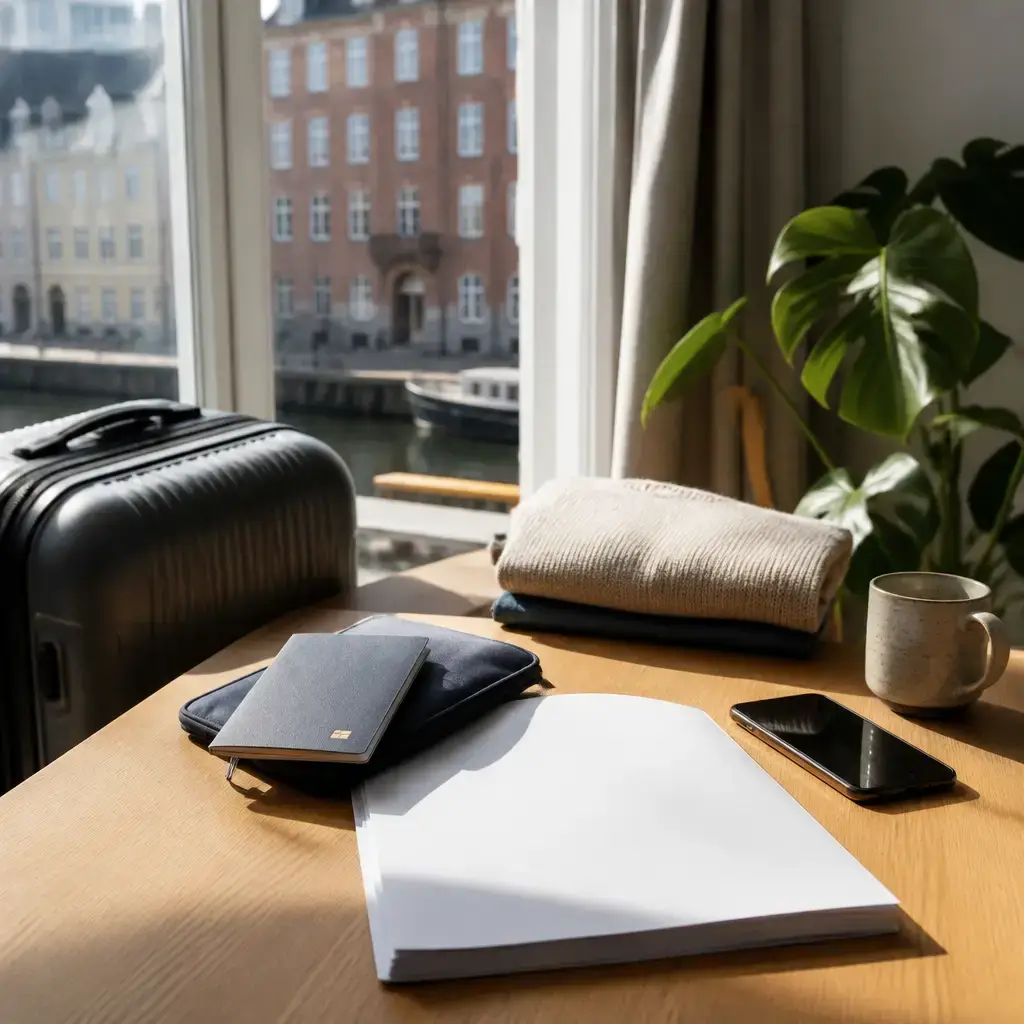
Use Checking travel documents to practice German conversation, pronunciation, vocabulary, grammar, and quizzes.
Dialogue
Könntest du mir helfen, die Reisedokumente zu prüfen, bevor wir losfahren?
KURN-tuhst doo meer HEL-fuhn, dee RYE-zuh-doh-koo-MEN-tuh tsoo PROO-fuhn, buh-FOHR veer LOHS-fah-run? Could you help me check the travel documents before we leave?Beginnen wir mit deinem Reisepass und deiner Bordkarte.
buh-GIN-un veer mit DYE-num RYE-zuh-pahs oont DYE-nuh BORT-kar-tuh. Let's start with your passport and boarding pass.Mein Reisepass ist in der Innentasche.
mine RYE-zuh-pahs ist in dair IN-nuhn-TAH-shuh. My passport is in the inside pocket.Hast du auch die Hotelreservierung bestätigt?
hahst doo owkh dee hoh-TEL-ray-zair-VOO-roong buh-SHTAY-tikt? Did you confirm the hotel reservation too?Die Bestätigungs-E-Mail ist auf meinem Handy gespeichert.
dee buh-SHTAY-toongz EE-mail ist owf MY-num HEN-dee guh-SHPEE-khert. The confirmation email is saved on my phone.Hast du eine ausgedruckte Kopie, falls dein Handy leer ist?
hahst doo EYE-nuh OWS-guh-DROOK-tuh koh-PEE-uh, fahls dine HEN-dee lair ist? Do you have a printed copy in case your phone dies?Ich habe eine ausgedruckt und in den Ordner gelegt.
ikh HAH-buh EYE-nuh OWS-guh-DROOKT oont in dayn ORD-nuh guh-LAYKT. I printed one and put it in the folder.Dann haben wir alles, was wir brauchen.
dahn HAH-bun veer AL-luhs, vahs veer BROW-khun. Then we have everything we need.Sentence explanations
Könntest du mir helfen, die Reisedokumente zu prüfen, bevor wir losfahren?
Could you help me check the travel documents before we leave?
- Könntest du
- could you
- mir
- me
- helfen
- help
- Reisedokumente
- travel documents
- zu prüfen
- to check
- bevor
- before
- wir
- we
- losfahren
- set off; leave
More detail
Könntest du is a reusable polite request pattern. Könntest is the second-person singular form of können in the Konjunktiv II: du kannst means “you can,” while Könntest du ...? softens the request to “Could you ...?” The subject is du, so the verb form is singular; this wording does not assert that the listener lacks ability. mir means “to me” or “for me” here. It is the dative form of the first-person pronoun: ich (subject) → mir (dative). German helfen takes a dative person, so the person receiving help is expressed with mir, not the accusative form mich. helfen is the infinitive “to help.” With könntest, the lexical verb stays in the infinitive: Du könntest mir helfen. This gives the reusable pattern könntest du + dative person + helfen for a polite request for assistance. Example: Könntest du mir helfen? — “Could you help me?” Reisedokumente means “travel documents.” It is the plural of the compound noun Reisedokument; its plural form ends in -e, giving Reisedokumente. The compound is built from Reise (“trip/travel”) and Dokument (“document”). The article die before it marks the plural accusative form in this sentence; it does not itself state a numeric count. zu prüfen means “to check.” prüfen is the base verb, and zu marks its infinitive in this construction. The requested activity is therefore “to check the travel documents.” Example: Ich versuche, die Liste zu prüfen. — “I am trying to check the list.” bevor introduces a time clause meaning “before.” In a German subordinate clause introduced by bevor, the finite verb normally comes at the end. The pattern is bevor + subject + ... + finite verb. bevor expresses the time relation; it does not by itself say how long the earlier activity lasts. wir is the first-person plural subject pronoun, “we.” It refers to the speaker together with at least one other person. In the supplied sentence, it is the subject of losfahren in the bevor clause. losfahren means “to set off” or “to leave.” It is a separable verb. In a finite main clause, its parts separate, as in Wir fahren los. — “We set off.” In bevor wir losfahren, the observed form is finite present indicative, first-person plural: its surface form happens to be identical to the infinitive losfahren, and the subordinate-clause position keeps the verb together at the end. The wir subject supplies the person and number; losfahren itself has no special plural ending here. Together, Könntest du mir helfen asks politely whether the listener can provide help, die Reisedokumente zu prüfen names the requested activity, and bevor wir losfahren places that activity before the speaker and others set off. The whole utterance means: “Could you help me check the travel documents before we leave?”
Beginnen wir mit deinem Reisepass und deiner Bordkarte.
Let's start with your passport and boarding pass.
- Beginnen wir
- let’s start
- mit
- with
- deinem
- your
- Reisepass
- passport
- deiner
- your
- Bordkarte
- boarding pass
More detail
Beginnen wir means “let’s begin” or “let’s start.” It uses the first-person plural form of beginnen (“to begin”) with wir (“we”) placed after the verb. This verb-first pattern is a common way to make a suggestion involving the speaker and others: Gehen wir! means “Let’s go!” mit means “with” and introduces what the activity starts with. It takes the dative case, so the following possessive forms are dative forms. deinem means “your” here and modifies the masculine noun Reisepass in the dative singular. The base possessive form is dein; its ending changes to deinem because of the combination of masculine singular and dative case. Compare: dein Reisepass (“your passport,” nominative) and mit deinem Reisepass (“with your passport,” dative). Reisepass means “passport.” It is a masculine noun: der Reisepass. The compound combines Reise (“travel”) with Pass (“passport/pass”), but the useful form to learn here is the complete noun Reisepass. Example: Ich habe meinen Reisepass. — “I have my passport.” deiner means “your” here and modifies the feminine noun Bordkarte in the dative singular. The base possessive form is again dein, but the ending is -er because Bordkarte is feminine and follows dative mit: mit deiner Bordkarte. Compare the two forms in this sentence: deinem agrees with masculine Reisepass, while deiner agrees with feminine Bordkarte; both are dative because of mit. Bordkarte means “boarding pass.” It is a feminine noun: die Bordkarte. The compound contains Bord (“on board”) and Karte (“card”), but learn Bordkarte as the complete word. Example: Wo ist meine Bordkarte? — “Where is my boarding pass?” Together, Beginnen wir mit ... forms the reusable pattern “Let’s start with ...”. The sentence applies it first to deinem Reisepass and then to deiner Bordkarte, yielding: “Let’s start with your passport and boarding pass.”
Mein Reisepass ist in der Innentasche.
My passport is in the inside pocket.
- Mein
- my
- Reisepass
- passport
- ist
- is
- in der
- in the
- Innentasche
- inside pocket
More detail
Mein means “my” here and is the possessive determiner for Reisepass. Because Reisepass is masculine singular and is the subject in the nominative case, the form is mein; compare meine with feminine or plural nouns, as in meine Bordkarte (“my boarding pass”). Reisepass means “passport.” It is a masculine noun: der Reisepass. German nouns are capitalized. The word is a compound built from Reise (“journey/travel”) and Pass (“passport/pass”), but it is learned and used as one noun. ist is the third-person singular present form of sein (“to be”). The present tense can describe a current location: Der Pass ist hier. — “The passport is here.” in der means “in the” before the feminine dative noun Innentasche. in is a two-way preposition: for a fixed location, it takes the dative; for movement into a place, it takes the accusative. Thus Der Pass ist in der Tasche. means “The passport is in the pocket/bag,” while Ich lege den Pass in die Tasche. means “I put the passport into the pocket/bag.” Innentasche means “inside pocket.” It is feminine: die Innentasche; after the location phrase in, its dative form is der Innentasche. The compound refers to a pocket located on the inside of something; the sentence does not specify what that larger item is. Together, Mein Reisepass is the subject, ist states its current location, and in der Innentasche gives that location. The complete meaning is: “My passport is in the inside pocket.”
Hast du auch die Hotelreservierung bestätigt?
Did you confirm the hotel reservation too?
- Hast du
- have you
- auch
- also; too
- Hotelreservierung
- hotel reservation
- bestätigt
- confirmed
More detail
Hast du is the 2nd-person singular present form of haben: du hast means “you have.” In a yes/no question, the finite verb comes first, so Hast du ...? means “Have you ...?” Here haben is the auxiliary for the completed action; the main verb appears at the end as bestätigt. Example: Hast du die E-Mail gelesen? — “Have you read the email?” auch means “also” or “too.” In this question it adds the hotel reservation to something else being considered: “the hotel reservation too.” Its exact scope is supplied by the context, but it does not itself state a number. Hotelreservierung is a feminine German noun: die Hotelreservierung. It is a compound made from Hotel and Reservierung, meaning a reservation for a hotel. The compound is written as one word, and its grammatical gender is feminine because the final component Reservierung is feminine. Example: Ich habe eine Hotelreservierung. — “I have a hotel reservation.” bestätigt is the past participle of bestätigen, “to confirm.” With present-tense haben, it forms the German perfect: du hast bestätigt — “you have confirmed.” The participle remains at the end in this yes/no question. Example: Sie hat den Termin bestätigt. — “She has confirmed the appointment.” Together, Hast du ... bestätigt? forms a question about whether the listener has completed the confirming action. The object is die Hotelreservierung, and auch marks it as an additional item. Thus the whole utterance means: “Did you confirm the hotel reservation too?”
Die Bestätigungs-E-Mail ist auf meinem Handy gespeichert.
The confirmation email is saved on my phone.
- Bestätigungs-E-Mail
- confirmation email
- ist
- is
- Handy
- mobile phone
- gespeichert
- saved
More detail
Bestätigungs-E-Mail is a compound noun meaning “confirmation email.” Bestätigung means “confirmation,” and E-Mail means “email”; the hyphens make the compound easy to read. In German, nouns are capitalized. Example: Ich öffne die Bestätigungs-E-Mail. — “I open the confirmation email.” ist is the third-person singular present form of sein (“to be”). The subject here is singular: Die Bestätigungs-E-Mail ist .... Useful forms include ich bin, du bist, er/sie/es ist, and wir/sie sind. Example: Die Datei ist wichtig. — “The file is important.” Handy means “mobile phone” in this usage. Its usual article is neuter: das Handy; the plural is die Handys. This German word is common for a mobile phone, while Telefon is a more general “telephone/phone.” Example: Mein Handy liegt hier. — “My phone is here.” gespeichert is the past participle of speichern (“to save” or “to store”). With sein, as in ist gespeichert, it describes the resulting state: something is saved. Compare Die Datei wird gespeichert. — “The file is being saved,” which focuses on the process. Example: Das Foto ist gespeichert. — “The photo is saved.” The location phrase auf meinem Handy means “on my phone.” For a fixed location, auf takes the dative here: meinem is the dative form of the possessive determiner for neuter das Handy. The phrase therefore identifies the phone as the place where the email is stored; it does not express movement onto the phone. Putting the parts together, Die Bestätigungs-E-Mail is the subject, ist gespeichert states its saved condition, and auf meinem Handy gives its location. The whole utterance means: “The confirmation email is saved on my phone.”
Hast du eine ausgedruckte Kopie, falls dein Handy leer ist?
Do you have a printed copy in case your phone dies?
- Hast du
- do you have
- ausgedruckte
- printed
- Kopie
- copy
- falls
- in case
- Handy
- mobile phone
- leer
- empty; dead
More detail
Hast du is the reusable present-tense question pattern for du with haben (“to have”). hast is the second-person singular form of haben; du is the subject. In a yes/no question, the finite verb comes first: Hast du Zeit? — “Do you have time?” ausgedruckte means “printed” here. It is the adjective formed from the past participle ausgedruckt, from ausdrucken (“to print”), and it describes Kopie. The ending -e agrees with the feminine singular accusative noun phrase eine ausgedruckte Kopie; the adjective itself, not Kopie, carries this ending. Example: Ich brauche eine ausgedruckte Fahrkarte. — “I need a printed ticket.” Kopie is a feminine noun meaning “copy.” With eine it is accusative here because it is what the speaker has: eine Kopie — “a copy.” The indefinite article marks an unspecified copy; it does not by itself assert a numerical quantity beyond the ordinary meaning of the singular noun. Example: Die Kopie liegt auf dem Tisch. — “The copy is on the table.” falls introduces a condition or precaution: “in case” or “if.” It starts a subordinate clause, so the finite verb goes to the end of that clause. A reusable pattern is ..., falls ... ist. Example: Nimm einen Regenschirm mit, falls es regnet. — “Take an umbrella in case it rains.” Handy is a neuter German noun for a mobile phone. In dein Handy, dein is the possessive determiner agreeing with the neuter singular noun; Handy is the subject of the falls clause. The specific phone is identified by the possessive relation, not by the noun’s position alone. Example: Mein Handy klingelt. — “My phone is ringing.” leer means “empty” here and describes the state of the phone. With sein, the adjective is predicative and has no ending: Das Handy ist leer. In everyday German, a phone that has no battery power can also be described as leer, which matches the intended meaning “dead” in the translation. Together, Hast du eine ausgedruckte Kopie asks whether the addressee has a printed copy. falls dein Handy leer ist gives the condition for its usefulness: the phone may have no battery power. The whole utterance therefore means, “Do you have a printed copy in case your phone dies?”
Ich habe eine ausgedruckt und in den Ordner gelegt.
I printed one and put it in the folder.
- Ich habe
- I have
- eine
- one
- ausgedruckt
- printed
- Ordner
- folder
- gelegt
- put
More detail
Ich habe introduces the speaker as the subject and uses haben as the auxiliary for the completed actions in this sentence. habe is the first-person singular present form of haben; the completed-action meaning comes from the past participles later in the sentence, not from habe alone. In a question, the same auxiliary can move to the front: Hast du ...? = “Do you have ...?” eine means “one” here and stands for one item, understood from the context as a copy. It is an indefinite pronoun rather than a full noun phrase in this sentence. Its form is feminine, matching the understood noun Kopie; the form does not itself mean “female.” ausgedruckt is the past participle of ausdrucken, “to print out.” The useful chain is ausdrucken → ausgedruckt; with haben, the participle helps form a completed-action construction. Example: Ich habe das Dokument ausgedruckt. — “I printed the document.” Ordner means “folder.” The form is identical here to the singular nominative and accusative forms; the article carries the visible case marking in den Ordner. The phrase in den Ordner expresses movement into or placement into the folder, so in takes the accusative here. This contrasts with location: in dem Ordner means “in the folder” as a place where something already is. gelegt is the past participle of legen, “to lay” or “to put/place.” The chain is legen → gelegt. In this sentence it describes placing the printed item in the folder, and habe ... gelegt forms the completed action. Do not confuse it with liegen → gelegen: legen describes putting something somewhere, while liegen describes something being located there. The sentence joins two completed actions with und: Ich habe eine ausgedruckt means “I printed one,” and in den Ordner gelegt adds “and put it in the folder.” The shared subject is Ich, and habe serves as the auxiliary for both participles, which appear at the end of their coordinated verb structure. Overall: “I printed one and put it in the folder.”
Dann haben wir alles, was wir brauchen.
Then we have everything we need.
- Dann
- then
- haben
- have
- wir
- we
- alles
- everything
- was
- what; that
- brauchen
- need
More detail
Dann means “then” here, usually linking this statement to an earlier point in time or sequence. It can also appear in other contexts with the meaning “in that case,” but the fixed translation supports the time/sequence meaning here. haben is the present-tense form of haben (“to have”) used with wir (“we”). The relevant present-tense pattern is ich habe, du hast, er/sie/es hat, wir haben, ihr habt, sie/Sie haben. Example: Wir haben Zeit. — “We have time.” wir is the first-person plural subject pronoun, “we.” It identifies the speaker together with at least one other person, but the sentence does not specify who else is included. alles means “everything” or “all of it” in this sentence. It is used here as a pronoun rather than as a modifier before a noun. Example: Alles ist bereit. — “Everything is ready.” was introduces the clause was wir brauchen, which specifies what alles includes. In this use, was is an invariant relative pronoun referring back to the broad idea expressed by alles; it does not change for gender or number. Within the clause, was is the object of brauchen, while wir is the subject. This differs from a question such as Was brauchst du? — “What do you need?”, where was asks for unknown information rather than linking a clause to alles. brauchen means “need.” In was wir brauchen, it is the present-tense form used with the subject wir; for this verb, the first-person plural form is identical in spelling to the infinitive: wir brauchen. Its finite position at the end of this subordinate clause is typical of German subordinate clauses. Example: Wir brauchen mehr Zeit. — “We need more time.” Together, Dann haben wir alles gives “Then we have everything,” and was wir brauchen narrows alles to “what we need.” The complete utterance therefore means “Then we have everything we need.”
Grammar Points
zu + Infinitiv
zu prüfen
tsoo PROO-fuhnto check
German uses zu before an infinitive in many dependent or purpose expressions.
Adjektivendung vor dem Nomen
ausgedruckte Kopie
OWS-guh-DROOK-tuh koh-PEE-uhprinted copy
The adjective ausgedruckt takes the ending -e before the feminine noun Kopie.
German Vocabulary
Quiz
Word Order
Arrange the words in the correct order.
My passport is in the inside pocket.
Show Answer
Mein Reisepass ist in der Innentasche.Did you confirm the hotel reservation too?
Show Answer
Hast du auch die Hotelreservierung bestätigt?Spelling
Tap the letters to spell the word.
to leave; to set off
Show Answer
losfahrento help
Show Answer
helfenpassport
Show Answer
Reisepassboarding pass