10 minutes free every day
Continue audio lessons in the app
Word explanations appear automatically in sync with the audio.
No login required · synced translations · playback with the screen locked
Choose your learning language and open this lesson in the app.

About This Lesson
Use Checking meeting room equipment to practice German conversation, pronunciation, vocabulary, grammar, and quizzes.
Dialogue
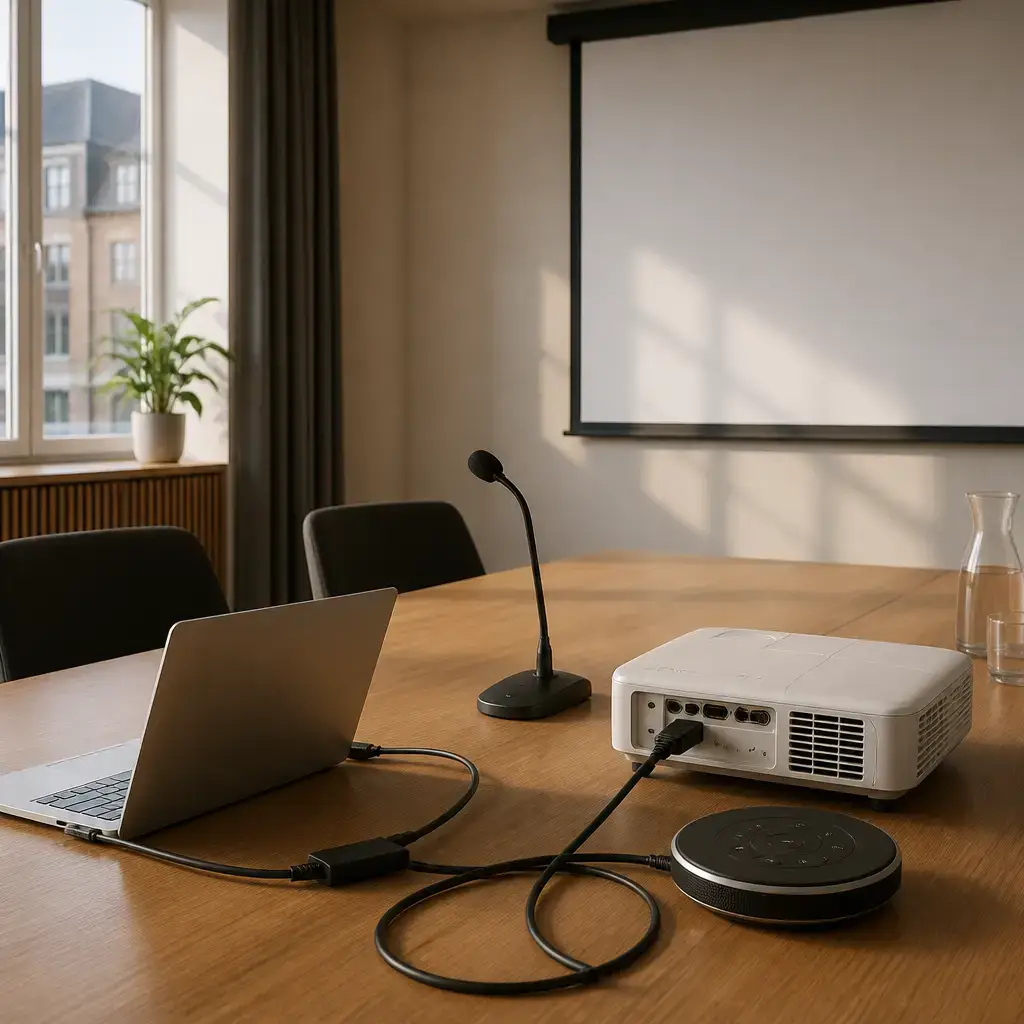
Wir sollten die Ausstattung im Besprechungsraum prüfen.
veer ZOHL-ten dee OWS-shta-toong im beh-SHPREKH-oongs-rowm PRUE-fen. We should check the meeting room equipment.Das Meeting beginnt bald.
dahs MEE-ting beh-GINT bahlt. The meeting starts soon.Lass uns das jetzt machen.
lahs oons dahs yetst MAKH-en. Let's do it now.Ist der Projektor mit dem Laptop verbunden?
ist dair proh-YEK-tor mit daym LEP-top fair-BOON-den? Is the projector connected to the laptop?Ja, aber dieses Kabel ist ein bisschen locker.
yah, AH-ber DEE-zes KAH-bel ist ayn BIS-khen LOCK-er. It is, but this cable feels a little loose.Lass uns das Mikrofon testen, bevor die Leute kommen.
lahs oons dahs mee-kroh-FOHN TES-ten, beh-FOHR dee LOY-te KOH-men. Let's test the microphone before people arrive.Es funktioniert, aber die Lautstärke ist niedrig.
ess foonk-tsyo-NEERT, AH-ber dee LOWT-shtair-ke ist NEE-drikh. It works, but the volume is low.Ich mache es ein bisschen lauter.
ikh MAKH-eh ess ayn BIS-khen LOW-ter. I'll turn it up a little.Das klingt besser. Der Raum ist bereit.
dahs klinkt BES-er. dair ROWM ist beh-RITE. That sounds better. The room is ready.Sentence explanations
Wir sollten die Ausstattung im Besprechungsraum prüfen.
We should check the meeting room equipment.
- Wir sollten
- we should
- Ausstattung
- equipment
- Besprechungsraum
- meeting room
- prüfen
- check
More detail
Wir sollten means “we should” here. Wir is the first-person plural subject: “we.” Sollten is the recommendation form of sollen; with a following infinitive, it expresses what the subject ought to do. The infinitive comes at the end of this modal construction. Example: Wir sollten gehen. — “We should go.” Ausstattung means “equipment” in this sentence. It is a feminine noun: die Ausstattung. Here it is the object being checked, so the definite article is still die in the accusative singular; feminine singular die has the same form in nominative and accusative. The word can also refer more broadly to furnishings or facilities, but “equipment” is the supported meaning here. Besprechungsraum means “meeting room.” It is a masculine compound noun: die Besprechung (“meeting”) + der Raum (“room”), with the compound’s grammatical gender coming from Raum: der Besprechungsraum. In im Besprechungsraum, im is the contraction of in dem. The phrase describes a fixed location, so in takes the dative here. Example: Wir arbeiten im Besprechungsraum. — “We work in the meeting room.” prüfen means “to check” or “to examine.” This is its infinitive form, required after sollten. Its present-tense forms include ich prüfe (“I check”) and wir prüfen (“we check”). Example: Ich prüfe den Bericht. — “I check the report.” Together, Wir sollten expresses a recommendation, die Ausstattung is what should be checked, im Besprechungsraum specifies its location, and prüfen names the recommended action. The complete meaning is: “We should check the meeting room equipment.”
Das Meeting beginnt bald.
The meeting starts soon.
- Meeting
- meeting
- beginnt
- begins; starts
- bald
- soon
More detail
Das is the definite article used here with the singular neuter noun Meeting: das Meeting. It identifies a particular meeting in the sentence; das does not itself state a numerical quantity. German articles change with grammatical gender, number, and case, so the form must be learned as part of the noun phrase rather than inferred from the English word. Meeting means “meeting” here and is a German noun borrowed from English. Its usual German plural is Meetings. German nouns are capitalized, as this one is. beginnt means “starts” or “begins” here. Its base form is beginnen; beginnt is the present-tense form for the third-person singular subject, matching das Meeting. For example: Der Kurs beginnt um neun. — “The course starts at nine.” bald is an adverb meaning “soon,” indicating that the starting time is near the relevant time of speaking or reference. It does not inflect. For example: Der Zug kommt bald. — “The train is coming soon.” Together, Das Meeting is the subject, beginnt says what it does, and bald gives the timing: “The meeting starts soon.”
Lass uns das jetzt machen.
Let's do it now.
- Lass uns
- let's
- das
- it
- jetzt
- now
- machen
- do; make
More detail
Lass uns is a reusable German way to propose doing something together: Lass uns + infinitive corresponds to “Let’s + verb.” Lass is the informal singular imperative of lassen (“to let; allow”), and uns is the first-person plural object form (“us”). In this construction, the combination functions as a suggestion involving the speaker and the addressee. Example: Lass uns anfangen. — “Let’s start.” das is the neuter accusative form of the demonstrative pronoun here, used for the intended object of the action: “it.” Its specific real-world referent is not named in the fixed sentence. The same form can also occur before a neuter noun as a demonstrative, for example das neue Projekt — “this/that new project”; that is a different use from the pronoun in the fixed utterance. jetzt means “now” and places the proposed action at the present time. It is unchanged for person, number, and gender. Example: Wir machen das jetzt. — “We’re doing it now.” machen is the infinitive “to do” or “to make.” In the Lass uns + infinitive pattern, it names the action being proposed and remains in the infinitive. Its present-tense forms include ich mache, du machst, and wir machen; the observed form machen is not a conjugated first-person plural form here, but the infinitive required by the construction. Example: Wir machen einen Plan. — “We’re making a plan.” Together, Lass uns introduces a joint proposal, das supplies the object “it,” jetzt specifies the time “now,” and machen supplies the action. The complete meaning is: “Let’s do it now.”
Ist der Projektor mit dem Laptop verbunden?
Is the projector connected to the laptop?
- Ist
- is
- Projektor
- projector
- mit
- with
- Laptop
- laptop
- verbunden
- connected
More detail
Ist is the present-tense form of sein (“to be”) for a third-person singular subject. In a yes/no question, the finite verb comes first: Ist ...? = “Is ...?” Compare the reusable pattern Ist das Kabel locker? — “Is the cable loose?” Projektor means “projector.” It is a masculine noun in this use, which is reflected by der Projektor (“the projector”). Its plural is Projektoren (“projectors”). Here, der Projektor is the subject of the question. mit means “with” and requires the dative case. The article therefore appears as dem in dem Laptop. This preposition expresses the connection or association between two things here; it does not mean that the laptop is the actor. Laptop means “laptop.” In this sentence, dem Laptop is the dative phrase after mit; standard German treats Laptop as masculine here, so its definite article is dem in the dative. Example: Ich arbeite mit dem Laptop. — “I work with the laptop.” verbunden means “connected” here. It is the past participle of verbinden (“to connect”), but with sein it describes a resulting state: sein + verbunden = “to be connected.” The participle remains verbunden with this subject; the finite form is carried by ist. Example: Der Drucker ist mit dem Computer verbunden. — “The printer is connected to the computer.” Together, Ist at the beginning marks a yes/no question. der Projektor is the subject, mit dem Laptop identifies what it is connected with, and verbunden describes its state. The complete meaning is: “Is the projector connected to the laptop?”
Ja, aber dieses Kabel ist ein bisschen locker.
It is, but this cable feels a little loose.
- Ja
- yes
- aber
- but
- dieses
- this
- Kabel
- cable
- ist
- is
- ein bisschen
- a little
- locker
- loose
More detail
Ja confirms or accepts the point just raised. It is the ordinary German word for “yes.” Nein is the contrasting word for “no.” aber means “but” and introduces a contrast: the speaker agrees with one point and then adds a different or limiting point. Example: Ich komme, aber später. — “I’m coming, but later.” dieses means “this” here and identifies a nearby or contextually salient thing. It is the neuter singular nominative form of the demonstrative dieser; the form changes with grammatical gender, number, and case. With a masculine singular noun, the nominative form is dieser, as in dieser Projektor (“this projector”). Kabel means “cable.” Its base form is das Kabel, a neuter noun; the plural is die Kabel, with the same noun form. In this sentence, Kabel is the subject, and dieses agrees with it in neuter singular nominative form. ist is the third-person singular present form of sein (“to be”): sein → ist for “he/she/it is.” German uses this form with a singular subject such as das Kabel. Example: Das Mikrofon ist bereit. — “The microphone is ready.” ein bisschen means “a little” or “slightly.” It softens the degree of the following description rather than asserting a large degree. Example: Das Kabel ist ein bisschen lang. — “The cable is a little long.” locker means “loose” here, describing the cable’s condition. As a predicate adjective after sein, it does not take an ending: Das Kabel ist locker. In other contexts, locker can also describe something relaxed or informal, but the fixed sentence uses the physical-condition meaning. Together, Ja, aber gives the structure “Yes, but …”: the speaker accepts the preceding idea while adding a qualification. dieses Kabel identifies the cable, ist links it to its condition, and ein bisschen locker expresses a slight degree of looseness. The whole utterance therefore means: “It is, but this cable feels a little loose.” Here the English “feels” conveys the intended assessment; the German wording literally uses ist, “is.”
Lass uns das Mikrofon testen, bevor die Leute kommen.
Let's test the microphone before people arrive.
- Lass uns
- let’s
- Mikrofon
- microphone
- testen
- test
- bevor
- before
- Leute
- people
- kommen
- come; arrive
More detail
Lass uns is a reusable way to suggest an action to a group that includes the speaker: “let’s …”. Lass is the informal singular imperative of lassen, addressed to one person; uns means “us” and identifies the people included in the suggestion. With plural informal address, German uses Lasst uns …; with formal address, Lassen Sie uns …. Mikrofon means “microphone”. The noun is neuter: das Mikrofon. Here it is the object of testen, so it is in the accusative, das Mikrofon; for this noun, the form is identical to the nominative singular. testen means “to test”. It is the infinitive used after the suggestion construction: Lass uns testen = “let’s test”. Useful forms include testet (“tests” or “test!” depending on context), testete (“tested”), and hat getestet (“has tested”). Example: Wir testen das Kabel. — “We are testing the cable.” bevor introduces a time clause meaning “before”. In a clause introduced by bevor, the finite verb normally goes to the end. The pattern is bevor + subject + other material + finite verb. Leute means “people”. It is normally used as a plural noun: die Leute (“the people”), with the plural verb form kommen here. It does not normally have an ordinary singular counterpart meaning one individual person; Person is commonly used for that meaning. kommen means “to come” and, in this sentence, means “to arrive”. It is the base form, but as the finite verb after plural die Leute, it appears as kommen: die Leute kommen. The present tense can describe an expected event, so this corresponds to “people arrive” in the translation. Example: Die Gäste kommen morgen. — “The guests are coming tomorrow.” Together, Lass uns das Mikrofon testen proposes testing the microphone, and bevor die Leute kommen sets the time limit: this should happen before the people arrive. The complete meaning is “Let’s test the microphone before people arrive.”
Es funktioniert, aber die Lautstärke ist niedrig.
It works, but the volume is low.
- funktioniert
- works; functions
- aber
- but
- die Lautstärke
- the volume
- niedrig
- low
More detail
funktioniert is the present-tense third-person singular form of funktionieren (“to function, work”). It describes something operating successfully; it does not itself specify what es refers to. In this sentence, Es is the subject pronoun translated as “it.” Example: Das Gerät funktioniert. — “The device works.” aber introduces a contrast: the first statement is true, and the following statement adds a limitation or opposing detail. It is a coordinating conjunction and does not change the word order of the clause that follows it. die Lautstärke means “the volume.” The noun is feminine, which is shown here by the article die; its plural is die Lautstärken. It is a useful noun for the level of sound, not for the sound source itself. Example: Die Lautstärke ist hoch. — “The volume is high.” niedrig means “low” here and describes the level of the volume. Used after ist, it is a predicate adjective and therefore has no ending in this sentence. For sound, leise (“quiet”) is also common, but it focuses more directly on how quiet the sound is; niedrig focuses on the volume level. Together, Es funktioniert says “It works,” and aber die Lautstärke ist niedrig contrasts that successful operation with the low volume. The complete meaning is: “It works, but the volume is low.”
Ich mache es ein bisschen lauter.
I'll turn it up a little.
- mache
- make/do
- ein bisschen
- a little
- lauter
- louder
More detail
mache is the first-person singular present form of machen (“to make/do”): ich mache. Here, with es and lauter, it means “I make it louder,” or “I turn it up.” German commonly uses machen + object + adjective to express causing something to become that way. For example: Ich mache das Fenster auf. — “I open the window.” ein bisschen is a fixed quantity expression meaning “a little” or “slightly.” It softens the degree of the change rather than stating a precise amount. For example: Sprich ein bisschen langsamer. — “Speak a little more slowly.” lauter is the comparative form of the adjective laut (“loud”): laut → lauter (“loud” → “louder”). In this sentence, it describes the result being caused by mache: the relevant sound or volume becomes louder. The comparative does not by itself specify how much louder; ein bisschen supplies the small degree of change. For example: Die Musik ist lauter. — “The music is louder.” Together, Ich mache es ... lauter means “I make it louder.” With ein bisschen inserted before the comparative, the complete utterance is: “I’ll turn it up a little.” The present-tense mache is naturally used here for an immediate intention or action, while es is the neuter object being adjusted; in the supplied context, this is compatible with the volume being low.
Das klingt besser. Der Raum ist bereit.
That sounds better. The room is ready.
- Das
- that; it
- klingt
- sounds
- besser
- better
- Raum
- room
- bereit
- ready
More detail
Das is a demonstrative pronoun here: “that” or, in a suitable context, “it.” It refers back to something already understood; with the preceding context, it can point to the result of turning the sound up. As a pronoun, it is neuter in form, but the exact grammatical constraints of the thing it refers to are not otherwise stated here. klingt comes from klingen (“to sound”). It is the present-tense third-person singular form: ich klinge, du klingst, er/sie/es klingt. The ending -t marks the third-person singular present form here. In this sentence, klingen describes how something sounds, not the physical act of producing a sound. besser is the comparative form of gut (“good”): gut → besser (“better”) → am besten (“best”). It compares the current impression with an earlier one, without stating exactly what the earlier sound was. Example: Das klingt gut. — “That sounds good.” Raum means “room” and is a masculine noun: der Raum. Its plural is die Räume (“rooms”), with the vowel change au → äu. In Der Raum, der marks the masculine singular nominative form because the room is the subject of the second sentence. bereit means “ready.” It is a predicate adjective after ist and does not take an ending here: Der Raum ist bereit. — “The room is ready.” German predicate adjectives normally remain uninflected after forms of sein. The first sentence combines the demonstrative subject Das with klingt and the comparative besser: “That sounds better.” The second sentence has Der Raum as the subject, ist as the present-tense form of sein (“to be”), and bereit as the predicate adjective: “The room is ready.”
Grammar Points
Lass uns + Infinitiv
Lass uns jetzt die Ausstattung prüfen.
lahs oons yetst dee OWS-shta-toong PRUE-fen.Let's check the equipment now.
Use „Lass uns“ followed by the infinitive to make a suggestion for doing something together.
bevor + Nebensatz mit Verb am Ende
Testen wir das Mikrofon, bevor die Leute kommen.
TES-ten veer dahs mee-kroh-FOHN, beh-FOHR dee LOY-te KOM-en.Let's test the microphone before the people arrive.
After „bevor“, the conjugated verb goes to the end of the subordinate clause.
German Vocabulary
Quiz
Word Order
Arrange the words in the correct order.
The meeting starts soon.
Show Answer
Das Meeting beginnt bald.Let's do it now.
Show Answer
Lass uns das jetzt machen.I'll turn it up a little.
Show Answer
Ich mache es ein bisschen lauter.Spelling
Tap the letters to spell the word.
now
Show Answer
jetztprojector
Show Answer
Projektorequipment
Show Answer
Ausstattungsoon