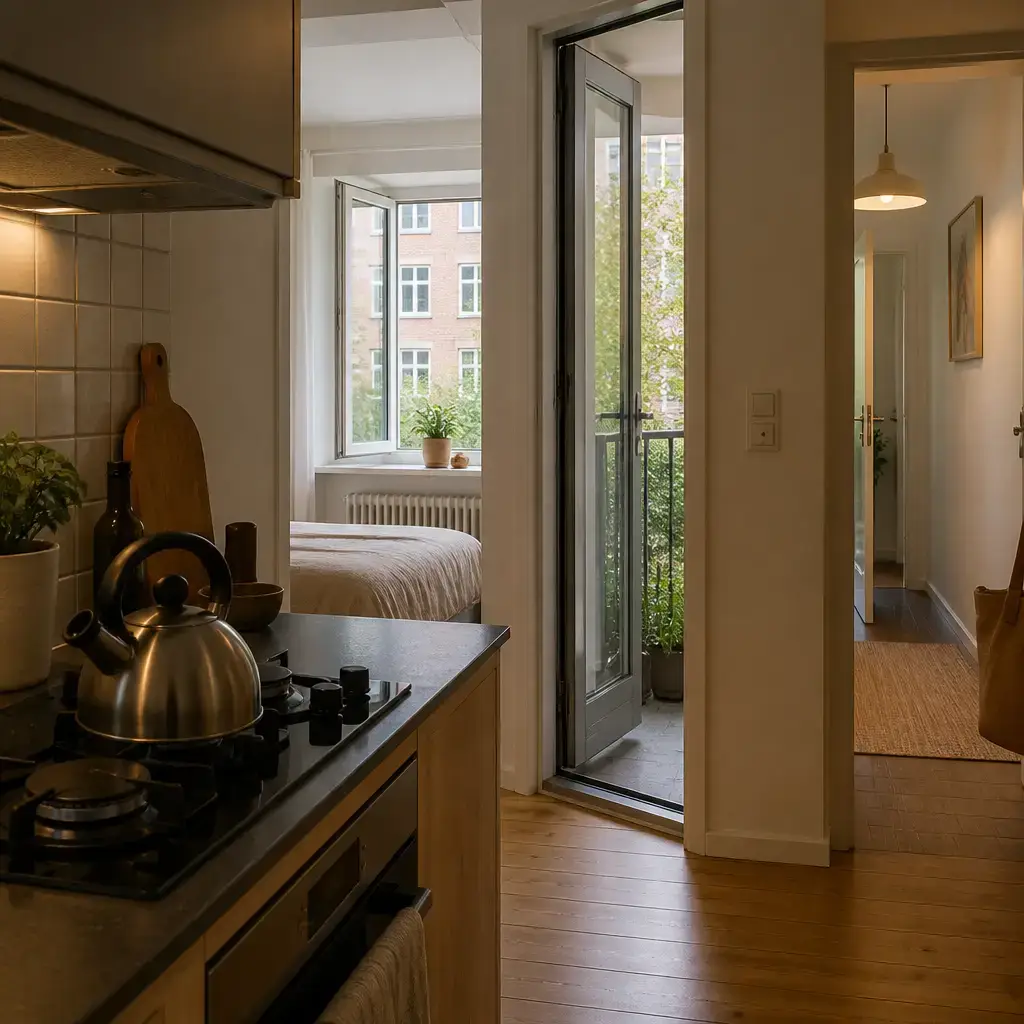
10 minutes free every day
Continue audio lessons in the app
Word explanations appear automatically in sync with the audio.
No login required · synced translations · playback with the screen locked
Choose your learning language and open this lesson in the app.

About This Lesson
Use Checking the Apartment Before Leaving to practice German conversation, pronunciation, vocabulary, grammar, and quizzes.
Dialogue
Bevor wir gehen, sollten wir die Wohnung überprüfen.
bay-FOHR veer GAY-en, ZOL-ten veer dee VOHN-oong UE-ber-PRUE-fen. Before we leave, we should check the apartment.Ich habe den Herd schon ausgeschaltet.
ikh HAH-buh dayn hayrt shohn OWS-guh-SHAL-tet. I already turned off the stove.Sind alle Fenster geschlossen?
zint ALL-uh FEN-stuh guh-SHLOSS-en? Are all the windows closed?Das Schlafzimmerfenster ist noch offen.
dahs SHLAHF-tsim-mer-FEN-stuh ist nokh OFF-en. The bedroom window is still open.Ich mache es zu und schließe die Balkontür ab.
ikh MAKH-uh ess tsoo oont SHLEE-suh dee bal-KOHN-TUER ahp. I'll close it and lock the balcony door.Die Lichter im Flur sind noch an.
dee LIKH-ter im FLOOR zint nokh ahn. The hallway lights are still on.Also schalte ich sie aus.
AL-zoh SHAL-tuh ikh zee ows. So I'll turn them off.Das sollte alles sein.
dahs ZOL-tuh ALL-ess zine. That should be everything.Gehen wir, bevor es zu spät wird.
GAY-en veer, bay-FOHR ess tsoo shpayt virt. Let's go before it gets too late.Sentence explanations
Bevor wir gehen, sollten wir die Wohnung überprüfen.
Before we leave, we should check the apartment.
- Bevor
- before
- gehen
- leave
- sollten wir
- we should
- Wohnung
- apartment
- überprüfen
- check
More detail
Bevor introduces a time clause meaning “before.” It connects one event with another event that has not happened yet in the sentence. A reusable pattern is Bevor + subject + ... + finite verb: Bevor wir anfangen, lesen wir die Anleitung. — “Before we start, we read the instructions.” gehen is the infinitive of gehen, “to go” or, in this sentence, “to leave.” With wir, the present-tense form is wir gehen: Wir gehen jetzt. — “We are leaving now.” In the subordinate clause beginning with Bevor, this finite verb appears at the end: Bevor wir gehen. sollten wir combines the subject pronoun wir, “we,” with sollten, the form of sollen used here to express “should.” It presents the checking as a recommendation or sensible course of action, not as a statement that it is compulsory. The useful contrast is wir sollen — “we are supposed to / we must” in a given context — versus wir sollten — “we should.” In the main clause, the finite verb comes before the subject: sollten wir .... Wohnung is the noun “apartment” or “flat.” Its base singular form is die Wohnung; the plural is die Wohnungen. In the sentence, die Wohnung is the object being checked, so the noun phrase has accusative function. The feminine gender is shown by the definite article: die Wohnung; the noun itself is not changed here. überprüfen is the infinitive “to check” or “to inspect.” Its base form is already the form shown. With wir, a present-tense main verb is wir überprüfen: Wir überprüfen den Plan. — “We check the plan.” Here it follows sollten, so it remains an infinitive and expresses the action recommended by sollten. Together, Bevor wir gehen means “Before we leave,” and sollten wir die Wohnung überprüfen means “we should check the apartment.” The complete structure is a temporal subordinate clause followed by the main clause: Bevor [subordinate clause], [finite modal verb] [subject] [object] [infinitive]. Thus the utterance means: “Before we leave, we should check the apartment.”
Ich habe den Herd schon ausgeschaltet.
I already turned off the stove.
- Ich habe
- I have
- Herd
- stove
- schon
- already
- ausgeschaltet
- turned off
More detail
Ich habe means “I have” here and forms the first part of the German perfect tense. With a first-person singular subject, the auxiliary is habe; other persons use forms such as hat or haben. In this sentence, habe combines with ausgeschaltet to describe a completed action. Herd means “stove.” Its useful base form is the noun der Herd; in den Herd, the masculine definite article den marks the object receiving the action. A reusable pattern is etwas ausschalten: “to turn something off.” schon means “already.” It places the completed action before the relevant reference point. For example, Ich habe schon gegessen. means “I have already eaten.” ausgeschaltet is the past participle of ausschalten, “to turn off” or “to switch off.” The verb is separable in some finite forms: Ich schalte den Herd aus. means “I turn the stove off.” In the perfect tense, its participle is used with haben: Ich habe den Herd ausgeschaltet. Together, Ich habe + den Herd + schon + ausgeschaltet means “I already turned off the stove.” The speaker presents turning off the stove as completed, and schon emphasizes that it was completed by the relevant point in the situation.
Sind alle Fenster geschlossen?
Are all the windows closed?
- Sind
- are
- alle
- all
- Fenster
- windows
- geschlossen
- closed
More detail
Sind is the present-tense form of sein (“to be”) for sie meaning “they” and for the formal “you” in the relevant forms; here it agrees with the plural subject alle Fenster. In a yes/no question, the finite verb comes first: Sind ...? Compare the reusable statement Alle Fenster sind geschlossen. — “All the windows are closed.” alle means “all” and is the plural form used with Fenster here. It expresses the complete set, not just some members. Compare alle Fenster — “all the windows” — with ein Fenster — “one/a window.” Fenster means “window” here. Its singular and plural forms are identical: das Fenster — “the window”; die Fenster — “the windows.” The plural meaning is clear here from alle and the plural verb sind. geschlossen means “closed.” It is the past participle of schließen (“to close”), and with sein it describes a resulting state: Das Fenster ist geschlossen. — “The window is closed.” The opposite is offen (“open”). Together, Sind + alle Fenster + geschlossen forms a yes/no question: “Are all the windows closed?” The finite form Sind is placed first because this is a yes/no question, while alle Fenster is the plural subject and geschlossen describes its state.
Das Schlafzimmerfenster ist noch offen.
The bedroom window is still open.
- Schlafzimmerfenster
- bedroom window
- noch offen
- still open
More detail
Schlafzimmerfenster means “bedroom window.” It is a compound noun: Schlafzimmer (“bedroom”) + Fenster (“window”). The final part, Fenster, determines the compound’s grammatical gender, so this noun is neuter: das Schlafzimmerfenster in the singular and die Schlafzimmerfenster in the plural. A useful related contrast is das Fenster (“the window”) versus die Tür (“the door”); these are different nouns with different grammatical genders. noch offen describes the window’s current state. offen is the adjective “open”; its basic form is also offen, and after the verb sein it appears here without an ending: Das Fenster ist offen (“The window is open”). noch means “still” here, showing that the state continues at the relevant time. Compare Das Fenster ist offen (“The window is open”) with Das Fenster ist noch offen (“The window is still open”). The whole utterance is assembled as Das Schlafzimmerfenster (“the bedroom window”) + ist (“is”) + noch offen (“still open”). Das is the neuter singular definite article required by Schlafzimmerfenster; ist is the third-person singular present form of sein (“to be”). Thus the sentence means: “The bedroom window is still open.”
Ich mache es zu und schließe die Balkontür ab.
I'll close it and lock the balcony door.
- mache … zu
- close
- schließe … ab
- lock
- Balkontür
- balcony door
More detail
mache ... zu is the separable verb zumachen, meaning “to close” here. mache is its first-person singular present form, and the particle zu moves to the end of the clause. The separate es supplies the meaning “it.” Example: Ich mache das Fenster zu. — “I close the window.” schließe ... ab is the separable verb abschließen, used here for locking something. schließe is the first-person singular present form of abschließen, while ab is the separable particle placed at the end of the clause. The related verb schließen can mean “to close”; adding ab gives the relevant meaning “to lock.” Example: Ich schließe die Tür ab. — “I lock the door.” Balkontür is a compound noun meaning “balcony door,” formed from Balkon and Tür. It is feminine: die Balkontür. The compound’s gender follows its final element, Tür. Example: Die Balkontür ist offen. — “The balcony door is open.” Together, Ich mache es zu means “I’ll close it,” and schließe die Balkontür ab means “and lock the balcony door.” The German present forms can express this intended future action in context, giving the complete meaning: “I’ll close it and lock the balcony door.”
Die Lichter im Flur sind noch an.
The hallway lights are still on.
- Lichter
- lights
- Flur
- hallway
- sind
- are
- noch an
- still on
More detail
Lichter is the plural of das Licht (“light”). The plural form refers to more than one light; compare singular das Licht with plural die Lichter. Here it is the subject of the sentence. Flur means “hallway” or “corridor.” In im Flur, im is the contraction of in dem, meaning “in the hallway.” The phrase identifies the location of the lights; it does not change the plural form of Lichter. sind is a form of sein (“to be”). It is the present-tense form used with a plural subject such as die Lichter: Die Lichter sind ... (“The lights are ...”). noch an means “still on.” an describes the lights' operating state here, while noch says that this state continues at the relevant time. The pattern etwas ist noch an is reusable for saying that something remains switched on. Example: Der Fernseher ist noch an. — “The television is still on.” Together, Die Lichter (“the lights”) and im Flur (“in the hallway”) identify the subject and its location. sind noch an says that these hallway lights continue to be on, giving the whole utterance: “The hallway lights are still on.”
Also schalte ich sie aus.
So I'll turn them off.
- Also
- so
- schalte … aus
- turn ... off
- ich
- I
- sie
- them
More detail
Also means “so” here, linking this action to what was just established. In German it is also commonly used to introduce a conclusion or next step; it is not the English adjective “also.” schalte ... aus comes from the separable verb ausschalten, “to switch/turn off.” The form schalte is the first-person singular present form of ausschalten; the subject is ich. In a main clause, the finite part appears in the second position and the prefix aus moves to the end: Ich schalte das Licht aus. — “I turn the light off.” German present tense can refer to a future action when the context makes that timing clear. Thus schalte is grammatically present, while the fixed translation conveys “I’ll turn ... off.” A future form such as Ich werde sie ausschalten is also possible, but it is not the form used here. ich is the first-person singular pronoun, “I.” It identifies the speaker as the person carrying out the action. sie is the accusative plural pronoun “them” here, referring to the lights supported by the fixed translation and context. Its plural form is the same in nominative and accusative; the case is shown by its role as the object of ausschalten. Together, Also schalte ich sie aus. has the pattern Also + finite verb + subject + object + separable prefix: “So I’ll turn them off.”
Das sollte alles sein.
That should be everything.
- Das
- that; it
- sollte
- should
- alles
- everything
- sein
- be
More detail
Das means “that” here as a demonstrative pronoun. Its specific referent is understood from the situation, but the supplied sentence does not identify it more precisely. German also uses das as a neuter singular article, but that article use is different from the pronoun use here. sollte is the form of sollen used here for “should.” The verb sollen is a modal verb; in this sentence, sollte expresses an expectation or tentative conclusion. Its infinitive is sollen, while sollte is its Konjunktiv II form. With this modal use, the other verb appears as an infinitive at the end of the clause. Example: Das sollte reichen. — “That should be enough.” alles means “everything” in this sentence. It is an indefinite pronoun referring to the whole relevant set or amount, rather than to one specifically named item. The related form alle means “all” and normally accompanies or replaces plural referents, whereas alles is the form used for “everything.” Example: Alles ist bereit. — “Everything is ready.” sein is the infinitive of sein, “to be.” It is required at the end here because sollte is functioning as a modal verb. The infinitive sein does not itself mark the subject’s person or number; those features would be expressed by a finite form such as ist in a clause without the modal. Together, Das sollte alles sein follows the pattern subject + modal verb + predicate + infinitive: Das identifies the relevant matter, sollte presents the assessment as an expectation, alles says that the whole relevant set or amount is covered, and final sein supplies “be.” The complete meaning is “That should be everything.”
Gehen wir, bevor es zu spät wird.
Let's go before it gets too late.
- Gehen wir
- Let's go
- bevor
- before
- es
- it
- zu spät
- too late
- wird
- gets; becomes
More detail
Gehen wir is a reusable German way to make a suggestion or exhortation: “Let’s go.” gehen is the base form “to go”; wir means “we.” In this pattern, the verb comes before the subject: Gehen wir! Compare the ordinary statement Wir gehen. (“We are going.”). Here the phrase is not a question despite its verb-first order. bevor introduces an event that must happen earlier than another event. It starts a subordinate clause, so the finite verb appears at the end of that clause. Pattern: bevor + subject + ... + finite verb. Example: Wir gehen, bevor es dunkel wird. — “We’re leaving before it gets dark.” es is the third-person singular pronoun used as the subject of this impersonal clause. In the fixed sentence, the translation gives its intended meaning as “it,” without identifying a particular concrete referent. German also uses es in expressions about conditions or changes, as in Es regnet. — “It is raining.” zu spät means “too late.” Here zu intensifies the adjective spät to express an excessive degree: something would happen later than is acceptable. spät means “late”; its comparative is später (“later”), while zu spät means “too late,” not simply “later.” wird is the third-person singular present form of werden, “to become” or “to get.” In es ... wird, it means “it gets/becomes.” The subject es is singular, which selects wird; the form is placed at the end because it is in the subordinate clause introduced by bevor. Example: Es wird kalt. — “It is getting cold.” Together, Gehen wir expresses the suggestion “Let’s go,” and bevor es zu spät wird gives the time limit: the going should happen before the situation becomes too late. The complete meaning is: “Let’s go before it gets too late.”
Grammar Points
bevor + Nebensatz: Verb am Ende
Bevor sie gehen, schließen sie die Balkontür ab.
bay-FOHR zee GAY-en, SHLEE-sen zee dee bal-KOHN-TUER ahp.Before they leave, they lock the balcony door.
Nach „bevor“ steht das konjugierte Verb im Nebensatz am Ende.
Trennbare Verben: zumachen → mache ... zu
Sie machen das Schlafzimmerfenster zu.
zee MAKH-en dahs SHLAHF-tsim-mer-FEN-stuh tsoo.They close the bedroom window.
Bei trennbaren Verben steht der Verbzusatz im Hauptsatz am Satzende.
German Vocabulary
Ich habe den Herd schon ausgeschaltet.
Bevor wir gehen, sollten wir die Wohnung überprüfen.
Sind alle Fenster geschlossen?
Bevor wir gehen, sollten wir die Wohnung überprüfen.
Sind alle Fenster geschlossen?
Ich habe den Herd schon ausgeschaltet.
Das Schlafzimmerfenster ist noch offen.
Das Schlafzimmerfenster ist noch offen.
Das Schlafzimmerfenster ist noch offen.
Ich habe den Herd schon ausgeschaltet.
Bevor wir gehen, sollten wir die Wohnung überprüfen.
Bevor wir gehen, sollten wir die Wohnung überprüfen.
Quiz
Word Order
Arrange the words in the correct order.
I already turned off the stove.
Show Answer
Ich habe den Herd schon ausgeschaltet.Are all the windows closed?
Show Answer
Sind alle Fenster geschlossen?The bedroom window is still open.
Show Answer
Das Schlafzimmerfenster ist noch offen.Spelling
Tap the letters to spell the word.
window; windows
Show Answer
Fensterbefore
Show Answer
bevorto check
Show Answer
überprüfenapartment