10 minutes free every day
Continue audio lessons in the app
Word explanations appear automatically in sync with the audio.
No login required · synced translations · playback with the screen locked
Choose your learning language and open this lesson in the app.

About This Lesson
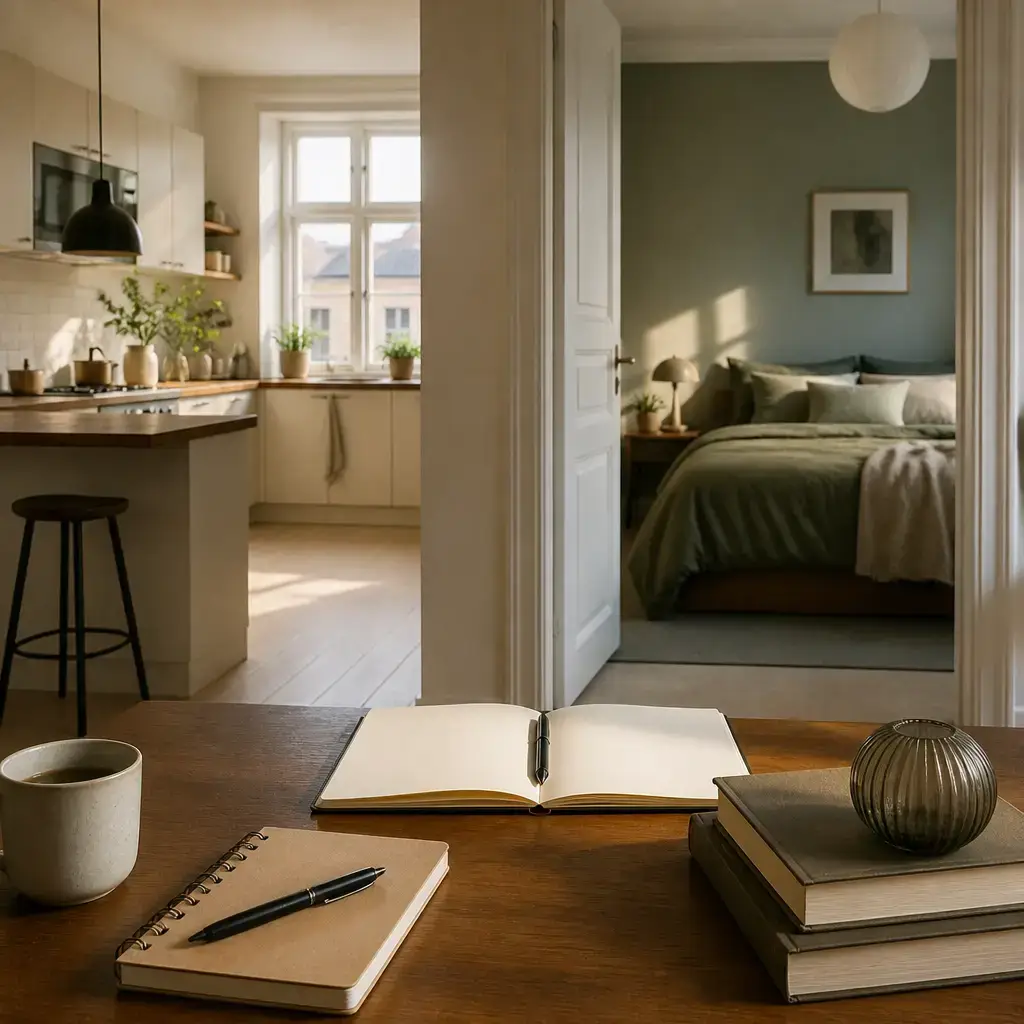
Use Choosing a Better Room for Studying to practice German conversation, pronunciation, vocabulary, grammar, and quizzes.
Dialogue
Welches Zimmer soll ich zum Lernen benutzen?
VEL-khes TSIM-er zohl ikh tsoom LER-nen beh-NOOT-sen? Which room should I use for studying?Was ist mit dem Schlafzimmer oder der Küche?
Vahs ist mit dehm SHLAHF-tsim-er OH-der dair KEW-khuh? What about the bedroom or the kitchen?Die Küche ist heller, aber dort wird es laut.
Dee KEW-khuh ist HEL-er, AH-ber dort veert ess lowt. The kitchen is brighter, but it gets noisy.Das Schlafzimmer ist ruhiger und gemütlicher.
Dahs SHLAHF-tsim-er ist ROO-ih-ger oont geh-MEW-tlikh-er. The bedroom is quieter and more comfortable.Ich muss mich ohne Unterbrechungen konzentrieren.
Ikh moos mikh OH-nuh oon-ter-BREKH-oong-en kohn-tsen-TREE-ren. I need to focus without interruptions.Dann ist das ruhigere Zimmer sinnvoller.
Dahn ist dahs ROO-ih-ger-uh TSIM-er zin-VOHL-er. Then the quieter room makes more sense.Ich werde heute im Schlafzimmer lernen.
Ikh VAIR-duh HOY-tuh im SHLAHF-tsim-er LER-nen. I'll study in the bedroom today.Schließ die Tür, wenn es im Flur laut wird.
Shleess dee TYOOR, venn ess im FLOOR lowt veert. Close the door if the hallway gets noisy.Sentence explanations
Welches Zimmer soll ich zum Lernen benutzen?
Which room should I use for studying?
- Welches
- which
- Zimmer
- room
- soll ich
- should I
- zum Lernen
- for studying
- benutzen
- use
More detail
Welches means “which” here and is the form used with Zimmer. German question words such as welcher, welche, and welches change according to the grammatical conditions of the noun phrase; welches Zimmer is the neuter singular form in this construction. The question asks the listener to choose one room, without stating which options are available. Zimmer means “room.” Its base form is also Zimmer; the plural is Zimmer, so the form itself does not show singular versus plural. Here, welches and the intended meaning identify it as one room. soll ich contains sollen in the present-tense first-person singular form soll plus the subject pronoun ich (“I”). In a question, this modal construction asks what the speaker is expected or advised to do: “should I …?” The modal verb comes before the subject, while the other verb goes to the end of the clause. For example, Soll ich warten? means “Should I wait?” zum Lernen expresses “for studying.” zum is the contraction of zu dem. Lernen is the nominalized infinitive of lernen (“to study” or “to learn”), so it is capitalized as a noun. The pattern zum + nominalized activity can express purpose, as in Ich gehe zum Einkaufen (“I am going shopping”). benutzen means “to use.” It is the base form placed at the end because soll is the finite modal verb. In the clause, the speaker asks about using a room for the purpose of studying. Together, Welches Zimmer asks which room, soll ich ... benutzen asks which one the speaker should use, and zum Lernen gives the purpose. The whole utterance therefore means: “Which room should I use for studying?”
Was ist mit dem Schlafzimmer oder der Küche?
What about the bedroom or the kitchen?
- Was ist mit
- what about
- Schlafzimmer
- bedroom
- oder
- or
- Küche
- kitchen
More detail
Was ist mit is a reusable German way to ask about an option or topic: “What about …?” Here, Was is the question word, ist is the present-tense third-person singular form of sein (“to be”), and mit is the preposition used in this construction. The preposition mit governs the dative case. Example: Was ist mit dem Badezimmer? — “What about the bathroom?” Schlafzimmer means “bedroom.” It is a neuter noun: das Schlafzimmer in the nominative and accusative, but dem Schlafzimmer here because mit requires the dative. Example: Das Schlafzimmer ist ruhig. — “The bedroom is quiet.” oder connects alternatives and means “or.” It presents the following item as another option rather than combining the two as one choice. Example: Möchtest du Tee oder Kaffee? — “Would you like tea or coffee?” Küche means “kitchen.” It is a feminine noun: die Küche in the nominative, while der Küche is its singular dative form after mit. Example: Die Küche ist hell. — “The kitchen is bright.” The sentence combines the question pattern Was ist mit ...? with two alternatives: dem Schlafzimmer and der Küche. Thus Was ist mit dem Schlafzimmer oder der Küche? asks, “What about the bedroom or the kitchen?”
Die Küche ist heller, aber dort wird es laut.
The kitchen is brighter, but it gets noisy.
- Küche
- kitchen
- heller
- brighter
- aber
- but
- dort
- there
- wird
- gets; becomes
- laut
- noisy
More detail
Küche means “kitchen” here. Its base form is die Küche; the noun is feminine, and in this sentence die is the definite article for feminine singular nominative. The plural is die Küchen. Example: Die Küche ist klein. — “The kitchen is small.” heller means “brighter” here. It is the comparative form of hell (“bright”): hell → heller → am hellsten (“bright” → “brighter” → “brightest”). The comparative presents the kitchen as having a greater degree of brightness than a comparison point supplied by the context; German need not state that point. Example: Das Zimmer ist heller. — “The room is brighter.” aber connects two contrasting statements and means “but.” In this sentence, it does not change the word order of the clause that follows it. Example: Es ist klein, aber gemütlich. — “It is small, but comfortable.” dort means “there.” It is a location word, not a noun, and can occur in different clause positions. Example: Dort ist es ruhig. — “It is quiet there.” wird is the third-person singular present form of werden. In wird ... laut, werden means “become” or “get,” expressing a change into a state; it is not the passive use of werden here. The adjective laut supplies the resulting state. Example: Das Zimmer wird warm. — “The room gets warm.” laut means “noisy” in this sentence. It is an adjective describing sound level, and after wird it appears in its uninflected form. Its opposite in this context is leise (“quiet”). Example: Der Flur ist laut. — “The hallway is noisy.” Together, Die Küche ist heller says “The kitchen is brighter,” with heller comparing its brightness. aber dort wird es laut contrasts this with a change of condition at the location indicated by dort: “but it gets noisy there.” The whole utterance means: “The kitchen is brighter, but it gets noisy there.”
Das Schlafzimmer ist ruhiger und gemütlicher.
The bedroom is quieter and more comfortable.
- Schlafzimmer
- bedroom
- ruhiger
- quieter
- gemütlicher
- more comfortable
More detail
Schlafzimmer means “bedroom.” It is a neuter German noun: das Schlafzimmer is the singular form, and die Schlafzimmer is also used for the plural. The compound combines Schlaf (“sleep”) and Zimmer (“room”), but it is learned as one noun. ruhiger means “quieter” here. Its base adjective is ruhig (“quiet”); the comparative is ruhiger. Because it follows ist as a description of the subject, it has no attributive adjective ending: Das Zimmer ist ruhig (“The room is quiet”) → Das Zimmer ist ruhiger (“The room is quieter”). gemütlicher means “more comfortable” or “cozier” here. Its base adjective is gemütlich; its comparative is formed as gemütlicher. Example: Dieses Zimmer ist gemütlicher. — “This room is cozier.” The sentence begins with Das, the neuter singular definite article for Schlafzimmer, followed by ist (“is”). The two comparative adjectives are coordinated by und: Das Schlafzimmer ist ruhiger und gemütlicher. Thus the complete meaning is “The bedroom is quieter and more comfortable.”
Ich muss mich ohne Unterbrechungen konzentrieren.
I need to focus without interruptions.
- Ich muss
- I need to / I must
- mich
- myself
- ohne
- without
- Unterbrechungen
- interruptions
- konzentrieren
- focus / concentrate
More detail
Ich muss combines Ich (“I”) with muss, the first-person singular present form of müssen (“must; need to”). Here it expresses the speaker’s need or necessity. The infinitive belonging to muss comes later in the sentence: Ich muss ... konzentrieren means “I need to ... focus.” With a different subject, the form changes: Du musst ... means “You need to ...”; wir müssen ... means “we need to ...”. mich is the reflexive pronoun referring back to the subject Ich. The verb sich konzentrieren is used reflexively in German, so its form with ich is mich: Ich konzentriere mich. Reflexive forms change with the subject; for example, Du konzentrierst dich means “You focus.” ohne means “without” and introduces what is absent. It is a preposition that takes the accusative case. The phrase ohne Unterbrechungen therefore means “without interruptions.” Unterbrechungen is the plural of Unterbrechung, “interruption.” The plural ending is visible in the form used here. A singular version would be ohne Unterbrechung, “without interruption.” Example: Sie arbeitet ohne Unterbrechungen. — “She works without interruptions.” konzentrieren is the infinitive “to focus” or “to concentrate.” In sich konzentrieren, it forms the reflexive verb “to focus.” After a modal verb such as müssen, German uses the infinitive: Ich muss mich konzentrieren. — “I need to focus.” Together, Ich muss expresses the speaker’s need, mich konzentrieren expresses the reflexive action “to focus,” and ohne Unterbrechungen specifies that the focus should happen without interruptions. The complete utterance means: “I need to focus without interruptions.”
Dann ist das ruhigere Zimmer sinnvoller.
Then the quieter room makes more sense.
- Dann
- then
- ist
- is
- das
- the
- ruhigere
- quieter
- Zimmer
- room
- sinnvoller
- more sensible
More detail
Dann means “then” here: it places this judgment at that point in time or sequence. Example: Dann gehe ich nach Hause. — “Then I’ll go home.” ist is the third-person singular present form of sein (“to be”). Here it links das ruhigere Zimmer with the description sinnvoller; it is not the word that carries the comparison. Other present forms include ich bin (“I am”) and sie sind (“they are”). das is the singular neuter definite article (“the”). It agrees with Zimmer, whose grammatical gender is neuter: das Zimmer. The article does not itself state a numerical quantity. ruhigere is the comparative form of the adjective ruhig (“quiet”): ruhig → ruhiger (“quieter”). Here the comparative has the ending -e because it stands before the neuter singular nominative noun after the definite article das. Example: das ruhigere Auto — “the quieter car.” Zimmer means “room.” Its singular form is das Zimmer; the plural is also Zimmer, as in die Zimmer (“the rooms”). sinnvoller is the comparative of sinnvoll (“sensible,” “meaningful,” or “reasonable”): sinnvoll → sinnvoller (“more sensible”). With ist, this can be translated here as “makes more sense.” Do not confuse it with sinnlos (“senseless”); the comparison says that one option is more sensible, without stating that the other option is senseless. Together, das ruhigere Zimmer means “the quieter room,” and ist sinnvoller says that this option is more sensible or “makes more sense.” With Dann at the beginning, the complete sentence means “Then the quieter room makes more sense.”
Ich werde heute im Schlafzimmer lernen.
I'll study in the bedroom today.
- Ich werde
- I will
- heute
- today
- im
- in the
- Schlafzimmer
- bedroom
- lernen
- study
More detail
Ich werde means “I will” here. werde is the first-person singular present form of werden, used as the future auxiliary. In this pattern, the main verb stays in the infinitive and goes to the end: Ich werde arbeiten = “I will work.” heute means “today” and gives the time of the studying. It can be placed in other positions depending on emphasis, for example: Heute werde ich lernen. = “Today I will study.” im is the contracted form of in dem, meaning “in the” here. in takes the dative when it describes a fixed location rather than movement into a place. The contraction is used with a masculine or neuter singular noun: im Park = “in the park.” Schlafzimmer means “bedroom.” It is a neuter noun: das Schlafzimmer. After the location use of in, it appears with dative dem, producing in dem Schlafzimmer or, more naturally, im Schlafzimmer. lernen means “to study” here. It is the infinitive form and stays at the end because werden is the conjugated future auxiliary. The same infinitive can also mean “to learn” in other contexts; here the fixed translation identifies the intended meaning as studying. Together, Ich werde marks a future action, heute specifies when it will happen, and im Schlafzimmer specifies the fixed location. The complete utterance is: “I’ll study in the bedroom today.”
Schließ die Tür, wenn es im Flur laut wird.
Close the door if the hallway gets noisy.
- Schließ
- close
- Tür
- door
- wenn
- if; when
- Flur
- hallway
- laut
- loud; noisy
- wird
- becomes; gets
More detail
Schließ is the imperative singular of schließen (“to close”). It addresses one person informally: Schließ die Tür! = “Close the door!” The imperative form is different from the infinitive; with formal address or a plural addressee, German uses a different command form. Tür means “door.” Its full noun phrase here is die Tür: Tür is feminine, and die is the accusative article because the door is the direct object of schließen. The noun itself does not show this case change; the article does. wenn introduces a condition or time clause. Here it means “if,” so the command applies under the condition that the hallway becomes noisy. In a German subordinate clause introduced by wenn, the finite verb normally comes at the end. Flur means “hallway” or “corridor.” It is masculine: der Flur. In the sentence, im Flur is the contraction of in dem Flur, meaning “in the hallway.” im is not part of the noun itself. laut means “loud” or, for a surrounding environment, “noisy.” It describes the sound level in the hallway here. Example: Die Musik ist laut. — “The music is loud.” wird is the third-person singular present form of werden (“to become; to get”). In laut wird, werden is a full verb meaning “becomes/gets,” not a future auxiliary: es wird laut = “it gets noisy” or “it becomes noisy.” The form is singular because the clause uses the impersonal subject es. Together, wenn es im Flur laut wird means “if the hallway gets noisy.” The conditional clause comes after the command, and its finite verb wird remains at the end. The whole utterance is therefore Schließ die Tür (“Close the door”) plus the condition wenn es im Flur laut wird (“if the hallway gets noisy”): “Close the door if the hallway gets noisy.”
Grammar Points
Komparativ: Adjektiv + -er
heller, ruhiger, gemütlicher, sinnvoller
HEL-er, ROO-ih-ger, geh-MEW-tlikh-er, zin-VOHL-erbrighter, quieter, cozier, more meaningful
Der Komparativ beschreibt einen höheren Grad: hell → heller und ruhig → ruhiger.
Reflexives Verb: sich konzentrieren
mich konzentrieren
mikh kohn-tsen-TREE-rento concentrate; to focus
Bei diesem Verb steht ein Reflexivpronomen: sich konzentrieren, zum Beispiel mich konzentrieren.
German Vocabulary
Welches Zimmer soll ich zum Lernen benutzen?
Das Schlafzimmer ist ruhiger und gemütlicher.
Die Küche ist heller, aber dort wird es laut.
Was ist mit dem Schlafzimmer oder der Küche?
Die Küche ist heller, aber dort wird es laut.
Welches Zimmer soll ich zum Lernen benutzen?
Das Schlafzimmer ist ruhiger und gemütlicher.
Was ist mit dem Schlafzimmer oder der Küche?
Ich muss mich ohne Unterbrechungen konzentrieren.
Dann ist das ruhigere Zimmer sinnvoller.
Ich muss mich ohne Unterbrechungen konzentrieren.
Welches Zimmer soll ich zum Lernen benutzen?
Quiz
Word Order
Arrange the words in the correct order.
The bedroom is quieter and more comfortable.
Show Answer
Das Schlafzimmer ist ruhiger und gemütlicher.I need to focus without interruptions.
Show Answer
Ich muss mich ohne Unterbrechungen konzentrieren.Then the quieter room makes more sense.
Show Answer
Dann ist das ruhigere Zimmer sinnvoller.Spelling
Tap the letters to spell the word.
quiet; calm
Show Answer
ruhigercomfortable; cozy
Show Answer
gemütlicherroom
Show Answer
Zimmerbright; light