10 minutes free every day
Continue audio lessons in the app
Word explanations appear automatically in sync with the audio.
No login required · synced translations · playback with the screen locked
Choose your learning language and open this lesson in the app.

About This Lesson
Use Keeping a shared kitchen clean to practice German conversation, pronunciation, vocabulary, grammar, and quizzes.
Dialogue
Ich bin neu in dieser Gemeinschaftsküche. Was sollte ich wissen?
Ikh bihn noy ihn DEE-zur guh-MINE-shahfts-KYOO-khuh. Vahs SHOL-tuh ikh VIH-sən? I'm new to this shared kitchen. What should I know?Halte die Arbeitsflächen frei und räume direkt nach dem Kochen auf.
HAL-tuh dee AR-bites-flay-khen fry oont ROY-muh dee-REKT nahkh daym KOH-khen owf. Keep the counters clear and clean up right after cooking.Wo soll ich eine Pfanne hinstellen, nachdem ich sie gespült habe?
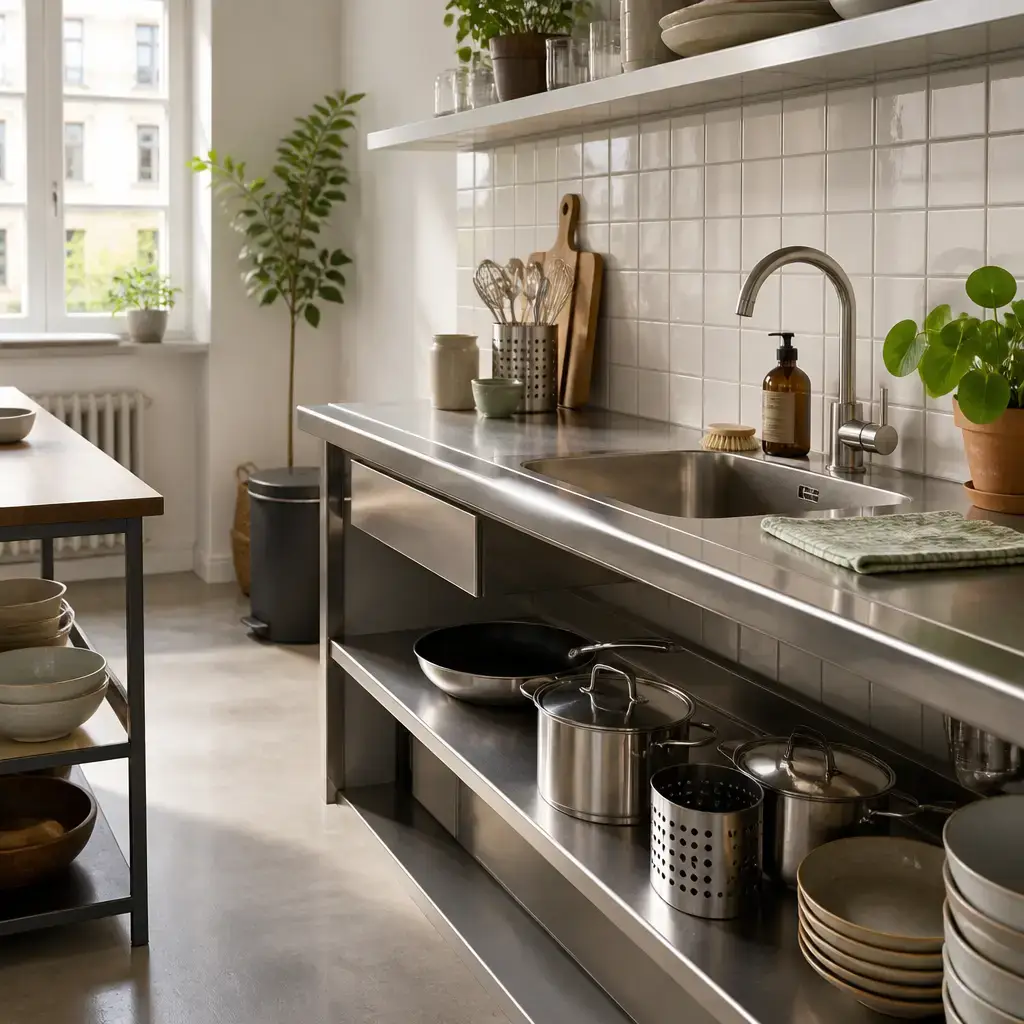
Voh zoll ikh EYE-nuh PFAN-nuh HIN-shtel-lən, NAHKH-daym ikh zee guh-SHPYOOLT HAH-buh? Where should I put a pan after I wash it?Benutze das untere Regal neben dem Spülbecken, wenn die Pfanne trocken ist.
Buh-NOOT-suh dahs OON-tuh-ruh reh-GAHL NAY-bən daym SHPYOOL-bekən, vehn dee PFAN-nuh TROH-kən ist. Use the lower shelf beside the sink, after the pan is dry.Soll ich die Arbeitsfläche abwischen, bevor ich gehe?
Zoll ikh dee AR-bites-flay-khuh AP-vih-shən, buh-FOHR ikh GAY-uh? Should I wipe the counter before I go?Wisch sie ab und räume alles weg, was du benutzt hast.
Vihsh zee AP oont ROY-muh AL-ləs vek, vahs doo buh-NOOTST hahst. Wipe it down and put away anything you used.Soll ich noch etwas überprüfen?
Zoll ikh nokh ET-vahs YOO-bur-PRYOO-fən? Anything else I should check?Lass die Küche für die nächste Person bereit.
Lahs dee KYOOKH-uh fyr dee NEKH-stuh per-ZOHN buh-RYTE. Leave the space ready for the next person.Sentence explanations
Ich bin neu in dieser Gemeinschaftsküche. Was sollte ich wissen?
I'm new to this shared kitchen. What should I know?
- Ich bin
- I am
- neu
- new
- Gemeinschaftsküche
- shared kitchen
- Was
- what
- sollte ich
- should I
- wissen
- know
More detail
Ich bin is the first-person singular present form of sein (“to be”): ich bin = “I am.” The form bin is specifically used with ich; other subjects use forms such as du bist and sie ist. neu means “new” here, describing the speaker’s situation or familiarity. After sein, this adjective is used predicatively and has no adjective ending: Ich bin neu. = “I am new.” Gemeinschaftsküche is a feminine singular compound noun meaning “shared kitchen” or “communal kitchen.” Its useful parts are Gemeinschaft (“community”) and Küche (“kitchen”), but the full compound names the shared kitchen. In in dieser Gemeinschaftsküche, in expresses location and therefore takes the dative here; dieser agrees with the feminine singular noun in that form. Was is the question word “what.” In this question it asks about the information the speaker ought to have, rather than about a person or a place. For example: Was brauchst du? = “What do you need?” sollte ich uses sollte, the first-person singular form of sollen in its Konjunktiv II form, together with ich. Here it asks for advice or guidance politely: “should I…?” The more direct present-tense form soll ich …? can also ask “am I supposed to…?”; sollte ich …? more clearly presents the action as a recommendation to consider. wissen means “to know,” especially to know information or a fact. It is the infinitive, and the modal verb sollte sends it to the end of the question: Was sollte ich wissen? The related verb kennen is used more typically for being familiar with a person or place, as in Ich kenne diese Küche (“I know this kitchen / am familiar with this kitchen”). Together, Ich bin neu in dieser Gemeinschaftsküche says that the speaker is new to this shared kitchen. The question Was sollte ich wissen? asks what information or rules would be useful for the speaker to know. The complete utterance therefore means: “I’m new to this shared kitchen. What should I know?”
Halte die Arbeitsflächen frei und räume direkt nach dem Kochen auf.
Keep the counters clear and clean up right after cooking.
- Halte
- keep; leave
- Arbeitsflächen
- work surfaces; counters
- frei
- clear; free
- räume … auf
- clean up; tidy up
- direkt nach
- right after
- Kochen
- cooking
More detail
Halte is the informal singular imperative of halten (“to keep” or “to hold”). Here it means “keep/leave something in a condition.” The imperative addresses one person directly; the subject du is normally omitted. Example: Halte die Tür offen. — “Keep the door open.” Arbeitsflächen is the plural of die Arbeitsfläche, meaning a work surface or countertop. The plural has the ending -n: Arbeitsfläche → Arbeitsflächen; the stem vowel does not change here. In this sentence, it is the object of halte: the surfaces are what should be kept clear. frei means “clear” here, with nothing left on the work surfaces. It is a resultative adjective after halte ..., describing the condition in which the Arbeitsflächen should be kept; it does not take a plural ending in this position. Example: Lass den Weg frei. — “Leave the path clear.” räume ... auf comes from the separable verb aufräumen, “to tidy up” or “to clean up.” In the informal singular imperative, aufräumen becomes räume ... auf: the verb stem räume appears near the beginning, while the particle auf moves to the end of the clause. Example: Räum dein Zimmer auf. — “Tidy your room.” direkt nach means “right after.” nach introduces what follows in time here, and direkt strengthens it to an immediate sequence. Example: Wir gehen direkt nach dem Essen. — “We are leaving right after the meal.” Kochen is the nominalized infinitive of kochen, “to cook,” so it means “cooking” as an activity. The capital letter shows that it is being used as a noun. After nach, it appears as dem Kochen, the dative form of the neuter noun phrase. Example: Nach dem Kochen lüfte ich. — “After cooking, I air out the room.” Together, the first command Halte die Arbeitsflächen frei means “Keep the work surfaces clear.” The second command räume direkt nach dem Kochen auf means “clean up right after cooking.” The two commands tell the person addressed to keep the counters clear and to tidy up immediately after cooking.
Wo soll ich eine Pfanne hinstellen, nachdem ich sie gespült habe?
Where should I put a pan after I wash it?
- Wo
- where
- soll ich
- should I
- Pfanne
- pan
- hinstellen
- put; place
- nachdem
- after
- sie
- it
- gespült
- washed; rinsed
More detail
Wo asks for a place or location: “where?” In a reusable question, it can appear at the beginning: Wo ist das Regal? means “Where is the shelf?” German commonly uses wo in questions about where something should be placed, as here; wohin more specifically asks “where to?” Soll ich combines soll, the first-person singular form of sollen, with the subject pronoun ich. Here sollen expresses what the speaker ought to do or is expected to do, so Soll ich ...? asks for guidance: “Should I ...?” In a main-clause question, the conjugated modal verb comes before the subject. The other verb remains in the infinitive at the end: Soll ich warten? — “Should I wait?” Pfanne is the noun die Pfanne, “pan.” The sentence uses the indefinite form eine Pfanne, referring to a pan without asserting a numerical count. The noun is feminine in German, which is relevant to forms such as die Pfanne and eine Pfanne. hinstellen means “to put or place” something, with the idea of placing it in a position. It is a separable verb: in a regular main clause, Ich stelle die Pfanne hin means “I put the pan there.” After the modal soll, however, the infinitive stays together at the end: Soll ich die Pfanne hinstellen? The prefix hin- contributes direction toward a place understood in the situation. nachdem introduces a time clause meaning “after.” The event in that clause occurs before the event of the main clause. A clause introduced by nachdem is subordinate, so its conjugated verb goes to the end: nachdem ich gegessen habe — “after I have eaten.” sie is the accusative feminine singular pronoun “it” in this sentence, referring to the pan identified by the fixed translation and context. Its form matches the feminine noun die Pfanne; the accusative role marks it as the thing washed. German sie can have other grammatical uses in other contexts, but here it is singular “it,” not a plural or formal “you” reading. gespült is the past participle of spülen, “to wash or rinse.” In ich sie gespült habe, it forms a perfect construction with habe: habe gespült means “have washed/rinsed.” Because this construction is inside the nachdem clause, habe comes last. The participle itself stays gespült; the auxiliary carries the person and number marking: ich habe gespült. Together, Wo soll ich eine Pfanne hinstellen? asks where the speaker should place a pan. nachdem ich sie gespült habe adds the time relation: this placement is to happen after the speaker has washed or rinsed the pan. The whole utterance therefore means: “Where should I put a pan after I wash it?”
Benutze das untere Regal neben dem Spülbecken, wenn die Pfanne trocken ist.
Use the lower shelf beside the sink, after the pan is dry.
- Benutze
- use
- untere
- lower
- Regal
- shelf
- neben
- beside
- Spülbecken
- sink
- Pfanne
- pan
- trocken
- dry
- wenn
- when; once
More detail
Benutze is the informal singular imperative of benutzen (“to use”), so it gives a direct instruction to one person. The same verb appears in other forms such as ich benutze (“I use”) and du benutzt (“you use”). untere means “lower” here and describes Regal. Its base form is the adjective unter; the ending changes because the adjective is inside the noun phrase das untere Regal. This is a useful pattern for identifying a lower item: das obere Regal = “the upper shelf.” Regal is a neuter noun meaning “shelf.” In das untere Regal, das marks the noun phrase as the object of Benutze; the form is the same for neuter nominative and accusative in this context. Example: Ich benutze das Regal. = “I use the shelf.” neben means “beside/next to.” With a stationary location, it commonly takes the dative: neben dem Spülbecken means “beside the sink.” This contrasts with a movement toward a position, where German can use the accusative, for example Ich stelle es neben das Spülbecken. = “I put it beside the sink.” Spülbecken means “sink” and is a neuter noun. After the location use of neben, it appears as dem Spülbecken, the dative form of the definite article. The noun itself does not show a special dative ending here. wenn introduces the time condition for the instruction. In this sentence it is temporal, meaning “when” or “once,” rather than expressing a hypothetical condition. A wenn clause places its finite verb at the end, as in wenn die Pfanne trocken ist. Pfanne means “pan.” Here it is the subject of the subordinate clause, shown by die Pfanne; it is feminine singular. Example: Die Pfanne ist heiß. = “The pan is hot.” trocken means “dry.” It is a predicative adjective after ist, so it does not take an ending: Die Pfanne ist trocken. = “The pan is dry.” The form trocken is the base form; an attributive version would be inflected, as in eine trockene Pfanne (“a dry pan”). Together, Benutze das untere Regal neben dem Spülbecken gives the instruction “Use the lower shelf beside the sink.” The temporal clause wenn die Pfanne trocken ist adds the condition “after/once the pan is dry.” The complete utterance therefore means: “Use the lower shelf beside the sink, after the pan is dry.”
Soll ich die Arbeitsfläche abwischen, bevor ich gehe?
Should I wipe the counter before I go?
- Soll ich
- Should I…?
- die Arbeitsfläche
- the counter/work surface
- abwischen
- wipe down
- bevor
- before
- gehe
- go / leave
More detail
Soll ich is a common way to ask whether the speaker should do something. soll is the present form of sollen used with ich; the same form also occurs with er, sie, or es, so its form alone does not identify the subject. The pattern Soll ich ...? can be reused for offers or requests for permission: Soll ich das Fenster öffnen? — “Should I open the window?” die Arbeitsfläche means the counter or work surface in this sentence. Arbeitsfläche is a feminine singular noun, and here die is its definite article in the accusative, because it is the object of abwischen: Ich reinige die Arbeitsfläche. — “I clean the counter.” The compound noun combines Arbeit (“work”) and Fläche (“surface”), but the complete word is the normal reusable form here. abwischen means “to wipe down.” It is a separable verb: in a main clause, the finite part and prefix separate, as in Ich wische die Arbeitsfläche ab. — “I wipe down the counter.” After the modal verb soll, however, the complete infinitive abwischen remains at the end of the main clause. The context-supported follow-up Wisch sie ab uses the imperative form of the same verb. bevor introduces a subordinate clause meaning “before.” In a German subordinate clause introduced by bevor, the finite verb normally goes to the end. The clause can describe an action that should happen earlier than the action in the bevor clause: Ich rufe an, bevor ich gehe. — “I’ll call before I leave.” gehe is the first-person singular present form of gehen, “to go” or “to leave.” Here the fixed translation identifies the intended sense as “leave.” In the bevor clause, ich is the subject and gehe appears at the end because of the subordinate-clause word order. Together, Soll ich asks whether the speaker should perform the action. die Arbeitsfläche abwischen names the action, and bevor ich gehe places it before the speaker leaves. The whole utterance therefore means: “Should I wipe the counter before I go?”
Wisch sie ab und räume alles weg, was du benutzt hast.
Wipe it down and put away anything you used.
- Wisch … ab
- wipe down
- sie
- it
- räume … weg
- put away
- alles
- everything; anything
- benutzt
- used
More detail
Wisch ... ab is the informal singular imperative of the separable verb abwischen (“to wipe down”). In this command, the prefix ab appears at the end: Wisch die Fläche ab. — “Wipe the surface down.” The form wisch addresses one person informally; a polite command uses Wischen Sie ... ab. sie is the accusative pronoun meaning “it” here, referring to the surface understood from the preceding context. Its form is feminine singular accusative in this use. German pronouns change according to grammatical case and, where relevant, gender and number: for example, ihn means “him/it” for a masculine singular referent, while sie can mean “her/it” for a feminine singular referent depending on context. räume ... weg is the informal singular imperative of the separable verb wegräumen (“to put away” or “clear away”). As with abwischen, the prefix is separated in the command: Räum das Geschirr weg. — “Put the dishes away.” alles means “everything” here and serves as the thing to be put away. In the following clause, was introduces a relative clause referring to this indefinite thing: alles, was ... means “everything that ...” or, in this context, “anything that ...”. benutzt is the past participle of benutzen, “to use,” in benutzt hast. German perfect forms use an auxiliary plus a past participle: du hast es benutzt — “you used it” or “you have used it.” Here hast carries the second-person singular present form of haben, while benutzt stays as the participle. The relative clause has the order was du benutzt hast: “that you used.” Together, Wisch sie ab means “Wipe it down,” and räume alles weg means “put everything away.” The relative clause was du benutzt hast specifies which things are meant: “that you used.” Thus the whole utterance is: “Wipe it down and put away anything you used.” The two imperatives address one person informally.
Soll ich noch etwas überprüfen?
Anything else I should check?
- Soll ich
- Should I …?
- noch etwas
- anything else
- überprüfen
- check
More detail
Soll ich contains the first-person singular form of sollen, whose basic meaning here is asking whether the speaker ought to do something. In a yes/no question, the conjugated modal comes first and the subject follows: Soll ich ...? = “Should I ...?” The infinitive belonging to sollen normally goes to the end of the question. noch etwas means “anything else” in this question. etwas is an indefinite pronoun meaning “something” or, in a question like this, “anything”; noch adds the idea of an additional item. The phrase does not identify what that additional item is. überprüfen is the infinitive “to check” or “to inspect.” After the modal soll, it remains in the infinitive and appears at the end: Soll ich das überprüfen? means “Should I check that?” In this sentence, überprüfen refers to checking something for completeness or correctness. Together, Soll ich asks about the speaker’s recommended action, noch etwas asks whether there is an additional unspecified thing, and überprüfen names that action. The complete meaning is: “Anything else I should check?” or, more literally, “Should I check anything else?”
Lass die Küche für die nächste Person bereit.
Leave the space ready for the next person.
- Lass
- leave
- Küche
- kitchen
- nächste
- next
- Person
- person
- bereit
- ready
More detail
Lass is the informal singular imperative of lassen, used here to tell one person to leave something in a particular state. The infinitive is lassen, and the command to one person is Lass! For example: Lass die Tür offen. — “Leave the door open.” Küche means “kitchen” here. The noun is die Küche; German nouns are capitalized. In die Küche, it is the direct object of Lass, so it is accusative. The feminine singular article is die in both the nominative and accusative. nächste means “next” and describes Person. The adjective is nächst-; after the feminine definite article in die nächste Person, it has the ending -e. Here it identifies the person who comes next in the relevant sequence. Example: Die nächste Person wartet. — “The next person is waiting.” Person means “person.” The noun is feminine: die Person; its plural is die Personen. In für die nächste Person, it is the object of für. The preposition für requires the accusative case, although the feminine singular article remains die. bereit means “ready” or “prepared.” Here it is a predicative adjective in the pattern etwas bereit lassen, meaning “leave something ready.” Because it is predicative, it has no adjective ending. Example: Lass alles bereit. — “Leave everything ready.” In the full sentence, Lass die Küche ... bereit means “Leave the kitchen ready,” while für die nächste Person says who it should be ready for. Thus the utterance means “Leave the space ready for the next person,” with die Küche specifying that the space is the kitchen. It is an informal singular command.
Grammar Points
Trennbare Verben: auf-/weg- + Verb
Räume die Arbeitsflächen auf.
ROY-muh dee AR-bites-flay-khen owf.Clean up the work surfaces.
In the present tense, the prefix moves to the end: aufräumen becomes räume ... auf.
Imperativ mit Verb am Satzanfang
Halte die Arbeitsflächen frei.
HAL-tuh dee AR-bites-flay-khen fry.Keep the work surfaces clear.
Commands often begin with the verb. The informal singular forms are Halte and Benutze.
German Vocabulary
Ich bin neu in dieser Gemeinschaftsküche.
Was sollte ich wissen?
Quiz
Word Order
Arrange the words in the correct order.
Anything else I should check?
Show Answer
Soll ich noch etwas überprüfen?Spelling
Tap the letters to spell the word.
clear; free
Show Answer
freito know
Show Answer
wissento keep
Show Answer
Halteright away; directly