10 minutes free every day
Continue audio lessons in the app
Word explanations appear automatically in sync with the audio.
No login required · synced translations · playback with the screen locked
Choose your learning language and open this lesson in the app.

About This Lesson
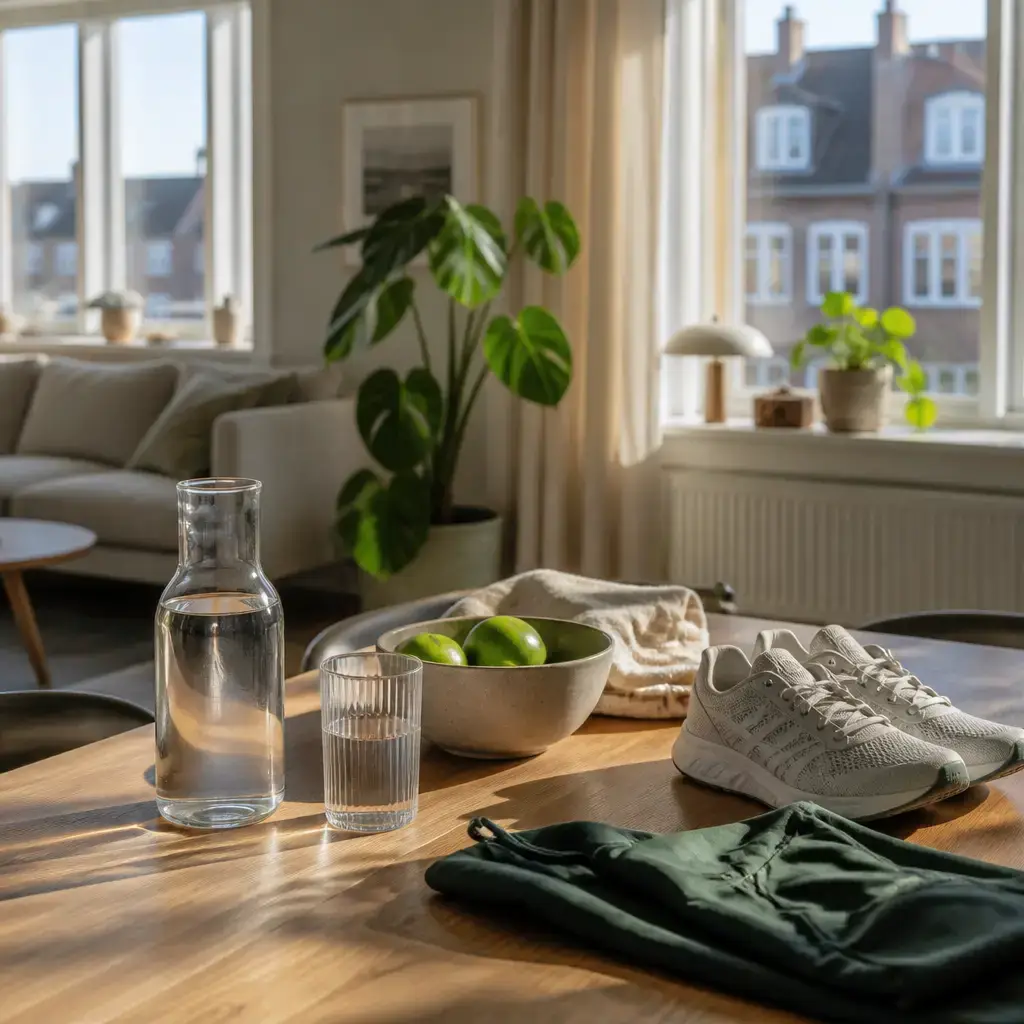
Use Small Healthy Daily Changes to practice German conversation, pronunciation, vocabulary, grammar, and quizzes.
Dialogue
Ich möchte eine gesündere tägliche Routine.
ikh MURH-tuh EYE-nuh guh-ZUEN-duh-ruh TAYG-lih-huh roo-TEE-nuh. I want a healthier daily routine.Beginne mit kleinen Veränderungen, die du beibehalten kannst.
buh-GIN-uh mit KLY-nun fehr-EN-duh-roong-un dee doo BYE-buh-HAL-tun kahnst. Start with small changes you can stick with.Ich kann bei der Arbeit mehr Wasser trinken.
ikh kahn bye dair AR-bite mair VAH-suh TRINK-un. I can drink more water while I'm at work.Das kann dir am Nachmittag mehr Energie geben.
dahs kahn deer ahm NAHKH-mi-tahk mair en-er-GHEE GAY-bun. That may help your energy in the afternoon.Soll ich nach dem Abendessen auch Sport machen?
zohl ikh nahkh daym AH-bn-ESS-n owkh SHPORT MAKH-n? Should I also exercise after dinner?Ein kurzer Spaziergang wäre ein Anfang, den du gut schaffen kannst.
EYE-n KOORT-suh shpa-TSEER-gahng VAIR-uh EYE-n AHN-fahng dayn doo goot SHAHF-n kahnst. A short walk would be a manageable start.Ich kann meine Schuhe an die Tür stellen, damit ich daran denke, loszugehen.
ikh kahn MY-nuh SHOO-uh ahn dee TEWR SHTEL-un duh-MIT ikh duh-RAHN DENK-uh LOHS-gay-un. I can put my shoes by the door so I remember to go.Das klingt realistisch und leicht durchzuhalten.
dahs klinkt ray-ah-LIS-tish unt LYEHT DOORKH-tsoo-HAL-tun. That sounds realistic and easy to keep up.Sentence explanations
Ich möchte eine gesündere tägliche Routine.
I want a healthier daily routine.
- Ich möchte
- I want
- gesündere
- healthier
- tägliche
- daily
- Routine
- routine
More detail
Ich möchte means “I want” here. möchte is the first-person singular form used to express a wish or desire; it is the subjunctive-II form of mögen, but in this use it functions as a polite, softer way to say “want.” The subject is Ich (“I”). With an action, German commonly uses möchte plus an infinitive: Ich möchte anfangen. — “I want to start.” Here, the desired thing is a noun phrase instead: Ich möchte eine neue Routine. — “I want a new routine.” gesündere describes a routine that is healthier than a relevant comparison point. Its base adjective is gesund (“healthy”); the comparative form is gesünder (“healthier”). In this sentence it appears before the feminine noun Routine, after eine, so the attributive form is gesündere: eine gesündere Routine. The comparison is part of the adjective, not of the noun. Example: Ich möchte gesünder essen. — “I want to eat more healthily.” tägliche means “daily” or “everyday” here. It is the attributive form of täglich (“daily”) and describes Routine. In eine gesündere tägliche Routine, both adjectives stand before the feminine noun and take the ending -e after eine. Example: Sie hat eine tägliche Gewohnheit. — “She has a daily habit.” Routine is a feminine noun meaning “routine.” Its plural is Routinen. The phrase eine Routine is an indefinite singular noun phrase referring to a routine, without asserting a numerical count as an independent fact. Example: Die Routine hilft mir. — “The routine helps me.” Together, Ich möchte states the speaker’s desire, and eine gesündere tägliche Routine names what the speaker wants: “a healthier daily routine.” The comparative gesündere presents this routine as healthier than the relevant existing or imagined alternative, while tägliche says that it is carried out daily.
Beginne mit kleinen Veränderungen, die du beibehalten kannst.
Start with small changes you can stick with.
- Beginne
- start / begin
- kleinen
- small
- Veränderungen
- changes
- beibehalten
- keep / stick with
- kannst
- can / are able to
More detail
Beginne is the informal singular imperative of beginnen (“to begin”). It addresses one person with du: Beginne mit ... means “Start with ...”. In formal singular address, German uses Beginnen Sie ...; for informal plural address, it uses Beginnt .... kleinen describes Veränderungen (“changes”). Its -en ending is required here because mit governs the dative and the noun is plural: mit kleinen Veränderungen = “with small changes.” The adjective’s base form is klein; its ending changes with the grammatical environment. Veränderungen is the plural of Veränderung (“change”): die Veränderung → die Veränderungen. Here it refers generally to changes without specifying a number. The -en ending marks this plural form; the ä is already present in the singular and is not a plural change here. beibehalten means “to keep” or “to continue with” something rather than stop or replace it. It is the infinitive of the separable verb beibehalten. In a finite clause, the prefix separates: Du behältst die Änderung bei. = “You keep the change.” In the supplied sentence it remains together because it follows the modal construction. kannst is the second-person singular present form of können (“can / be able to”). With du, the form is du kannst; a modal verb places the other verb in the infinitive at the end: Du kannst die Veränderung beibehalten. = “You can keep the change.” The relative clause die du beibehalten kannst modifies Veränderungen. die is a plural relative pronoun referring to the changes; in this clause it functions as the object of beibehalten, while du is the subject. The clause therefore means “that you can stick with.” Together, Beginne mit kleinen Veränderungen gives “Start with small changes,” and die du beibehalten kannst specifies that these should be changes you are able to maintain. The complete utterance is: “Start with small changes you can stick with.” The imperative is direct and informal, suitable for addressing one person with du.
Ich kann bei der Arbeit mehr Wasser trinken.
I can drink more water while I'm at work.
- Ich kann
- I can
- bei der Arbeit
- at work
- mehr
- more
- Wasser
- water
- trinken
- drink
More detail
Ich kann expresses the speaker’s ability or possibility: “I can.” kann is the present-tense form of können for ich; the infinitive is können, but it is not the form used here. With a modal verb, the other verb normally appears as an infinitive at the end of the clause. Example: Ich kann helfen. — “I can help.” bei der Arbeit means “at work” or “while at work.” The preposition bei takes the dative case, so die Arbeit appears here as der Arbeit. This is a useful pattern for describing being at or during a workplace activity: bei der Arbeit. mehr means “more.” It compares an amount with a smaller or previously understood amount; it does not itself specify an exact quantity. Example: Ich brauche mehr Zeit. — “I need more time.” Wasser means “water.” It is a mass noun here, referring to water generally rather than to a stated number of containers. The noun is neuter: das Wasser; after mehr, no article is needed in this sentence. trinken means “to drink.” This is the infinitive form, and it stays in the infinitive after kann: Ich kann Wasser trinken. — “I can drink water.” Together, Ich kann + bei der Arbeit + mehr Wasser + trinken gives: “I can drink more water while I’m at work.” The modal kann expresses possibility or ability, bei der Arbeit gives the situation, mehr increases the amount of Wasser, and trinken is the action.
Das kann dir am Nachmittag mehr Energie geben.
That may help your energy in the afternoon.
- Das kann
- That may
- dir
- to you
- am Nachmittag
- in the afternoon
- mehr
- more
- Energie
- energy
- geben
- give; provide
More detail
Das kann combines a demonstrative pronoun with the present-tense form kann of können. Das means “that” here; the supplied sentence does not identify exactly what it refers to. Kann is the third-person singular form: ich kann, du kannst, er/sie/es kann, wir können. With a following infinitive, können can express ability or possibility; here the intended meaning is possibility, “may.” In this pattern, the modal is finite and the other verb stays in the infinitive at the end: Das kann helfen = “That may help.” dir is the informal singular “you” in the dative case. It marks the person who receives or benefits from something; it is not the possessive “your.” A useful pattern is jemandem etwas geben (“to give someone something”), with the person in the dative. am Nachmittag is a time expression meaning “in the afternoon.” Am is the contraction of an dem; Nachmittag is a masculine noun, so the form after an is dem in this expression. The contraction is common in ordinary speech and writing. mehr means “more” and is the comparative form related to viel (“much/many”): viel → mehr → am meisten. Here it compares the amount of energy with an understood smaller amount, without stating a precise quantity. Energie is the noun “energy.” It is feminine in German (die Energie) and is capitalized because German nouns are capitalized. In mehr Energie, mehr describes the amount of this noun. geben is the infinitive “to give” or “to provide.” Its base form appears after the modal kann. In the pattern jemandem etwas geben, dir is the recipient and Energie is what is provided. For example: Das kann dir mehr Zeit geben. — “That may give you more time.” Together, Das kann dir ... geben means “That may give you ...”; mehr Energie supplies what may be provided, and am Nachmittag specifies when. The complete utterance therefore means: “That may give you more energy in the afternoon.”
Soll ich nach dem Abendessen auch Sport machen?
Should I also exercise after dinner?
- Soll ich
- Should I …?
- nach dem Abendessen
- after dinner
- auch
- also
- Sport machen
- exercise
More detail
Soll ich uses sollen in the first-person singular present: ich soll → Soll ich …? at the start of a yes/no question. Here it asks whether the speaker ought to or should do the action. In a question, the conjugated modal verb comes first and the other verb stays in the infinitive at the end. Compare: Soll ich warten? — “Should I wait?” nach dem Abendessen expresses a time after dinner. The preposition nach takes the dative here, so the neuter noun phrase das Abendessen appears as dem Abendessen. nach can also introduce a destination in other contexts, but this phrase has the temporal meaning “after dinner.” auch means “also” or “too.” It adds this activity to something already relevant in the conversation; it does not itself specify what that earlier activity is. Its position here places the addition before the activity phrase: auch Sport machen — “also exercise.” Sport machen is a common German expression for doing exercise or exercising. machen is the infinitive “to do/make,” and Sport is used without an article in this activity expression. The verb machen can also describe other activities, such as Hausaufgaben machen — “do homework,” but the noun determines the activity’s meaning. Together, Soll ich frames a suggestion or question about the speaker’s action, nach dem Abendessen sets the time, auch adds this activity, and Sport machen names the activity. The complete meaning is: “Should I also exercise after dinner?”
Ein kurzer Spaziergang wäre ein Anfang, den du gut schaffen kannst.
A short walk would be a manageable start.
- kurzer
- short
- Spaziergang
- walk
- wäre
- would be
- Anfang
- start
- gut
- well
- schaffen
- manage
- kannst
- can
More detail
kurzer describes Spaziergang here. Its base form is kurz; useful comparison forms are kürzer (“shorter”) and am kürzesten (“shortest”). The ending -er appears because the adjective is in the masculine singular nominative form after ein in ein kurzer Spaziergang. Spaziergang is a masculine noun meaning a walk or stroll. In the fixed sentence, ein kurzer Spaziergang is the subject: “a short walk.” The article and adjective together show the noun phrase’s masculine singular nominative form. wäre is the third-person singular form of sein in the subjunctive II (Konjunktiv II). It presents the proposal as a hypothetical or tentative possibility: “would be.” Here the singular subject is ein kurzer Spaziergang. Anfang is a masculine noun meaning a beginning or start. ein Anfang means “a start” in this sentence. The following den refers back to this start and introduces the relative clause den du gut schaffen kannst. gut means “well” here and describes how the action can be managed. In this construction, it works adverbially with schaffen, rather than describing the noun Anfang. schaffen is the infinitive meaning “manage” or “accomplish” here. German can also use this verb for “create,” but that is a different context. Example: Ich schaffe das. — “I can manage that.” kannst is the second-person singular present form of können, used with du. The pattern du ... schaffen kannst means “you can manage ...”. With a modal verb such as können, the other verb stays in the infinitive: schaffen; in this relative clause, kannst comes at the end. Together, ein kurzer Spaziergang wäre ein Anfang says “a short walk would be a start.” The relative clause den du gut schaffen kannst specifies that this is a start you can manage well. The complete meaning is therefore: “A short walk would be a manageable start.”
Ich kann meine Schuhe an die Tür stellen, damit ich daran denke, loszugehen.
I can put my shoes by the door so I remember to go.
- Ich kann
- I can
- Schuhe
- shoes
- an die Tür
- by the door
- Tür
- door
- stellen
- put/place
- damit
- so that
- daran
- about it/that
- denke
- think/remember
- loszugehen
- to set off
More detail
Ich kann means “I can” here. kann is the first-person singular present form of können, expressing ability or possibility. With a modal verb, the other verb remains in the infinitive and goes to the end of its clause: Ich kann ... stellen = “I can put ...”. meine Schuhe: Schuhe is the plural of der Schuh (“shoe”). meine is the possessive determiner “my”; before a plural noun it has the form meine. Example: Ich suche meine Schuhe. — “I am looking for my shoes.” an die Tür gives the placement location, “by the door”. The two-way preposition an takes the accusative when something is placed at a location, as here. die is also the accusative form of the feminine noun die Tür, so its form does not visibly change. With a stationary location, an takes the dative: Die Schuhe stehen an der Tür. — “The shoes are by the door.” Tür means “door”. Its plural is Türen: Die Türen sind offen. — “The doors are open.” stellen means “to put” or “to place”, especially placing something in a standing or upright position. Its base form is stellen; the first-person present form is ich stelle. Example: Ich stelle die Tasche neben den Stuhl. — “I put the bag next to the chair.” damit introduces a purpose clause, meaning “so that”. In this subordinate clause, the finite verb goes at the end: damit ich daran denke. daran is a pronominal adverb formed from da and an. With denken, an etwas denken means “think of something”. In the construction daran denken, ... zu ..., the construction can mean “remember to ...”; here the intended action is supplied by loszugehen. denke is the first-person singular present form of denken, whose base form means “think”. Here, in ich daran denke, loszugehen, it participates in the meaning “I remember to set off”. In another context, Ich denke an den Urlaub. means “I am thinking about the holiday.” loszugehen means “to set off” or “to leave”. It is the infinitive with zu of the separable verb losgehen: losgehen → loszugehen. In a zu-infinitive, zu is inserted between the separable prefix and the verb stem. Together, Ich kann meine Schuhe an die Tür stellen says that the speaker can put their shoes by the door. damit ich daran denke, loszugehen gives the purpose: this is intended to help the speaker remember to set off. The whole utterance means: “I can put my shoes by the door so I remember to go.”
Das klingt realistisch und leicht durchzuhalten.
That sounds realistic and easy to keep up.
- Das
- That / it
- klingt
- sounds
- realistisch
- realistic
- leicht
- easy
- durchzuhalten
- to keep up
More detail
Das is a demonstrative pronoun used here as the subject. In this sentence it means “that” and refers to an idea or situation already understood from context; its specific referent is not named in the fixed sentence. German das is neuter singular in form, but this form does not by itself identify a particular noun. klingt comes from klingen (“to sound”). It is the present-tense, third-person singular form: ich klinge, du klingst, er/sie/es klingt. With an adjective, klingen describes how something seems based on what is heard or considered: Das klingt gut. — “That sounds good.” realistisch is an adjective meaning “realistic” or “feasible.” After klingt, it describes how the subject seems: Der Plan klingt realistisch. — “The plan sounds realistic.” The ending does not change here because the adjective follows klingt as a predicate, rather than directly modifying a noun. leicht means “easy” in this sentence. It describes the difficulty of the action expressed by the following infinitive. Compare schwer (“difficult”): Das ist leicht zu verstehen. — “That is easy to understand.” durchzuhalten is the zu-infinitive of the separable verb durchhalten, “to keep up,” “to persevere,” or “to maintain.” In a zu-infinitive, the zu is placed inside this verb: durchhalten → durchzuhalten. The pattern leicht zu + infinitive means “easy to ...”; for example, Die Gewohnheit ist leicht durchzuhalten. — “The habit is easy to keep up.” Together, Das klingt realistisch says “That sounds realistic,” and leicht durchzuhalten says that the relevant plan or practice is easy to keep up. The complete utterance is therefore: “That sounds realistic and easy to keep up.”
Grammar Points
gesünder + Adjektivendung: gesündere
Eine gesündere tägliche Routine wäre realistisch.
EYE-nuh guh-ZUEN-duh-ruh TAYG-lih-huh roo-TEE-nuh VAIR-uh ray-ah-LIS-tish.A healthier daily routine would be realistic.
The comparative gesünder takes an adjective ending before a feminine noun with eine: gesündere Routine.
wäre ..., zu + Infinitiv
Es wäre realistisch, Wasser zu trinken.
ess VAIR-uh ray-ah-LIS-tish, VAH-suh tsoo TRINK-un.It would be realistic to drink water.
After wäre es realistisch, use zu plus the infinitive to express what would be realistic to do.
German Vocabulary
eine gesündere tägliche Routine
mit kleinen Veränderungen
Quiz
Word Order
Arrange the words in the correct order.
I want a healthier daily routine.
Show Answer
Ich möchte eine gesündere tägliche Routine.That sounds realistic and easy to keep up.
Show Answer
Das klingt realistisch und leicht durchzuhalten.Spelling
Tap the letters to spell the word.
to drink
Show Answer
trinkenwater
Show Answer
Wasserwant
Show Answer
möchteto stick with; to maintain