10 minutes free every day
Continue audio lessons in the app
Word explanations appear automatically in sync with the audio.
No login required · synced translations · playback with the screen locked
Choose your learning language and open this lesson in the app.

About This Lesson
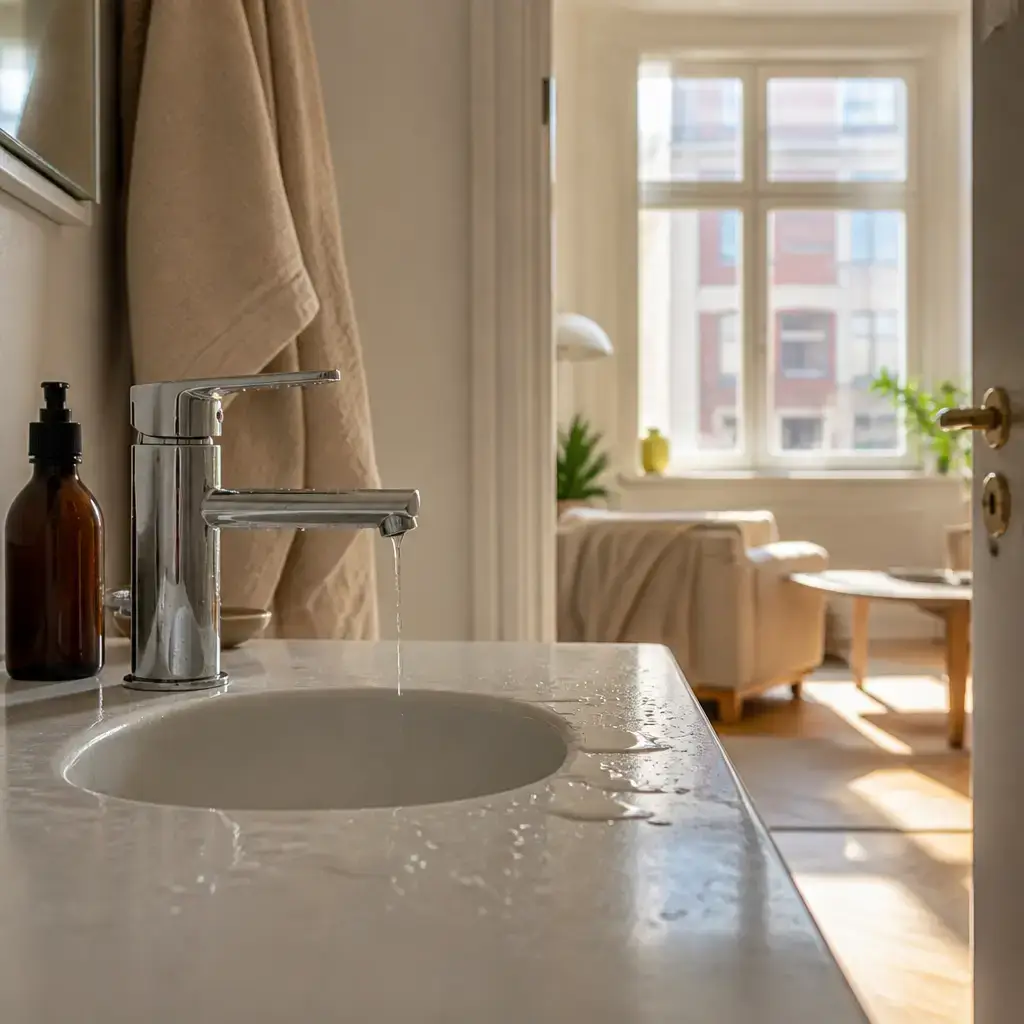
Use Writing to the landlord about a leaking tap to practice German conversation, pronunciation, vocabulary, grammar, and quizzes.
Dialogue
Der Wasserhahn im Badezimmer ist wieder undicht, obwohl ich ihn gestern festgezogen habe.
dair VAH-ser-hahn im BAH-deh-tsim-mer ist VEE-der OON-dikht, ohp-VOHL ikh een GES-tairn FEST-tsuh-GOH-gen HAH-buh. The bathroom tap is leaking again, even after I tightened it yesterday.Da das immer wieder passiert, sollten wir wahrscheinlich den Vermieter kontaktieren.
dah dahs IM-mer VEE-der pah-SSEERT, ZHOL-ten veer vah-SHYNE-likh dane fer-MEE-ter kon-tak-TEE-ren. Since it keeps happening, we should probably contact the landlord.Ich kann ein Foto schicken und erklären, dass eine vorübergehende Reparatur nicht funktioniert hat.
ikh kahn ayn FOH-toh SHIK-en oont air-KLair-en, dahs EYE-nuh for-OOO-ber-GAY-en-duh ray-pah-rah-TOOR nikht foonk-tsyo-NEERT haht. I can send a photo and explain that a temporary repair did not work.Schreib dazu, dass Wasser verschwendet wird und die Arbeitsfläche nass wird.
shryp dah-TSOO, dahs VAH-ser fer-SHVEN-det veert oont dee AR-bites-FLEH-khuh nahs veert. Mention that water is being wasted and the counter is getting wet.Sollen wir sagen, dass wir das Problem nicht selbst verursacht haben?
ZHOL-en veer ZAH-gen, dahs veer dahs proh-BLAYM nikht zelbst fer-OOOR-zakht HAH-ben? Should we say that we did not cause the problem ourselves?Schreib das deutlich dazu, aber halte den Ton ruhig.
shryp dahs DOYT-likh dah-TSOO, AH-ber HAL-tuh dane tohn ROO-ikh. Include that clearly, but keep the tone calm.Die Nachricht sollte höflich, aber genau sein, damit es keine Missverständnisse gibt.
dee NAHKH-rikht ZHOL-tuh HURF-likh, AH-ber guh-NOW zine, dah-MIT es KYE-nuh MISS-fer-SHTEND-nis-suh gipt. The message should be polite but specific, so there is no confusion.Frag, wann ein Klempner kommen könnte, weil die Vormittage an Werktagen für uns schwierig sind.
frahk, vahn ayn KLEMP-ner KOM-en KURR-tuh, vile dee FOR-mit-TAH-guh ahn VAIRK-tah-gen fyoor oons SHVEE-rikh zint. Ask when a plumber could visit, because weekday mornings are difficult for us.Wir können ein flexibles Zeitfenster vorschlagen, in dem jemand zu Hause sein kann.
veer KURN-en ayn FLEKS-ee-bles TSYTE-fen-ster FOR-shlah-gen, in dame YAY-mant tsoo HOW-zuh zine kahn. We can suggest a flexible time window when someone can be home.Das sollte es dem Vermieter erleichtern, die Reparatur zu organisieren.
dahs ZHOL-tuh es dame fer-MEE-ter air-LYKH-tern, dee ray-pah-rah-TOOR tsoo or-gah-nee-ZEE-ren. That should make it easier for the landlord to arrange the repair.Sentence explanations
Der Wasserhahn im Badezimmer ist wieder undicht, obwohl ich ihn gestern festgezogen habe.
The bathroom tap is leaking again, even after I tightened it yesterday.
- Wasserhahn
- tap
- Badezimmer
- bathroom
- wieder
- again
- undicht
- leaking
- obwohl
- although
- ich
- I
- ihn
- it
- gestern
- yesterday
- festgezogen
- tightened
More detail
Wasserhahn means “tap” here, specifically a water tap or faucet. It is a masculine noun: der Wasserhahn. The plural is die Wasserhähne. Badezimmer means “bathroom.” It is a neuter noun: das Badezimmer. In im Badezimmer, im is the contraction of in dem, meaning “in the bathroom”; the phrase identifies the tap’s location. wieder means “again.” It indicates that the leaking has occurred another time, without by itself specifying how many previous times. undicht describes something that is not sealed properly and lets liquid or gas escape. Here it is used predicatively after ist: Der Wasserhahn ist undicht — “The tap is leaking.” It is an adjective, not a verb; the verb is ist, the form of sein used with this singular subject. obwohl introduces a contrast: something is true despite the information in the following clause. It sends the conjugated verb to the end of its subordinate clause. For example: Obwohl es regnet, gehen wir spazieren. — “Although it is raining, we are going for a walk.” ich is the first-person singular pronoun “I.” Its form identifies the speaker as the subject of the subordinate clause. In German, the related object form is mich, as in Er sieht mich — “He sees me.” ihn means “it” here and refers to the masculine noun Wasserhahn; German uses the masculine accusative form ihn for that object. The object form is required because the speaker tightened the tap. The corresponding masculine subject form is er, while ihn is the accusative form. gestern means “yesterday,” locating the tightening on the day before the utterance. It does not itself mark the verb’s tense; it works with the past construction habe ... festgezogen. festgezogen is the past participle of festziehen, “to tighten.” The verb is separable in some finite forms: Ich ziehe die Schraube fest — “I tighten the screw.” In the perfect tense, German uses haben plus the participle: ich habe ... festgezogen. The participle is placed at the end of this subordinate clause because of obwohl. The main clause is Der Wasserhahn im Badezimmer ist wieder undicht: “The bathroom tap is leaking again.” The location phrase im Badezimmer specifies which tap is meant, ist undicht states its current condition, and wieder marks the recurrence. The subordinate clause obwohl ich ihn gestern festgezogen habe adds the contrast: “even though I tightened it yesterday.” Together, the utterance says that the tap is leaking again despite the speaker’s tightening it the previous day.
Da das immer wieder passiert, sollten wir wahrscheinlich den Vermieter kontaktieren.
Since it keeps happening, we should probably contact the landlord.
- Da
- since / because
- das
- it / that
- immer wieder
- again and again
- passiert
- happens
- sollten wir
- we should
- wahrscheinlich
- probably
- Vermieter
- landlord
- kontaktieren
- contact
More detail
Da introduces a reason: here it means “since/because,” not the adverb “there.” It starts a subordinate clause, so the finite verb comes at the end. Example: Da es regnet, bleiben wir zu Hause. — “Since it is raining, we are staying at home.” das is a neuter singular demonstrative pronoun meaning “it/that” here. It refers to the situation being discussed—the recurring problem—not to a newly specified person. The form das itself does not show whether its referent is near or far; its reference comes from context. immer wieder describes repeated recurrence: something happens repeatedly, with the same kind of event returning. It is useful for ongoing or repeated problems. Example: Der Fehler tritt immer wieder auf. — “The error keeps occurring.” passiert is the third-person singular present form of passieren (“to happen”). The base form is passieren; in this sentence, das is the singular subject, so the form is passiert. Example: Das passiert manchmal. — “That sometimes happens.” sollten wir expresses a recommendation or expectation translated here as “we should.” sollten is the first-person plural form of sollen in the subjunctive II form, often used to make advice less forceful or more tentative. wir is the first-person plural pronoun “we.” In the main clause, the initial subordinate clause occupies the first position, so the finite verb sollten comes before wir: Da ..., sollten wir .... wahrscheinlich is an adverb meaning “probably.” It marks the proposed action as likely or sensible rather than completely certain. Example: Wir kommen wahrscheinlich morgen. — “We will probably come tomorrow.” Vermieter means “landlord.” It is a masculine noun; in den Vermieter, the article den marks masculine singular accusative, because the landlord is the direct object of kontaktieren. The noun itself has the same form in masculine singular nominative and accusative: der Vermieter / den Vermieter. kontaktieren is the infinitive “to contact.” It takes a direct object in the accusative: jemanden kontaktieren — “to contact someone.” After the modal verb sollten, the lexical verb remains in the infinitive at the end of the main clause. Example: Wir sollten den Kundendienst kontaktieren. — “We should contact customer service.” Together, Da das immer wieder passiert gives the reason “Since it keeps happening.” The following main clause, sollten wir wahrscheinlich den Vermieter kontaktieren, says that, as a likely recommendation, “we should probably contact the landlord.” The full utterance therefore means: “Since it keeps happening, we should probably contact the landlord.”
Ich kann ein Foto schicken und erklären, dass eine vorübergehende Reparatur nicht funktioniert hat.
I can send a photo and explain that a temporary repair did not work.
- Ich kann
- I can
- Foto
- photo
- schicken
- send
- erklären
- explain
- dass
- that
- vorübergehende
- temporary
- Reparatur
- repair
- nicht
- not
- funktioniert
- worked
More detail
Ich kann expresses the speaker’s ability or possibility: “I can.” kann is the first-person singular present form of können; the infinitive is können. With a modal verb, the following lexical verb normally stays in the infinitive: Ich kann kommen = “I can come.” Foto means “photo.” Its plural is Fotos. In this sentence, ein Foto is the thing being sent; the article and noun together form an accusative object after schicken. schicken means “to send.” It is an infinitive because it follows kann. Example: Ich schicke ein Foto. = “I am sending a photo.” erklären means “to explain.” It is coordinated with schicken and is also an infinitive governed by kann: Ich kann ein Foto schicken und erklären ... = “I can send a photo and explain ...” dass introduces the content of the explanation, roughly “that.” In the clause beginning with dass, the finite auxiliary appears at the end: ..., dass es funktioniert hat. = “... that it worked.” vorübergehende means “temporary” here. Its base form is the adjective vorübergehend. It describes feminine singular Reparatur; after the indefinite article eine, it has the ending -e: eine vorübergehende Reparatur. The adjective says that the repair is temporary; eine does not by itself assert a numerical count. Reparatur means “repair.” It is a feminine noun, as shown here by eine and the adjective ending. Example: Die Reparatur ist fertig. = “The repair is finished.” nicht negates the following predicate phrase. Here it makes the statement negative: the temporary repair did not work. funktioniert comes from funktionieren, “to work” or “to function.” In this sentence it is the perfect participle, and it has the same visible form as the infinitive: funktionieren → funktioniert. The auxiliary hat completes the perfect construction hat funktioniert, meaning “worked” or “has worked.” Example: Das Gerät hat nicht funktioniert. = “The device did not work.” Together, Ich kann ein Foto schicken und erklären means “I can send a photo and explain.” The dass clause gives the content of erklären: dass eine vorübergehende Reparatur nicht funktioniert hat means “that a temporary repair did not work.” The complete utterance is therefore: “I can send a photo and explain that a temporary repair did not work.”
Schreib dazu, dass Wasser verschwendet wird und die Arbeitsfläche nass wird.
Mention that water is being wasted and the counter is getting wet.
- Schreib dazu
- mention/add that
- Wasser
- water
- verschwendet wird
- is being wasted
- Arbeitsfläche
- counter/work surface
- nass wird
- gets wet
More detail
Schreib dazu is an informal singular imperative of schreiben (“to write”). dazu means “in addition to that” here, so the construction is a reusable way to ask someone to add a piece of information: Schreib dazu, dass … = “Add/mention that …”. The imperative addresses one person informally; a formal or plural command would use a different form. Wasser means “water”. It is normally used as an uncountable noun, as in Ich trinke Wasser (“I drink water”). Its definite article is das: das Wasser. verschwendet wird expresses a present passive: verschwendet is the past participle of verschwenden (“to waste”), and wird is the present-tense form of werden used to form the passive. In the dass clause, the finite verb goes to the end, so the order is dass Wasser verschwendet wird. This focuses on water being wasted, without stating who is wasting it. Active contrast: Jemand verschwendet Wasser = “Someone is wasting water.” Arbeitsfläche means “work surface” or, in this translation, “counter”. It is a feminine compound noun: die Arbeitsfläche, plural die Arbeitsflächen. The compound combines Arbeit (“work”) and Fläche (“surface/area”), but the whole word names the surface used for work. nass wird means “gets/becomes wet”. wird here is not forming a passive; it is the verb werden with the adjective nass, describing a change of state. Compare Die Arbeitsfläche ist nass (“The work surface is wet”), which describes the resulting state. In the dass clause, this finite verb also appears at the end: dass die Arbeitsfläche nass wird. The two dass clauses are joined by und: dass Wasser verschwendet wird und die Arbeitsfläche nass wird. Together they are the content to be added. The complete utterance is an informal singular instruction: “Mention that water is being wasted and the counter is getting wet.”
Sollen wir sagen, dass wir das Problem nicht selbst verursacht haben?
Should we say that we did not cause the problem ourselves?
- Sollen wir
- should we
- sagen
- say
- dass wir
- that we
- das Problem
- the problem
- nicht
- not
- selbst
- ourselves
- verursacht haben
- have caused
More detail
Sollen wir asks whether “we” should do something. sollen is the modal verb sollen; in this question it expresses a proposed or considered action, not a past obligation. In a main-clause question, the finite modal comes first and the subject follows: Sollen wir ...? = “Should we ...?” sagen means “to say” and stays in the infinitive because it follows the modal verb sollen. With another subject, the same pattern is reusable: Soll ich sagen ...? = “Should I say ...?” dass wir introduces a subordinate clause and gives its subject, “we.” dass is a conjunction meaning “that.” In a German dass clause, the finite verb normally moves to the end. The wir here refers to the speakers as the people who did or did not cause the problem. das Problem means “the problem.” Problem is a neuter noun, so its definite article is das in the nominative and accusative singular. Here it is the object of “caused,” so the accusative form is used; for this neuter noun, the article still appears as das. nicht negates the relevant action: the clause says that we did not cause the problem. Its position helps show that the causing is being denied, rather than changing selbst into a separate negation. selbst means “ourselves” in this sentence and emphasizes the subject wir: the speakers did not cause the problem on their own or by their own action. It can also mean “self” or “even” in other contexts, so its exact effect comes from the surrounding construction. verursacht haben is the perfect-tense verb phrase “have caused.” The lexical verb is verursachen (“to cause”); verursacht is its past participle. haben is the finite auxiliary here, and in the dass clause it appears at the end after the participle. The pattern is haben + past participle, for example: Wir haben den Schaden verursacht. — “We caused the damage.” Together, Sollen wir sagen asks whether the speakers should state something. The dass clause supplies the content of that statement: wir das Problem nicht selbst verursacht haben = “we did not cause the problem ourselves.” The complete utterance therefore means: “Should we say that we did not cause the problem ourselves?”
Schreib das deutlich dazu, aber halte den Ton ruhig.
Include that clearly, but keep the tone calm.
- Schreib
- include / add
- das
- that
- deutlich
- clearly
- dazu
- to that / in addition
- halte
- keep
- Ton
- tone
- ruhig
- calm
More detail
Schreib is the informal singular imperative of schreiben (“to write”). It directly addresses one person: “Write …” or, in this context, “Include/add …”. A useful contrast is schreibt, which can address several people informally or serve as a present-tense form with ihr. das is a demonstrative pronoun meaning “that” here. Its grammatical form is neuter singular accusative, but the sentence does not identify exactly what “that” refers to. It can point back to information already under discussion without naming that information again. deutlich means “clearly” in this sentence. As an adverb, it describes how the writing should be added. The adjective can also be used before a noun, with an ending determined by the noun phrase: eine deutliche Erklärung = “a clear explanation.” dazu means “to that” or “in addition to it” and shows that something is being added to the already mentioned material. The separated-looking meaning is a useful pattern: etwas dazu schreiben = “write/add something to it.” Here it combines with das: das deutlich dazu schreiben = “add that clearly.” halte is the informal singular imperative of halten (“to keep” or “to hold”). The imperative form is halte; the present-tense form with du is also hältst, so halte should not be treated as the ordinary present form. In this sentence, halten means maintaining a quality or condition. Ton is the masculine noun “tone.” Its accusative singular form is den Ton, because it is the object of halte. The noun can refer to the style or emotional quality of speech or writing, not only to a literal sound. ruhig means “calm” here and describes the desired quality of den Ton. As an adjective after halten, it appears in its basic form: den Ton ruhig halten = “keep the tone calm.” A related but different use is ruhig sprechen = “speak calmly.” Together, the first part gives the reusable pattern Schreib [etwas] dazu: “add/write [something] in.” deutlich specifies that the addition should be clear. The second part uses etwas ruhig halten: “keep something calm,” with den Ton as the thing whose quality is maintained. The complete utterance means: “Include that clearly, but keep the tone calm.”
Die Nachricht sollte höflich, aber genau sein, damit es keine Missverständnisse gibt.
The message should be polite but specific, so there is no confusion.
- Nachricht
- message
- sollte
- should
- höflich
- polite
- genau
- specific; precise
- sein
- be
- damit
- so that
- Missverständnisse
- misunderstandings
- gibt
- gives
More detail
Nachricht means “message” here. Its base form is die Nachricht; the plural is die Nachrichten. Example: Die Nachricht ist kurz. — “The message is short.” sollte is the third-person singular form of sollen. It has the same form as the simple past sollte and the Konjunktiv II form; in this sentence, the English “should” supports the recommendation or expectation reading. Example: Die Nachricht sollte klar sein. — “The message should be clear.” höflich means “polite” here. After sein, this descriptive adjective has no adjective ending. Example: Der Ton ist höflich. — “The tone is polite.” genau means “specific” or “precise” here, describing the content’s precision. This contrasts with höflich, which describes the manner or tone. Example: Bitte sei genau. — “Please be precise.” sein is the infinitive “to be.” After the modal verb sollte, it remains in the infinitive and appears at the end of the first clause. Example: Der Text sollte kurz sein. — “The text should be short.” damit introduces a subordinate clause expressing an intended result or purpose: “so that.” In this clause, the finite verb goes to the end. The reusable pattern is ..., damit ... [finite verb]. Missverständnisse means “misunderstandings.” It is the plural of the neuter noun das Missverständnis: das Missverständnis → die Missverständnisse. The plural changes the ending; the umlaut is already present in the singular and is not newly added in the plural. Example: Wir wollen Missverständnisse vermeiden. — “We want to avoid misunderstandings.” gibt is the third-person singular form of geben, “gives.” In the construction es gibt, it means “there is” or “there are.” Thus es gibt keine Missverständnisse means “there are no misunderstandings”; the construction uses singular gibt even when the following noun phrase is plural. Example: Es gibt keine Probleme. — “There are no problems.” Together, Die Nachricht sollte höflich, aber genau sein says that the message should be polite but precise. aber connects the contrast. The subordinate clause damit es keine Missverständnisse gibt gives the aim: “so that there are no misunderstandings.” The complete meaning is: “The message should be polite but specific, so there is no confusion.”
Frag, wann ein Klempner kommen könnte, weil die Vormittage an Werktagen für uns schwierig sind.
Ask when a plumber could visit, because weekday mornings are difficult for us.
- Frag
- ask
- wann
- when
- Klempner
- plumber
- kommen
- come; visit
- könnte
- could
- weil
- because
- Vormittage
- mornings
- an Werktagen
- on weekdays
- für uns
- for us
- schwierig
- difficult
More detail
Frag is the informal singular imperative of fragen (“to ask”). It addresses one person directly: Frag! = “Ask!” The formal imperative is different: Fragen Sie! wann means “when” here and introduces an indirect question. In German, the finite verb normally goes to the end of this embedded question: wann ein Klempner kommen könnte. Klempner is a masculine noun meaning “plumber.” In ein Klempner, it is the subject of the embedded question. The indefinite article identifies one plumber as the person who may come, but it does not by itself assert a numerical count as the main point. kommen is the infinitive “to come.” The fixed translation makes “visit” the intended context-specific meaning: the plumber would come to the relevant place. With a modal form, the infinitive stays at the end of the clause: kommen könnte. könnte is the third-person singular form of können in the Konjunktiv II, commonly used for “could” or a possible, less direct statement. Here it expresses that the plumber might be able to come at a particular time. Compare: Er kann kommen. = “He can come.” / Er könnte kommen. = “He could come.” weil means “because” and introduces the reason for the request. A weil clause places its finite verb at the end, as in the final sind of weil die Vormittage an Werktagen für uns schwierig sind. Vormittage is the plural of Vormittag (“morning,” specifically the part before noon). The plural ending is visible in -e: ein Vormittag → die Vormittage. Here it is the subject of sind. an Werktagen means “on weekdays.” Werktagen is the dative plural of Werktag, required here by the temporal use of an: an einem Werktag / an Werktagen. It specifies which mornings are difficult. für uns means “for us.” für takes the accusative, and the first-person plural pronoun has the accusative form uns; this form is also identical to the dative form. The phrase marks the people affected by the difficulty. schwierig means “difficult.” It is a predicate adjective describing die Vormittage; the plural agreement is carried by the verb sind, while schwierig itself does not change for plural here. Example: Die Zeiten sind schwierig. = “The times are difficult.” Together, Frag gives the direct instruction “Ask,” and wann ein Klempner kommen könnte specifies what to ask: the possible time of the plumber’s visit. weil die Vormittage an Werktagen für uns schwierig sind gives the reason: weekday mornings are difficult for the people represented by uns. The whole utterance therefore means: “Ask when a plumber could visit, because weekday mornings are difficult for us.”
Wir können ein flexibles Zeitfenster vorschlagen, in dem jemand zu Hause sein kann.
We can suggest a flexible time window when someone can be home.
- Wir können
- we can
- ein
- a
- flexibles
- flexible
- Zeitfenster
- time window
- vorschlagen
- suggest
- in dem
- in which; when
- jemand
- someone
- zu Hause
- at home
- sein
- be
- kann
- can
More detail
Wir können introduces “we can”: können is the finite present-tense form of können for wir. With a modal verb, the other verb normally stays in the infinitive and goes to the end of the clause. Here it expresses ability or feasibility to make a suggestion. ein is the indefinite article before the noun Zeitfenster. It does not by itself assert a numerical count; it presents one unspecified time window. flexibles means “flexible” here. The adjective is based on flexibel, and its -es ending agrees with the neuter singular noun Zeitfenster in the accusative after ein: ein flexibles Zeitfenster. The ending belongs to the adjective, not to the noun. Zeitfenster is a neuter noun meaning a time period available for an activity or appointment. Its plural is Zeitfenster; the form does not visibly change in the plural. Example: Wir brauchen ein größeres Zeitfenster. — “We need a larger time window.” vorschlagen means “to suggest” or “to propose.” It is a separable verb: in a present-tense main clause, Wir schlagen ein Zeitfenster vor; after a modal, the infinitive remains together: Wir können ein Zeitfenster vorschlagen. The form here is not a past-tense form. in dem begins a relative clause referring to the time window. in takes the dative here because the clause describes the setting or time period in which something is possible, and dem is the dative relative pronoun for a neuter singular antecedent. The combination can naturally mean “in which” or, with a time period, “when.” jemand means “someone” and refers to an unspecified person. It is grammatically singular, so the finite verb later in this clause is singular. It does not identify which person is meant. zu Hause is the fixed phrase “at home.” It describes a person’s location; zu Hause sein means “to be at home.” sein is the infinitive “to be,” used here with the modal verb kann. Example: Jemand kann morgen zu Hause sein. — “Someone can be at home tomorrow.” kann is the third-person singular present form of the modal verb können, agreeing with jemand: jemand kann. In this clause it expresses that being at home is possible or feasible. Because the clause is introduced by in dem, the finite verb comes at the end: in dem jemand zu Hause sein kann. Together, ein flexibles Zeitfenster vorschlagen means “suggest a flexible time window.” The relative clause in dem jemand zu Hause sein kann specifies that this is a window during which someone can be at home. The complete utterance therefore means: “We can suggest a flexible time window when someone can be home.”
Das sollte es dem Vermieter erleichtern, die Reparatur zu organisieren.
That should make it easier for the landlord to arrange the repair.
- Das sollte
- that should
- es
- it
- dem Vermieter
- the landlord
- erleichtern
- make easier
- die Reparatur
- the repair
- zu organisieren
- to arrange
More detail
Das sollte means “that should” here. Das is a neuter demonstrative pronoun referring to the situation or action just mentioned; the previous sentence supports that reading. sollte is the form of sollen used here to express an expected or intended result, not an instruction. Example: Das soll helfen. — “That is supposed to help.” es is the anticipatory object in the pattern es jemandem erleichtern, etwas zu tun: “to make it easier for someone to do something.” It does not itself refer to the situation mentioned by Das; the following infinitive phrase identifies what is made easier. dem Vermieter means “the landlord.” Vermieter is a masculine noun, and dem marks dative singular. The dative identifies the person for whom the task becomes easier. Example: Das erleichtert der Mieterin die Arbeit. — “That makes the work easier for the female tenant.” erleichtern means “to make easier.” This is the base form, used after sollte, and the person benefiting is expressed in the dative: jemandem etwas erleichtern. Do not confuse it with leichter machen, which has the same basic meaning but uses the comparative adjective leichter. die Reparatur means “the repair.” Reparatur is a feminine noun, and die marks accusative singular here because the repair is the object of organisieren. The same form die can also mark feminine nominative singular, so its role comes from the sentence structure. zu organisieren means “to arrange.” organisieren is the base form, and because it is a non-separable verb, zu comes directly before it in the infinitive construction: etwas zu organisieren. Example: Es ist schwer, den Termin zu organisieren. — “It is difficult to arrange the appointment.” Together, Das sollte es dem Vermieter erleichtern says that the referenced situation should make something easier for the landlord. The anticipatory es points forward to die Reparatur zu organisieren, so the whole utterance means: “That should make it easier for the landlord to arrange the repair.”
Grammar Points
obwohl + Nebensatz (Verb am Ende)
Obwohl der Wasserhahn undicht ist, verschwendet er immer wieder Wasser.
ohp-VOHL dair VAH-ser-hahn OON-dikht ist, fer-SHVEN-det air IM-mer VEE-der VAH-ser.Although the tap is leaking, it wastes water again and again.
After obwohl, the conjugated verb moves to the end of the subordinate clause.
vorschlagen, ... zu + Infinitiv
Der Vermieter schlägt vor, den Wasserhahn festzuziehen.
dair fer-MEE-ter shlaykt for, dane VAH-ser-hahn FEST-tsee-en.The landlord suggests tightening the tap.
After vorschlagen, use zu with the infinitive. In separable verbs, zu comes between the prefix and the verb.
German Vocabulary
Der Wasserhahn im Badezimmer ist wieder undicht.
ein Foto schicken und erklären
obwohl ich ihn gestern festgezogen habe
Ich kann ein Foto schicken
Da das immer wieder passiert
den Vermieter kontaktieren
obwohl ich ihn gestern festgezogen habe
Da das immer wieder passiert
Ich kann ein Foto schicken
Der Wasserhahn im Badezimmer ist wieder undicht.
den Vermieter kontaktieren
Der Wasserhahn im Badezimmer ist wieder undicht.
Quiz
Spelling
Tap the letters to spell the word.
leaking; not watertight
Show Answer
undichttap
Show Answer
Wasserhahnlandlord
Show Answer
Vermieteralthough; even though