10 minutes free every day
Continue audio lessons in the app
Word explanations appear automatically in sync with the audio.
No login required · synced translations · playback with the screen locked
Choose your learning language and open this lesson in the app.

About This Lesson
Use A fair cleaning routine to practice German conversation, pronunciation, vocabulary, grammar, and quizzes.
Dialogue
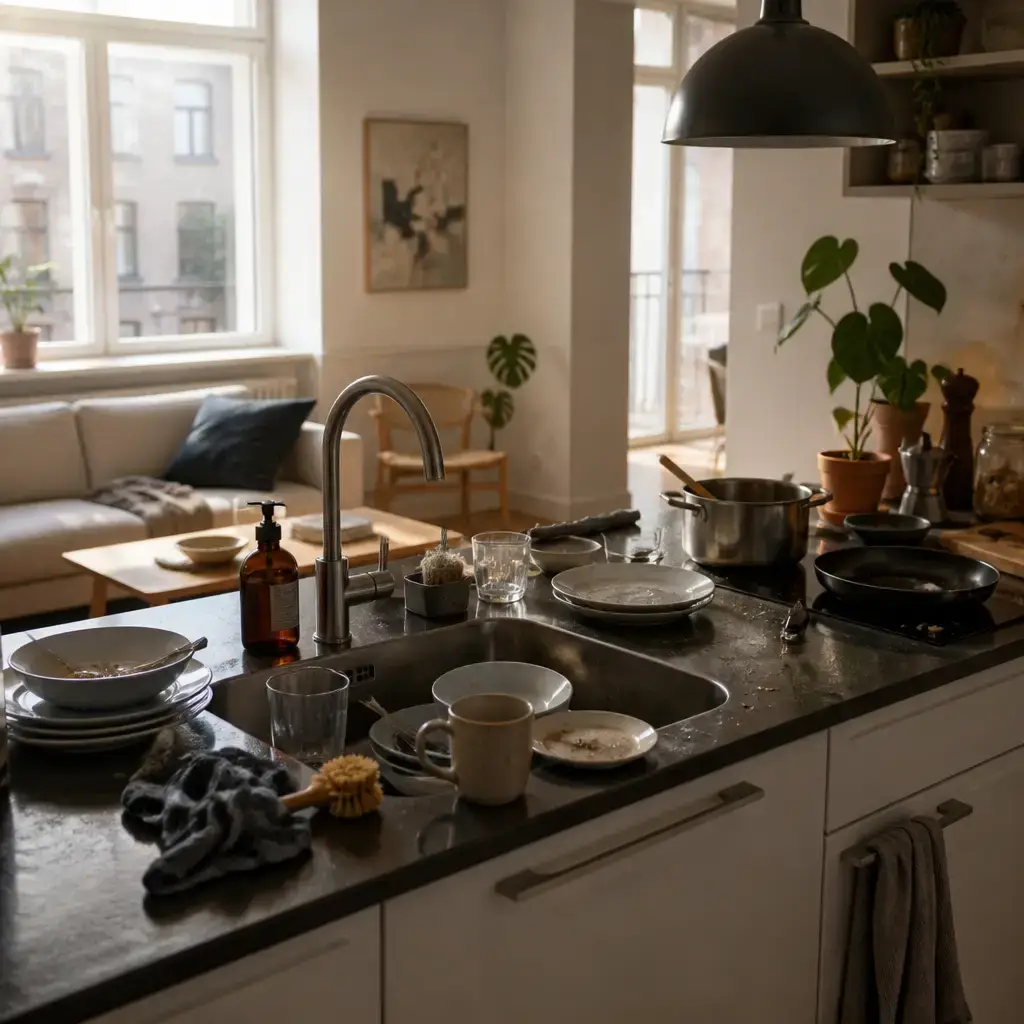
Unsere Putzroutine funktioniert nicht, und die Küche wird immer wieder unordentlich.
OON-zeh-reh POOTS-roo-TEE-neh foonk-tsee-oh-NEERT nikht, oont dee KUE-kheh veert IM-mer VEE-der oon-ORD-ent-likh. Our cleaning routine is not working, and the kitchen keeps getting messy.Ich glaube nicht, dass einer von uns das absichtlich macht.
ikh GLOW-beh nikht, dahs EYE-ner fon oons dahs AP-zikh-tlikh makht. I do not think either of us is doing it on purpose.Vielleicht brauchen wir klarere Regeln, besonders für das Geschirr und den Herd.
fee-LYKHT BROW-khen veer KLAH-reh-reh RAY-geln, beh-ZON-ders fyoor dahs geh-SHEER oont dehn HAYRT. Maybe we need a clearer standard, especially for dishes and the stove.Wir könnten die Aufgaben wöchentlich wechseln, damit nicht immer dieselbe Person wischt.
veer KURN-ten dee OWF-gah-ben VURH-ent-likh VEK-seln, dah-MIT nikht IM-mer DEEZ-el-beh per-ZOHN visht. We could rotate tasks weekly, so the same person does not always mop.Das klingt fair, obwohl ich lieber den Müll hinausbringe, als das Bad zu putzen.
dahs klinkt fair, ob-VOHL ikh LEE-ber dehn MYOOL hin-OWS-bring-eh, ahls dahs baht tsoo POOT-sen. That sounds fair, although I prefer taking out the trash to cleaning the bathroom.Vorlieben sind in Ordnung, aber die unangenehmen Aufgaben müssen trotzdem geteilt werden.
FOR-lee-ben zint in ORD-noong, AH-ber dee OON-ang-eh-NAY-men OWF-gah-ben MYOOS-en TROTS-daym geh-TYLT VAYR-den. Preferences are fine, but the unpleasant jobs still need to be shared.Wenn wir es aufschreiben, kann sich später kein Frust anstauen.
ven veer ess OWF-shry-ben, kan zikh SHPAY-ter kine FROOST an-SHTOW-en. If we write it down, we can keep resentment from building up later.Lass uns einen einfachen Plan machen und ihn überprüfen, nachdem wir ihn eine Weile ausprobiert haben.
lahs oons EYE-nen EYE-nfakh-en plahn MAKH-en oont een oo-ber-PRUE-fen, NAHKH-daym veer een EYE-neh VY-leh OWS-proh-beert HAH-ben. Let's make a simple chart and review it after we try it for a while.Wenn es sich zu streng anfühlt, können wir es anpassen, statt zu streiten.
ven ess zikh tsoo shtrehng an-FUEHLT, KURN-en veer ess AN-pahs-en, shtat tsoo SHTRY-ten. If it feels too strict, we can adjust it instead of arguing.Das Ziel ist ein saubereres Zuhause, kein perfektes System.
dahs tseel ist eye-n ZOW-ber-er-es tsoo-HOW-zeh, kine per-FEKT-es zys-TAYM. The goal is a cleaner home, not a perfect system.Sentence explanations
Unsere Putzroutine funktioniert nicht, und die Küche wird immer wieder unordentlich.
Our cleaning routine is not working, and the kitchen keeps getting messy.
- Unsere
- our
- Putzroutine
- cleaning routine
- funktioniert
- works; functions
- nicht
- not
- Küche
- kitchen
- wird
- gets; becomes
- immer wieder
- again and again; repeatedly
- unordentlich
- messy
More detail
Unsere means “our” here and modifies the feminine singular noun Putzroutine. It is a form of the possessive determiner unser: unser Plan (our plan), unsere Routine (our routine), unser Problem (our problem). The ending -e marks feminine singular nominative in this noun phrase; it is not the noun that carries this ending. Putzroutine is a feminine noun meaning “cleaning routine.” It is a compound containing Putz-, related to cleaning, and Routine (routine); German compounds are written as one capitalized noun. Example: Unsere Morgenroutine beginnt früh. — “Our morning routine starts early.” funktioniert is the third-person singular present form of funktionieren (to work, function). Its subject here is the singular noun Putzroutine, so the form is funktioniert; with a plural subject, use funktionieren: Die Pläne funktionieren. — “The plans work.” In this sentence, nicht makes the statement negative. nicht means “not.” Here it negates funktioniert, so the sentence says that the routine is not working rather than that it is working. German places nicht in relation to the part being negated; in this clause it follows the conjugated verb. Küche is the feminine noun for “kitchen”: die Küche. Its plural is die Küchen. Example: Die Küche ist sauber. — “The kitchen is clean.” The supplied translation supports the intended reading that the kitchen repeatedly becomes messy. wird is the third-person singular present form of werden (to become, get). In wird ... unordentlich, werden expresses a change of state: “gets/becomes messy.” This is not a passive construction; unordentlich is an adjective describing the resulting state. Compare Die Küche bleibt sauber. — “The kitchen stays clean.” immer wieder is a repeated-time expression meaning “again and again” or “repeatedly.” It presents the change as recurring, not as a single event. Example: Der Drucker fällt immer wieder aus. — “The printer keeps breaking down.” unordentlich is an adjective meaning “messy” or “untidy.” After wird, it appears in its plain form because it is a predicate adjective, not an adjective placed directly before a noun. Before a noun, it takes an ending: eine unordentliche Küche — “a messy kitchen.” The first clause combines Unsere Putzroutine funktioniert nicht: “Our cleaning routine is not working.” The conjunction und links it to the second clause, die Küche wird immer wieder unordentlich: “the kitchen keeps getting messy.” Together, the utterance means: “Our cleaning routine is not working, and the kitchen keeps getting messy.”
Ich glaube nicht, dass einer von uns das absichtlich macht.
I do not think either of us is doing it on purpose.
- glaube
- think; believe
- einer von uns
- one of us
- das
- it
- absichtlich
- deliberately; on purpose
- macht
- does; is doing
More detail
glaube is the first-person singular present form of glauben, “to think” or “to believe”: ich glaube = “I think.” The ending -e marks the ich form here. Example: Ich glaube dir. — “I believe you.” einer von uns means “one of us.” einer is a singular pronoun, so it selects a singular verb later: einer ... macht, not a plural form. von takes the dative here, and uns is the dative form of “we/us.” This expression identifies one member of the speaker’s group without specifying which member. das is the neuter accusative pronoun “it” in this sentence. It stands for the thing or situation being discussed, but the supplied texts do not identify that referent more specifically. German pronouns have grammatical forms such as das; the form itself does not identify the real-world object. absichtlich is the adverb “deliberately” or “on purpose.” It describes the manner or intention of the action. Its useful contrast is unabsichtlich, “unintentionally.” Example: Sie hat das nicht absichtlich gemacht. — “She did not do that on purpose.” macht is the third-person singular present form of machen, “to do” or “to make”: machen → er/sie/es macht. Here it is used with einer, so the singular form is required. Although the German present is used, the English translation can express the activity as ongoing: “is doing it.” Example: Er macht das jeden Tag. — “He does that every day.” The surrounding structure is Ich glaube nicht, dass ...: nicht negates the speaker’s belief, giving “I do not think that ...” In the dass-clause, the finite verb comes at the end: dass einer von uns das absichtlich macht. The clause means “that one of us is doing it on purpose.” Together, the utterance means: “I do not think either of us is doing it on purpose.”
Vielleicht brauchen wir klarere Regeln, besonders für das Geschirr und den Herd.
Maybe we need a clearer standard, especially for dishes and the stove.
- Vielleicht
- maybe
- brauchen
- need
- wir
- we
- klarere
- clearer
- Regeln
- rules
- besonders
- especially
- Geschirr
- dishes; tableware
- Herd
- stove
More detail
Vielleicht introduces uncertainty: “maybe” presents the statement as possible rather than certain. It is an adverb and does not change for person, number, or gender. brauchen means “need” here. The form is present-tense wir brauchen; for this verb, the first-person plural form is identical to the infinitive brauchen. It takes a direct object: Wir brauchen mehr Zeit. — “We need more time.” wir is the first-person plural pronoun “we.” It identifies the speaker together with at least one other participant, while the verb form brauchen agrees with it in the first-person plural. klarere is the comparative form of klar (“clear”): klar → klarer (“clearer”). Here the comparative is inflected as klarere because it modifies plural Regeln in the accusative noun phrase klarere Regeln. German can use a comparative without naming what it is clearer than; the sentence expresses a need for a higher degree of clarity. Regeln means “rules” here. Its singular form is Regel, and its plural is Regeln. Because brauchen has klarere Regeln as its direct object, this noun phrase is accusative; the plural noun itself has the same form in nominative and accusative. besonders means “especially.” It highlights one part of the statement: the need for rules is given particular emphasis in relation to the things named afterward. Geschirr means “dishes” or “tableware” here. It is a mass or collective noun and is grammatically neuter: das Geschirr. After für, the noun phrase is accusative, but neuter das remains das: für das Geschirr — “for the dishes/tableware.” Herd means “stove” or “cooker.” Its basic form is masculine der Herd. After the preposition für, it appears in the accusative as den Herd: für den Herd — “for the stove.” The change from der to den is carried by the article, not by the noun Herd. The structure is Vielleicht brauchen wir [comparative adjective + noun], besonders für [accusative object] und [accusative object]. Thus Vielleicht brauchen wir klarere Regeln means “Maybe we need clearer rules.” besonders für das Geschirr und den Herd specifies that these rules are especially needed for the dishes/tableware and the stove. As a whole, the utterance expresses a tentative need for clearer rules, with those two areas singled out.
Wir könnten die Aufgaben wöchentlich wechseln, damit nicht immer dieselbe Person wischt.
We could rotate tasks weekly, so the same person does not always mop.
- Wir könnten
- we could
- Aufgaben
- tasks
- wöchentlich
- weekly
- wechseln
- to rotate; to change
- damit
- so that
- nicht immer
- not always
- dieselbe
- the same
- Person
- person
- wischt
- mops
More detail
Wir könnten means “we could.” könnten is the Konjunktiv II form of können, used here for a possible or suggested action rather than a firm statement. Compare Wir können die Aufgaben wechseln — “We can rotate the tasks,” which presents ability or opportunity more directly. Aufgaben is the plural of Aufgabe (“task”). Here it is the object of wechseln: the tasks are what the speakers propose changing or rotating. wöchentlich means “weekly” and functions here as an adverb describing how often the rotation would happen. Example: Wir treffen uns wöchentlich. — “We meet weekly.” wechseln is the infinitive “to change” or, with tasks or duties, “to rotate.” It follows the modal verb könnten; the modal is conjugated while wechseln remains in the infinitive at the end of the main clause. Example: Wir wechseln die Plätze. — “We change seats.” damit introduces a purpose clause, meaning “so that.” In a German damit clause, the finite verb normally goes to the end. Here, damit ... wischt expresses the intended result of rotating the tasks. nicht immer means “not always.” Together, these words limit the frequency of the action: the same person does not mop on every occasion. The negation limits the following idea, not the proposal to rotate tasks. dieselbe means “the same” in the sense of the same individual or thing. Here it is the feminine singular nominative form agreeing with Person. Related forms include derselbe for masculine singular nominative, dasselbe for neuter singular nominative or accusative, and dieselben for plural nominative or accusative. dieselbe Person identifies one and the same person, whereas eine andere Person means “a different person.” Person means “person.” It is a feminine noun in German, and here it is the subject of wischt, so the agreeing phrase is dieselbe Person. wischt means “mops” here. It is the third-person singular present form of wischen (“to wipe; to mop”): ich wische, du wischst, sie/er wischt. The form is singular because dieselbe Person is the subject. Example: Die Person wischt den Boden. — “The person mops the floor.” The whole sentence combines the proposal Wir könnten die Aufgaben wöchentlich wechseln (“We could rotate the tasks weekly”) with the purpose clause damit nicht immer dieselbe Person wischt (“so that the same person does not always mop”). It proposes rotating responsibilities to prevent one person from mopping every time.
Das klingt fair, obwohl ich lieber den Müll hinausbringe, als das Bad zu putzen.
That sounds fair, although I prefer taking out the trash to cleaning the bathroom.
- klingt
- sounds
- fair
- fair
- obwohl
- although
- lieber … als
- prefer ... to ...
- Müll
- trash
- hinausbringe
- take out
- Bad
- bathroom
- putzen
- clean
More detail
klingt is the third-person singular present form of klingen, “to sound.” Its subject here is Das, referring to the proposed arrangement in the preceding context. The sentence uses Das klingt ... to give an assessment: the arrangement sounds fair. For example, Das klingt gut. means “That sounds good.” fair is an unchanged German adjective meaning “fair” or “reasonable” here. After klingt, it describes how the proposal seems, rather than modifying a noun directly. obwohl introduces a subordinate clause meaning “although.” In this clause, the finite verb comes at the end: obwohl ich ... hinausbringe. This word signals a contrast between the fair assessment and the speaker’s personal preference. lieber is the comparative form of gern in the sense of preference: gern = “gladly/preferably,” lieber = “rather,” and am liebsten = “most preferably.” Here lieber expresses the speaker’s preferred task. The pattern lieber X als Y means “prefer X to Y” or “would rather do X than Y.” als introduces the alternative being compared; it is not the word for “than” in every kind of comparison. Müll is a masculine noun meaning “trash” or “rubbish.” In den Müll, the article den marks the masculine accusative form, because the trash is the object of the action. The noun itself remains Müll. hinausbringe is the first-person singular present form of the separable verb hinausbringen, “to take out” or literally “to bring out.” The subject ich determines the -e ending, and because this is a subordinate clause, the finite verb appears at the end. In a main clause, the separable parts are normally distributed, as in Ich bringe den Müll hinaus. Bad is a neuter noun meaning “bathroom” here. In das Bad, the neuter article has the same form in the relevant nominative and accusative contexts; its object role is supplied by the verb phrase das Bad zu putzen. The phrase refers to cleaning the bathroom, not to the bathroom as an actor. putzen is the infinitive “to clean.” With zu, it forms zu putzen, “to clean,” as the second activity in the preference comparison. The first activity is expressed by the finite verb hinausbringe, while the second uses an infinitive because it is the alternative paired with lieber ... als. Together, obwohl introduces the contrasting personal preference: although the arrangement sounds fair, the speaker prefers taking out the trash to cleaning the bathroom. The two activities are compared with the reusable pattern lieber [activity A] als [activity B]; the surrounding context makes clear that these are household tasks being shared, without changing who performs the preference stated here.
Vorlieben sind in Ordnung, aber die unangenehmen Aufgaben müssen trotzdem geteilt werden.
Preferences are fine, but the unpleasant jobs still need to be shared.
- Vorlieben
- preferences
- sind in Ordnung
- are fine
- unangenehmen
- unpleasant
- Aufgaben
- tasks; jobs
- müssen
- must; have to
- trotzdem
- still; nevertheless
- geteilt werden
- be shared
More detail
Vorlieben is the plural of Vorliebe, meaning preferences or personal likes. The plural form fits the general statement about preferences. Example: Jeder hat andere Vorlieben. — “Everyone has different preferences.” sind in Ordnung uses sein plus the idiomatic expression in Ordnung. Here it says that the preferences are acceptable or fine, not that they are physically “in order.” The present-tense form sind agrees with the plural subject Vorlieben. unangenehmen comes from the adjective unangenehm, “unpleasant.” In die unangenehmen Aufgaben, the adjective describes Aufgaben; its -en ending is the weak plural ending after the definite article die. Example: Die unangenehmen Aufgaben beginnen früh. — “The unpleasant tasks start early.” Aufgaben is the plural of the feminine noun Aufgabe, “task” or “job.” Here it is the subject of the passive construction: the tasks are the things that must be shared. Example: Wir teilen die Aufgaben. — “We divide the tasks.” müssen is the present-tense plural form of the modal verb müssen, “must” or “have to.” With a plural subject such as die ... Aufgaben, it has this form. A modal verb places the other verb in the infinitive at the end: Wir müssen anfangen. — “We have to start.” trotzdem is an adverb meaning “nevertheless” or “still.” It marks a contrast with the preceding statement: even though preferences are acceptable, the unpleasant tasks still have to be shared. geteilt werden forms the passive infinitive of teilen, “to share” or “divide.” geteilt is the past participle, and werden is the infinitive used to form the passive. In the full clause, müssen causes this passive infinitive to appear at the end: Die Aufgaben müssen geteilt werden. — “The tasks have to be shared.” The tasks receive the action; the sentence does not specify who shares them. Together, Vorlieben sind in Ordnung means “Preferences are fine.” aber introduces the contrast, and die unangenehmen Aufgaben müssen trotzdem geteilt werden means “the unpleasant jobs still need to be shared.” The complete utterance is therefore: “Preferences are fine, but the unpleasant jobs still need to be shared.”
Wenn wir es aufschreiben, kann sich später kein Frust anstauen.
If we write it down, we can keep resentment from building up later.
- Wenn wir
- if we
- es
- it
- aufschreiben
- write down
- kann
- can
- später
- later
- kein
- no; not any
- Frust
- resentment
- sich … anstauen
- build up
More detail
Wenn wir introduces a condition: wenn means “if/when,” and wir is the first-person plural pronoun “we.” In this sentence, the intended reading is conditional: “if we …”. A clause beginning with wenn places its finite verb at the end, so the conjugated verb appears later in Wenn wir es aufschreiben. es is the pronoun “it.” Its grammatical form is neuter singular, but the supplied sentence does not identify a more specific referent. German pronouns must match the grammatical form of what they refer to, so es is not interchangeable with every other pronoun form. aufschreiben means “to write down.” Its base form is the separable verb aufschreiben; in a main clause, the prefix can separate, as in Wir schreiben es auf. In the wenn clause here, the infinitive remains together at the end: wenn wir es aufschreiben. kann is the third-person singular present form of können, “can” or “be able to.” Here it expresses possibility or ability: the buildup can be prevented. With a modal verb, the other verb normally appears as an infinitive at the end of the clause; here that infinitive is anstauen. später means “later,” referring to a later time than the writing-down action. It is an adverb, so it does not take noun-like case or gender endings. kein means “no” or “not any” before a noun. It negates the noun phrase kein Frust; it is not itself a numeric statement. Because Frust is masculine singular and is the nominative subject here, the form is kein. Compare kein Frust with keine Probleme, where the ending reflects the plural noun. Frust means “frustration” or “resentment” in this sentence. It is a masculine noun: der Frust. As the subject of kann sich … anstauen, it is in the nominative case. The fixed translation selects the sense “resentment” in this context. sich … anstauen is the reflexive construction “to build up” or “accumulate.” The verb is anstauen, and sich marks the reflexive form used when something builds up within itself or accumulates. In this sentence, Frust is what accumulates, not an agent deliberately accumulating something. The same verb can also be used transitively in another construction, for example: Der Damm staut das Wasser an. — “The dam holds back the water.” Together, Wenn wir es aufschreiben means “If we write it down.” The subordinate clause comes first, so the main clause begins with the finite verb: kann sich später kein Frust anstauen — “no resentment can build up later.” The complete utterance therefore means: “If we write it down, we can keep resentment from building up later.”
Lass uns einen einfachen Plan machen und ihn überprüfen, nachdem wir ihn eine Weile ausprobiert haben.
Let's make a simple chart and review it after we try it for a while.
- Lass uns
- let’s
- einfachen
- simple
- Plan
- plan
- machen
- make
- ihn
- it
- überprüfen
- check; review
- nachdem
- after
- Weile
- while; period
- ausprobiert
- tried; tested
- haben
- have
More detail
Lass uns is the reusable German way to suggest an action involving the speaker and the listener: “let’s …”. It uses the imperative form Lass of lassen with uns (“us”). Here it governs the two coordinated actions machen and überprüfen. einfachen means “simple” here. Its base form is einfach; the ending -en appears because the adjective describes the masculine accusative noun phrase einen einfachen Plan. The indefinite article einen marks this phrase as the object of machen; it does not by itself state a numerical count. Plan means “plan”. It is the masculine noun in einen einfachen Plan, and machen takes this phrase as its object. A useful pattern is einen Plan machen (“make a plan”). machen means “make” and is an infinitive here. In Lass uns ... machen, it names the suggested action rather than marking a separate tense. ihn means “it” in this sentence and refers back to the masculine noun Plan. German uses the masculine accusative pronoun ihn for that role. The same form can refer to another masculine singular referent in a different context, but the fixed sentence supports Plan here. überprüfen means “check” or “review”. It is the second infinitive coordinated with machen: Lass uns ... machen und ihn überprüfen means “Let’s make ... and review it.” The object ihn comes before this infinitive and identifies what is reviewed. nachdem introduces a time clause meaning “after”. It places the action in that clause before the action of the main clause: the trying happens first, and the checking happens afterward. In a nachdem clause, the finite verb normally appears at the end. Weile means a period or stretch of time. The expression eine Weile means “for a while”. Here eine is part of that time expression; the sentence does not need to assert a count of exactly one. ausprobiert is the past participle of ausprobieren, “to try out” or “test”. The prefix aus- stays attached in the participle: ausprobieren → ausprobiert. haben is the present-tense form of haben used with wir (“we”). Together, ausprobiert haben forms the perfect construction “have tried out”. Because it occurs in the subordinate clause introduced by nachdem, haben is placed at the end: nachdem wir ihn eine Weile ausprobiert haben. The whole structure is Lass uns [object] machen und [pronoun] überprüfen, nachdem [subject] [object] eine Weile ausprobiert haben: “Let’s make a simple plan and review it after we have tried it for a while.” The two occurrences of ihn refer to the same plan, while wir identifies the people who try it. The wording is a direct, collaborative suggestion.
Wenn es sich zu streng anfühlt, können wir es anpassen, statt zu streiten.
If it feels too strict, we can adjust it instead of arguing.
- Wenn
- if
- streng
- strict
- anfühlt
- feels
- können wir
- we can
- anpassen
- adjust
- statt
- instead of
- streiten
- arguing
More detail
Wenn introduces a condition: “if/when.” Here it starts the condition Wenn es sich zu streng anfühlt (“If it feels too strict”). A reusable pattern is Wenn ..., ... for “If ..., ...”. Example: Wenn es regnet, bleiben wir zu Hause. — “If it rains, we stay at home.” streng means “strict” here. With zu, zu streng means “too strict,” expressing an excessive degree. The adjective itself is not inflected in this phrase because it follows zu in this predicate expression. anfühlt is the finite form of the separable/reflexive verb sich anfühlen, “to feel.” In this subordinate clause, the parts appear together at the end: sich ... anfühlt. The es is the thing or situation that feels a certain way; the fixed translation supports the general reading “it feels.” Example: Der Stoff fühlt sich weich an. — “The fabric feels soft.” können wir means “we can.” können is the modal verb können, “can/be able to,” and wir is “we.” Because the sentence begins with a subordinate clause, the main clause places the finite verb before its subject: können wir .... The modal combines with an infinitive later in the clause: Wir können es ändern. — “We can change it.” anpassen means “adjust” or “adapt.” It is the infinitive of anpassen; with the object es, es anpassen means “adjust it.” After the modal können, the infinitive remains at the end of the main clause. Example: Wir können den Plan anpassen. — “We can adjust the plan.” statt introduces an alternative and means “instead of” here. The construction statt zu + infinitive means “instead of doing something.” streiten is the infinitive “argue” or “quarrel.” In statt zu streiten, it forms the alternative “instead of arguing.” The zu-infinitive construction presents the action as the alternative to the adjustment; it does not make streiten a finite verb. Example: Sie lesen, statt zu streiten. — “They read instead of arguing.” Together, the condition is Wenn es sich zu streng anfühlt (“If it feels too strict”). The main proposal is können wir es anpassen (“we can adjust it”), and statt zu streiten specifies the alternative being avoided: “instead of arguing.” The complete meaning is: “If it feels too strict, we can adjust it instead of arguing.”
Das Ziel ist ein saubereres Zuhause, kein perfektes System.
The goal is a cleaner home, not a perfect system.
- Ziel
- goal
- ist
- is
- ein
- a/an
- saubereres
- cleaner
- Zuhause
- home
- kein
- not a
- perfektes
- perfect
- System
- system
More detail
Ziel means “goal” here. It is a neuter noun: das Ziel, plural die Ziele. The phrase Das Ziel is the subject, “the goal”; Das is the definite article for this noun in the nominative case. ist is the present-tense form of sein (“to be”) for er, sie, and es, and it also occurs with a singular noun such as das Ziel. The pattern X ist Y links X with a description or identification: Das Problem ist klein. — “The problem is small.” ein is the indefinite article here. With the neuter singular nominative noun Zuhause, it has the form ein; it does not by itself assert a numeric count. saubereres means “cleaner.” Its base adjective is sauber (“clean”); the comparative is sauberer (“cleaner”), and the superlative is commonly am saubersten (“cleanest”). In saubereres Zuhause, the adjective has the comparative meaning and the ending -es because it modifies the neuter singular nominative phrase ein ... Zuhause. Zuhause means “home” in the sense of the place where someone lives. It is a neuter noun: das Zuhause; the capital letter marks it as a noun. The phrase ein saubereres Zuhause therefore means “a cleaner home.” kein negates an indefinite noun phrase. Here it is the neuter singular nominative form corresponding to ein: kein perfektes System means “not a perfect system.” It is not an additional article meaning “not a” in every context; its form changes with the noun phrase’s grammatical conditions, for example keine with a feminine noun or a plural noun in the nominative. perfektes means “perfect” here. The base adjective is perfekt; with the neuter singular nominative noun System after kein, it takes the ending -es. This adjective describes the system rather than the home. System means “system.” It is a neuter noun: das System, plural die Systeme. In kein perfektes System, it is the noun being negated. Together, Das Ziel ist ein saubereres Zuhause says “The goal is a cleaner home.” The second noun phrase, kein perfektes System, contrasts with the first after the comma: the goal is characterized as a cleaner home, rather than as a perfect system. The complete utterance is therefore: “The goal is a cleaner home, not a perfect system.”
Grammar Points
Trennbare Verben: hinausbringen → Ich bringe den Müll hinaus.
Ich bringe den Müll hinaus.
ikh BRING-eh dehn MYOOL HIN-ows.I take out the trash.
Bei trennbaren Verben steht der Präfix im Hauptsatz am Satzende: bringe … hinaus.
Komparativ mit Adjektivendung: klarer → klarere Regeln
Wir brauchen klarere Regeln.
veer BROW-khen KLAH-reh-reh RAY-geln.We need clearer rules.
Im Komparativ erhält das Adjektiv vor einem Nomen zusätzlich die passende Endung, hier -e.
German Vocabulary
Einer von uns macht das nicht absichtlich.
Einer von uns macht das nicht absichtlich.
Unsere Putzroutine funktioniert nicht.
Besonders für das Geschirr und den Herd.
Ich glaube nicht, dass einer von uns das absichtlich macht.
Besonders für das Geschirr und den Herd.
Vielleicht brauchen wir klarere Regeln.
Die Küche wird immer wieder unordentlich.
Unsere Putzroutine funktioniert nicht.
Vielleicht brauchen wir klarere Regeln.
Die Küche wird immer wieder unordentlich.
Wir könnten die Aufgaben wöchentlich wechseln.
Quiz
Spelling
Tap the letters to spell the word.
cleaning routine
Show Answer
Putzroutineto work; to function
Show Answer
funktioniertmessy; untidy
Show Answer
unordentlichkitchen