10 minutes free every day
Continue audio lessons in the app
Word explanations appear automatically in sync with the audio.
No login required · synced translations · playback with the screen locked
Choose your learning language and open this lesson in the app.

About This Lesson
Use Planning balanced meals for a busy week to practice German conversation, pronunciation, vocabulary, grammar, and quizzes.
Dialogue
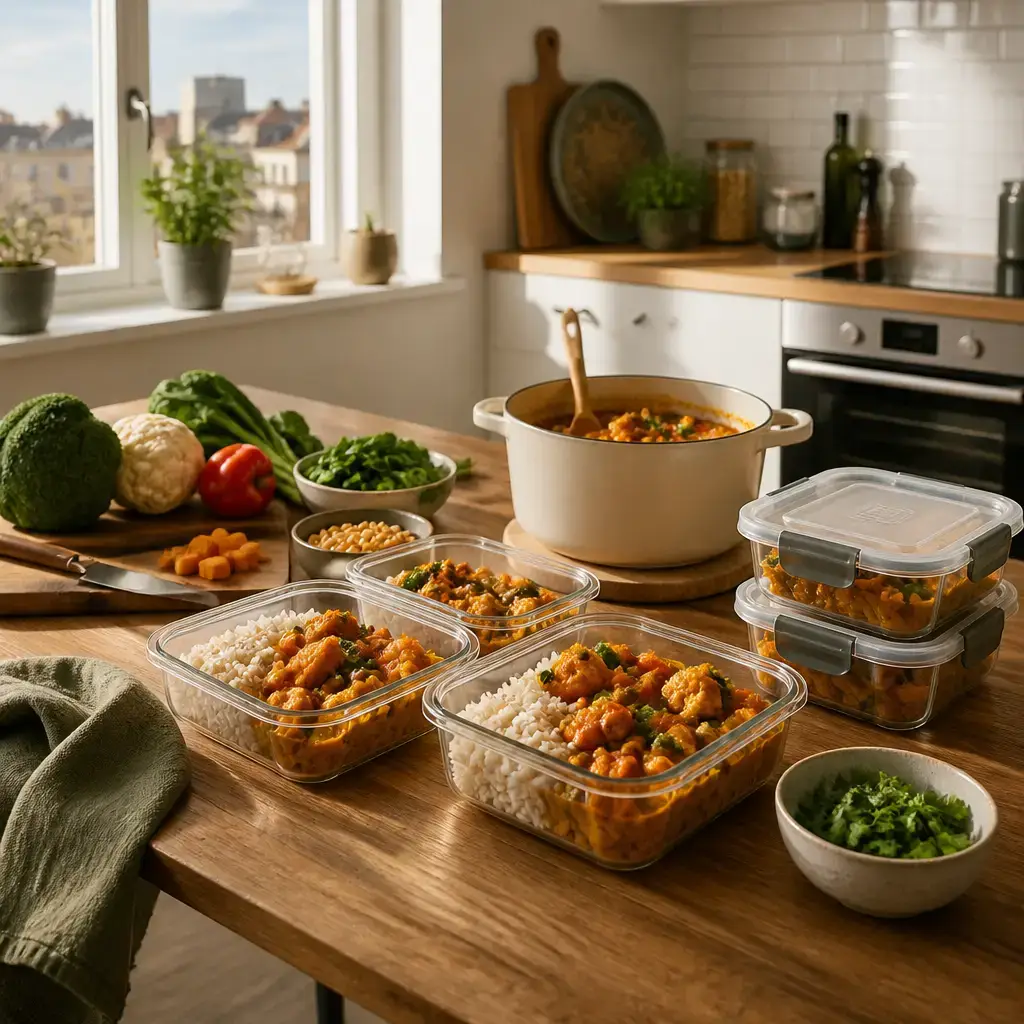
Nächste Woche sieht voll aus, deshalb wäre es hilfreich, einige Mahlzeiten im Voraus zuzubereiten.
NEKH-stuh VOH-khuh zeet FOHL ows, dehs-HAHLP VAIR-uh ess HILF-rikh, EYE-ni-guh MAHL-tsyte-un im foh-ROWS tsoo-tsoo-buh-RYE-tun. Next week looks busy, so preparing some meals in advance would help.Mahlzeiten vorzubereiten wird helfen, aber vermeide es, jeden Tag dasselbe zu essen.
MAHL-tsyte-un for-tsoo-buh-RYE-tun veert HEL-fun, AH-ber fer-MY-duh ess, YAY-den tahk DAH-sel-buh tsoo ESS-un. Meal prep will help, but avoid eating the same thing every day.Ich hatte daran gedacht, eine große Menge Gemüsecurry zu machen.
ikh HAH-tuh dah-RAHN geh-DAKHt, EYE-nuh GROH-suh MEN-guh geh-MYOO-zuh-KUR-ree tsoo MAKH-un. I was thinking of making a big batch of vegetable curry.Das klappt, wenn du es richtig portionierst und sicher aufbewahrst.
dahs klahpt, venn doo ess RIKH-tikh por-tsyo-NEERST oont ZIKH-er owf-buh-VAHRST. That works if you portion it properly and store it safely.Soll ich einen Teil einfrieren und den Rest im Kühlschrank aufbewahren?
zohl ikh EYE-nen tyle EYN-free-run oont dayn REST im KYOOL-shrahngk owf-buh-VAHR-un? Should I freeze some and keep the rest in the fridge?Friere ein paar Portionen ein.
FREE-ruh eyn pahr por-TSYOH-nun eyn. Freeze a few portions.Beschrifte jeden Behälter, damit die Auswahl leichter fällt.
buh-SHRIF-tuh YAY-den beh-HEL-ter, dah-MIT dee OWS-vahl LYEKH-ter felt. Label each container so it is easy to choose.Ich brauche zum Mittagessen auch etwas Ausgewogenes, nicht nur Reis.
ikh BROW-khuh tsoom MIT-tahk-ESS-un owkh ET-vahs OWS-guh-VOH-guh-nuhs, nikht noor RYSE. I also need something balanced for lunch, not just rice.Füge Eier, Bohnen oder Hähnchen hinzu, je nachdem, worauf du Lust hast.
FYOO-guh EYE-er, BOH-nen OH-der HAIN-khen hin-TSOO, yay nahkh-DAYM, voh-ROWF doo LOOST hahst. Add eggs, beans, or chicken, depending on what you feel like eating.Wenn die Reste langweilig wirken, kann ich die Beilage ändern.
ven dee RES-tuh LANG-vy-likh VEER-kun, kahn ikh dee BYE-lah-guh AIRN-durn. If the leftovers feel boring, I can change the side dish.Kleine Änderungen machen vorbereitete Mahlzeiten angenehmer.
KLY-nuh AIRN-duh-roong-un MAKH-un for-buh-RYE-tuh-tuh MAHL-tsyte-un AHN-guh-NAY-mer. Small changes make prepared meals more enjoyable.Sentence explanations
Nächste Woche sieht voll aus, deshalb wäre es hilfreich, einige Mahlzeiten im Voraus zuzubereiten.
Next week looks busy, so preparing some meals in advance would help.
- Nächste
- next
- Woche
- week
- sieht … aus
- looks
- voll
- busy; full
- deshalb
- therefore; so
- wäre
- would be
- hilfreich
- helpful
- einige
- some
- Mahlzeiten
- meals
- im Voraus
- in advance
- zuzubereiten
- to prepare
More detail
Nächste modifies Woche. Its form is feminine singular here because Woche is feminine and the phrase means “next week.” The base form is nächst-; compare nächste Woche with nächsten Monat (“next month”), where the ending reflects the different noun phrase. Example: Nächsten Dienstag arbeite ich. — “Next Tuesday I work.” Woche means “week.” Its plural is Wochen: zwei Wochen — “two weeks.” sieht ... aus is the separable verb aussehen, “to look” or “to appear.” In the finite present form, sieht is the third-person singular form of sehen, while the prefix aus appears at the end: Die Woche sieht ... aus. In an infinitive, the parts stay together: Die Woche scheint voll auszusehen. — “The week seems to look busy.” Here, the construction describes how the week appears, not an action of visually inspecting it. voll literally means “full.” With a schedule such as a week, it can mean “busy” or “packed,” which is the intended sense here. It is an adjective and does not take an ending in this position after sieht ... aus: Der Tag sieht voll aus. — “The day looks busy.” deshalb means “therefore” or “so” and links a reason to a consequence. It can also stand first in a clause and then causes the finite verb to come immediately after it: Deshalb bleibe ich zu Hause. — “So I am staying at home.” wäre is the third-person singular subjunctive II form of sein, “to be.” It contributes the tentative or conditional meaning “would be,” rather than stating simply that something is helpful. The useful contrast is ist (“is”) versus wäre (“would be”): Das wäre hilfreich. — “That would be helpful.” hilfreich means “helpful” or “useful.” In wäre es hilfreich, es is a grammatical placeholder, while the following infinitive phrase identifies what would be helpful. The adjective itself does not carry the conditional meaning; wäre does. einige means “some” or “several.” It indicates an unspecified part of a larger set, not an exact number. It accompanies the plural noun Mahlzeiten here: einige Aufgaben — “some tasks.” Mahlzeiten is the plural of Mahlzeit, “meal.” The singular is eine Mahlzeit; the plural is Mahlzeiten. Example: Wir planen drei Mahlzeiten. — “We are planning three meals.” im Voraus is a fixed expression meaning “in advance” or “ahead of time.” It describes doing something before the relevant time: Bitte bezahle im Voraus. — “Please pay in advance.” zuzubereiten is the infinitive with zu of the separable verb zubereiten, “to prepare,” especially food. In the sentence, it is the action being evaluated as helpful. The infinitive construction Mahlzeiten zuzubereiten means “to prepare meals.” Example: Es ist einfach, Gemüse zuzubereiten. — “It is easy to prepare vegetables.” Together, Nächste Woche sieht voll aus says that next week appears busy. deshalb connects that situation to the recommendation or assessment that follows. wäre es hilfreich presents the idea tentatively as something that would help, and einige Mahlzeiten im Voraus zuzubereiten specifies the useful action: preparing some meals ahead of time. The whole utterance therefore means that, because next week looks busy, preparing some meals in advance would be helpful.
Mahlzeiten vorzubereiten wird helfen, aber vermeide es, jeden Tag dasselbe zu essen.
Meal prep will help, but avoid eating the same thing every day.
- Mahlzeiten
- meals
- vorzubereiten
- to prepare
- helfen
- help
- vermeide es
- avoid it
- jeden Tag
- every day
- dasselbe
- the same thing
- zu essen
- to eat
More detail
Mahlzeiten means “meals” here. It is the plural of die Mahlzeit and is the accusative object of vorzubereiten, even though the whole infinitive clause Mahlzeiten vorzubereiten functions as the subject of the sentence. German uses the same form for nominative and accusative plural here. Example: Ich plane die Mahlzeiten. — “I plan the meals.” vorzubereiten means “to prepare” in the infinitive construction Mahlzeiten vorzubereiten. Its base verb is vorbereiten (“to prepare”), a separable verb. With zu, the particle and infinitive marker surround the verb stem: vorzubereiten. Example: Es ist gut, das Essen vorzubereiten. — “It is good to prepare the food.” helfen is the infinitive “to help.” In this sentence, the whole infinitive group Mahlzeiten vorzubereiten acts as the subject of wird helfen. The verb’s present-tense forms include ich helfe, du hilfst, and er/sie hilft; after wird, the infinitive helfen stays at the end. Example: Das wird helfen. — “That will help.” vermeide es means “avoid it” here. vermeide is the informal singular imperative of vermeiden (“to avoid”), and es is used in the construction es vermeiden, etwas zu tun. The following infinitive group specifies what is to be avoided. Example: Vermeide es, zu spät zu kommen. — “Avoid arriving too late.” jeden Tag means “every day.” jeden is the masculine accusative form of the determiner jeder because Tag is masculine and this time expression uses the accusative form. Tag means “day”; its plural is Tage. Example: Ich lerne jeden Tag. — “I study every day.” dasselbe means “the same thing” in this sentence. It is the neuter form of derselbe/dieselbe/dasselbe, used here substantively rather than directly before a noun. The neuter form is grammatical information, but it does not by itself identify exactly what the referent is; the fixed translation supports “the same thing” being eaten. It does not mean merely “similar.” Example: Sie trägt dasselbe. — “She is wearing the same thing.” zu essen means “to eat.” Its base verb is essen; useful forms include ich esse, du isst, and the past participle gegessen. In es vermeiden, ... zu essen, zu introduces an infinitive clause. Example: Ich versuche, mehr Gemüse zu essen. — “I am trying to eat more vegetables.” Together, Mahlzeiten vorzubereiten is the subject: “preparing meals.” Within that clause, Mahlzeiten is what is prepared. wird helfen says that this will help. The first clause therefore means “Preparing meals will help.” After aber (“but”), vermeide es gives the informal singular instruction “avoid it,” and jeden Tag dasselbe zu essen identifies the action to avoid: eating the same thing every day. The complete utterance means: “Meal prep will help, but avoid eating the same thing every day.”
Ich hatte daran gedacht, eine große Menge Gemüsecurry zu machen.
I was thinking of making a big batch of vegetable curry.
- Ich hatte
- I had
- daran gedacht
- thought of it
- eine
- a
- große
- big
- Menge
- batch; amount
- Gemüsecurry
- vegetable curry
- zu machen
- to make
More detail
Ich hatte: Ich is the first-person singular pronoun, “I.” hatte is the first-person singular preterite of haben. Together with gedacht, it forms the pluperfect of denken: ich hatte gedacht literally presents the thinking as completed before a past reference point. The sentence itself does not state that reference point, and the fixed translation renders the intended meaning as “I was thinking.” This German form should not be treated as a general progressive marker. Compare ich habe gedacht (“I have thought”) with ich hatte gedacht (“I had thought”). daran gedacht: gedacht is the past participle of denken (“to think”), with the irregular chain denken – dachte – gedacht. daran denken is a reusable pattern meaning “to think about it” or “to consider it.” Here daran points forward to the following action, so daran gedacht, ... zu machen conveys “thought of making ...”; it does not refer to a separately identified object called “it.” Example: Ich denke daran, morgen zu kochen. — “I’m thinking of cooking tomorrow.” eine: This is the indefinite article accompanying singular feminine Menge in the accusative noun phrase. It marks the noun phrase as indefinite; by itself it does not assert a numerical count. Its form changes with case and gender, for example eine Menge here but mit einer Menge (“with an amount/batch”). große: This is the inflected form of the adjective groß (“large, big”). With singular feminine Menge after eine, it appears as große: eine große Menge. The useful comparison chain is groß – größer – am größten (“big – bigger – biggest”). Example: Wir brauchen eine große Schüssel. — “We need a large bowl.” Menge: Menge is a feminine noun meaning “amount,” “quantity,” or, for prepared food, “batch.” Here it refers to a large quantity of the curry, matching the fixed translation “a big batch.” Eine Menge + noun can also mean “a lot of + noun”; the precise sense depends on context. Gemüsecurry: This compound noun combines Gemüse (“vegetables”) and Curry (“curry”), giving “vegetable curry.” German compounds are written as one word, and the final component generally determines the compound’s grammatical gender; Gemüsecurry is neuter in standard usage (das Gemüsecurry). Here it is the food being made and belongs to the accusative object of machen. zu machen: machen means “to make” or “to do.” With zu, this infinitive names the dependent action after daran denken: daran denken, etwas zu machen means “to think of making something.” The infinitive is machen, with zu directly before it here. Example: Sie denkt daran, eine Suppe zu machen. — “She is thinking of making a soup.” Together, Ich hatte daran gedacht presents the speaker’s thought, and eine große Menge Gemüsecurry zu machen identifies the action considered: making a large batch of vegetable curry. The complete intended meaning is: “I was thinking of making a big batch of vegetable curry.”
Das klappt, wenn du es richtig portionierst und sicher aufbewahrst.
That works if you portion it properly and store it safely.
- Das klappt
- That works
- wenn
- if
- richtig
- properly
- portionierst
- portion
- sicher
- safely
- aufbewahrst
- store
More detail
Das klappt means “That works” here: klappt is the third-person singular present form of klappen, used for something being feasible or turning out successfully. The subject Das points to the plan under discussion; it is not the German word for a person. Example: Das klappt morgen. — “That works tomorrow.” wenn introduces a condition: “if/when.” In this sentence it starts a subordinate clause, so the finite verbs appear at the end of that clause. A reusable pattern is Das klappt, wenn ... — “That works if ...” richtig is an adverb meaning “properly” here. It modifies the way the portioning is done. The related adjective is richtig as well; German uses the same form here because this word is functioning adverbially. Example: Mach es richtig. — “Do it properly.” portionierst is the second-person singular present form of portionieren, “to portion.” The ending -st marks du: du portionierst — “you portion.” Example: Du portionierst die Suppe. — “You portion the soup.” sicher is an adverb meaning “safely” here. It describes the manner of storing, not the amount or size of the food. The same form can also be an adjective meaning “safe” when it describes a noun, but its role in this sentence is adverbial. Example: Bewahre es sicher auf. — “Store it safely.” aufbewahrst is the second-person singular present form of the separable verb aufbewahren, “to store” or “to keep.” In a subordinate clause, the conjugated verb remains at the end as one visible form: du ... aufbewahrst. In a main clause, the prefix normally separates: Du bewahrst es auf. — “You store it.” The ending -st again agrees with du. The remaining small words connect these pieces. du is “you,” and es is the object “it,” matching the fixed translation’s item being portioned and stored. The condition is therefore wenn du es richtig portionierst und sicher aufbewahrst: “if you portion it properly and store it safely.” und joins the two coordinated actions; the shared subject du does both. Altogether, the utterance means: “That works if you portion it properly and store it safely.”
Soll ich einen Teil einfrieren und den Rest im Kühlschrank aufbewahren?
Should I freeze some and keep the rest in the fridge?
- Soll ich
- should I …?
- Teil
- part
- einfrieren
- freeze
- Rest
- rest
- Kühlschrank
- fridge
- aufbewahren
- store; keep
More detail
Soll ich is a reusable way to ask whether the speaker ought to do something or whether the speaker should do it. sollen is the base form; soll is its present-tense form for ich (and also for er/sie/es), so the subject still has to be read from the sentence. In a yes/no question, the conjugated modal comes first: Soll ich warten? = “Should I wait?” The other verb remains an infinitive later in the clause. einen Teil means “a part” or, in this context, “some.” Teil is a masculine noun, so the indefinite article has the accusative form einen here because it is the object of einfrieren. The article does not by itself state a numerical amount. Example: Ich nehme einen Teil. = “I’ll take part of it.” einfrieren means “to freeze.” It is a separable verb: in a finite main-clause form, the prefix can separate, as in Ich friere es ein. = “I freeze it.” After the modal soll, however, the complete infinitive stays together at the end of its verb phrase: Soll ich es einfrieren? = “Should I freeze it?” den Rest means “the remainder” or “the rest.” Rest is masculine, and den marks the accusative object of aufbewahren. The phrase refers to what remains after the part under discussion, without specifying its exact amount. Example: Den Rest esse ich morgen. = “I’ll eat the rest tomorrow.” im Kühlschrank means “in the refrigerator” or “in the fridge.” im is the contraction of in dem; here in describes a fixed location, so the phrase uses the dative form dem. Kühlschrank is a masculine noun. Compare the movement meaning in den Kühlschrank = “into the fridge” with the location meaning im Kühlschrank = “in the fridge.” aufbewahren means “to store” or “to keep.” It is also separable: a finite example is Ich bewahre es auf. = “I keep it.” With the modal, the infinitive remains whole: Soll ich den Rest aufbewahren? = “Should I keep the rest?” The two infinitives are coordinated after the single modal: Soll ich [einen Teil einfrieren] und [den Rest im Kühlschrank aufbewahren]? The speaker asks whether they should freeze some of the item and store the remainder in the refrigerator. The context supports the general storage-and-portioning meaning, while this sentence itself leaves the exact quantity of the part unspecified.
Friere ein paar Portionen ein.
Freeze a few portions.
- Friere … ein
- freeze (something)
- paar
- a few
- Portionen
- portions
More detail
Friere and ein belong together as the separable verb einfrieren (“to freeze”). Here they form the informal singular imperative: the implied subject is du, so this is an instruction to one person. In a main-clause imperative, the prefix ein appears at the end: Friere ... ein. The verb is not the same as simply using the standalone word frieren, which means “to be cold” or “to freeze” in a different sense. Example: Friere die Suppe ein. — “Freeze the soup.” paar appears in the quantity expression ein paar, meaning “a few” or “several,” without specifying an exact number. The following noun is plural. This expression is distinct from ein Paar, with a capital P, which means “a pair” of matching or connected things. Example: Ich nehme ein paar Äpfel. — “I’ll take a few apples.” Portionen is the plural of the feminine noun die Portion, “portion” or “serving.” The plural ending here is -en: eine Portion → mehrere Portionen. In this utterance, it is the object being frozen. Together, Friere ... ein gives the instruction “freeze ...,” ein paar limits the quantity to a few, and Portionen names what should be frozen. The complete meaning is: “Freeze a few portions.”
Beschrifte jeden Behälter, damit die Auswahl leichter fällt.
Label each container so it is easy to choose.
- Beschrifte
- label
- jeden
- each
- Behälter
- container
- damit
- so that
- die Auswahl
- the choice
- leichter
- easier
- fällt
- falls
More detail
Beschrifte is the informal singular imperative of beschriften (“to label”): du beschriftest in the present tense, but the command uses the shorter imperative form. Example: Beschrifte die Gläser. — “Label the jars.” jeden means “each” here and is the masculine singular accusative form of jeder. It agrees with the masculine noun Behälter, which is the object being labeled. The form changes with case and gender: for example, jede Flasche is feminine singular, while jedes Glas is neuter singular. Jeden does not by itself assert a particular numerical count; it presents the containers individually as members of the relevant set. Behälter means “container.” The singular and plural forms are identical: der Behälter — “the container”; die Behälter — “the containers.” In this sentence, Behälter is singular because jeden is masculine singular accusative. damit introduces a purpose clause, meaning “so that.” In a clause introduced by damit, the finite verb normally goes to the end. Pattern: ..., damit ... [verb]. Example: Schreib es auf, damit du es nicht vergisst. — “Write it down so that you do not forget it.” die Auswahl means “the choice” or “the selection.” Auswahl is a feminine noun, so its definite article is die here. In this clause, die Auswahl is the subject of the expression involving fällt. leichter is the comparative form of leicht, “easy” or “light” depending on context. Here it means “easier”: leicht → leichter → am leichtesten (“easy” → “easier” → “easiest”). The comparative presents the choice as easier than a relevant alternative; here the labeling is intended to make the choice easier. It does not say that the choice is physically lighter. fällt is the third-person singular present form of fallen, “to fall”: er/sie/es fällt. In die Auswahl fällt leichter, German uses fallen in the expression etwas fällt leicht/leichter/schwer, literally “something falls easily/more easily/with difficulty,” to express how easy or difficult something is. The form fällt is not an inflection of Auswahl; it is the verb, and Auswahl is its subject. The main clause is the command Beschrifte jeden Behälter (“Label each container”). The purpose clause damit die Auswahl leichter fällt explains the intended result: labeling the containers will make choosing easier. Together, the utterance means: “Label each container so it is easy to choose.”
Ich brauche zum Mittagessen auch etwas Ausgewogenes, nicht nur Reis.
I also need something balanced for lunch, not just rice.
- brauche
- need
- zum Mittagessen
- for lunch
- etwas Ausgewogenes
- something balanced
- nicht nur
- not just
- Reis
- rice
More detail
brauche is the first-person singular present form of brauchen (“to need”): ich brauche. The same verb can be reused with a noun or an infinitive phrase. Example: Ich brauche Wasser. — “I need water.” zum Mittagessen means “for lunch.” zum is the contraction of zu dem; here Mittagessen is a neuter noun, das Mittagessen, so zu dem Mittagessen becomes zum Mittagessen. Mittagessen can also mean the lunch meal itself. etwas Ausgewogenes means “something balanced.” etwas introduces an unspecified thing, while Ausgewogenes is the nominalized adjective ausgewogen (“balanced”). Because the adjective is used as a neuter noun after etwas, it is capitalized and has the ending -es. Example: Wir suchen etwas Einfaches. — “We are looking for something simple.” nicht nur means “not just” or “not only.” It commonly sets up a contrast with auch (“also”), as in this sentence: the speaker needs a balanced item in addition to rice, rather than rice being the only item. Example: Ich trinke nicht nur Wasser. — “I drink not only water.” Reis means “rice.” It is normally used as a mass noun: der Reis. Example: Der Reis ist fertig. — “The rice is ready.” Together, Ich brauche gives “I need,” zum Mittagessen specifies that this need is for lunch, and etwas Ausgewogenes identifies the needed item only generally as something balanced. auch ... nicht nur Reis adds that rice is not the sole item being considered. The complete meaning is: “I also need something balanced for lunch, not just rice.”
Füge Eier, Bohnen oder Hähnchen hinzu, je nachdem, worauf du Lust hast.
Add eggs, beans, or chicken, depending on what you feel like eating.
- Füge … hinzu
- add
- Eier
- eggs
- Bohnen
- beans
- Hähnchen
- chicken
- je nachdem
- depending on
- worauf du Lust hast
- what you feel like
More detail
Füge ... hinzu is the informal singular imperative of the separable verb hinzufügen (“to add”). The verb stem appears as füge at the beginning, while the prefix hinzu moves to the end in this command. The subject is understood as du, so this form addresses one person informally. Example: Füge etwas Salz hinzu. — “Add some salt.” Eier is the plural of Ei (“egg”). The plural form is useful when referring to eggs generally or to more than one egg. Example: Ich kaufe Eier. — “I’m buying eggs.” Bohnen is the plural of Bohne (“bean”). Example: Bohnen passen gut dazu. — “Beans go well with that.” Hähnchen means “chicken” here as food. The form can refer to a chicken portion or to chicken meat, depending on context; in this sentence it is one of the possible ingredients. Hähnchen has the same written form in the singular and plural. Example: Wir essen heute Hähnchen. — “We’re eating chicken today.” je nachdem introduces a condition or choice that determines what happens: “depending on”. It commonly connects to a following clause or phrase explaining the relevant condition. Here, it introduces the person’s preference. worauf du Lust hast literally uses worauf (“what ... on/about”) with the expression Lust auf etwas haben, “to feel like having something”. worauf asks about the thing associated with auf; in this sentence, the fixed translation identifies that thing as what the person feels like eating. Because this is an embedded clause, hast comes at the end: worauf du Lust hast. Compare the direct question Worauf hast du Lust? — “What do you feel like?” Together, Füge ... hinzu gives the instruction “add ...”, Eier, Bohnen oder Hähnchen lists the alternatives, and je nachdem, worauf du Lust hast makes the choice depend on what you feel like eating. The complete meaning is: “Add eggs, beans, or chicken, depending on what you feel like eating.”
Wenn die Reste langweilig wirken, kann ich die Beilage ändern.
If the leftovers feel boring, I can change the side dish.
- Wenn
- if
- Reste
- leftovers
- langweilig
- boring
- wirken
- seem; feel
- kann ich
- I can
- Beilage
- side dish
- ändern
- change
More detail
Wenn introduces a condition: “if/when.” In this sentence it begins the subordinate clause, and the conjugated verb comes at the end of that clause. A reusable pattern is Wenn ..., ... = “If ..., ...”. Reste means “leftovers” here. Its base form is der Rest (“the remainder”); Reste is the plural form. The plural subject controls the plural verb form wirken later in the clause. langweilig means “boring.” Here it is a predicate adjective after wirken, so it has no adjective ending: Die Reste wirken langweilig = “The leftovers seem boring.” Compare the attributive form langweilige Reste, where the adjective is placed directly before the noun. wirken means “seem” or “come across as” here. It links the subject with an impression or apparent quality; it does not mean that the leftovers literally perform an action. For example, Der Plan wirkt einfach. means “The plan seems simple.” kann ich combines kann, the first-person singular present form of können, with the subject ich (“I”). Können expresses ability or possibility; with another verb, that verb stays in the infinitive. In a simple main clause, the finite verb is in second position: Ich kann helfen. = “I can help.” Beilage means “side dish.” The noun is feminine: die Beilage; its plural is die Beilagen. The article is not included in the selected quote, but in the sentence die Beilage is the definite object of ändern. ändern means “change” or “alter.” It is the infinitive required after the modal verb kann; the modal carries the tense and person marking, while ändern remains in the infinitive. For example, Ich kann den Plan ändern. means “I can change the plan.” Together, Wenn die Reste langweilig wirken gives the condition “If the leftovers seem boring.” Because this is a subordinate clause, wirken stands at its end. kann ich die Beilage ändern gives the result or available action “I can change the side dish.” Here the entire subordinate clause occupies the first position of the sentence, so kann comes immediately after the comma; ändern remains at the end as the infinitive. The whole utterance therefore means: “If the leftovers feel boring, I can change the side dish.”
Kleine Änderungen machen vorbereitete Mahlzeiten angenehmer.
Small changes make prepared meals more enjoyable.
- Kleine
- small
- Änderungen
- changes
- machen
- make
- vorbereitete
- prepared
- Mahlzeiten
- meals
- angenehmer
- more enjoyable
More detail
Kleine describes Änderungen and means “small” here. Its base form is klein; the ending -e marks the adjective form used with this plural subject when no article is present. Compare kleine Änderungen (“small changes”) with singular eine kleine Änderung (“a small change”). Änderungen is the plural of Änderung (“change”). The umlaut and ending change the singular form Änderung to the plural Änderungen; here it is the subject of the sentence. A useful related verb is ändern (“to change”), but the noun and verb are separate forms. machen is the present-tense form of machen (“to make”) for a third-person plural subject such as kleine Änderungen. German uses this verb in the reusable pattern etwas angenehmer machen: “to make something more enjoyable.” For example, Musik macht die Arbeit angenehmer. means “Music makes the work more enjoyable.” vorbereitete describes Mahlzeiten and means “prepared.” It is related to the past participle vorbereitet of vorbereiten (“to prepare”). Used as an adjective before the plural object, it takes the ending -e: vorbereitete Mahlzeiten. For example, vorbereitete Speisen sparen Zeit. means “Prepared dishes save time.” Mahlzeiten is the plural of the feminine noun Mahlzeit (“meal”). The plural ending is -en; in this sentence, Mahlzeiten is the object affected by machen. Eine Mahlzeit means “one meal” or “a meal,” while mehrere Mahlzeiten means “several meals”; the indefinite article itself does not necessarily assert a numerical count. angenehmer is the comparative form of the adjective angenehm (“enjoyable” or “pleasant”). The chain is angenehm → angenehmer (“more enjoyable”) → am angenehmsten (“most enjoyable”). After machen, this comparative describes the resulting quality of the object: the meals become more enjoyable, with the comparison understood as an increase in enjoyability rather than necessarily naming what they are compared with. Together, Kleine Änderungen is the subject, machen expresses the causative action, and vorbereitete Mahlzeiten is the object whose quality is affected. The pattern Subjekt macht Objekt + Adjektiv gives the meaning “A subject makes an object [adjective].” Thus Kleine Änderungen machen vorbereitete Mahlzeiten angenehmer. means “Small changes make prepared meals more enjoyable.”
Grammar Points
zu + Infinitiv bei trennbaren Verben: zuzubereiten
Es ist hilfreich, Mahlzeiten im Voraus zuzubereiten.
ess ist HILF-rikh, MAHL-tsyte-un im foh-ROWS tsoo-tsoo-buh-RYE-tun.It is helpful to prepare meals in advance.
Bei zubereiten steht zu im Infinitiv zwischen den Verbteilen: zuzubereiten.
Trennbares Verb im Imperativ: Füge ... hinzu
Füge Reste hinzu.
FYOO-guh RES-tuh hin-TSOO.Add leftovers.
Bei trennbaren Verben steht der erste Teil im Hauptsatz am Ende: Füge ... hinzu.
German Vocabulary
Ich hatte daran gedacht, eine große Menge Gemüsecurry zu machen.
Jeden Tag dasselbe zu essen.
Deshalb wäre es hilfreich, einige Mahlzeiten im Voraus zuzubereiten.
Jeden Tag dasselbe zu essen.
Deshalb wäre es hilfreich, einige Mahlzeiten im Voraus zuzubereiten.
Einige Mahlzeiten im Voraus zuzubereiten.
Einige Mahlzeiten im Voraus zuzubereiten.
Eine große Menge Gemüsecurry.
Vermeide es, jeden Tag dasselbe zu essen.
Nächste Woche sieht voll aus.
Nächste Woche sieht voll aus.
Einige Mahlzeiten im Voraus zuzubereiten.
Quiz
Word Order
Arrange the words in the correct order.
Freeze a few portions.
Show Answer
Friere ein paar Portionen ein.Small changes make prepared meals more enjoyable.
Show Answer
Kleine Änderungen machen vorbereitete Mahlzeiten angenehmer.Spelling
Tap the letters to spell the word.
helpful
Show Answer
hilfreichto avoid
Show Answer
vermeideweek
Show Answer
Wochethe same thing