10 minutes free every day
Continue audio lessons in the app
Word explanations appear automatically in sync with the audio.
No login required · synced translations · playback with the screen locked
Choose your learning language and open this lesson in the app.

About This Lesson
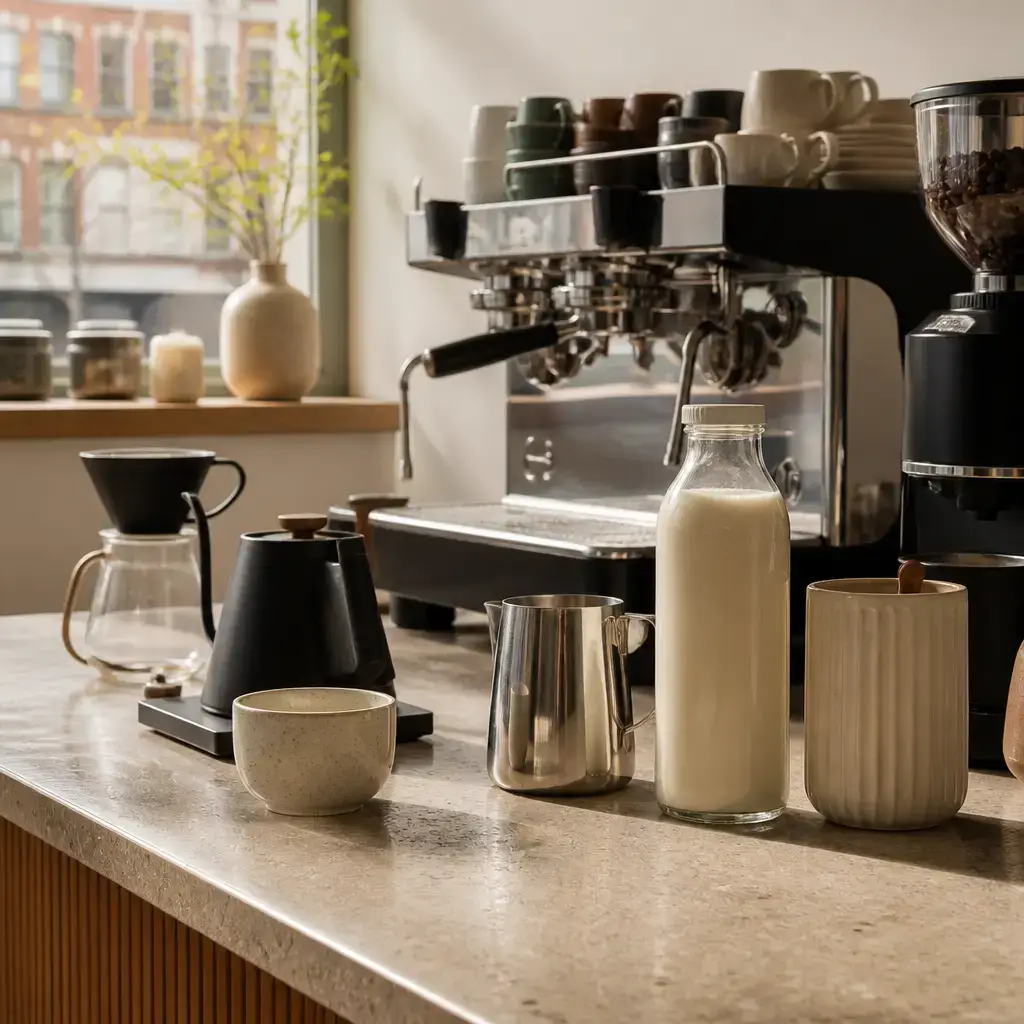
Use Ordering a latte with oat milk and less foam to practice German conversation, pronunciation, vocabulary, grammar, and quizzes.
Dialogue
Könnte ich einen Latte mit Hafermilch bekommen, wenn Sie welche haben?
KURN-tuh ikh EYE-nen LAH-tuh mit HAH-fer-milkh beh-KOM-men, ven zee VEL-khuh HAH-ben? Could I have a latte with oat milk if you have it?Ja, die haben wir. Möchten Sie die übliche Menge Milchschaum?
YAH, dee HAH-ben veer. MYURKH-ten zee dee UE-blih-khuh MENG-uh MILKH-shoum? We do. Would you like the usual amount of foam?Weniger Schaum wäre besser. Ich vermeide heute normale Milch.
VAY-nih-ger SH OWM VAIR-uh BES-ser. Ikh fer-MY-duh HOY-tuh nor-MAH-luh MILKH. Less foam would be better. I'm avoiding regular milk today.Ich bereite ihn mit weniger Schaum zu.
Ikh beh-RY-tuh een mit VAY-nih-ger SH OWM tsoo. I'll make it with less foam.Das ist alles, was ich brauche.
DAHS ist AHL-les, vahs ikh BROW-khuh. That's all I need.Ich bereite ihn jetzt zu und prüfe das Etikett, bevor ich ihn Ihnen gebe.
Ikh beh-RY-tuh een yetst tsoo oont PRUE-fuh dahs ay-tee-KET, beh-FOR ikh een EE-nen GAY-buh. I'll prepare it now and check the label before I hand it over.Sentence explanations
Könnte ich einen Latte mit Hafermilch bekommen, wenn Sie welche haben?
Could I have a latte with oat milk if you have it?
- Könnte ich
- Could I …?
- Latte
- latte
- Hafermilch
- oat milk
- bekommen
- get; have
- wenn Sie welche haben
- if you have some
More detail
Könnte ich is a polite request pattern: könnte is the subjunctive II form of können (“can”), and ich is the subject. The wording makes the request less direct than present-tense Kann ich …?. A reusable pattern is Könnte ich … bekommen? — “Could I have …?” Latte is the drink being requested. In standard German, Latte is masculine in this meaning, so the indefinite article in the accusative is einen: einen Latte. The article shows the case here; it does not by itself assert a numerical count in the English sense. Hafermilch means “oat milk.” It is a feminine noun: die Hafermilch. After mit, German uses the dative, but because there is no article in mit Hafermilch, that case is not visibly marked. mit + noun is a useful pattern for specifying what something comes with. bekommen means “get” or “receive,” and here it corresponds naturally to “have” when ordering. It is the infinitive used with könnte: könnte … bekommen. For example: Könnte ich einen Tee bekommen? — “Could I have a tea?” wenn Sie welche haben means “if you have some/it.” wenn introduces the condition, and in this subordinate clause the finite verb haben comes at the end. Sie is formal “you”; with formal Sie, the verb form is plural: Sie haben. welche is a pronoun meaning “some” here and, supported by the fixed translation and the following context, refers to the requested oat milk. Its form can serve more than one agreement pattern, so the form alone does not establish a unique number. Together, Könnte ich einen Latte mit Hafermilch bekommen asks politely for a latte with oat milk. Adding wenn Sie welche haben makes the request conditional: “Could I have a latte with oat milk if you have it?”
Ja, die haben wir. Möchten Sie die übliche Menge Milchschaum?
We do. Would you like the usual amount of foam?
- Ja
- yes
- die haben wir
- we do
- Möchten Sie
- would you like
- übliche
- usual
- Menge
- amount
- Milchschaum
- foam
More detail
Ja is a direct affirmative: “yes.” It confirms the availability expressed in the next chunk. die haben wir means “we have it.” Here die is the feminine accusative pronoun referring to the oat milk mentioned in the preceding request. The pronoun replaces a feminine noun rather than repeating it. haben is the present-tense form of haben for wir (“we”); wir haben is the ordinary subject–verb order, while die haben wir places the object first for this answer pattern. Reusable pattern: Das haben wir. — “We have that.” Möchten Sie is a formal “would you like …?” question. möchten is the polite subjunctive form used here with Sie (“you,” formal); it is not the simple present form mögen. The formal pronoun Sie is capitalized and takes the same verb form as a third-person plural subject. Example: Möchten Sie Kaffee? — “Would you like coffee?” übliche means “usual” here. Its base form is the adjective üblich. In die übliche Menge, the adjective describes the feminine noun Menge and has the ending -e after the definite article die; the adjective, not the noun, carries this ending. Menge means “amount” or “quantity.” It is a feminine noun: die Menge. It is useful for an amount of something, especially something measured as a whole rather than counted as separate items. Example: eine kleine Menge Zucker — “a small amount of sugar.” Milchschaum means “milk foam” or “foam.” It is a compound noun formed from Milch (“milk”) and Schaum (“foam”), and it is masculine: der Milchschaum. In this sentence it refers to the foam being requested in a particular amount. Together, die haben wir answers that the requested oat milk is available. Möchten Sie die übliche Menge Milchschaum? then asks, formally, whether the listener would like the usual amount of milk foam. The question contains the noun phrase die übliche Menge Milchschaum: “the usual amount of milk foam.”
Weniger Schaum wäre besser. Ich vermeide heute normale Milch.
Less foam would be better. I'm avoiding regular milk today.
- Weniger
- less
- Schaum
- foam
- wäre
- would be
- besser
- better
- vermeide
- avoid
- heute
- today
- normale
- regular
- Milch
- milk
More detail
Weniger means “less” here, referring to a smaller amount of something that can be measured. It is the comparative form of wenig (“little/few”): wenig → weniger (“less”) → am wenigsten (“the least”). In this sentence it modifies the amount of Schaum, not the foam as a different kind of substance. Schaum means “foam.” It is a masculine noun: der Schaum. German nouns are capitalized. The phrase weniger Schaum expresses a smaller amount without stating an exact quantity. wäre means “would be” in this sentence. It is the subjunctive II form of sein (“to be”), used here for a suggested or hypothetical assessment. The relevant pattern is X wäre besser — “X would be better.” The form wäre is not the ordinary present form ist (“is”). besser means “better.” It is the comparative form of gut (“good”): gut → besser → am besten (“best”). The adjective compares the proposed amount with an alternative, without specifying what that alternative is. Example: Weniger Zucker wäre besser. — “Less sugar would be better.” vermeide means “avoid” here. It is the first-person singular present form of vermeiden (“to avoid”): ich vermeide — “I avoid / I am avoiding.” The ending -e is part of the first-person singular present-tense form used with ich. Example: Ich vermeide Kaffee. — “I avoid coffee.” heute means “today.” It places the avoiding in the current day. It can be moved for emphasis without changing the basic meaning, for example: Heute vermeide ich Kaffee. — “Today I am avoiding coffee.” normale means “regular” here. It is the adjective normal with an ending because it modifies Milch. In normale Milch, -e is the feminine nominative/accusative singular ending used here with no determiner. The adjective ending marks the phrase’s grammatical form; the adjective itself is not derived from Milch. Milch means “milk.” It is a feminine noun: die Milch. In normale Milch, it is the direct object of vermeide, so the phrase means “regular milk” as the thing being avoided. Example: Ich trinke normale Milch. — “I drink regular milk.” Together, Weniger Schaum wäre besser means “Less foam would be better”: a smaller amount of foam is being proposed as preferable. Ich vermeide heute normale Milch means “I’m avoiding regular milk today.” The two sentences therefore state the preferred foam amount and the speaker’s current choice to avoid regular milk.
Ich bereite ihn mit weniger Schaum zu.
I'll make it with less foam.
- Ich
- I
- bereite … zu
- prepare; make
- ihn
- it
- mit
- with
- weniger
- less
- Schaum
- foam
More detail
Ich means “I.” It is the first-person singular pronoun, used for the speaker. The verb form that follows agrees with it: bereite is the first-person singular present form of zubereiten (“to prepare,” “to make”). bereite … zu is the separable form of zubereiten. In a main clause, the conjugated part bereite occupies the regular verb position, while the prefix zu moves to the end: Ich bereite das Essen zu. — “I prepare the food.” The fixed sentence uses this split pattern, not a separate verb meaning “prepare” plus an unrelated zu. ihn is the accusative masculine singular form of er (“he”/“it” for a masculine noun). Here, the fixed translation supports the meaning “it,” but it does not identify the exact noun being referred to. The form marks the object that is being prepared; it is not the subject. mit means “with” and introduces what accompanies or characterizes the preparation. It normally governs the dative: mit dem Schaum means “with the foam.” Here the noun phrase has no article, so no visible dative article appears. weniger means “less” and indicates a smaller amount. It is the comparative form related to wenig (“little,” “not much”): wenig → weniger (“less”) → am wenigsten (“the least”). With an uncountable substance, weniger refers to a reduced amount rather than a reduced number of separate items. Example: Ich möchte weniger Zucker. — “I would like less sugar.” Schaum is the masculine noun “foam.” Its basic form is der Schaum; the noun itself is capitalized in German. In this sentence it names the substance whose amount is reduced. Example: Der Schaum ist zu dick. — “The foam is too thick.” Together, Ich bereite ihn … zu means “I’ll prepare/make it …,” with the present tense understood from context as a planned or intended action. mit weniger Schaum specifies the preparation: it will be made with a smaller amount of foam. Thus the whole utterance means, “I’ll make it with less foam.”
Das ist alles, was ich brauche.
That's all I need.
- Das ist
- that is
- alles
- everything; all
- was
- what; that which
- brauche
- need
More detail
Das ist means “That is” or, as in this sentence, “That’s.” Das is the demonstrative pronoun used as the subject here, and ist is the third-person singular present form of sein (“to be”). The form ist agrees with the singular subject das; it is not a form of the following word alles. alles means “everything” or “all” in this use. It is an indefinite pronoun, so it can stand on its own rather than modifying a stated noun. A useful contrast is alle (“all” referring to plural people or things), while alles refers to everything as a whole. For example: Alles ist fertig. — “Everything is ready.” was introduces the clause that specifies what alles consists of: “what” or “that which.” After an indefinite pronoun such as alles, German commonly uses was for this kind of relative clause. Here it does not mean a separate unidentified object; it links alles to the information that follows. brauche is the first-person singular present form of brauchen, “to need.” The useful form chain is brauchen — “to need”; ich brauche — “I need.” In the relative clause, brauche comes at the end, as is normal for a German subordinate clause introduced by was. For example: Das ist, was ich brauche. — “That is what I need.” The sentence first identifies something with Das ist alles (“That is all/everything”), then the relative clause was ich brauche specifies it as “what I need.” Together, Das ist alles, was ich brauche. means “That’s all I need.”
Ich bereite ihn jetzt zu und prüfe das Etikett, bevor ich ihn Ihnen gebe.
I'll prepare it now and check the label before I hand it over.
- bereite … zu
- prepare
- ihn
- it
- jetzt
- now
- prüfe
- check
- Etikett
- label
- bevor
- before
- Ihnen
- to you (formal)
- gebe
- give; hand over
More detail
bereite … zu: These two separated parts belong to the separable verb zubereiten, “to prepare.” In the present tense with ich, the finite part is bereite, while zu moves to the end of the clause: Ich bereite das Essen zu. — “I prepare the food.” Here, ihn is the masculine accusative pronoun for the thing being prepared; the translation fixes its intended meaning as “it,” without identifying the thing further. jetzt: This time adverb means “now” and places the preparing in the present moment. It does not change the verb forms. prüfe: This is the ich form of prüfen, “to check.” The present-tense pattern is ich prüfe, du prüfst, er/sie/es prüft. Here it introduces a second action coordinated with the first: “and I check.” Etikett: das Etikett means “the label.” The form das shows the noun’s neuter gender, while Etikett itself does not change here; the noun phrase is the accusative object of prüfe. Example: Ich prüfe das Etikett. — “I check the label.” bevor: This conjunction means “before” and introduces an event that happens later than the checking in the sentence’s temporal sequence. In a bevor clause, German places the finite verb at the end: bevor ich gehe — “before I leave.” Ihnen: This capitalized form is the formal “you” in the dative role, meaning “to you.” The capital letter marks formal address; Ihnen can refer to one formally addressed person or to multiple people. It is the recipient of the handing-over action here. gebe: This is the ich form of geben, “to give” or, in this context, “to hand over.” Its basic pattern is jemand gibt jemandem etwas: a person gives someone something. The clause contains ich as the giver, Ihnen as the recipient, and ihn as the thing handed over. Compare Ich gebe Ihnen das Buch. — “I give you the book.” Together, Ich bereite ihn jetzt zu says “I’ll prepare it now,” with the separable verb zubereiten split around its object. und prüfe das Etikett adds “and check the label.” bevor ich ihn Ihnen gebe says that this checking occurs before I hand it over to you. Thus the whole utterance means: “I’ll prepare it now and check the label before I hand it over.”
Grammar Points
wenig → weniger
weniger Milchschaum
VAY-nih-ger MILKH-shoumless milk foam
Weniger is the comparative form of wenig and describes a smaller amount.
zubereiten → bereite ... zu
bereite ... zu
beh-RY-tuh ... tsooprepare
Zubereiten is a separable verb: the prefix zu moves to the end in a main clause.
German Vocabulary
einen Latte
normale Milch
die übliche Menge
weniger Schaum
Quiz
Word Order
Arrange the words in the correct order.
That's all I need.
Show Answer
Das ist alles, was ich brauche.Spelling
Tap the letters to spell the word.
get; receive
Show Answer
bekommenamount; quantity
Show Answer
Mengelatte
Show Answer
Latteoat milk